

You scored Band 7.5 eighteen months ago. You felt relieved. Then your university intake got pushed, your visa file took longer than expected, and now a quiet worry has crept in: is that score still usable, or has it quietly expired?
This is one of the most expensive misunderstandings in the whole IELTS journey. Thousands of applicants every year discover that their result has crossed its expiry date right when they are ready to submit. The fix usually means booking a new test, paying again, and waiting weeks for results.
IELTS score validity is the rule that decides whether your hard-earned band can still be used. Get it right and you save money and stress. Get it wrong and you can lose an admission cycle. This guide explains exactly how long your score lasts, how the rule changes by country, and what to do if the clock is running out.
What IELTS Score Validity Actually Means
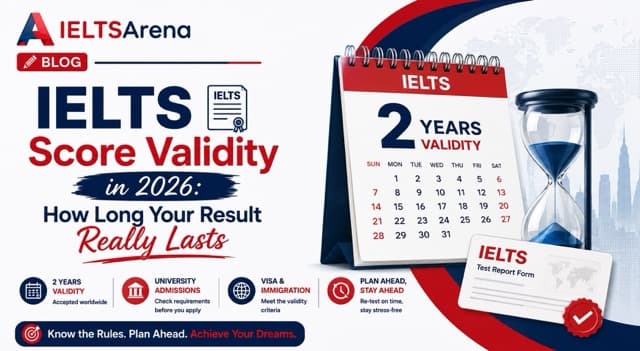
IELTS score validity is the official period during which your test result is accepted by universities, employers, and immigration authorities. The standard rule is two years, counted from the date you sat the test, not the date your results were released.
This is set by the test owners because language ability can fade. If you stop using English actively for a long stretch, your fluency, vocabulary, and accuracy can slip. The two-year window is meant to ensure your score still reflects your current level.
Your Test Report Form, often called the TRF, shows your test date clearly. That date is the start of the clock. After 24 months, most institutions treat the result as expired, even if your actual English is stronger than ever.
The rule applies to both the Academic and General Training versions of the test. The validity period itself does not change based on which version you sat. What can change is which organisations accept your score and how recent they want it to be.
One detail trips up many people. Validity is measured from the test date, not from when you collected or downloaded your results. If you booked early and sat the exam in January, your two years end in January, regardless of when the report arrived.
Advertisement
Why the Common Assumptions About Validity Fail
The first mistake is assuming validity starts when results are issued. It does not. It starts on your exam day. People who count from the wrong date often miscalculate by two or three weeks and submit just after the deadline.
The second mistake is treating two years as a universal guarantee. The two-year rule is the baseline, but individual universities and visa streams can apply stricter limits. Some programmes want scores taken within the last six to twelve months, even though the official IELTS score validity is longer.
A third assumption is that an expired score can be extended or renewed. It cannot. There is no extension form, no grace period, and no way to revive an old result. Once the validity period ends, the only path is a fresh test.
Many applicants also assume immigration bodies are flexible. They are usually the strictest. Visa systems often run automated checks on the test date, and a score even a few days past its window can trigger a rejection or a request for new evidence.
The final trap is leaving the test until late in the process. People sit the exam early to feel prepared, then let months pass while gathering documents. By submission time, the score has aged badly and the IELTS score validity window has nearly closed.
The danger is never the test itself. It is the gap between sitting the exam and using the result.
A Real Student Situation: Daniel from Nigeria
Daniel, a 27-year-old nurse from Lagos, scored Band 7.0 overall and felt his migration plan was secure. He passed comfortably and put the result aside while he completed his professional registration paperwork.
The registration process took longer than expected. By the time his file was ready, almost 22 months had passed. When he opened his application portal, the system flagged that his score would expire before the final decision stage.
"I genuinely thought I had plenty of time," Daniel said. "Nobody told me the clock started on my exam day, not on the day I got my result. I nearly lost the whole submission window."
Daniel had two months left. He used that time to take a focused refresher, practiced under timed conditions, and re-sat the test. He scored Band 7.5 the second time, slightly higher than before, because his English had kept improving through daily work.
His takeaway was simple. He should have mapped his entire timeline against his IELTS score validity from the start, and only booked the test once his other documents were close to ready.
Data and Insight on Validity and Expiry
The official IELTS validity period is two years, or 24 months, from the test date. This figure is consistent across the major test providers and is reported the same way by study-abroad guidance services such as Shiksha and Edvoy in their 2026 explainers.
Country-level practice varies within that rule. For Australian skilled migration streams, some pathways accept scores up to three years old, according to 2026 immigration guidance summaries. This is an exception, not the norm, so it must be confirmed against the specific visa class.
For most universities worldwide, the two-year limit holds firm. Yet even inside that window, selective programmes sometimes request results from the last six to twelve months, especially competitive postgraduate courses.
There is no published "renewal" mechanism. Across every 2026 guidance source reviewed, the consistent message is the same: an expired IELTS score cannot be extended, and a new test is required. The One Skill Retake option, where available, only helps before expiry, not after.
The practical insight is that timing matters as much as the score itself. A Band 8.0 that has expired is worth exactly the same as no score at all for application purposes. Treating your IELTS score validity as a hard deadline, rather than a soft suggestion, protects the result you worked so hard to earn.
The Right Approach to Managing Your Score Validity
Follow these steps so your score is always usable when you actually need it.
- Confirm your exact expiry date. Take your test date from the TRF and add 24 months. Mark that date as a hard deadline in your calendar.
- Check the recency rule of every target institution. Even within the two-year window, confirm whether your university or visa stream wants a score from the last six or twelve months.
- Work backwards from your submission deadline. Identify the latest point at which you can submit, then make sure your score will still be valid on that exact day, including any decision-stage checks.
- Book the test at the right moment. Do not sit the exam many months before your documents are ready. Aim to have your result fresh when the application goes in.
- Build in a retake buffer. Leave at least eight to ten weeks of margin so that if you need to re-sit, you can do so without missing your cycle.
- Keep digital and physical copies of your TRF. Some institutions verify results directly, but having your own record helps you track the IELTS score validity at a glance.
This sequence removes almost all timing risk. The score stops being a guessing game and becomes a controlled part of your plan.
How IELTSArena Helps You Stay Test-Ready
The hardest part of managing validity is staying sharp enough to re-sit at short notice if a deadline shifts. This is where consistent practice protects you, and where IELTSArena fits naturally into your plan.
IELTSArena replicates the real IELTS computer-based test interface, including the highlighter, notepad, and navigation panel, so you stay familiar with exam conditions even months after your first attempt. If you suddenly need a fresh score, you are not starting from zero.
IELTSArena's AI feedback gives you an instant band estimate and pinpoints exact mistakes on your Writing tasks, so a refresher takes days rather than weeks. You quickly see whether you are still performing at your target level.
For Speaking, IELTSArena scores fluency, pronunciation, vocabulary, and grammar, helping you confirm your readiness before you commit to a new test date. Expert tutors on IELTSArena add band-focused human correction where the difference between bands is subtle.
IELTSArena also tracks your performance across every mock test, so you can see at a glance whether your level has held steady since your last sitting. More than 10,000 learners have used IELTSArena to prepare and re-prepare around shifting timelines.
If your IELTS score validity is close to expiring, a few timed mock tests on IELTSArena tell you whether you can match your old band before you book again. You can start free on IELTSArena.
Self-Diagnosis: Is Your Score Still Safe?
Answer these honestly to find out whether your validity is under control.
- Do you know the exact date your current score expires, counted from your test date and not your results date?
- Have you checked whether each target university or visa stream wants a score taken within the last six to twelve months?
- Will your score still be valid not just at submission, but through the final decision stage of your application?
- If you had to re-sit within the next month, could you still hit your target band today?
- Have you left at least eight weeks of buffer in case a retake becomes necessary?
If you answered no to any of these, your score may be more at risk than you think. A short diagnostic mock test will show you exactly where you stand.
See Where Your Band Stands Today
The safest way to protect your application is to know, right now, whether you could match your existing score under real exam pressure.
Take a Free Mock Test on IELTSArena →
Frequently Asked Questions
How long is an IELTS score valid for immigration to Canada or Australia?
For immigration purposes, the standard IELTS score validity is two years from your test date, and Canada applies this two-year rule for both study and immigration pathways. Australia follows the same two-year rule for student visas and most purposes, but certain skilled migration streams may accept scores up to three years old. Because exceptions exist, always confirm the exact requirement against the specific visa class you are applying under. Immigration systems tend to enforce the date strictly, often through automated checks, so submit while your score is comfortably within its window rather than close to the expiry edge.
What happens if my IELTS score expires before I submit my visa application?
If your score expires before submission, it is treated as invalid and cannot be used, regardless of how high the band was. There is no extension, grace period, or renewal option once the validity period ends. The only solution is to take a new test and obtain a fresh result. To avoid this, count 24 months from your test date and make sure your score remains valid not only at submission but through any final decision stage. Practising regularly on a platform like IELTSArena keeps you ready to re-sit quickly if a deadline shifts unexpectedly.
Can I use an IELTS score that is more than 2 years old for university admission?
In almost all cases, no. The two-year IELTS score validity rule applies to university admissions worldwide, and a score older than 24 months is normally rejected by admissions systems. Some institutions are even stricter, asking for scores taken within the last six to twelve months for competitive programmes. A score past two years cannot be revived or extended, so you would need to take the test again. Before assuming an older result is fine, check the exact recency requirement on the university website, because policies differ between undergraduate, postgraduate, and professional courses.
Does IELTS score validity differ between academic and general training?
The validity period itself does not differ. Both Academic and General Training results are valid for two years from the test date. What can differ is who accepts each version and how recent they want it. Universities usually require the Academic version, while many immigration and work pathways accept General Training. The two-year rule applies equally to both, but individual institutions may add their own recency conditions on top. Always match the correct test version to your goal first, then confirm the recency rule that the receiving organisation applies within that two-year window.
If my IELTS score has expired do I need to retake the full exam?
Yes. Once your score expires, you must retake the full test, since there is no way to extend or partially renew an expired result. The One Skill Retake option, where it is offered, only helps before expiry and only for improving a single section of a still-valid result. After expiry, all four skills must be taken again. The good news is that focused preparation can make a retake fast and even improve your band. Using IELTSArena's real CBT interface and AI feedback, many learners re-sit confidently within weeks rather than starting their preparation from the beginning.
![Best IELTS Book for Self Study [2026]: The 2-Book Rule Nobody Tells You](/_next/image?url=%2Fblog%2Fcover-best-ielts-book-for-self-study.jpeg&w=3840&q=75&dpl=dpl_DXyM63YUHjigMzg2B75HT6s5tc1D)
![IELTS Speaking Part 1 Questions and Answers [2026]: 40+ Real Questions From the Current Cycle](/_next/image?url=%2Fblog%2Fcover-ielts-speaking-part-1-questions-and-answers.jpeg&w=3840&q=75&dpl=dpl_DXyM63YUHjigMzg2B75HT6s5tc1D)