Most IELTS Reading candidates run out of time. Not because the passages are too complex, but because they are reading incorrectly.
The IELTS Reading section gives you 60 minutes to answer 40 questions across three passages. That works out to 90 seconds per question on average — including the time it takes to read each passage. There is no comfortable way to read all three passages slowly and still finish the questions.
Skimming and scanning are the two reading techniques that close this time gap. But many candidates do not use them, or use them incorrectly, or confuse the two and try to do both at once. Getting clear on what each one is, and exactly when to apply each, is the single biggest unlock for IELTS Reading performance.
What Skimming and Scanning Actually Are
These two techniques are constantly mentioned in IELTS preparation, often interchangeably. They are not the same thing.
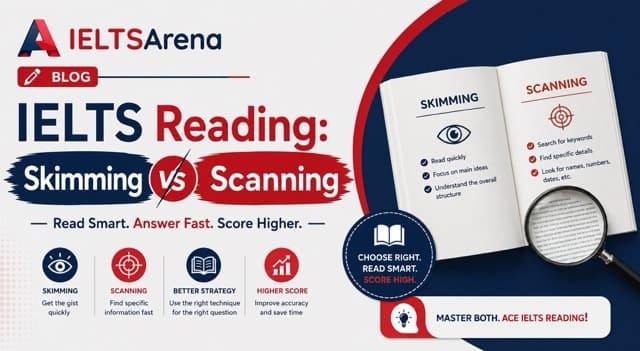
Skimming is reading quickly to get the overall meaning and structure of a text without processing every word. When you skim, you are asking: what is this passage about? What does each paragraph cover? You are building a mental map of the passage.
Scanning is moving your eyes rapidly through a passage to locate specific information — a name, a date, a percentage, a keyword. You are not reading for meaning. You are searching for a visual target.
The key distinction is this: skimming gives you context. Scanning gives you answers.
Both techniques are essential, and they serve different purposes at different points in your work through the test.
Advertisement
Why Candidates Struggle With These Techniques
Three specific mistakes hold candidates back from using skimming and scanning effectively.
Reading the passage fully before looking at the questions. Many candidates start by reading the entire passage carefully, then move to the questions. This uses up significant time on parts of the passage that may not contain any answers, and leaves insufficient time for the questions themselves.
Skimming too slowly. A genuine skim of a 900-word passage should take 60 to 90 seconds. Many candidates skim at half their normal reading speed, which is not skimming — it is reading slowly. True skimming means moving through the text faster than feels comfortable, picking up only the structural signals.
Scanning by re-reading. When candidates look for specific information, they often start re-reading paragraphs sequentially, hoping to encounter the answer. This defeats the purpose of scanning entirely. Scanning means moving your eyes across the text looking for visual shapes (a number, a capitalised word, a keyword pattern), not reading sentence by sentence.
A Real Candidate Story: Rafael From the Philippines
Rafael, a 26-year-old nurse preparing for IELTS Academic to support a UK NMC registration application, sat the test twice and scored Band 6.5 in Reading both times. He needed Band 7.0.
Both attempts had the same problem. He left three to five questions unanswered on Passage 3 because he ran out of time. His comprehension was strong. His vocabulary was strong. He just could not finish.
When he reviewed his timing pattern, the issue was clear. On both attempts he had read each passage fully before looking at the questions, then re-read sections to find answers. He was effectively reading each passage twice.
"I thought careful reading would protect my accuracy," he said. "But the time pressure meant I never reached Passage 3 with enough minutes left."
He spent two weeks rebuilding his approach using a strict sequence: skim the passage in 60 to 90 seconds, read the questions carefully, then scan specifically for the information needed. On his next attempt he completed all three passages with four minutes to spare and achieved Band 7.5 in Reading.
The improvement was not better reading. It was the right technique applied at the right moment.
What the Research Shows About Time Pressure in IELTS Reading
Cambridge Assessment English research and analysis of IELTS Reading performance consistently identify time pressure — not comprehension — as the primary reason candidates fail to complete the section.
Candidates who adopt a structured skimming pass before reading questions improve their completion rates significantly compared to those who read passages fully before moving to questions.
Section 3 passages are the most time-consuming relative to the marks available. Candidates who arrive at Section 3 with fewer than 18 minutes remaining typically lose marks not from misunderstanding but from running out of time on the longer, denser passage.
True/False/Not Given and Yes/No/Not Given questions produce the highest error rates partly because candidates scan for keywords without first establishing what each paragraph actually claims. These question types reward skimming for paragraph claims, not scanning for individual words.
The highest-scoring candidates are not necessarily the strongest readers in general. They are the most efficient. They have an internal sequence — skim, read questions, scan, confirm — and they apply it consistently across all three passages.
How to Apply Skimming and Scanning Correctly
The right approach uses each technique at a specific point in your work through each passage.
When to use skimming:
- At the beginning of each new passage, before you read any questions. Spend 60 to 90 seconds skimming.
- What to read during a skim: the title, any subheadings, the first sentence of each paragraph, the final sentence of the last paragraph, and any bolded or italicised terms.
- The goal: answer the internal question "which paragraph likely contains the answers to which topics?"
- Use skimming again later when working on paragraph-matching or heading-matching questions, where understanding paragraph topics matters more than locating individual words.
When to use scanning:
- After you have read a specific question and identified exactly what type of information you need to find.
- Identify your search target clearly before scanning: a number, a proper noun, a year, a specific keyword.
- Move your eyes vertically and diagonally down the relevant sections of the passage, looking for visual shapes — capitalised words and numbers stand out visually and are easy to locate.
- Once you locate your target, slow down and read the two or three surrounding sentences carefully. That context is where the actual answer lives.
The correct combined sequence for each passage:
- Skim the entire passage in 90 seconds maximum.
- Read all the questions for that passage carefully, identifying what each one asks.
- Scan for each answer using question keywords as search targets.
- For matching headings questions, skim individual paragraphs for their central ideas — do not scan for keywords, since paragraph claims require structural understanding.
- For sentence completion questions, identify the type of missing information (a noun, a year, an amount) and scan specifically for that category.
How IELTSArena Helps You Build the Right Reading Sequence
The challenge with skimming and scanning is that the techniques only develop through deliberate practice under time pressure. Reading articles in your spare time does not build these specific skills.
IELTSArena provides full-length Reading practice tests that replicate the real exam environment. Every test runs in CBT format with a strict 60-minute timer that mirrors exam conditions exactly. The pressure is part of the practice — you cannot build the right sequence without it.
The performance breakdown by question type shows which categories cost you the most marks. If your True/False/Not Given accuracy is consistently 50 percent while your sentence completion sits at 85 percent, your practice time belongs on TFNG strategy and paragraph-claim skimming — not on general reading.
Section-by-section analysis reveals whether your pace is sustainable across all three passages. Many candidates start strong and run out of time on Passage 3. The IELTSArena dashboard shows exactly where your timing breaks down so you can adjust your skimming pace or your question-answering speed.
Both IELTS Academic and General Training Reading are supported with passages that match real exam standards in length, vocabulary, and question type distribution. All nine question types appear under timed conditions, so your skimming and scanning skills develop on the exact formats you will face on test day.
IELTSArena is used by candidates across Pakistan, the Philippines, Nigeria, Bangladesh, and the Gulf region preparing for visa, professional registration, and university entry requirements. Start your free Reading practice on IELTSArena and complete your first timed test today.
Self-Diagnosis: Are You Using the Right Sequence?
Run through these questions honestly before your next practice test:
- When you begin a new passage, do you skim it for structure before reading any questions, or do you go straight to the questions?
- When you scan, do you know exactly what type of information you are looking for before you start, or are you re-reading hoping to find it?
- In your last practice test, did you complete all three sections within 60 minutes? Which passage ran over time?
- For True/False/Not Given questions, do you skim the relevant paragraph for its overall claim before confirming whether each statement matches?
- Have you timed your skimming specifically to verify it is actually fast enough — under 90 seconds per passage?
If you answered no to two or more of these, your Reading approach has a sequence problem, not a comprehension problem. The fix is fast.
Take a Timed Reading Test Today
Skimming and scanning are not theoretical techniques. They are the practical mechanism that allows strong readers to complete all 40 IELTS Reading questions in 60 minutes with marks to spare.
The fastest way to find out whether your current approach is working is to take one full timed Reading test and see exactly where your pace breaks down.
Start Your Free Timed Reading Test on IELTSArena →
Frequently Asked Questions
What is the difference between skimming and scanning in IELTS Reading?
Skimming means reading quickly to understand the overall structure and main ideas of a passage without processing every word. You skim to build a mental map of what each paragraph covers. Scanning means moving through a passage rapidly to locate specific pieces of information such as names, dates, percentages, or keywords. You scan to find answers, not to understand context. Both techniques are essential in IELTS Reading, but they serve different purposes at different points in your work through the test. Skimming gives you context. Scanning gives you answers.
When should I skim and when should I scan the passage in IELTS Reading?
Skim first, before reading any questions, to understand which paragraph covers which topic — this should take 60 to 90 seconds for a typical IELTS passage. Then read the questions carefully to identify the type of information each one asks for. Finally, scan the relevant section of the passage for that specific information. For matching headings questions, skim individual paragraphs for their central ideas rather than scanning for keywords, since paragraph claims require structural understanding, not single-word matches.
Does skimming the passage first actually save time in IELTS Reading?
Yes. A proper skim of a 900-word passage takes 60 to 90 seconds and creates a mental map you can use for all 13 to 14 questions on that passage. Without this initial map, candidates typically re-read the same sections of the passage repeatedly as they work through each question, which uses far more total time than the original skim would have. The 90 seconds invested in skimming returns five or more minutes in the question-answering phase.
How do I scan for specific information quickly in a long IELTS Reading passage?
Before you start scanning, identify exactly what you are looking for — a number, a proper noun, a specific keyword from the question. Move your eyes vertically down the relevant section of the passage, looking for visual shapes rather than reading sequentially. Numbers and capitalised words are visually distinct and easy to locate without reading the surrounding text. Once you spot your target, slow down and read the two or three sentences around it carefully — that is where the actual answer lives.
Can I answer all IELTS Reading questions correctly without reading the whole passage?
For most question types, yes. IELTS Reading is designed to test your ability to locate and understand specific information, not to recall everything in the passage. With efficient skimming and scanning, you can encounter only small portions of the passage in detail and still answer accurately. The main exception is matching headings tasks, which require understanding each paragraph's main idea — for those, you need to skim each paragraph carefully even if no specific question is yet attached to it.