
Form completion is the IELTS Listening question type where candidates who should be scoring Band 8 give away 1 to 2 marks that cost them the overall band. It is a Section 1 specialty, it looks straightforward, and that is exactly why candidates stop drilling it. If your Section 1 score is 8 or 9 out of 10 rather than a clean 10, start a free Section 1 form completion practice on IELTSArena first to identify which specific field type (names, addresses, dates, phone numbers, prices) is actually costing you marks. The pattern is almost always one or two specific formats, not generalised listening weakness.
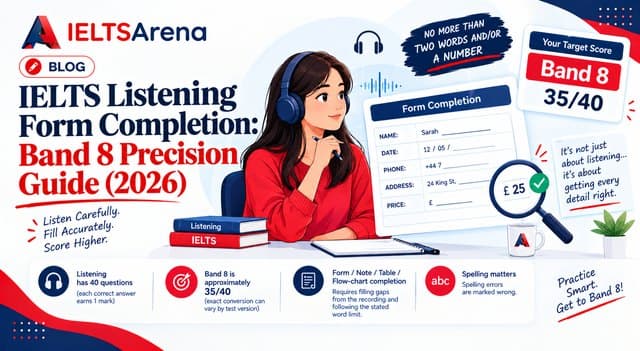
Quick answer: IELTS listening form completion is a question type where you fill in missing information on a form while listening to a conversation, typically a two-speaker Section 1 booking, enquiry, or registration call. You hear fields filled in one at a time: name, address, phone number, date of birth, course name, price, membership number. The challenge is not comprehension (the audio is slow and clear) but precision: correct spelling, correct number format, respecting word-count limits (usually "NO MORE THAN THREE WORDS AND/OR A NUMBER"), and distinguishing confusable spellings in real time. Form completion appears mostly in Section 1 and occasionally in Section 2 or 3. Candidates targeting Band 8 or above should expect to score 10 out of 10 on form completion sets consistently. Anything less is a precision gap, not a listening gap.
Try it before you read. If your Section 1 score fluctuates between 8 and 10 across mock tests, form completion is almost certainly the question type costing you. Take a free IELTS Listening practice test on IELTSArena and review your Section 1 form completion errors specifically. If misses cluster on names, dates, or numbers, the frameworks in this guide fix it in three weeks.
In This Guide
- What Form Completion Actually Is
- Why Form Completion Is a Section 1 Specialty
- How Form Completion Compares to Other Listening Question Types
- The 5 Field-Type Traps That Cost Band 8 Candidates Marks
- Form Completion Raw Scores and Your Overall Listening Band
- A Real Student's Story: From 8/10 to 10/10 on Section 1 in Three Weeks
- The Data Behind This Question Type
- The Right Approach: A 3-Week Form Completion Fix Plan
- The Pre-Listening Prediction Framework
- The 7 Most Common Form Field Types and What to Expect
- Sample Form Completion Walkthrough
- How IELTSArena Helps You Drill Form Completion Specifically
- Self-Diagnosis: Is Form Completion Capping Your Section 1?
- Key Takeaways
- Frequently Asked Questions
Advertisement
What Form Completion Actually Is
IELTS listening form completion is a gap-fill question type where you complete missing information on a printed form while listening to a conversation. The form on your question paper (or screen in CBT) looks like a standard real-world document: an enrolment form, a booking confirmation, an insurance claim, a membership application. The fields are mostly blank, with a word-count instruction at the top: usually "NO MORE THAN THREE WORDS AND/OR A NUMBER FOR EACH ANSWER" or "ONE WORD AND/OR A NUMBER".
Form completion is one of the standard IELTS Listening question types, alongside multiple choice (see IELTS Listening Multiple Choice), map labelling (see IELTS Listening Map Questions), note completion, sentence completion, matching, and short answer questions. Each correct answer is worth 1 mark toward the 40-question Listening raw score. The raw score converts to a Listening band using the standard table published by Cambridge Assessment English, covered in our IELTS Band Score Chart and calculated instantly in the IELTS Band Score Calculator.
What distinguishes form completion from other gap-fill question types is predictability. The form shows you exactly what kind of information you need: a Name field needs a name, a Phone field needs a phone number, a Date field needs a date. This is why form completion looks easy. It is also why candidates stop drilling it and lose marks on avoidable format errors they would have caught with deliberate practice.
Why Form Completion Is a Section 1 Specialty
Form completion appears predominantly in Section 1 of the IELTS Listening test. Occasionally it appears in Section 2 or 3, but the overwhelming majority of form completion questions in official IELTS material are Section 1 questions.
Section 1 is a two-speaker social conversation, usually an everyday transaction: booking a hotel room, enrolling in a language course, enquiring about a gym membership, applying for library access, reporting a lost item. The format is designed to be the most accessible of the four Listening sections, which is why it carries the easiest question types. The audio is clearer, the vocabulary is everyday rather than academic, and there are two preview windows (one before questions 1 to 5, another before questions 6 to 10) to help you orient.
This gentle format sets the trap. Candidates look at Section 1, see familiar everyday vocabulary, and assume full marks are automatic. Then they lose marks on specific precision errors: spelling a name wrong because they did not catch the spelled-out letters, writing a phone number with hyphens when the instruction says "A NUMBER", writing "25th March" when the audio said "the twenty-fifth of March" and the form field expected "25 March". These are not listening failures. They are preparation failures, specifically failures to drill the predictable Section 1 form completion patterns.
For candidates targeting the dense academic marks in IELTS Listening Section 3 and IELTS Listening Section 4 (where Band 6.5 plateau candidates lose the bulk of their marks), it is tempting to assume Section 1 is already handled. For candidates at Band 7.5 pushing for Band 8 or Band 8.5, the opposite is true: Section 1 precision is where the final 1 to 2 marks live, and form completion is where they are won or lost.
How Form Completion Compares to Other Listening Question Types
Understanding where form completion sits in the Listening test is the fastest way to prepare for it correctly.
| Question type | Where it appears | What you write | Primary challenge |
|---|---|---|---|
| Form completion | Mostly Section 1 | Short facts: name, number, place, date | Spelling precision, number format |
| Note completion | Sections 1, 2, 4 | Keywords from a note | Catching answers at speed |
| Sentence completion | Sections 3, 4 | Keywords to complete sentences | Grammatical fit, context |
| Multiple choice | Sections 2, 3 | A, B, or C | Resisting distractors |
| Matching | Sections 2, 3 | Letters matched to items | Speaker attribution, paraphrase |
| Map labelling | Section 2 | Letters matched to locations | Dual-task spatial tracking |
| Short answer | Section 1, 2 | 1 to 3 words | Precision, word count |
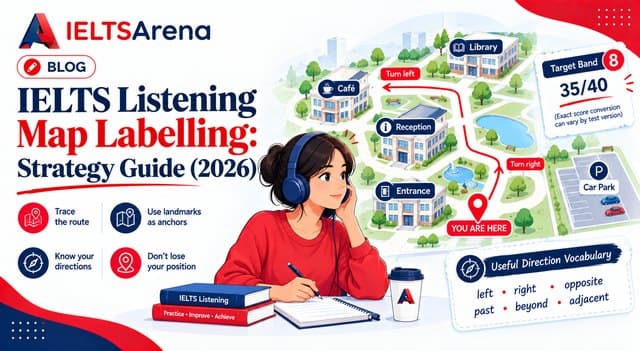
Three observations matter most. First, form completion is the question type where spelling precision is tested most intensively. Names, addresses, and course titles frequently get spelled out letter by letter in the audio, and candidates who miss "M as in Mike, N as in November" distinctions lose marks that cannot be recovered. See our dedicated guide on IELTS Listening Spelling Mistakes for the broader spelling drill.
Second, form completion is where number formats are tested most frequently. Phone numbers, dates, prices, ages, membership numbers, flight numbers, and reference codes all appear as form fields, each with its own format convention. Candidates who do not drill number formats specifically give away marks on simple transcription.
Third, form completion is the only question type where the question structure (the form itself) tells you exactly what kind of answer to expect. A field labelled "Date of Birth" cannot be filled with a name. A field labelled "Postcode" cannot be filled with a date. This predictability is a gift that too many candidates fail to use properly in the preview window.
The 5 Field-Type Traps That Cost Band 8 Candidates Marks
Five specific field-type traps account for most form completion marks lost at the Band 7.5 to Band 8 level.
Trap 1: Names spelled aloud. When the audio spells a name letter by letter ("B as in Bravo, R as in Romeo..."), candidates miss one or two letters and guess. The confusable pairs are M vs N, B vs P, D vs T, F vs S, G vs J, and the vowels I vs E. Fix: drill the NATO phonetic alphabet and the standard letter-clarification phrases ("double L", "F for Fred", "spelt with a Y not an I").
Trap 2: Address format. Addresses include street number, street name, suburb or neighbourhood, city, and postcode. The audio presents them in various orders, often with spelling clarifications for street names. Candidates write the address but miss the postcode because it comes last and attention has already shifted. Fix: hold the full address field open until the speaker has moved on to the next topic, not just when the first few address elements are mentioned.
Trap 3: Phone numbers. Phone number formats vary globally. The audio may say "oh three nine, double five seven, four one two" and the candidate writes "03955774 12" instead of "0395574 12". Candidates also sometimes write hyphens or spaces when the field expects a plain number string. Fix: write the digits in blocks matching the audio's natural pauses, then review in the transfer time to normalise the format.
Trap 4: Dates and times. Dates can be presented as "the fifteenth of March", "March fifteenth", "March the fifteenth", or "fifteen three" (day-month-year numeric). Times can be twelve-hour or twenty-four-hour, with or without "am" or "pm". Candidates write what they hear in a format the examiner may not accept. Fix: write the date in the simplest unambiguous format (15 March, 15/3, or 15 March 2026) and the time as a clock number (3:30 pm, 15:30).
Trap 5: Prices and currencies. Prices include a currency symbol or word (£, $, euros, pounds), a numerical value, and often a decimal portion (fifty pence, twenty cents). Candidates miss the currency, write "15.50" instead of "£15.50", and lose the mark. Fix: always write the currency with the number, and if the audio says "pounds" use the written word or the symbol consistently with how the field is labelled.
Each trap has a drill. Spend 15 minutes per day for one week on each trap, and your form completion accuracy will visibly improve. Candidates targeting IELTS Band 7, Band 7.5, or above should be able to spot which trap caught them within 30 seconds of reviewing a wrong answer.
Form Completion Raw Scores and Your Overall Listening Band
Form completion typically carries 5 to 7 marks across a single Section 1 question set, so getting 10 out of 10 on Section 1 depends heavily on form completion precision.
If your Section 1 score is 8 out of 10 with 7 or 8 out of 10 on Sections 2, 3, and 4, your overall raw score is roughly 30 to 32, which maps to Listening Band 7 to Band 7.5. If you lift Section 1 to a clean 10 out of 10 while holding the other sections, overall raw score moves to 32 to 34, which lifts the Listening band by 0.5 in most cases. For candidates targeting Band 8 (36 out of 40, roughly 89 percent correct) or Band 8.5 (37 out of 40), a clean Section 1 is non-negotiable. Losing 2 marks on form completion in Section 1 almost always caps you below Band 8 regardless of how strong your Sections 3 and 4 are.
For Band 9 candidates, form completion must be a zero-error zone. The one or two careless answers that separate Band 8 from Band 9 almost always include at least one form completion precision error. For context on how overall Listening band maps to visa and immigration requirements, see our IELTS Score for Canada PR 2026, IELTS Score for Australia PR 2026, IELTS for UK Visa, UK Skilled Worker Visa IELTS Requirement 2026, and IELTS for NMC UK Nursing threshold guides.
Mid-article check. If your Section 1 average is 8 or 9 out of 10 and your target is Band 8 overall, form completion drilling is likely the fastest 2-mark lift available to you. Start structured form completion practice on IELTSArena with Section 1 question sets filtered by field type.
A Real Student's Story: From 8/10 to 10/10 on Section 1 in Three Weeks
Fatima, a university student from Rabat applying for a Canadian Study Permit, needed IELTS Academic Band 7.5 overall. Her first attempt returned Listening 7.5, with Sections 2, 3, and 4 solid at 8 to 9 each. Section 1 was 8 out of 10. The two misses were a phone number (she wrote the digits in the wrong grouping) and a date (she wrote "March 15" when the mark scheme expected "15 March").
I was so focused on preparing for Section 3 and Section 4 that I almost did not practise Section 1 at all. In my first exam I just assumed the easy section would take care of itself. Then I lost two marks on things that had nothing to do with my English. One was a phone number format and one was a date format. I was angry with myself for weeks.
Her diagnostic was clean. She did not have a comprehension gap. She had never deliberately drilled form completion field formats. For her second attempt, she dedicated 30 minutes per day for three weeks to Section 1 form completion specifically, using a trap-by-trap drill structure.
Week 1: names and addresses. She drilled spelled-aloud names until the NATO phonetic alphabet was automatic (Alpha, Bravo, Charlie, Delta...) and address formats until she could hold street number, street name, suburb, and postcode in parallel. Week 2: phone numbers and dates. She drilled phone number grouping (two-digit, three-digit, four-digit groupings in British, Australian, and American conventions) and date formats (DD Month, DD/MM, DD/MM/YYYY). Week 3: prices and other numerical fields (ages, membership numbers, flight numbers, reference codes, times).
Her second sitting scored Section 1 at 10 out of 10. Overall Listening band: 8. Canadian Study Permit cleared within the standard processing window. The techniques Fatima used are compatible with the broader programme in our IELTS Study Plan 3 Months and the IELTS 30-Day Study Plan guides. For candidates using the One Skill Retake route to lift Listening alone, see the IELTS One Skill Retake 2026 guide.
The Data Behind This Question Type
Cambridge Assessment English publicly identifies form completion, note completion, table completion, and sentence completion as the Listening question types where candidates most commonly lose avoidable marks due to spelling and format errors (Cambridge Assessment English, IELTS Test Statistics 2024 to 2025).
British Council guidance confirms that form completion sits predominantly in Section 1 and is designed to test precision rather than comprehension. IELTS.org (2026 test specification) lists form completion as a core question type across both Academic and General Training versions, with identical mechanics in both.
The specific skill form completion tests (capturing exact names, addresses, numbers, and short facts in real time while someone speaks) is directly relevant to real-world situations like booking medical appointments, applying for professional registration, enrolling in courses, and filling out immigration forms. This is why professional registration bodies and immigration authorities place weight on Listening band scores from form-heavy real-world transactions: see the IELTS for NMC UK Nursing threshold (L7, R7, S7, W6.5) and the UK Skilled Worker Visa IELTS requirement (CEFR B2 minimum 5.5 in each skill from January 2026) for the specific thresholds.
The Right Approach: A 3-Week Form Completion Fix Plan
Fixing IELTS listening form completion is a focused three-week process, shorter than the four-week programmes for Section 3 and Section 4 because the drilling is more mechanical and the audio content is less complex.
Week 1: Names and addresses. Spend 30 minutes per day. First 15 minutes: drill the NATO phonetic alphabet (Alpha, Bravo, Charlie, Delta, Echo, Foxtrot, Golf, Hotel, India, Juliet, Kilo, Lima, Mike, November, Oscar, Papa, Quebec, Romeo, Sierra, Tango, Uniform, Victor, Whiskey, X-ray, Yankee, Zulu) and standard spelling clarifications ("double L", "with a K", "the shorter version"). Second 15 minutes: drill address format listening (street number, street name, suburb or neighbourhood, city, postcode) using IELTS Section 1 practice material. By end of Week 1, both drills should feel automatic.
Week 2: Phone numbers and dates. Spend 30 minutes per day. First 15 minutes: drill phone number listening in British (two-digit, three-digit, three-digit groupings), Australian (four-digit, three-digit, three-digit), and American (three-digit, three-digit, four-digit) conventions. Train yourself to hear "double seven" as "77" and "treble four" as "444". Second 15 minutes: drill date formats across all common presentations ("the fifteenth of March", "March fifteenth", "fifteen three") and times (twelve-hour with am/pm, twenty-four-hour).
Week 3: Prices, other numericals, and full Section 1 drills. Spend 30 minutes per day. First 10 minutes: price formats across currencies (£, $, euros, pence, cents) and the convention of writing the currency symbol with the number. Second 10 minutes: other numerical fields (ages, membership numbers, flight codes, reference numbers). Final 10 minutes: full Section 1 drills under timed conditions, 1 full Section 1 per day with score tracking by field type. Target 10 out of 10 consistently by end of Week 3.
For parallel Listening improvement across all four sections, see IELTS Listening Tips 2026 and the dedicated section guides for Section 3 and Section 4.
The Pre-Listening Prediction Framework
The 30-second preview window before each Section 1 question set is the most valuable time in form completion. Use it with a structured prediction framework.
Step 1: Scan the form field labels. Note what KIND of answer each field expects. Name field: expect a word, possibly spelled out. Phone field: expect a number string. Date field: expect a date. Postcode field: expect a short alphanumeric code.
Step 2: Predict the format. For each field, write a quick mental template of what the answer will look like. Phone: __ __ __ (digits). Date: DD Month. Price: £X.XX.
Step 3: Note the word-count instruction. Form completion sets usually say "NO MORE THAN THREE WORDS AND/OR A NUMBER FOR EACH ANSWER" or "ONE WORD AND/OR A NUMBER". Breaking the word count means losing the mark even if the answer is otherwise correct.
Step 4: Identify the likely order. Section 1 forms almost always follow the natural order of a conversation: greeting, name, contact details, address, specific transaction details, closing. The question numbers usually follow this order too, so you know where in the audio each answer will come.
With this four-step preview complete in 30 seconds, you enter the audio with a prediction map that tells you exactly what to listen for at each moment. Band 8 candidates do this automatically. The techniques in IELTS Listening Tips 2026 apply across all four sections, but the preview-and-predict mechanic is at its most powerful in Section 1 form completion.
The 7 Most Common Form Field Types and What to Expect
Section 1 form completion question sets draw from a predictable library of field types. Knowing the top seven cuts preparation time significantly.
Field type 1: Person names. Expect first and last names. Common distractors: unusual spellings ("Thorne" not "Thorn", "Clare" not "Claire"), hyphenated names, double-barrelled surnames. The name is almost always spelled aloud, which is why the NATO phonetic alphabet drill is non-negotiable.
Field type 2: Street addresses. Expect street number, street name, and often a suburb or neighbourhood. Common distractors: street names that sound like common words with different spellings ("Mead" vs "Meade", "Grey" vs "Gray"), unusual street types ("Esplanade", "Crescent", "Avenue").
Field type 3: Postcodes. Expect alphanumeric codes. UK postcodes are two letters, one or two digits, a space, one digit, two letters (SW1A 2AA). Australian postcodes are four digits. US ZIP codes are five digits. Candidates confuse formats and lose the mark.
Field type 4: Phone numbers. Expect 7 to 11 digit strings. The grouping varies by convention. The number must be written as plain digits in most cases, with no spaces or hyphens unless the field explicitly uses them.
Field type 5: Dates. Expect day, month, and sometimes year. Birth dates are especially common in forms. Format conventions vary: "15 March 2026", "March 15, 2026", "15/3/26". Write in the simplest unambiguous format (15 March or 15/3) and respect the field convention.
Field type 6: Prices. Expect a currency plus a numerical value. The currency may be stated as a word (pounds, dollars, euros) or as a symbol. Write the symbol or word with the number: "£50" or "50 pounds", not "50" alone.
Field type 7: Course or product names. Expect short noun phrases like "Beginner Spanish", "Weekly Yoga", "Family Membership". The name is usually said in the audio exactly as it should be written on the form, with no spelling clarification needed, but word choice matters: "Beginner Spanish" is different from "Spanish for Beginners" and the mark scheme is strict.
Beyond these seven, less common field types include membership numbers, flight codes, reference numbers, ages, and quantities. All follow the same precision discipline.
Sample Form Completion Walkthrough
Here is a sample Section 1 form completion excerpt covering a gym membership enquiry, with answers a Band 8 candidate would capture.
Form (printed on question paper):
GYM MEMBERSHIP ENQUIRY Example: Enquiry type: Membership
- Full name: _______________
- Date of birth: _______________
- Address: _______________
- Postcode: _______________
- Phone number: _______________
- Membership type: _______________
- Monthly fee: _______________
Audio excerpt:
Receptionist: Thank you for calling City Fitness. How can I help?
Caller: Hi, I would like to enquire about membership. I would like to join if possible.
Receptionist: Of course. Can I take your full name please?
Caller: Yes, it is Sarah Fitzgerald. That is F-I-T-Z-G-E-R-A-L-D.
Receptionist: Thank you Sarah. And your date of birth?
Caller: The twelfth of July, nineteen ninety-two.
Receptionist: And where do you live?
Caller: Forty-two Maple Grove, in Richmond.
Receptionist: Could you spell Maple please? Just to be sure.
Caller: Yes, M-A-P-L-E. Maple.
Receptionist: And the postcode?
Caller: It is TW9 1XR. That is T-W-nine, one-X-R.
Receptionist: And a contact phone number?
Caller: Yes, oh seven, double four, three nine, two one, double seven.
Receptionist: Thank you. What type of membership are you looking at?
Caller: The family membership please. For me, my partner, and our two children.
Receptionist: The family membership is seventy-nine pounds fifty per month.
Band 8 candidate's answers:
- Full name: Sarah Fitzgerald
- Date of birth: 12 July 1992
- Address: 42 Maple Grove, Richmond
- Postcode: TW9 1XR
- Phone number: 07443 921 77 (would normalise in transfer time to the field convention)
- Membership type: family
- Monthly fee: £79.50
Each answer applies the field-type discipline. Name: spelled aloud, written exactly. Date: simplest unambiguous format. Address: street number plus street name plus suburb, captured in order. Postcode: alphanumeric, exact format. Phone: digit grouping matched to natural pauses. Membership: short noun as the caller stated it. Price: currency symbol with decimal value.
For practice with full Section 1 question sets at multiple band levels, take the Free IELTS Listening Practice Test 2026. Candidates also benefit from drilling IELTS Listening Multiple Choice and IELTS Listening Map Questions for complete Section 1 and Section 2 coverage.
How IELTSArena Helps You Drill Form Completion Specifically
IELTSArena's Listening library lets you filter practice by question type, so you can drill form completion in isolation without taking a full 40-question test every session. Each form completion practice uses the exact CBT interface used in the real exam, with the preview windows timed as in the official test and the audio delivered by trained voice actors covering the full range of IELTS accents (British, Australian, American, Canadian, mixed-international).
The platform's analytics track form completion accuracy by field type, so you can see whether your gap is names, addresses, phone numbers, dates, or prices. For candidates targeting Band 8 or Band 8.5, this granularity is what makes three-week improvement realistic. The platform also provides full IELTS Academic Practice Tests and IELTS General Training Practice Tests, and section-by-section results that highlight exactly where marks are being lost.
IELTSArena's dashboards also feed into tutor feedback sessions. If your form completion accuracy pattern shows consistent spelling misses on names, a tutor can target that specific gap in a 30-minute session rather than running generic Listening drills.
Start your free IELTS Listening practice on IELTSArena and take a Section 1 form completion practice this week.
Self-Diagnosis: Is Form Completion Capping Your Section 1?
Work through these questions honestly against your last Section 1 practice session or mock test.
Did you score 10 out of 10 on Section 1, or did you lose 1 to 2 marks? If you lost marks, were they on form completion questions or on other question types? For the form completion misses, can you identify the field type (name, address, phone, date, price)? Can you spell the NATO phonetic alphabet from memory (Alpha, Bravo, Charlie, Delta...)? When a phone number is read aloud with "double" or "treble" prefixes, do you reliably capture the correct digit grouping? Do you write dates in a single unambiguous format every time, or do you switch between "15 March" and "March 15" depending on how the audio presents them? Do you always write the currency symbol or word with a price, or do you sometimes just write the number? Do you use the 30-second preview to run a four-step prediction framework (field type, format, word count, order), or do you just read the form?
If you hesitated on more than two of these, form completion precision is where your Section 1 is leaking marks. Three weeks of focused drilling should take Section 1 to a clean 10 out of 10.
For broader skill-level diagnostics, see our guides on IELTS Writing Mistakes to Avoid, IELTS Speaking Common Mistakes, and IELTS Reading Tips for parallel work on the other three skills.
Key Takeaways
- IELTS listening form completion is a Section 1 specialty where candidates fill missing information on a form while listening to a two-speaker everyday transaction (booking, enquiry, enrolment). It typically carries 5 to 7 marks per Section 1 question set.
- Form completion is where Band 7.5 candidates lose the 1 to 2 marks that keep them below Band 8. The gap is precision, not comprehension.
- The five field-type traps are: names spelled aloud (fix with NATO phonetic alphabet drill), address format (fix with structured address listening), phone numbers (fix with grouping discipline), dates and times (fix with single-format discipline), prices and currencies (fix with currency-plus-number convention).
- The 30-second preview window supports a four-step prediction framework: scan field types, predict format, note word count instruction, identify likely order.
- The seven most common form field types are: person names, street addresses, postcodes, phone numbers, dates, prices, and course or product names. Each has its own precision discipline.
- Three weeks of focused form completion drilling (names and addresses, phone numbers and dates, prices and other numericals) typically moves Section 1 accuracy from 8 out of 10 to 10 out of 10 for most candidates.
Related Guides on IELTSArena
Listening cluster:
- IELTS Listening Section 3: Academic Discussion Strategy
- IELTS Listening Section 4: The Academic Monologue Guide
- Free IELTS Listening Practice Test 2026: Audio and Full Answers
- IELTS Listening Multiple Choice: Why Students Lose Marks
- IELTS Listening Map Questions: Complete Strategy Guide
- IELTS Listening Tips 2026: Score Band 8-9 in Every Section
- IELTS Listening Spelling Mistakes to Avoid
- IELTS Listening Note Completion: Fill Gaps Without Missing Audio
Reading cluster:
- IELTS Reading Tips: 10 Proven Strategies to Score Band 8
- IELTS Reading Skimming vs Scanning Explained
- IELTS Matching Headings: Stop Getting It Wrong
- IELTS Academic Reading vs General Training Reading
Band target posts:
- IELTS Band 6: How to Reach It
- How to Get Band 7 in IELTS
- How to Get Band 7.5 in IELTS
- IELTS Band 8 Guide 2026
- How to Get Band 8 in IELTS
- How to Get Band 8.5 in IELTS
- IELTS Band 9 Guide 2026
Visa and immigration routes:
- IELTS for UK Visa: Score Requirements
- UK Skilled Worker Visa IELTS Requirement 2026
- IELTS Score for Canada PR 2026
- IELTS Score for Australia PR 2026
- IELTS for NMC UK Nursing
Study plans and tools:
- IELTS Study Plan 3 Months: Zero to Band 7 in 90 Days
- IELTS 30-Day Study Plan: Prepare and Score Band 7
- IELTS One Skill Retake 2026: Complete OSR Guide
- IELTS Band Score Chart 2026
- IELTS Band Score Calculator 2026
- IELTS Practice Tests Online 2026
- IELTS General Training Practice Test 2026
- IELTS General Training 2026: Full Test Guide
Lock in Your Clean Section 1 This Month
Take a free Section 1 Listening practice on ieltsarena.com, apply the four-step prediction framework, and drill the five field-type traps for three weeks. By the end of month one, your Section 1 should be a reliable 10 out of 10.
Start your free IELTS practice on IELTSArena
Frequently Asked Questions
How do I answer form completion questions in IELTS listening? Form completion questions require you to fill missing information on a printed form while listening to a conversation, usually in Section 1. The approach has four steps. First, use the 30-second preview to scan the form field labels and predict what kind of answer each field expects (name, date, number, address). Second, note the word-count instruction at the top of the form, usually "NO MORE THAN THREE WORDS AND/OR A NUMBER FOR EACH ANSWER". Third, listen to the audio once and write the answers in order, matching each field to the information as it is given. Fourth, use the 10-minute transfer time (on paper IELTS) or the final review window (on computer IELTS) to check spelling, number formats, and word counts. The precision disciplines matter more than listening ability for this question type.
What is form completion in IELTS listening? Form completion is one of the standard IELTS Listening question types, alongside multiple choice, map labelling, note completion, sentence completion, matching, and short answer questions. It involves completing missing information on a printed form (an enrolment form, a booking confirmation, an insurance claim, a membership application) while listening to a conversation. The form appears on your question paper (paper IELTS) or on your screen (computer IELTS) with blank fields that you fill as you listen. Form completion appears predominantly in Section 1, a two-speaker everyday social conversation. It occasionally appears in Section 2 or 3, but Section 1 is where you will encounter it most often. Each correct answer is worth 1 mark toward your 40-question Listening raw score.
How many words can I write in form completion? The word limit varies by question set and is stated clearly at the top of the form, usually as "NO MORE THAN THREE WORDS AND/OR A NUMBER FOR EACH ANSWER" or "ONE WORD AND/OR A NUMBER" or "NO MORE THAN TWO WORDS". Breaking the word limit means losing the mark even if the answer is otherwise correct. For numbers, "NUMBER" generally means digits (123, 2026, 50.75), not words (one hundred and twenty-three). Hyphenated words like "part-time" count as one word. Dates with the format "15 March" count as two words. Always check the specific instruction for your form, and in the transfer time count the words you have written against the limit. This is a common source of avoidable mark loss and worth 10 seconds of checking per answer.
Why do I lose marks on form completion in IELTS listening? There are five common reasons. First, spelling errors on names, especially when the name is spelled aloud and you miss confusable letter pairs (M vs N, B vs P). Second, wrong number formats (phone numbers written with hyphens when the field expects plain digits, dates written in a format the mark scheme does not accept). Third, missing the currency symbol or word on a price. Fourth, breaking the word-count limit by writing too many words. Fifth, missing the final piece of information in a longer field (the postcode after an address, the room number after a floor). The fix is targeted drilling by field type over three weeks, not generalised Listening practice. Candidates who identify which specific field type is costing them marks and drill that type specifically see fast improvement.
How do I spell names in IELTS listening? Names in form completion are usually spelled aloud, letter by letter. The two drills that build this skill are the NATO phonetic alphabet (Alpha, Bravo, Charlie, Delta, Echo, Foxtrot, Golf, Hotel, India, Juliet, Kilo, Lima, Mike, November, Oscar, Papa, Quebec, Romeo, Sierra, Tango, Uniform, Victor, Whiskey, X-ray, Yankee, Zulu) and standard spelling clarifications ("double L", "with a K not a C", "spelt the long way"). Drill the NATO alphabet until it is automatic, which takes most candidates two to three days of 15-minute sessions. Then drill name-spelling listening with real IELTS practice material. Pay specific attention to the confusable letter pairs: M vs N, B vs P, D vs T, F vs S, G vs J, and the vowels I vs E. Capture these in writing even if you are uncertain, then review in the transfer time rather than guessing.
Last updated September 2026 by the IELTSArena Editorial Team, a team of IELTS tutors, certified CBT examiners, and Listening preparation specialists who publish weekly research-backed guides on ieltsarena.com.