
You heard the word perfectly. You wrote it down with confidence. Yet when your results arrive, the answer is marked wrong, and a band you were sure of slips by half a point.
Welcome to one of the most frustrating ways to lose marks on the exam. IELTS listening spelling mistakes punish you even when your listening was flawless. You understood the recording, you caught the answer, and a single wrong letter still cost you the point.
This is not a small problem. In a test where each correct answer matters and the gap between Band 6.5 and Band 7 can be two or three marks, these repeated spelling errors can quietly pull your whole score down. Here is exactly why it happens and how to fix it.
How Spelling Is Scored in IELTS Listening
The rule is simple and unforgiving. In IELTS Listening, an answer must be spelled correctly to earn the mark. If the spelling is wrong, the answer is wrong, even if you clearly heard and understood the word.
The Listening test has 40 questions across four sections in 30 minutes, with extra time to transfer answers on the paper-based version. Many answers are single words or short phrases that you must write exactly as they should appear.
This affects question types like form completion, note completion, table completion, and sentence completion. These are the questions where you write a word you hear, and these are where spelling errors do the most damage.
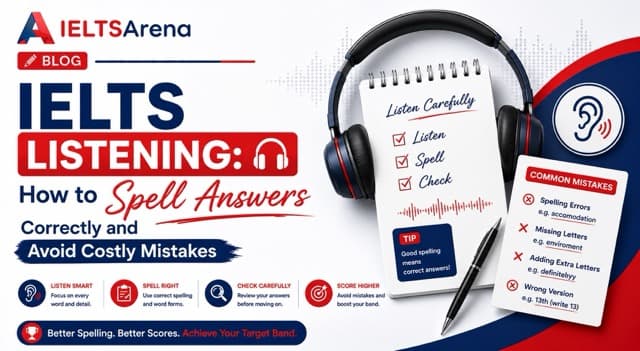
Both British and American spellings are generally accepted, so "colour" and "color" both count. What is not accepted is a genuine misspelling. "Accommodation" written with one "m" is marked wrong, because it is simply incorrect, not an alternative form.
Understanding this scoring rule is the first defence against IELTS listening spelling mistakes. The test is not judging your listening alone. It is judging whether you can record what you hear accurately.
Advertisement
Why Smart Candidates Still Lose These Marks
Strong listeners are often the most surprised by spelling errors, because they assume hearing the word is the hard part. The writing feels automatic. That assumption is exactly the trap.
The first cause is speed. The recording moves on while you are still writing. You rush the spelling, drop a letter, and never check it.
The second cause is unfamiliar words. The Listening test deliberately includes names, places, and spelled-out words read letter by letter. If you miss two letters of a name spelled aloud, you have lost the mark no matter how well you understood the conversation.
The third cause is interference from how a word sounds. Words like "Wednesday", "February", and "restaurant" are not spelled the way they are pronounced. Candidates write the sound, not the spelling.
The fourth cause is plurals and word forms. The recording says "two tickets" and the candidate writes "ticket". A missing "s" is one of the most common IELTS listening spelling mistakes, and it is purely a transcription error, not a listening failure.
The point is that spelling accuracy is a separate skill from listening comprehension. Candidates who never train it keep making the same spelling errors test after test.
A Student Story: Grace From the Philippines
Grace, an aspiring nurse from Manila, the Philippines, needed Band 7 in every section for her registration abroad. Her Listening was strong, yet she kept landing on 6.5.
"I would walk out feeling like I had done really well," Grace said. "Then my Listening came back at 6.5 again, and I could not understand why. I was sure I had heard every answer."
When she reviewed her practice tests carefully, the pattern was obvious. She had written "goverment" instead of "government", "accomodation" with one "m", and "Febuary" without the first "r". Her listening was Band 8 quality. Her spelling was dragging it down to 6.5.
She had not made a single comprehension error. Every lost mark came from IELTS listening spelling mistakes on words she knew but never wrote out under timed pressure.
Grace started a focused spelling routine alongside her listening practice. She drilled the words that appear often in the test, practised writing answers under exam timing, and checked every transfer carefully. Within five weeks her Listening rose to Band 7.5. "Nothing about my listening changed," she said. "I just stopped throwing away marks on spelling."
What the Data Shows About Lost Marks
The impact of spelling on Listening scores is larger than most candidates expect.
According to performance data published by the British Council and IDP, Listening and Reading bands are decided on a strict raw-score conversion, where a small number of additional correct answers can lift you a full half band. In that conversion, every answer lost to spelling is a direct band cost.
Cambridge assessment guidance confirms that spelling errors result in incorrect answers in Listening, with no partial credit for a recognisable attempt. The mark is binary. Right spelling earns it, wrong spelling does not.
Examiner observations referenced by IELTS partners note that completion-type questions, where candidates write what they hear, are among the most common places to lose avoidable marks, and spelling is a leading reason. For many test-takers, three or four spelling errors per test is the difference between 6.5 and 7.0.
The data points to a clear conclusion. If you are close to your target band, fixing spelling is often the fastest available gain, because the listening ability is already there.
Hearing the answer is only half the mark. Writing it correctly is the other half, and most candidates only train the first.
The Right Way to Stop Losing Spelling Marks
Spelling accuracy is trainable. Here is a focused method to eliminate IELTS listening spelling mistakes.
- Build a personal error list. Every time you misspell an answer in practice, write the correct version five times and add it to a running list. Your own mistakes are your most valuable study material.
- Master the high-frequency words. Certain words appear repeatedly in Listening: accommodation, government, restaurant, Wednesday, February, beautiful, business, necessary, definitely, and address. Learn to spell these automatically.
- Drill spelled-out names and numbers. Practise listening to letters and numbers read aloud, including the easily confused pairs like "m" and "n", "b" and "p", and the way "double l" is spoken. Names and postcodes are common answers.
- Watch plurals and word endings. Train yourself to listen for the final "s", "ed", or "ing". Many marks are lost on the form of the word, not the word itself.
- Leave time to check transfers. On the paper-based test you get time to copy answers onto the answer sheet. Use it to verify spelling. On the computer-based test, review your answers before the section ends.
- Practise under real timing. Spelling collapses under pressure. The only way to build accuracy that survives the exam is to practise writing answers at exam speed, not in slow, comfortable conditions.
Follow this method consistently and IELTS listening spelling mistakes stop being a mystery. They become a fixed, shrinking list.
How IELTSArena Helps You Catch Spelling Errors
The hardest part of fixing spelling is that you often cannot see your own errors. You write a word, it looks right to you, and you move on. IELTSArena removes that blind spot.
IELTSArena replicates the real IELTS computer-based test interface, including the on-screen timer and answer fields. You practise typing your Listening answers exactly as you will on test day, which trains spelling accuracy under genuine exam conditions rather than relaxed ones.
After each mock test, IELTSArena shows you which answers were wrong and why, so spelling errors are flagged immediately instead of hiding inside a raw score. This is the feedback loop Grace was missing for months.
IELTSArena's progress analytics track your Listening performance across every test, so you can see whether your spelling errors are decreasing over time. Patterns that you would never notice on your own become visible in the dashboard.
Because IELTSArena supports both Academic and General Training Listening, you practise the exact format you will sit. More than 10,000 learners have used IELTSArena to lift their scores, and you can start free on IELTSArena. Eliminating IELTS listening spelling mistakes is one of the quickest wins the platform helps you secure.
Self-Diagnosis: Is Spelling Costing You Marks?
Answer these honestly to find out whether spelling is hiding in your score.
- When you review a Listening practice test, do you check whether wrong answers were misheard or just misspelled?
- Can you spell accommodation, government, and necessary correctly without thinking?
- Do you consistently catch plurals and verb endings when you write answers?
- Have you practised writing answers under real exam timing, not in slow conditions?
- Do you keep a list of the specific words you tend to misspell?
If you answered no to two or more, spelling is almost certainly costing you marks you have already earned with your listening. That is the easiest band gap to close.
See How Many Marks Spelling Is Costing You
You can keep walking out of practice tests feeling confident and keep landing half a band below your target, or you can find out exactly how many marks spelling is taking from you.
Take a Free Listening Mock Test on IELTSArena →
Frequently Asked Questions
Does spelling matter in the IELTS listening test if I write the right word?
Yes, spelling matters completely. In IELTS Listening, an answer must be spelled correctly to earn the mark, even if you clearly heard and understood the word. If you write the right word with a wrong letter, the answer is marked incorrect with no partial credit. Both British and American spellings are accepted, so "colour" and "color" both count, but a genuine misspelling like "accomodation" with one "m" is wrong. This is why strong listeners still lose marks. Comprehension and accurate writing are two separate skills. IELTSArena lets you practise typing answers on the real computer-based interface and flags spelling errors after each test, so you can fix them before exam day.
How do I improve my spelling accuracy for IELTS listening answers?
Start by building a personal error list. Each time you misspell an answer in practice, write the correct version several times and keep a running record of your weak words. Master the high-frequency words that appear often, such as accommodation, government, restaurant, Wednesday, and necessary. Drill spelled-out names and numbers, and train yourself to catch plurals and verb endings like the final "s" or "ed". Most importantly, practise writing answers under real exam timing, because spelling accuracy collapses under pressure. IELTSArena's mock tests replicate exam conditions and show you exactly which answers you misspelled, giving you the feedback loop needed to turn repeated errors into a shrinking list.
What are the most commonly misspelled words in IELTS listening tests?
Common culprits fall into a few groups. Words that are not spelled the way they sound, such as Wednesday, February, restaurant, and business. Words with double letters, such as accommodation, necessary, and address. Words that test-takers shorten by mistake, such as government, which is often written as "goverment". Names and places spelled aloud letter by letter also trip candidates up, along with plurals where a final "s" is dropped. These words appear repeatedly because they target predictable weaknesses. Learning to spell them automatically removes a large share of avoidable errors. IELTSArena helps you identify your personal high-risk words by flagging the exact answers you misspell across every practice test.
If I spell an answer wrong in IELTS listening is the whole mark lost?
Yes. Listening marks are awarded on an all-or-nothing basis for each question. A misspelled answer earns zero marks for that question, with no partial credit for a recognisable attempt. There is no half mark for being close. This is why spelling can quietly pull a strong listener from Band 7 down to Band 6.5, since each lost mark moves you on the strict raw-score conversion. The good news is that this is one of the most fixable problems in the entire exam, because your listening ability is already there. IELTSArena reviews every answer after a mock test, so you can see precisely how many marks spelling cost you and target them directly.
How do I practise spelling specifically for the IELTS listening test?
Practise in a targeted way rather than hoping it improves on its own. Do dictation exercises where you write down words and short phrases as you hear them, then check each one. Focus on the high-frequency words and your personal error list. Drill letters and numbers read aloud to handle names and codes. Always practise at real exam speed, because spelling that holds up in slow conditions often fails under time pressure. Finish each practice test by reviewing which answers were misspelled rather than misheard. IELTSArena's computer-based mock tests let you type answers under exam timing and flag spelling mistakes immediately, which is the most efficient way to train this specific skill before test day.