

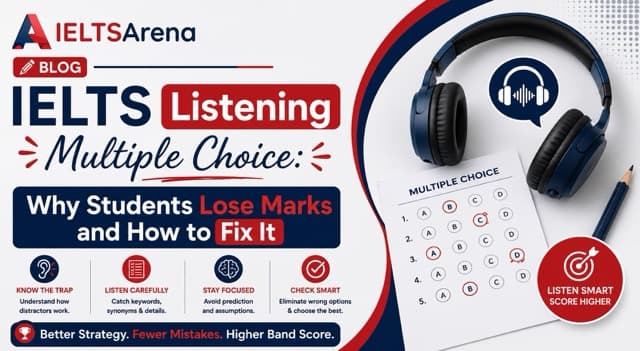
You hear the answer. You select it with confidence. Then the audio continues, the speaker changes their mind, and the correct option was actually the one you ruled out two seconds earlier.
This is the trap at the heart of IELTS Listening multiple choice. The questions are not testing whether you can hear English. They are testing whether you can hold focus while the audio deliberately leads you toward the wrong choice.
Most test-takers lose Listening marks here not because of weak English, but because they do not understand how the question is built to mislead them.
Once you see the mechanics, the fix becomes clear and trainable.
What IELTS Listening Multiple Choice Actually Tests
The IELTS Listening test has four sections, 40 questions, and runs for 30 minutes of audio plus 10 minutes to transfer answers on the paper-based test. On the computer-based test, the transfer time is shorter because you type as you go.
Multiple choice is one of the most common question types across these sections, and it appears in two formats. The first gives you a question with three options where you pick one answer. The second gives you a longer list and asks you to choose two or more correct answers.
The number of IELTS Listening multiple choice questions varies by test, but you can typically expect somewhere between five and ten across the four sections. They appear most often in Sections 2 and 3.
The skill being measured is not pure comprehension. It is the ability to track meaning across a full stretch of speech, notice when the speaker corrects or qualifies an idea, and match the final meaning to the correct option.
That is why a test-taker with strong English can still score below Band 7 on Listening. The multiple choice format punishes anyone who locks in an answer too early.
Advertisement
Why Common Approaches to IELTS Listening Multiple Choice Fail
The first failure is keyword hunting. Test-takers scan the options for a word, then wait to hear that exact word in the audio. The problem is that the audio rarely uses the same words as the correct option, but it often does use the exact words from a wrong option. This is the distractor doing its job.
The second failure is answering on the first match. The speaker mentions option B, you select B, and you stop listening. Then the speaker says "but actually" and switches to option C. You never hear it because you already moved on.
The third failure is reading the options too late. If you are still reading the three choices when the audio starts, you cannot listen and read at the same time, and you miss the opening that often frames the answer.
The fourth failure is panic after one miss. You lose one question, your mind stays on it, and you miss the next two while replaying the one you got wrong.
The fifth failure is treating every option as equally likely. Strong test-takers eliminate before they listen, so they only need to confirm between two realistic choices, not three.
A Realistic Student Story
Amara, a graduate from Nigeria applying to a university in Canada, needed Band 7.0 in Listening. She consistently scored Band 6.5, and the gap was almost entirely in the multiple choice questions.
"I could understand everything the speakers said," Amara explained. "But every time, I picked the answer they mentioned first, and the real answer came later when they changed direction."
Her habit was to commit the moment she heard a matching word. She had trained herself to react fast, which is exactly the wrong instinct for IELTS Listening multiple choice.
She changed two things. She started reading all the options during the preparation pause, and she trained herself to wait for the speaker to finish the relevant point before selecting.
Within three weeks of focused practice, her Listening mock scores moved to Band 7.5. The change was not better hearing. It was better timing and a clear understanding of how distractors trap fast reactors.
Data and Insight on Multiple Choice Accuracy
According to the British Council, Sections 3 and 4 of the Listening test are where scores most often drop, and these sections carry a heavy share of the multiple choice questions. The conversation and lecture formats give distractors more room to operate.
IDP IELTS guidance highlights that multiple choice is rated by candidates as one of the hardest Listening question types, ahead of form completion and matching, because it demands sustained concentration rather than single-word recognition.
Consider what one careless multiple choice answer costs. On the IELTS Listening band scale, the difference between 30 and 32 correct answers out of 40 can be the difference between Band 7.0 and Band 7.5. Two distractor traps can hold you back half a band.
Examiner commentary repeatedly notes that test-takers lose multiple choice marks not from vocabulary gaps but from selecting before the speaker has finished the relevant idea.
In IELTS Listening multiple choice, the answer is rarely the option that sounds first. It is the meaning that survives once the speaker stops talking.
The Right Approach to IELTS Listening Multiple Choice
Here is a method that directly counters how distractors are designed.
Step 1: Read all options during the pause. Before each section, you get time to read the questions. Use it to read the full question and all answer options. Underline the difference between the options, because the audio will hinge on that difference, not on the shared words.
Step 2: Predict and eliminate early. Once you know what each option claims, decide which one or two are most plausible. Eliminating an obviously wrong option before the audio starts means you only have to confirm between the realistic choices.
Step 3: Listen for meaning, not matching words. The correct answer is usually paraphrased. If the option says "reduce costs," the audio might say "spend less money." If you hear the exact words from an option, treat it as a possible distractor and stay alert.
Step 4: Wait for the full point before selecting. Speakers signal changes with words like "however," "actually," "on second thought," and "but in the end." When you hear these, the answer is about to shift. Do not commit until the idea is complete.
Step 5: Move on instantly after each question. If you miss one, let it go. The next question is already starting. Dwelling on a lost mark is how test-takers lose three more.
Step 6: Use the elimination habit on multi-answer questions. For "choose two" formats, rule out the clear wrong answers first, then listen to separate the remaining realistic options.
Train these steps with full audio practice, not isolated clips. The skill is sustained focus across a complete section, and you can only build that with realistic, timed practice.
How IELTSArena Helps You Beat the Distractors
The core problem with multiple choice is that you cannot fix it by reading tips. You fix it by practising under real audio pressure and reviewing exactly where the distractor caught you.
IELTSArena gives you real exam-style Listening tests with the same four-section structure, the same timing, and the same multiple choice formats you will face on test day.
Because IELTSArena replicates the real IELTS CBT interface, you practise selecting answers on screen with the actual navigation panel, which removes the surprise of the computer-based format on exam day.
After each test, IELTSArena's progress analytics show you which question types cost you marks. If multiple choice is your weak point, you will see it clearly in the dashboard instead of guessing.
IELTSArena lets you replay the audio and check the transcript for the exact moment the speaker switched direction, so you can train yourself to wait for the full point before answering.
For test-takers who want deeper support, IELTSArena combines AI-driven practice with expert tutor guidance, which goes beyond the free scoring tools that many competitor platforms offer.
More than 10,000 learners have used IELTSArena to lift their Listening scores, and you can start your first full Listening test in minutes. The combination of real CBT simulation and detailed performance tracking is what makes IELTSArena effective for fixing multiple choice errors specifically.
When you review your mistakes on IELTSArena, you stop losing the same distractor trap twice.
Self-Diagnosis: Are Distractors Costing You Marks?
Answer these five questions before your next Listening mock test.
- Do you finish reading all three answer options before the audio starts, or are you still reading when the speaker begins?
- When you hear a word that matches an option exactly, do you select it immediately, or do you treat it as a possible distractor?
- Do you wait for the speaker to finish the relevant point, or do you commit at the first match?
- After missing one question, can you refocus instantly, or does it pull your attention into the next two?
- Can you tell, after a mock test, which question type cost you the most marks?
If you struggled with any of these, distractors are likely the reason your Listening score has stalled. The solution is realistic practice with honest review.
Start Fixing Your Listening Score Today
You will not beat IELTS Listening multiple choice by hoping for cleaner audio. You beat it by training your timing and learning how distractors are built.
Take a Free Listening Practice on IELTSArena →
Frequently Asked Questions
Why do I keep picking wrong answers in IELTS Listening multiple choice questions?
Most test-takers pick wrong answers because they commit too early. The audio often mentions a wrong option first, using the exact words from that option, then the speaker changes direction toward the correct answer. If you select at the first match, you choose the distractor. The fix is to wait until the speaker finishes the relevant point before answering, and to listen for paraphrased meaning rather than matching words. Practising full Listening sections on IELTSArena and reviewing where the speaker switched direction trains you to hold focus until the idea is complete, which is the single biggest cause of lost multiple choice marks.
How do distractors work in IELTS listening multiple choice questions?
Distractors are wrong options deliberately designed to sound correct. They usually use the exact vocabulary from the audio, while the correct answer is paraphrased. The speaker may mention a wrong option clearly, then correct or qualify it with signals like "however," "actually," or "but in the end." Test-takers who react to the first familiar word fall for the distractor. To beat them, read all options first, identify the difference between them, and treat any exact word match as a warning sign rather than a confirmation. Waiting for the full point before selecting is the most reliable way to avoid distractors.
Should I read all three answer options before the IELTS listening audio starts?
Yes. Reading all three options during the preparation pause is essential. It lets you understand what each option claims and identify the key difference between them, which is usually where the answer turns. If you are still reading when the audio begins, you cannot listen and read at the same time, so you miss the opening that often frames the answer. Use the pause to underline the contrast between options and eliminate any that are clearly unlikely. On IELTSArena you can practise this routine inside the real CBT interface so reading ahead becomes an automatic habit before every section.
How do I eliminate wrong options in IELTS listening multiple choice quickly?
Eliminate before the audio starts by reading the options and ruling out any that are extreme, illogical, or off-topic. This leaves you with two realistic choices to confirm during the audio, which reduces pressure. During the audio, eliminate an option the moment the speaker contradicts it. For multi-answer questions, remove the clear wrong answers first, then focus on separating the remaining options. Speed comes from practice, not from rushing. Training on realistic Listening tests with IELTSArena and reviewing your errors helps you recognise distractor patterns faster, so elimination becomes quicker and more accurate over time.
How many multiple choice questions appear in the IELTS listening test?
The IELTS Listening test has 40 questions across four sections, and multiple choice is one of several question types used. The exact number of multiple choice questions varies by test, but you can typically expect roughly five to ten, appearing most often in Sections 2 and 3. They come in two formats: single-answer questions with three options, and multi-answer questions that ask you to choose two or more correct responses. Because the number changes between tests, the safest preparation is to be confident with the question type itself. Practising full Listening tests on IELTSArena exposes you to both formats regularly.
![IELTS Speaking Part 1 Questions and Answers [2026]: 40+ Real Questions From the Current Cycle](/_next/image?url=%2Fblog%2Fcover-ielts-speaking-part-1-questions-and-answers.jpeg&w=3840&q=75&dpl=dpl_DXyM63YUHjigMzg2B75HT6s5tc1D)