
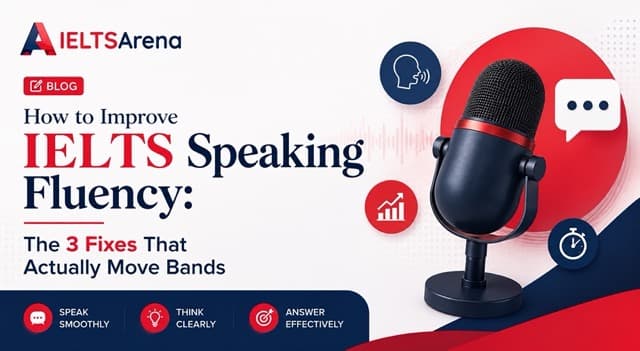
Learning how to improve IELTS speaking fluency does not require memorising phrases or speaking faster. It requires three specific fixes, applied in a specific order, because these move your Fluency and Coherence band faster than anything else in the marking system.
Fluency and Coherence contributes 25% of your Speaking score, and it is where most Band 6.5 candidates lose the half-band that separates them from Band 7. The fixes below map directly to where the official band descriptors set that gap. If you are currently plateaued at Band 6 or 6.5 in Speaking, one of these three is almost certainly the reason.
What Fluency Actually Means in IELTS
The single most common misunderstanding about how to improve IELTS speaking fluency is that it means speaking quickly. It does not.
The official Band 7 descriptor for Fluency and Coherence says the candidate "speaks at length without noticeable effort or loss of coherence." The Band 8 descriptor adds that "hesitation is usually content-related rather than language-related." Neither mentions speed. What matters is whether you can maintain natural speech without long pauses spent hunting for words.
Speaking too fast is often a sign of anxiety and typically hurts your score because it introduces mispronunciation. Speaking at a natural pace with occasional thinking pauses is Band 7. Speaking slowly with frequent "um" and "you know" between every phrase is Band 6.
Advertisement
Fix 1: Replace Filler Words With Deliberate Pauses
The single fastest way to raise your Fluency and Coherence band is to eliminate filler words: "um," "uh," "like," "you know," "actually," and their equivalents in your first language when they leak into English speech.
Filler words are the loudest Band 6 signal in IELTS Speaking. The Band 6 descriptor notes that the candidate "uses cohesive devices but not always appropriately," and this shows up in real responses as filler words replacing the connective structure that Band 7 speakers use. Every "um" tells the examiner you are searching for a word, which shifts your Fluency band down.
The fix: replace filler words with a short deliberate pause and a controlled breath. Silence sounds more confident than "um." A one-second thinking pause reads as "considering my answer," while three "ums" in a row reads as "struggling with the language."
Before: "Um, I think that, uh, technology has, you know, changed education, like, in many ways."
After: "I think technology has changed education in several important ways."
Same idea, roughly the same length, dramatically different Fluency score. This single fix, applied consistently over two to three weeks of recorded practice, moves Fluency from Band 6 to Band 6.5 or Band 7 for most candidates. It is the highest-leverage change in learning how to improve IELTS speaking fluency.
The practical technique: record a two-minute Part 2 response every day, listen back, and count how many filler words you used. Set a target of reducing the count by one filler per week. Within four to six weeks, most candidates cut fillers by 60 to 80 percent.
Fix 2: Extend Short Answers Into Full Responses
The second most common Band 6 pattern is one-sentence answers, particularly in Part 1 and Part 3 questions where a follow-up is expected.
The Band 6 descriptor mentions the candidate is "willing to speak at length, though may lose coherence at times." Band 7 requires that you "speak at length without noticeable effort." One-sentence answers do not demonstrate ability to speak at length, no matter how grammatically correct.
The fix: extend every answer to three or four sentences using the point-reason-example structure. State your point, explain why, then give one concrete example.
Before: "Do you like reading?" — "Yes, I enjoy reading books."
After: "Do you like reading?" — "Yes, I enjoy reading, particularly historical fiction. It gives me a chance to learn about different periods while following a good story. Recently I finished a novel set in eighteenth-century Japan, which sparked my interest in learning more about that era."
The second response is naturally three sentences: point, reason, example. It takes 20 seconds instead of 3, and it moves your Fluency band from 6 to 7 by demonstrating ability to speak at length coherently.
For Part 2 (the long turn), the target is speaking for the full two minutes without running out of things to say. Structure your response around the cue card's four bullet points, allocating roughly 30 seconds to each.
Fix 3: Diversify Your Connectives Beyond "And Then, But, So"
The final Band 6 tell is a narrow range of linking words. The Band 6 descriptor calls this "uses cohesive devices but not always appropriately," while Band 7 requires "a range of connectives and discourse markers with some flexibility."
Most Band 6 candidates rely on three or four connectives across their entire response: "and then," "but," "so," and "however." That narrow range signals limited linguistic resources, which caps your Fluency and Coherence at Band 6.
The fix: deliberately practise five specific connective categories, using each at least once in every Part 2 response.
Cause and effect: "as a result," "which led to," "the reason being." Contrast: "on the other hand," "having said that," "in contrast to." Addition: "furthermore," "in addition to that," "beyond that." Example: "for instance," "to give you an example," "a case in point." Time sequence: "initially," "subsequently," "eventually."
Before: "I went to university and then I got a job and then I moved to another city."
After: "I initially went to university to study engineering, and subsequently found a position at a manufacturing firm, which eventually led me to relocate to a different city."
Same story, more sophisticated connective range. This fix takes longer than the first two because it requires vocabulary building over three to four weeks, but it is what separates a candidate consistently getting Band 7 from a candidate stuck at Band 6.5.
Why These Three, Not the Standard 20-Item Lists on How to Improve IELTS Speaking Fluency
Every generic guide lists 15 to 30 things to work on: shadow native speakers, expand vocabulary, learn idioms, practise topics, record yourself, join a conversation group, listen to podcasts, master the tenses. The problem is not that any of these are wrong. The problem is that they treat all improvements as equal, and they are not.
The three fixes above map directly to the descriptor language that separates Band 6 from Band 7. Fillers, response length, and connective range are the observable behaviours an examiner notices in the first 30 seconds. Fixing all three raises your Fluency and Coherence band, which is 25% of your Speaking score.
The other three Speaking criteria matter too, but they move slower than Fluency and Coherence and require different, more time-intensive practice. Fix Fluency first because it moves fastest.
A Realistic Student Story
Priya, a Bengaluru-based software engineer preparing for a Canadian Express Entry application, had been stuck at Band 6.5 on Speaking across two attempts. Her Fluency and Coherence was consistently the lowest of her four criteria at Band 6.
She started with Fix 1. Every day for two weeks, she recorded a two-minute Part 2 response, listened back, and counted her filler words. Her count dropped from 22 fillers per two minutes to 6. Her Fluency band rose to Band 6.5.
She moved to Fix 2 in week three. She extended every Part 1 answer to at least three sentences and structured her Part 2 responses around the cue card's bullet points. By the end of week four, her Fluency band hit Band 7.
Fix 3 started in week five, expanding her connective range beyond her usual "and, but, so." Her overall Speaking band on her actual test hit Band 7.5 in week seven.
Her English had not changed. She stopped saying "um" every eight words, stopped answering with single sentences, and stopped starting every clause with "and then."
If you have been guessing at which specific behaviour is capping your Speaking band, try IELTSArena's free Speaking evaluation and see the criterion-level breakdown before your next practice session.
The Order to Follow When Learning How to Improve IELTS Speaking Fluency
Fix 1 (filler words) first, because it takes two to three weeks and requires no vocabulary building. Fix 2 (response length) second, because it stacks on top of the filler discipline you just built. Fix 3 (connective range) last, because it takes longer, and you want your first two fixes locked in before you add slower-moving work.
Do not try to apply all three simultaneously. Pick one, drill it for two weeks, move to the next.
Where IELTSArena Fits
IELTSArena's AI Speaking evaluation scores your Fluency and Coherence separately from the other three criteria, quotes specific moments in your transcript that raised or lowered your band, and lets you compare your criterion scores across daily practice sessions. That criterion-level diagnosis is what tells you which of the three fixes above applies to you first. Start from the full practice test hub for Speaking practice alongside Reading, Listening, and Writing.
For candidates within half a band of their target, optional expert human tutor review is available on Speaking responses flagged below your target band, particularly useful for the Part 3 depth and interaction nuances that AI evaluation cannot yet fully capture.
A Quick Self-Check
Do you know your current Fluency and Coherence band separately from your overall Speaking band? Have you counted the filler words in a recent two-minute Part 2 recording? Are you giving three-to-four sentence answers on Part 1 questions, or one-sentence responses? Are you using more than four different connectives across a Part 2 response?
If any of these are unclear, that is where your path to a Band 7 Speaking band is silently stalling.
Start With Fix 1 This Week
The single most useful thing you can do in the next seven days is record one two-minute Part 2 response, count your filler words, and set a target for reducing them by half in two weeks. Try IELTSArena's free Speaking evaluation and get a criterion-by-criterion breakdown.
FAQ
What stops most candidates from reaching Band 7 in IELTS Speaking? Filler words are the fastest Band 6 signal for most candidates. "Um," "uh," "like," and "you know" between phrases tell the examiner you are searching for words, which shifts your Fluency and Coherence band down. Replacing fillers with deliberate silent pauses is the fastest way to move from Band 6 to Band 6.5 or Band 7.
How do examiners judge fluency in IELTS Speaking? By observing three things: how smoothly you speak without long pauses, how naturally you use connective words to link ideas, and whether your hesitations are content-related (thinking about the topic) rather than language-related (searching for words). Speed is not judged; sustained natural speech is.
Should I speak faster to sound more fluent in IELTS? No. Speaking faster typically introduces mispronunciation and reduces clarity, both of which hurt other criteria. Fluency in IELTS is measured by sustained natural speech without hesitation, not by pace. A moderate speaking speed with occasional thinking pauses is Band 7. Fast, mumbled speech is not.
How do I stop using filler words in IELTS Speaking? Record a two-minute Part 2 response every day, listen back, and count your fillers. Set a weekly target of reducing them by one per week. Replace each removed filler with a short deliberate pause and controlled breath. Most candidates cut fillers by 60 to 80 percent within four to six weeks using this method.
How long until IELTS speaking fluency improves? For candidates currently at Band 6.5, focused practice on filler-word reduction typically shows a 0.5-band improvement in three to four weeks. Response-length extension takes two more weeks. Full connective diversification takes three to four weeks beyond that. Total time to move from Band 6 to Band 7 in Fluency is typically 8 to 10 weeks of daily practice.
![IELTS Speaking Part 1 Questions and Answers [2026]: 40+ Real Questions From the Current Cycle](/_next/image?url=%2Fblog%2Fcover-ielts-speaking-part-1-questions-and-answers.jpeg&w=3840&q=75&dpl=dpl_DXyM63YUHjigMzg2B75HT6s5tc1D)