
You scored Band 7.5. You studied harder, practised more, sat the test again, and scored Band 7.5 once more. The jump to Band 8 feels like it lives behind a wall you cannot see.
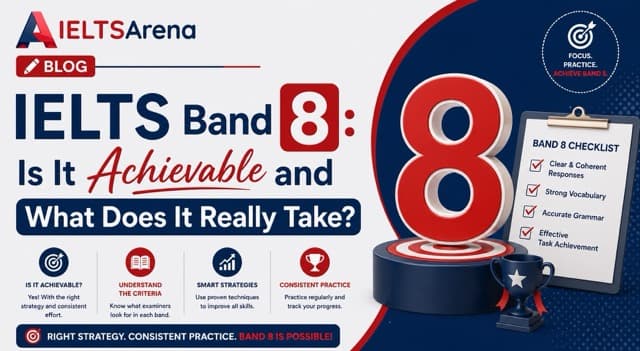
Reaching IELTS band 8 is absolutely achievable, including for non-native speakers, but only with a clear understanding of what the band actually requires. It is not about knowing more words or writing longer answers. It is about removing the small, repeated errors that quietly cap a Band 7.5 candidate where they are.
This guide breaks down the official Band 8 definition, the specific reason most strong candidates plateau, the data on what makes a Band 8 profile, and the seven-step path that consistently moves people from 7.5 to 8.
What IELTS Band 8 Actually Means
The IELTS band scale defines Band 8 as a "very good user" who handles "complex and detailed language with only occasional unsystematic inaccuracies and inappropriate usage."
Your overall band is the average of your four skill scores, rounded to the nearest 0.5. To reach an overall Band 8 you typically need three skills at Band 8 and one at Band 7.5, depending on rounding. A profile of 8, 8, 8, 7.5 averages to 7.875 and rounds to an overall 8.
Globally, Band 8 sits well into the top tier of all test-takers. According to official IELTS test partner data, the mean overall score for Academic candidates is around Band 6.0 to 6.5, and only a small percentage of candidates worldwide achieve an overall Band 8 or above.
The headline takeaway: Band 8 is rare, but it is structured. The candidates who reach it are not English natives or geniuses. They are people who systematically removed their weak spots, one criterion at a time.
Advertisement
Why Most Strong Candidates Plateau at Band 7
The habits that produce Band 7 are exactly the habits that cap you there. At Band 7 you communicate clearly and accurately most of the time, and small errors no longer block your meaning. The examiner can follow what you mean, so you cleared the comprehension bar.
But Band 8 is not about being understood. It is about precision and consistency.
In Writing, candidates plateau because they rely on memorised structures and comfortable vocabulary. The same "Firstly... Secondly... In conclusion..." pattern produces fine 7.0 essays but blocks 8.0, which rewards flexible, precise word choice and ideas developed with depth.
In Speaking, fluent candidates plateau because their connectors and phrases become repetitive. They reach for the same "I think," "for example," and "in my opinion" in every answer. Band 8 requires idiomatic accuracy and natural flexibility, not just smooth delivery.
In Reading and Listening, the difference between Band 7.5 and Band 8 is often just one or two careless answers. Candidates miss a spelling, mishandle a "Not Given," or run out of time on the last question. These are not comprehension failures. They are precision failures.
The deeper issue is feedback. Most students practising alone cannot see why their writing or speaking sits at 7 rather than 8. Without precise correction, they repeat the same near-miss errors month after month.
A Real Candidate Story: Sofia from Brazil
Sofia, a 31-year-old engineer applying for an Australian skilled migration visa, sat IELTS three times and scored Band 7.5 overall on each attempt. Her Writing was stuck at Band 7.0. She needed Band 8 for the Proficient English points category, worth an additional 10 CRS-equivalent points on her visa application.
"I thought I needed more impressive sentences," Sofia said. "I was adding longer, more complex structures. But the examiner kept marking the same things: article errors, occasional collocation mistakes, repeated linking words."
Her feedback was always polite but clear: great range, occasional unsystematic errors. The Band 7 ceiling described exactly.
She changed her approach. Instead of writing more impressive sentences, she focused on eliminating her repeated small errors. She made a personal list: missing articles, wrong prepositions, weak collocations like "make a research." She practised shorter, cleaner sentences and reread each one looking specifically for her own pattern errors.
Within six weeks her Writing reached Band 8.0 in a mock test. Her real exam result: Writing 8.0, lifting her overall to Band 8. She received her invitation to apply two months later.
What the Data Shows About Band 8
Several patterns emerge consistently in the test partner data and in candidate outcomes.
Writing has the lowest mean band of the four skills, typically sitting at Band 5.8 to 6.0 globally. This is why Writing is statistically the hardest skill to score Band 8 in for most candidates.
Listening and Reading sit higher, with mean bands typically at Band 6.2 to 6.5. Band 8 in these sections often comes down to one or two careless answers, which is why technique review on incorrect answers is so high-leverage.
Reaching an overall Band 8 generally requires consistency across all four skills with a margin in your strongest two. Candidates who score 9, 9, 7, 7 sometimes hit overall 8, but the path is far more reliable when at least three skills sit at 8 and one at 7.5.
The most common preparation timeline from Band 7 to Band 8 is six to twelve weeks of focused work. Faster is possible if the gap is purely careless errors in receptive skills. Longer is normal if the productive skills need substantial refinement.
The Seven-Step Path to Band 8
Use this sequence to move from Band 7.5 to Band 8.
Step 1: Identify your weakest skill and protect the average. Get a recent honest mock score for each skill. The weakest skill is your priority. Lifting Writing from 7.0 to 8.0 protects the overall band more than lifting Listening from 8.0 to 8.5.
Step 2: Shift from impressive to precise language. Stop trying to add complex structures for the sake of complexity. Choose the right word for the meaning, not the longest word. Band 8 rewards control, not display.
Step 3: Hunt repeated small errors. Articles, prepositions, collocations, plurals, word forms. These are the patterns that cap fluent writers at Band 7. Make a personal list of yours and review it weekly.
Step 4: Develop ideas fully rather than listing many shallow points. A Band 8 Task 2 essay covers two ideas with depth, not five ideas in single sentences. Each paragraph needs a claim, an explanation, an example, and a clear link to the question.
Step 5: Eliminate careless losses in Reading and Listening. Review every wrong answer in your last three mocks. Was it a spelling error? A missed "Not Given"? A timing issue? The pattern shows you what to fix.
Step 6: Get precise, criteria-based feedback. You cannot diagnose your own Band 7 ceiling. AI feedback and expert tutor corrections show you the specific patterns invisible to self-review.
Step 7: Practise under real exam conditions. Stamina, timing, and CBT interface familiarity all matter at Band 8. A 9.0 on a relaxed practice means nothing if you cannot replicate it under 60 minutes of timed pressure.
The final half-band is won by removing weaknesses, not by adding more impressive language.
How IELTSArena Closes the Gap to Band 8
The structural problem for Band 7 candidates is that the errors costing the half-band are invisible to self-review. IELTSArena solves this with precision feedback that names the exact patterns holding your score back.
The AI Writing feedback scores every Task 1 and Task 2 essay across all four criteria and pinpoints small repeated errors: article missing, weak collocation, wrong word form, mechanical linker overuse. These are the Band 7 ceiling patterns, and seeing them named is the first step to removing them.
Expert tutor feedback adds human, examiner-level evaluation for candidates targeting Band 8 specifically. The tutor identifies the difference between a Band 7.5 paragraph and a Band 8 one in ways automated tools cannot fully capture.
The real CBT interface removes test-day surprises, and the progress dashboard tracks your accuracy by section and criterion across every mock, so you can confirm your weakest skill is climbing toward 8.
Start free on IELTSArena and take a Band 8 diagnostic mock today.
Self-Diagnosis: Are You Ready for Band 8?
Check yourself against these five questions.
- Do you know which of your four skills is weakest, and are you spending most of your practice time on it?
- Can you use precise, flexible language naturally, or are you reaching for complex structures to look advanced?
- Can you list at least three specific small errors that repeat across your last few essays?
- When you lose marks in Reading or Listening, are they genuine comprehension gaps or careless preventable losses?
- Have you received criteria-based feedback on your Writing and Speaking from a source that uses official band descriptors?
A "no" on any of these is the precise gap to close before your next attempt.
Take a Free Band 8 Diagnostic Today
Stop guessing why Band 7.5 will not move. One free mock test will show you exactly which criterion is capping you and what the path to Band 8 looks like for your specific profile.
Take a Free Band 8 Mock on IELTSArena →
Frequently Asked Questions
Is IELTS Band 8 much harder than Band 7?
Yes, Band 8 is significantly harder than Band 7 because it rewards consistency and precision rather than general clarity. Globally, only a small percentage of candidates achieve an overall Band 8 or above. The challenge is not adding more impressive language but eliminating the small repeated errors and careless losses that keep otherwise strong candidates at 7 or 7.5. The path requires precise feedback, deliberate practice on your weakest skill, and protecting the overall average by lifting that single weakest score by half a band.
What is the difference between Band 7.5 and Band 8 in IELTS?
A Band 7.5 candidate communicates clearly with a good range of vocabulary and grammar but makes occasional errors or slightly awkward phrasing. A Band 8 candidate largely avoids these. In Writing and Speaking, Band 8 requires flexible, accurate language used naturally, with fully developed ideas and few noticeable mistakes. In Reading and Listening, the difference is often just one or two answers — usually a spelling error, a missed plural, or one misread instruction. The half-band gap is real but specific, and it responds to targeted practice with criteria-based feedback rather than general study.
Which IELTS skill is the hardest to score Band 8 in?
For most candidates, Writing is the hardest skill to score Band 8 in. Globally, the mean Writing band sits at Band 5.8 to 6.0, lower than Listening and Reading averages, which means Band 8 in Writing is statistically the rarest of the four. Writing Band 8 demands precise word choice, a wide range of sentence structures used naturally, and fully developed arguments, while avoiding the small errors in articles, prepositions, and collocations that block the eighth band. Targeted criterion-level feedback is the most effective lever for raising Writing to Band 8.
Can a non-native speaker reach IELTS Band 8?
Yes. IELTS Band 8 is regularly achieved by non-native speakers, and you do not need to sound native to get there. The band descriptors reward consistency, precision, and natural communication, not first-language status. Thousands of non-native candidates reach Band 8 each year through targeted practice and precise feedback on their specific weak patterns. The main obstacle is rarely raw ability; it is the lack of accurate correction that lets near-miss errors keep repeating month after month. With criteria-based feedback and focused practice, Band 8 is realistic for committed non-native candidates.
How long does it take to prepare from Band 7 to Band 8?
Most candidates moving from Band 7 to Band 8 need roughly six to twelve weeks of focused preparation. The gap is narrow and specific, usually small repeated errors rather than general weakness, so general practice rarely closes it. Effective preparation centres on identifying the exact patterns capping each skill and targeting them directly. Candidates who use AI Writing feedback and expert tutor corrections typically progress faster than those self-studying, because the productive skills respond to external diagnosis far more than to additional volume of practice without feedback.