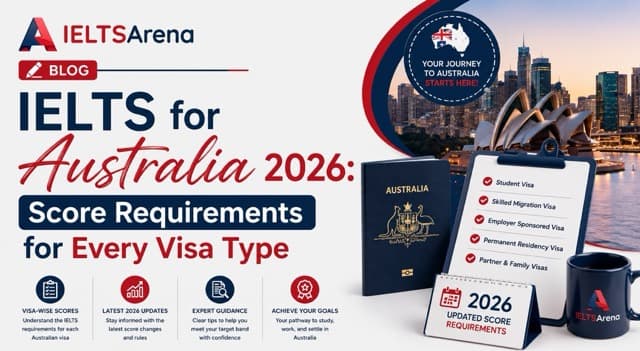
Your Expression of Interest has been sitting in the SkillSelect pool for five months. You have 78 points. The last invitation round for your occupation drew candidates at 85. You have maximum points for age, work experience, and your skills assessment. You cannot change those numbers.
Then someone tells you that your IELTS score for Australia PR 2026 could be worth up to 20 more points on the points test — points you have not yet claimed.
That is not a minor detail. For most General Skilled Migration applicants, the English language tier is the single fastest and most controllable lever remaining in their application. Understanding exactly which band you need — and which of your four IELTS components is holding your tier back — is the difference between waiting another two years or receiving an invitation in the next draw.
Why Your English Band Determines More Than Eligibility
Most candidates preparing for Australian Permanent Residency through General Skilled Migration know they need a minimum English band to submit an Expression of Interest. What many do not understand is that English is one of the few points categories where you can earn substantial bonus points above that minimum threshold.
Australia's General Skilled Migration points test awards English proficiency in three tiers:
- Competent English: IELTS 6.0 in each of the four components (Listening, Reading, Writing, and Speaking individually). This satisfies the eligibility requirement and allows you to submit an EOI. It adds zero bonus points to your total.
- Proficient English: IELTS 7.0 in each component. This adds 10 points to your skilled migration points total.
- Superior English: IELTS 8.0 in each component. This adds 20 points.
The emphasis on "each component" is critical. An overall band score of 7.5 does not qualify for Proficient English if one component is below 7.0. A 7.5 average with Writing at 6.5 leaves you at Competent English and zero bonus points. This is an exact, component-by-component requirement — not an average threshold.
For a skilled migration applicant with 75 base points, the gap between Competent and Superior English represents 20 additional points on the skills test. In a SkillSelect pool where invitation cut-offs for competitive occupations have been running at 85 to 95+ in 2026, those 20 points are not a minor bonus. They are potentially the margin between receiving an invitation this year and waiting indefinitely.
Why Candidates Get Stuck at Competent English
The pattern is consistent across thousands of Australian PR applicants: a candidate achieves 6.0 in each IELTS component, satisfies the Competent English threshold, and moves on. The assumption is that other categories — occupation, age, work experience, Australian study — will carry them to a competitive points total.
Competent English gets you into the pool. Proficient English gets you invited from it.
That assumption held reasonably well in 2022 and 2023, when many occupation categories had invitation cut-offs in the mid-60s to low 70s. It breaks down significantly in 2025 and 2026.
According to the Department of Home Affairs 2025 General Skilled Migration outcomes data, many non-healthcare and non-education occupations saw invitation cut-offs rise to 85 to 95+ points in general draws. An applicant at 75 base points with Competent English was competitive three years ago. The same profile in mid-2026 may not receive an invitation for twelve to eighteen months or longer.
The second reason candidates stay stuck at Competent English is more practical: they took IELTS once, passed the threshold, and have not considered retaking. For Australian skilled migration, a result has a two-year validity window. A result from 2024 may still be valid, but it may also be the ceiling on points they are willing to revisit.
For candidates who are already at 6.0 in each band, the preparation effort to reach 7.0 in each band is significantly less than the effort it took to reach 6.0 from a lower starting point. It requires targeted, criteria-specific practice — not starting over.
Miguel's 10-Point Upgrade
Miguel Santos, a certified accountant from Davao City in the Philippines, had been sitting in the SkillSelect pool for six months with 77 points. His occupation (ANZSCO 221111, Accountant) had been drawing invitations in general skilled migration rounds at around 85 to 87 points through the first half of 2026. He had a confirmed skills assessment from CPA Australia, maximum points for age (32 years old at the time of his EOI), and full points for five or more years of overseas skilled work experience. A state nomination was not realistic for his occupational category.
His IELTS General Training result from fifteen months prior showed: Listening 7.5, Reading 7.0, Writing 6.0, Speaking 6.5. His overall band was 6.5. Every component met the Competent English threshold. No component met the Proficient English threshold of 7.0.
"I thought my overall band of 6.5 was already quite good. I did not realise I needed 7.0 in every single section," he said.
Miguel committed to a six-month preparation plan targeting Writing and Speaking specifically. He practised Task 2 essays under timed conditions three times per week, receiving AI feedback on each draft and expert tutor corrections twice monthly on full essays. He retook IELTS General Training six months later and achieved: Listening 8.5, Reading 8.0, Writing 7.0, Speaking 7.0. Every component at 7.0 or above qualified him for Proficient English.
His IELTS score for Australia PR 2026 jumped his total from 77 to 87 points. He received an invitation in the following general draw for accountants.
What the Data Shows About English and Invitation Outcomes
According to the Australian Department of Home Affairs 2025 General Skilled Migration data, English language proficiency tier was a key differentiating factor among candidates in competitive occupation groups. Candidates holding Proficient English (10 bonus points) or Superior English (20 bonus points) were more likely to sit above the cut-off threshold in draws where the cut-off was between 80 and 95 points.
IELTS remains the most widely used English test for Australian skilled migration, used by approximately 65% of applicants globally (IDP Education, 2025 Test Taker Insights report). PTE Academic accounts for around 30%, and OET for approximately 5%.
The component that most frequently prevents candidates from reaching Proficient English is Writing. In IELTS General Training, Writing Task 2 requires control of Grammatical Range and Accuracy at a level that demonstrates facility with complex sentence structures alongside accurate simple ones. Moving from Band 6.0 to Band 7.0 in Writing requires demonstrating a wider range of vocabulary with some awareness of style and collocation, and a mix of structures where complex sentences are used correctly and not just attempted.
These are specific, assessable criteria. They respond to feedback-focused practice in a way that generic grammar study or vocabulary memorisation does not.
Your Strategy for Reaching Proficient or Superior English
Here is the preparation pathway that addresses your Australia PR band target directly, component by component.
Step 1: Find your exact gap. Pull your most recent IELTS result. Identify which of the four components is below 7.0. This is your primary preparation target. For most candidates at Competent English, it is Writing, Speaking, or both.
Step 2: Understand the 7.0 criteria for your weak component. For Writing Task 2, Band 7 requires a clear position with fully developed ideas, not just stated views. For Speaking, Band 7 requires fluent delivery with only occasional hesitation, a broad range of vocabulary used flexibly, and a mix of structures that includes complex forms used accurately.
Step 3: Practise under real CBT conditions. IELTS General Training is a fully computer-delivered test since June 27, 2026. If you have been practising on paper or with outdated materials, you are not replicating your actual test environment. Your band score on a computer interface may differ from your band score in a notebook.
Step 4: Get specific, criteria-referenced feedback on Writing and Speaking. Generic feedback ("your vocabulary is good") does not raise scores between bands. What raises scores is knowing which of the four criteria is pulling your Writing from 6.5 to 7.0, and which specific patterns to change.
Step 5: Track improvement across multiple practice sessions over six to eight weeks. A single mock test result tells you one data point. A series of results across six weeks tells you whether your preparation is producing measurable movement — and at what rate you can expect to reach 7.0.
For Superior English (8.0 in each component): This is a high but achievable target for candidates already at Proficient level. The additional 10 points over Proficient English (total 20 over Competent) is worth the additional preparation time for candidates whose points total is competitive if they can push above the cut-off. The most commonly reached 8.0 component is Listening; the hardest to reach is typically Writing. A realistic preparation window from Proficient to Superior is three to six months of intensive practice.
How IELTSArena Helps You Target the Next English Tier
IELTSArena is built for exactly this kind of targeted, band-level improvement. For candidates working toward Proficient or Superior English on the Australian points test, the platform provides three directly relevant features.
AI Writing Feedback gives you an instant band score on every Task 1 and Task 2 essay you submit, broken down by all four writing criteria. If your Writing is stuck at 6.0 because of Grammatical Range and Accuracy rather than Lexical Resource, that distinction appears in your feedback immediately. You are not practising blind. Every session tells you specifically which criterion needs attention.
Expert Tutor Feedback adds the human layer that automated scoring cannot replicate. IELTSArena's tutors provide band-focused corrections on your actual essays — the kind of evaluative judgment that explains why a Task 2 essay scores 6.5 rather than 7.0 in Coherence and Cohesion, and what structural change to make in the next draft. This is the differentiator for candidates in the 6.0 to 7.0 range, where the gap is often in organisation and argument development rather than vocabulary or grammar.
Real CBT Interface means every practice session replicates the actual computer-delivered IELTS environment, including the on-screen highlighter, notepad, navigation panel, and section timing. If your last IELTS result is more than twelve months old and you sat a paper-based test, your first CBT sitting without preparation may cost you half a band on Listening or Reading due to interface unfamiliarity alone.
IELTSArena's Band Calculator helps you estimate your current band in each component and see exactly how far each skill is from the next tier threshold.
Over 10,000 students globally have used IELTSArena to improve their IELTS band score. Start free on IELTSArena and run a diagnostic mock test to identify which component is keeping your English tier below where your points total needs it to be.
Self-Diagnosis: Are You Leaving Points on the Table?
These five questions will tell you where you stand.
- What is your current IELTS result in each of the four components individually — not your overall band? Write down four separate numbers: Listening, Reading, Writing, Speaking.
- Is every component at 7.0 or above? If not, which component or components are below the Proficient English threshold?
- How many total points are you scoring on the SkillSelect points test right now, and how far from the typical invitation cut-off for your occupation is that number?
- Have you practised IELTS General Training under timed, fully computer-delivered conditions recently — including using an on-screen interface for Listening and Reading?
- Have you received specific, criteria-referenced feedback on your Writing Task 2 from someone who can explain exactly which of the four assessment criteria is limiting your score?
If your answer to question 2 is that Writing or Speaking is below 7.0, you have a clear path to 10 additional points. The question is not whether you can improve — it is how targeted your preparation is going to be in the next eight to sixteen weeks.
Start Your Free Practice on IELTSArena
If your IELTS score for Australia PR 2026 is the category preventing you from reaching the invitation threshold, you now know what the tiers mean, which component is most likely limiting your tier, and what a targeted preparation plan looks like.
Take Your First Free Australia PR Mock on IELTSArena →
Frequently Asked Questions
What is the minimum IELTS score for Australia PR in 2026?
The minimum IELTS score for Australian General Skilled Migration (Subclass 189, 190, or 491) is Competent English: 6.0 in each of the four components individually — Listening, Reading, Writing, and Speaking. Your overall band score is not the relevant measure. Each component must independently reach 6.0. An overall band of 7.0 with Writing at 5.5 does not satisfy the Competent English threshold. Meeting this minimum allows you to submit an Expression of Interest into SkillSelect but adds zero bonus points to your skilled migration points total.
How many extra points does a higher IELTS score give for Australia PR?
Australia's skilled migration points test awards English proficiency in three tiers. Competent English (6.0 in each component) gives zero bonus points. Proficient English (7.0 in each component) adds 10 points. Superior English (8.0 in each component) adds 20 points. These are bonus points on top of your base points from age, work experience, skills assessment, qualifications, and other categories. In competitive occupation groups where invitation cut-offs are running at 85 to 95+ points in 2026, the difference between Competent and Superior English can be the deciding factor between receiving an invitation and waiting in the pool indefinitely.
Which IELTS module do I need for Australia skilled migration?
For most Australian General Skilled Migration and permanent residency visas — including the Skilled Independent Visa (Subclass 189), the Skilled Nominated Visa (Subclass 190), and the Skilled Work Regional Visa (Subclass 491) — you need IELTS General Training. The Subclass 485 Temporary Graduate Visa also uses IELTS General Training in most cases. However, some professional registration bodies require IELTS Academic. The Medical Board of Australia and the Nursing and Midwifery Board of Australia, for example, require IELTS Academic 7.0 overall with 7.0 in each component. Always check the requirements of both the visa and any professional registration body relevant to your occupation.
How long does it take to improve from Competent to Proficient English for Australia PR?
Moving from Competent English (6.0 in each band) to Proficient English (7.0 in each band) typically takes eight to sixteen weeks of structured, feedback-driven preparation for candidates already at the Competent level. The exact timeline depends on which component is your weakest and how consistently you practise. Writing and Speaking respond well to expert, criteria-specific feedback combined with regular timed practice. Candidates who practise three to four times per week with feedback on each Writing submission and CBT interface time for Listening and Reading typically see measurable band movement within six to eight weeks. IELTSArena's AI Writing feedback and expert tutor corrections can accelerate this by identifying specific gaps quickly.
Does the IELTS score for Australia PR 2026 need to be from IELTS General Training?
For General Skilled Migration visa applications, the Department of Home Affairs uses your IELTS General Training component scores to determine your English tier (Competent, Proficient, or Superior). IELTS Academic results are accepted for the same visa categories and the component thresholds are the same, but the Reading and Writing tasks differ between modules. PTE Academic and OET are also accepted for Australian PR, and they use their own score-to-tier conversion tables. Whichever test you sit, each component must individually meet the threshold — not just the overall score or average. IELTS General Training remains the most commonly used test for Australian skilled migration, used by approximately 65% of applicants (IDP Education, 2025).