The single biggest mistake in a permanent residency application is treating the language test as an afterthought. Many applicants book their IELTS test late, score the bare minimum, and then watch competitors with higher bands take the limited invitations.
In points-based immigration systems, your IELTS band is not a pass or fail. It is a score that can add or cost you dozens of points. A half-band difference can decide whether you receive an invitation to apply or wait another year.
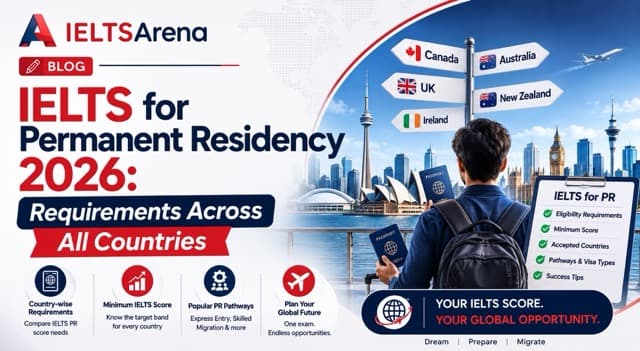
This guide breaks down IELTS for permanent residency country by country for 2026, so you know the exact band you need, the difference between the minimum and the competitive score, and how to prepare for the band that actually gets you approved.
Why IELTS Matters So Much for Permanent Residency
Most major destination countries run skilled migration on a points system. You earn points for age, education, work experience, and language ability. In almost all of these systems, language ability is one of the most heavily weighted factors.
This is the crucial point that catches applicants off guard. Meeting the minimum IELTS score often gets you into the pool, but it rarely gets you selected. The applicants who receive invitations usually score well above the floor.
IELTS for permanent residency therefore has two numbers you must understand: the minimum eligibility band, and the competitive band that actually earns enough points to be selected. Confusing the two is the most common and most expensive error.
Almost every country accepts IELTS as proof of English, and for migration purposes the relevant version is usually IELTS General Training rather than Academic. Always confirm the exact test type your pathway requires before you book.
Advertisement
Why Common Approaches Fail
Applicants pursuing IELTS for permanent residency tend to repeat the same errors.
The first error is aiming for the minimum. Someone reads that Canada requires CLB 7, which is IELTS 6.0 in each band, and targets exactly that. They forget that recent Express Entry rounds select candidates far above the floor. They qualify but never get invited.
The second error is ignoring the per-band requirement. Immigration systems usually demand a minimum in each of the four skills, not just an overall average. An applicant with an overall Band 7 but a 5.5 in Writing can be rejected outright. One weak skill sinks the whole application.
The third error is booking the test too early or too late. IELTS scores for migration have a validity window, and a result that expires before your application is submitted is useless. Time the test to your application timeline.
The fourth error is preparing without knowing the target. Without a clear band goal per skill, practice drifts. Effective IELTS for permanent residency preparation starts by fixing the exact number you need in each of the four skills.
A Realistic Student Story
Amara, an accountant from Ghana, was applying for permanent residency in Canada through Express Entry. She knew the minimum was CLB 7, so she prepared for IELTS 6.0 in each band and hit it comfortably.
Her profile entered the Express Entry pool, and then nothing happened. Round after round, the cutoff score sat well above her total. Her IELTS band was simply not earning enough language points to compete.
"I thought meeting the minimum meant I was ready," Amara said. "Nobody told me that the minimum for IELTS for permanent residency is only the door, not the invitation."
Amara re-took the test with a new target of CLB 9, which is IELTS 7.0 in each band. She focused hard on Writing, her weakest skill, using timed practice and detailed feedback. She reached 7.5 in three skills and 7.0 in Writing.
The jump added a large block of language points to her profile. Within two rounds, she received her invitation to apply. "The difference was not luck," she said. "It was understanding that a competitive band, not the minimum, is what IELTS for permanent residency really needs."
Data and Insight Layer
The gap between minimum and competitive scores is where most applications succeed or fail.
In Canada, the Federal Skilled Worker route sets the floor at CLB 7, equal to IELTS 6.0 in each skill. Yet analysis of Express Entry data shows most successful candidates reach CLB 9 or higher, and language ability at CLB 9 can contribute over 100 points to a Comprehensive Ranking System score. That is why the minimum rarely wins an invitation.
In Australia, skilled migration sets a competent English floor of IELTS 6.0 in each band, but points scale upward. Proficient English at IELTS 7.0 in each band and superior English at IELTS 8.0 in each band earn extra points that often make the difference in invitation rounds.
New Zealand typically requires an overall IELTS of 6.5 for its skilled migrant category, applied as an eligibility threshold rather than a sliding points scale.
The United Kingdom works differently. For indefinite leave to remain, the settlement stage, the English requirement is set at B1 level on the Common European Framework, roughly IELTS 4.0 in each skill, combined with the Life in the UK test. The bar is lower, but it is still a firm requirement.
The insight across all four is consistent. IELTS for permanent residency is rarely about scraping a pass. In points-based systems, every extra half band can convert into points that decide your outcome.
The Right Approach: Country by Country for 2026
Here is what to target for IELTS for permanent residency in the major destinations. Always verify the current figures with the official immigration authority before you apply, as thresholds can change.
- Canada. The minimum is CLB 7, which is IELTS General Training 6.0 in each skill. The competitive target is CLB 9, which is 7.0 in each skill or higher. Language points are heavily weighted in Express Entry, so aim well above the minimum. Your IELTS result must be less than two years old when you submit your profile and your application.
- Australia. Competent English is IELTS 6.0 in each band, the eligibility floor. Proficient English at 7.0 in each band and superior English at 8.0 in each band earn valuable extra points under the skilled migration points test. For most applicants, 7.0 in each band is the realistic competitive target. General Training is the version used for skilled migration.
- New Zealand. The skilled migrant category typically requires an overall IELTS of 6.5. Higher bands do not add points in the same sliding way, but a strong score supports your settlement case and any employer requirements.
- United Kingdom. For indefinite leave to remain, you need B1 English, roughly IELTS 4.0 in each skill, plus a pass in the Life in the UK test. Earlier visa stages may require a higher band, so check the requirement for your specific route.
- Other destinations. Countries such as Ireland and several others accept IELTS for settlement and citizenship pathways at varying bands. The principle is the same everywhere: identify the per-skill minimum, then aim above it if the system awards points for language.
Across every country, three rules hold. Confirm whether you need Academic or General Training. Meet the minimum in each skill, not just overall. And aim for the competitive band, not the floor.
How IELTSArena Helps You Hit Your PR Band
Knowing you need IELTS 7.0 in each band for a competitive Canada or Australia profile is one thing. Reaching it in every skill is another. This is where IELTSArena becomes the practical tool for IELTS for permanent residency.
IELTSArena lets you practise both Academic and General Training, so you train on the exact test type your PR pathway requires. Many migration applicants waste weeks preparing for the wrong version. IELTSArena removes that risk.
The platform replicates the real IELTS computer-based test interface, with the same on-screen tools and timer you will face on test day. This matters for applicants who have not taken a computer-based exam before, because the interface itself can cost marks if it is unfamiliar.
IELTSArena's AI Writing and Speaking feedback is built for exactly the weak-skill problem that sinks so many PR applications. If your Writing is the band pulling you below your target, the AI feedback shows your precise errors on Task 1 and Task 2 essays, scored against the official criteria. Expert tutor feedback then adds band-focused human correction.
The progress analytics dashboard tracks your score in each of the four skills across every mock test. For IELTS for permanent residency, where you must hit a minimum in each skill, this per-skill tracking is exactly what you need to see which band is holding you back.
More than 10,000 learners have used IELTSArena to prepare, including many targeting a specific PR band. Because you can start free, you can measure your current band in each skill before you spend a rupee, dollar, or naira on the official test.
The minimum score opens the door. The competitive score gets you the invitation. Prepare for the second number, not the first.
Start your free practice for IELTS for permanent residency on IELTSArena and see your current band in every skill today.
Self-Diagnosis: Are You Ready for Your PR Band?
Answer these questions honestly to check your readiness.
- Do you know the exact minimum IELTS band in each skill for your target country, not just the overall average?
- Do you know the competitive band that actually earns enough points to be selected, not only the eligibility floor?
- Are you preparing for the correct test type, General Training or Academic, for your specific PR pathway?
- Do you know which of your four skills is currently your weakest, and by how much?
- Will your IELTS result still be valid on the date you plan to submit your application?
If any answer is unclear, your IELTS for permanent residency plan has a gap that could cost you an invitation or a full application cycle.
Start Your Free Practice Today
Your permanent residency depends on a number, and that number is your IELTS band in each skill. Guessing where you stand is the most expensive mistake you can make.
Take a free mock test on IELTSArena and see your current band in Listening, Reading, Writing, and Speaking. In one free test, you will know exactly how far you are from your target PR band and which skill to fix first.
Take a Free PR-Targeted Mock on IELTSArena →
Frequently Asked Questions
What IELTS score do I need for permanent residency in Australia in 2026?
For Australian skilled migration, the minimum is competent English, which is IELTS 6.0 in each of the four bands. However, this is only the eligibility floor. Proficient English at 7.0 in each band and superior English at 8.0 in each band earn extra points under the skilled migration points test, and those points often decide who receives an invitation. Most competitive applicants target at least 7.0 in each band. Use IELTS General Training for skilled migration, and confirm the current requirement with the official authority. IELTSArena lets you practise General Training and track your band in each skill toward that target.
Is the same IELTS score required for PR in Canada as for immigration?
In Canada, permanent residency through Express Entry is the immigration process, so the requirement is the same. The minimum is CLB 7, equal to IELTS General Training 6.0 in each skill, for the Federal Skilled Worker route. But CLB 7 is only the floor. Most candidates who actually receive an invitation reach CLB 9, which is IELTS 7.0 in each skill or higher, because language ability is heavily weighted in the Comprehensive Ranking System. Aim well above the minimum. IELTSArena's per-skill analytics help you see whether you are hitting a competitive band across all four skills.
Can I use IELTS General Training for permanent residency in Australia?
Yes. For Australian skilled migration and most permanent residency pathways, IELTS General Training is the accepted version, not Academic. General Training is designed for migration and work purposes, which matches PR applications. The scoring scale and band requirements are the same across the four skills. Always confirm the exact test type your specific visa subclass requires before booking, since a small number of pathways may differ. IELTSArena supports both General Training and Academic practice, so you can train on the correct version and avoid the common mistake of preparing for the wrong test type.
How long is my IELTS score valid when applying for permanent residency?
An IELTS result is generally valid for two years from the test date for most immigration and permanent residency purposes. For Canada Express Entry, your test results cannot be older than two years when you submit both your profile and your application, so timing matters. Some countries and pathways allow a slightly longer window for skilled migration, so always check the rule for your destination. The safest approach is to take the test close enough to your planned application date that it will still be valid at submission. Prepare thoroughly first so you only need to sit the test once.
What IELTS score do I need for UK indefinite leave to remain ILR?
For UK indefinite leave to remain, the settlement stage, the English language requirement is B1 on the Common European Framework, which corresponds to roughly IELTS 4.0 in each skill. You must also pass the Life in the UK test. This bar is lower than for points-based skilled migration in other countries, but it is still a firm requirement you cannot skip. Earlier UK visa stages, such as a skilled worker visa, may require a higher band, so check the requirement for your specific route. IELTSArena lets you practise to whichever band your UK pathway requires.