
A single IELTS band can decide whether your New Zealand visa application moves forward or stalls. For the Skilled Migrant Category, the main applicant generally needs an overall Band 6.5, and being at 6.0 instead of 6.5 can hold up the whole file.
That half band is where most applicants lose time, money, and momentum. They book the test, score close to the target, and have to resit because nobody told them the exact number their pathway required.
Taking IELTS for New Zealand is not one fixed requirement. The score you need depends entirely on whether you are migrating, studying an undergraduate degree, or entering a high-stakes profession like nursing or teaching. This guide gives you the 2026 numbers for each route and a plan to hit them.
What New Zealand Actually Requires
New Zealand uses IELTS as one of its accepted proofs of English for both immigration and study, so the first step is to identify which pathway you are on.
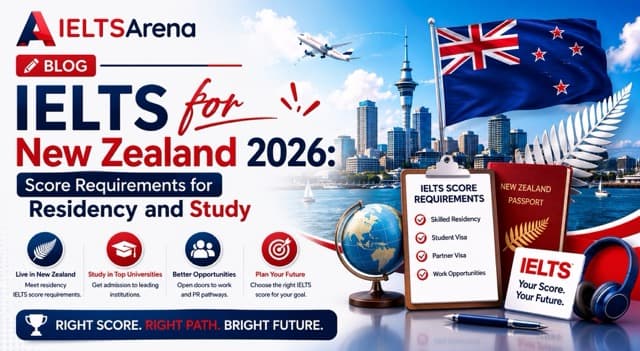
For residence, the Skilled Migrant Category sits at the centre. The principal applicant typically needs an overall Band 6.5, while partners and dependent family members aged 16 or over usually need an overall Band 5.0.
For study, the requirement is set by your level. Undergraduate programmes generally ask for an overall 6.0, and postgraduate programmes generally ask for an overall 6.5, often with no individual band below a set floor.
For regulated professions, the bar is higher. Fields such as nursing and teaching frequently require an overall Band 7.0, sometimes with a 7.0 in each of the four skills.
Always confirm the current figure against Immigration New Zealand and your specific institution, because requirements are reviewed periodically. The numbers in this guide reflect the commonly published 2026 thresholds and are the right targets to prepare against.
Advertisement
Why Applicants Get the IELTS Score Wrong
The most common mistake when preparing IELTS for New Zealand is treating "I need a 6.5" as the whole story. The detail underneath that number is what trips people up.
Many applicants do not realise their visa or course sets a minimum in each skill, not just an overall average. You can hit an overall 6.5 and still fall short because one skill landed at 5.5.
A second error is choosing the wrong test type. Some applicants prepare for Academic when their pathway accepts General Training, or the reverse, and the practice material does not match the real exam they sit.
A third issue is timing. People book the test before their weakest skill is ready, score just under the threshold, and lose six to eight weeks and another test fee to a resit that better preparation would have avoided.
The fix is to know your exact pathway number, including any per skill minimum, before you book, then prepare against that specific target.
How Sefina Reached Her New Zealand Score
Sefina, a registered nurse from Fiji, was preparing IELTS for New Zealand to meet her nursing registration requirement. Her target was an overall Band 7.0 with a 7.0 in each skill, which is one of the toughest bars New Zealand sets.
"My speaking and reading were fine," she said. "But my writing kept landing at 6.5, and for nursing that 6.5 was not enough. I needed a 7 in every single skill, not just overall."
She had been practising broadly instead of targeting the one skill blocking her. Once she saw that Writing was the only barrier, she focused almost entirely on Task 1 and Task 2 under timed conditions.
She wrote essays repeatedly, reviewed the feedback on her Lexical Resource and Task Response, and tracked whether her Writing band was moving toward 7.0.
On her next attempt she scored 7.0 in Writing and held 7.0 or above in the other three skills, clearing the nursing requirement on a single sitting. The change was targeting her weak skill, not adding more general study.
The Data Behind New Zealand IELTS Pathways
The numbers show why the right target matters so much for IELTS for New Zealand applicants.
The Skilled Migrant Category requirement of an overall Band 6.5 is meaningfully above the global mean overall IELTS score, which the IELTS partners report sits around Band 6 to 6.5 for Academic candidates. That means the typical test-taker is right on the edge of the skilled migrant threshold and cannot rely on a single attempt.
For study, the gap between an undergraduate 6.0 and a postgraduate 6.5 is only half a band on paper, but according to Cambridge research a half band improvement in a productive skill like Writing can take many weeks of focused work, not a few days.
For nursing and teaching, the 7.0 in each skill requirement is the real hurdle. Because it must be met in every skill, your single weakest skill decides everything, which is why broad practice so often fails these applicants.
The lesson is consistent across all three routes. Identify your exact required band, find your weakest skill against it, and direct most of your preparation there.
The Right Way to Prepare for New Zealand
Follow these steps to hit your New Zealand target efficiently.
- Confirm your exact requirement. Check Immigration New Zealand for your visa or your university for your course, and note both the overall band and any per skill minimum.
- Choose the correct test type. Most study routes use IELTS Academic, while many residence and work routes accept General Training. Prepare only for the one your pathway requires.
- Take a full diagnostic mock. Sit one complete timed test to find your real starting band in each skill, not your guessed band.
- Target your weakest skill. Put the majority of your study into the one skill furthest below your target, because that skill is what holds the whole application back.
- Practise under real exam conditions. Use the computer-based format with a live timer, since New Zealand test centres widely offer the CBT version.
- Track your bands across attempts. Only book the real test once your mock scores reliably clear your target in every required skill, including the weakest one.
The applicants who pass on the first attempt are not the strongest. They are the ones who knew their exact number and prepared against it.
How IELTSArena Prepares You for New Zealand
The biggest risk in taking IELTS for New Zealand is booking too early and resitting, which costs both the test fee and weeks of delay to your visa or admission timeline.
IELTSArena removes that guesswork. You can take full CBT practice tests that replicate the real computer-based exam New Zealand centres use, complete with the timer, highlighter, notepad, and navigation panel, so the format never surprises you on the day.
For the skills that block most New Zealand applicants, the AI writing and speaking feedback gives an instant band estimate and flags the exact issues holding you below your target, whether that is a 6.5 for skilled migration or a 7.0 for nursing.
The expert tutor feedback then adds human, examiner-style correction on your Writing and Speaking, which is the difference between knowing you scored 6.5 and knowing precisely how to reach 7.0. AI shows the patterns instantly, and the tutor shows the path to the next band.
Because IELTSArena tracks every mock test in one dashboard, you can see whether your weakest skill has truly cleared your New Zealand requirement before you ever book the real exam. Start free on IELTSArena.
Self-Diagnosis: Are You Ready for New Zealand?
Answer these five questions before you book your test.
- Do you know the exact overall band and per skill minimum your New Zealand pathway requires?
- Do you know whether your route needs IELTS Academic or General Training?
- Have you taken a full timed mock test to find your real current band in each skill?
- Do you know which single skill is furthest below your New Zealand target?
- Are your practice scores reliably clearing your required band in every skill, not just overall?
If you answered "no" to any of these, you are not yet ready to book, and sitting now risks an avoidable resit.
See Your New Zealand Band Today
You do not need to gamble on a test booking. One full mock test tells you exactly where you stand against your New Zealand requirement.
Take a Free New Zealand-Targeted Mock on IELTSArena →
Frequently Asked Questions
What IELTS score do I need for the New Zealand skilled migrant visa in 2026?
For the Skilled Migrant Category in 2026, the principal applicant generally needs an overall IELTS Band 6.5, and partners or dependent family members aged 16 or over usually need an overall Band 5.0. Some pathways also expect a minimum in each individual skill rather than only an overall average, so an overall 6.5 with one skill at 5.5 may still fall short. Always confirm the current figure with Immigration New Zealand before booking. Practising IELTS for New Zealand against this exact target on IELTSArena helps you avoid an expensive resit.
Does New Zealand require IELTS Academic or General Training for immigration?
For immigration and skilled migration, New Zealand generally accepts IELTS General Training, while university study usually requires IELTS Academic. The two tests share the same Listening and Speaking sections but differ in Reading and Writing, so preparing for the wrong one wastes time. Confirm which version your specific visa or course accepts before you start, because the practice material and Task 1 format are different. On IELTSArena you can practise the correct test type for your New Zealand pathway so your preparation matches the real exam you will sit.
What is the minimum IELTS band for a New Zealand student visa?
For a New Zealand student visa, the minimum is set by your level of study rather than a single fixed number. Undergraduate programmes typically require an overall IELTS Band 6.0, and postgraduate programmes typically require an overall 6.5, often with no individual skill below a set floor such as 5.5 or 6.0. Some professional courses like teaching and nursing demand 7.0. Always check the exact requirement with your chosen institution, since each university sets its own threshold, and prepare against that specific band in every skill.
Which New Zealand universities require IELTS Band 6.5 or higher?
Many New Zealand universities require an overall IELTS Band 6.5 or higher for postgraduate and several competitive undergraduate programmes, with the exact figure set course by course. Postgraduate degrees commonly ask for 6.5 with no band below 6.0, and specialised fields such as health, education, and law often require 7.0. Because every institution and programme publishes its own threshold, the only reliable source is the admissions page for your specific course. Prepare against the highest number your shortlist requires so a single application does not hold you back.
How do I prepare for IELTS specifically to meet New Zealand immigration requirements?
Start by confirming your exact required band and any per skill minimum from Immigration New Zealand, then take a full timed mock test to find your real starting score in each skill. Identify the single weakest skill against your target and direct most of your practice there, since that skill decides the outcome. Practise in the computer-based format New Zealand centres use, and only book the real test once your mock scores reliably clear your target everywhere. IELTSArena offers CBT practice, AI feedback, and expert tutor corrections to prepare for New Zealand with this precision.