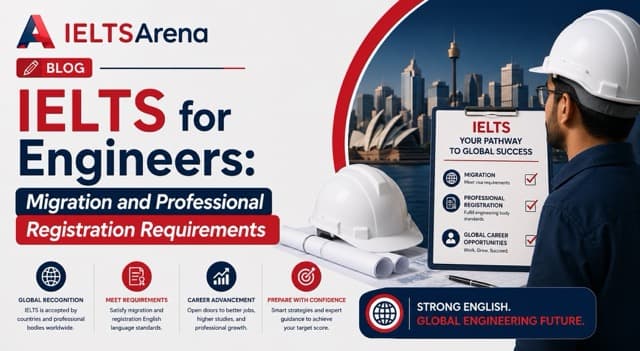
You are a qualified engineer with years of experience, a strong degree, and a job offer or migration plan in sight. Then you discover that the one thing standing between you and your visa is not your technical skill. It is an English test.
For thousands of technical professionals every year, IELTS for engineers migration becomes the unexpected bottleneck. You can design systems, manage projects, and solve complex problems, yet the exam still demands a specific band score in four separate skills.
The frustration is real. Many engineers speak English confidently at work but lose marks on Writing or Speaking because the exam tests skills their daily job never stretches. This guide breaks down exactly what score you need, where, and how to prepare when your time is limited.
Why IELTS Matters So Much for Engineers
Skilled migration programmes in the major destination countries use IELTS as proof of English ability. For engineers, the test appears at two separate stages, and this catches many professionals off guard.
The first stage is professional registration or skills assessment. Bodies like Engineers Australia assess your qualifications before you can apply for a visa, and English proof is often part of that process.
The second stage is the visa application itself. The immigration department sets its own English requirement, which can be different from the registration body's requirement.
This means IELTS for engineers migration is not a single hurdle. You may need to satisfy two different score thresholds, one for your profession and one for your visa.
The stakes are high because your English score often affects your points total in skilled migration systems. A higher band can lift you above the selection cut-off, while a lower band can leave your application stuck.
Understanding the exact requirements for your target country before you book the test saves months of wasted effort and repeat attempts.
Advertisement
Why Common Approaches Fail for Technical Professionals
Engineers often approach IELTS with the wrong assumptions, and it costs them.
The first mistake is assuming fluency equals a high band. Speaking English at work is not the same as meeting the four IELTS criteria: Fluency and Coherence, Lexical Resource, Grammatical Range and Accuracy, and Pronunciation. Confident speakers still lose marks on grammar precision and vocabulary range.
The second mistake is underestimating Writing. Technical professionals write reports and emails, but IELTS Writing tests different skills. Task 2 demands a structured argument essay, and Task 1 in the General test demands a letter in a specific tone. Many engineers score lowest here.
The third mistake is choosing the wrong test type. Some engineers take Academic when they need General Training, or the reverse, and waste an entire attempt.
The fourth mistake is cramming without a plan. Busy professionals study in scattered bursts around work, which rarely builds the consistent skill the exam rewards.
The exam does not measure whether you can do your job in English. It measures four specific language skills, and engineers who train those skills directly are the ones who pass on the first attempt.
A Realistic Student Story
Kwame, a civil engineer from Ghana, planned to migrate to Australia through a skilled visa. His technical assessment was ready, but his first IELTS attempt gave him an overall Band 6.5, with Writing dragging him down to Band 6.0.
"I was confident because I use English every day at work," he said. "I did not expect Writing to be my weakness. My Task 2 essays were full of ideas but badly structured, and my grammar kept slipping."
Kwame needed a stronger overall score to secure competitive points in the skilled migration system. He stopped studying randomly and built a focused plan around his weakest skills.
He practised Task 2 essays under timed conditions, learned a clear four-paragraph structure, and drilled the specific grammar patterns examiners reward. He also practised Speaking Part 3, where discussion questions had exposed his tendency to give short answers.
Ten weeks later he retook the test and scored overall Band 7.5, with Band 7.0 in Writing. "The difference was targeted practice," Kwame said. "Once I trained the exact skills the exam scores, my band jumped."
Data and Insight: What Engineers Actually Need
Requirements vary by country and by pathway, so always confirm the current rules with the official body before booking. The figures below reflect commonly published thresholds for engineering and technical professionals.
For IELTS engineers Australia, skilled migration through Engineers Australia typically requires the Academic or General Training test, and a common English requirement for the skilled visa is Band 6.0 in each of the four skills as a minimum, according to published Department of Home Affairs guidance. Higher bands, such as Band 7.0 or Band 8.0 in each skill, earn additional points that strongly improve selection chances.
For IELTS engineers Canada, Express Entry uses IELTS General Training, and English ability is scored through the Comprehensive Ranking System. There is no fixed engineering-specific band, but higher scores directly raise your points, and competitive candidates often target Band 7.0 or higher in each skill.
For IELTS professional engineers UK, the Skilled Worker visa commonly requires English at CEFR level B1, which usually maps to around Band 4.0 to 5.0, according to published UK visa guidance. Software engineers and IT professionals on this route generally need IELTS unless they qualify for an exemption, such as a degree taught in English.
For engineers targeting the UAE, employers and licensing bodies may request IELTS as proof of English for certain professional and academic roles, with requirements set by the specific employer or authority.
The pattern is clear. Migration systems reward higher bands with more points, so the practical target for most engineers is Band 7.0 in each skill, even when the minimum is lower.
The Right Approach to IELTS for Engineers Migration
Here is a focused plan for busy technical professionals.
- Confirm your exact requirement first. Check the official immigration and professional body websites for your target country. Know whether you need Academic or General Training, and the exact band per skill, before you study anything.
- Choose the correct test type. Most skilled migration routes, including Australia and Canada, accept or require General Training. University-linked pathways usually require Academic. Confirming this early prevents a wasted attempt.
- Diagnose your weakest skill. Take one full timed mock test to find your real starting bands. For most engineers, Writing and Speaking are weaker than Reading and Listening. Target your weakest skill first.
- Master Task 2 structure. Learn a clear four-paragraph essay structure: introduction, two body paragraphs, and conclusion. Structure alone lifts Writing bands quickly for technical professionals who already have strong logic.
- Train Speaking Part 3. Discussion questions reward extended, developed answers. Practise explaining and justifying opinions for longer, since short answers cap your Fluency and Coherence score.
- Build a realistic weekly routine. Consistency beats cramming. Even 45 focused minutes a day, five days a week, outperforms occasional long sessions. This suits professionals with demanding jobs.
- Practise under exam timing. Every skill must be trained against the clock, because time pressure is what separates a practice band from a real exam band.
How IELTSArena Fits the Busy Engineer
Engineers rarely have time to waste. What you need is targeted practice, honest feedback, and a way to track improvement around a full-time job. That is exactly what IELTSArena provides.
IELTSArena replicates the real IELTS CBT interface, so you practise on the same computer-based format used at most test centres, including the highlighter, notepad, and navigation panel. For technical professionals sitting the computer-delivered test, this removes surprises on exam day.
Writing is where most engineers lose marks, and IELTSArena tackles it directly. Its AI writing feedback gives you an instant band estimate and specific corrections on Task 1 and Task 2, so you learn exactly why your essay scored where it did. For extra precision, expert tutors provide band-focused human correction that AI-only tools cannot match.
Speaking is trained the same way. IELTSArena scores your fluency, pronunciation, vocabulary, and grammar, so you can practise Part 3 discussion answers and see measurable improvement.
Because IELTSArena tracks your performance across every mock test, you always know which skill still needs work. This is ideal for engineers who must use limited study time efficiently. More than 10,000 learners have used IELTSArena to reach their target band, and you can start free on IELTSArena.
You can take one full timed test today, see your real bands in every skill, and know exactly how far you are from your migration target.
Self-Diagnosis: Are You Ready for Your Migration Score?
Answer these honestly to see how ready you are for IELTS for engineers migration.
- Do you know the exact band score your target country requires in each of the four skills?
- Are you certain whether you need the Academic or General Training test?
- Can you write a structured Task 2 essay in 40 minutes that would score Band 7.0?
- Can you speak for the full two minutes in Part 2 and develop your answers in Part 3?
- Have you taken a full timed mock test recently to confirm your real starting bands?
If you hesitated on two or more, you have a clear starting point, and targeted practice can close the gap faster than you expect.
Get Migration Ready With a Real Practice Test
Your engineering career should not be held back by an English test. Once you know your target score and train the exact skills the exam rewards, IELTS for engineers migration becomes a manageable step, not a barrier.
Take a Free Engineer-Targeted Mock on IELTSArena →
Frequently Asked Questions
What IELTS score do engineers need to migrate to Australia through Engineers Australia?
For skilled migration to Australia, a common minimum English requirement is Band 6.0 in each of the four skills, based on published Department of Home Affairs guidance, though you should confirm the current rule for your specific visa. Higher bands earn valuable migration points, so many engineers target Band 7.0 or even Band 8.0 in each skill to strengthen their selection chances. Both Academic and General Training are generally accepted for the visa. Because your English score directly affects your points total, aiming above the minimum is usually the smart strategy. Practising full timed tests on IELTSArena helps you confirm your real band in each skill before booking.
Do software engineers need IELTS for a skilled worker visa in the UK?
In most cases, yes. The UK Skilled Worker visa requires English at CEFR level B1, which commonly maps to around Band 4.0 to 5.0 in IELTS, according to published UK visa guidance. Software engineers and other IT professionals usually need to prove English through an approved test unless they qualify for an exemption, such as holding a degree that was taught in English or being a national of a majority English-speaking country. Always check the current exemption list before booking a test. If you do need IELTS, the required level is lower than for many university courses, but you should still prepare properly. IELTSArena lets you practise the exact test format to confirm you meet the level.
Which IELTS test, Academic or General, do engineers take for Canadian immigration?
For Canadian permanent residence through Express Entry, engineers take the IELTS General Training test, not Academic. English ability is scored through the Comprehensive Ranking System, where higher bands earn more points and improve your ranking. There is no fixed engineering-specific band, but competitive candidates often aim for Band 7.0 or higher in each skill to maximise their score. If your pathway involves studying at a Canadian university first, you would usually need the Academic test instead. Confirm your route before booking. IELTSArena supports both Academic and General Training practice, so you can prepare for the exact test your immigration pathway requires.
What band score does an engineer need for an Australian skilled worker visa?
The common baseline for many Australian skilled visas is Band 6.0 in each of the four skills, but this only meets the minimum threshold. Because Australia uses a points-based system, higher English scores add points that often decide whether you receive an invitation. Reaching Band 7.0 in each skill typically adds meaningful points, and Band 8.0 adds more. For this reason, most engineers should treat Band 7.0 as their working target rather than the Band 6.0 minimum. Always confirm the requirement for your specific visa subclass and occupation. A full diagnostic test on IELTSArena shows your current band in each skill so you can plan realistically.
How do I prepare for IELTS as a technical professional with limited time?
Start by confirming your exact required score and test type, then take one full timed mock test to find your weakest skill. For most engineers, Writing and Speaking need the most work, so focus your limited time there first. Learn a clear Task 2 essay structure, practise developing longer Speaking answers, and train every skill under exam timing. Consistency matters more than long sessions, so even 45 focused minutes a day is effective. IELTSArena is built for busy professionals, with a real CBT interface, instant AI writing and speaking feedback, expert tutor corrections, and progress tracking that shows exactly where to spend your limited study time.