You book your IELTS test, you score an overall Band 6.5, and you feel ready. Then you open the application page and see that your course needs Band 7.0 with no section below 6.5. Suddenly that 6.5 means nothing.
This is the trap thousands of test-takers fall into every year. They chase a single overall number and ignore the one rule that decides most applications: the minimum IELTS score is almost never just an overall average.
The minimum IELTS score you actually need depends on three things at once: the country, the specific purpose, and the individual band rule attached to it. Get any one of those wrong and a strong overall score can still get you rejected.
This guide breaks down the minimum IELTS score for immigration, university entry, and professional registration across the UK, Australia, Canada, the USA, and New Zealand in 2026, including the exact per-section rules that catch people out.
What a Minimum IELTS Score Really Means
A minimum IELTS score is the lowest band an organisation will accept for a specific purpose. It comes in two forms, and you must satisfy both.
The first form is the overall band. This is the average of your four skills, rounded to the nearest half band. The second form is the individual band requirement, which sets a floor for each separate skill: Listening, Reading, Writing, and Speaking.
Here is why this matters. A university might ask for an overall 6.5 with no band below 6.0. If you score 7.0, 7.0, 7.0, and 5.5, your overall is 6.5, but your 5.5 in one skill fails the rule. Your application is rejected even though your average looks fine.
IELTS is scored on a scale of 1 to 9 in half band increments. There is no pass or fail mark set by IELTS itself. The minimum IELTS score is set entirely by the country, university, or professional body you are applying to.
That is the single most important idea in this entire guide. When you read any IELTS entry requirement, you are reading two numbers, not one.
Advertisement
Why Most People Misread IELTS Score Requirements
The most common mistake is treating the overall band as the only target. Students train to lift their average and ignore their weakest skill, which is usually the exact skill that fails them.
The second mistake is assuming all requirements within a country are the same. They are not. A UK student visa for degree study needs an overall 5.5 with 5.5 in each band, but a Russell Group university for the same degree often wants 7.0. Same country, very different IELTS entry requirements.
The third mistake is using outdated information. Immigration rules change, and 2026 brought real changes. The UK Skilled Worker visa English level moved up in January 2026, and Canada retired its old fast-track student stream in late 2024. People who prepared using last year's required IELTS score sometimes train for the wrong target.
The fourth mistake is confusing test types. Academic and General Training are different exams. University and professional registration usually need Academic. Migration and some work visas accept General Training. Booking the wrong one means a wasted test fee and a delayed application.
Each of these errors is avoidable. The fix is to verify the exact minimum IELTS score, including the per-band rule, for your specific country and purpose before you start preparing.
Maria's Story: One Band Below the Cutoff
Maria, a 27-year-old nurse from the Philippines, wanted to register and work in Australia. She had studied in English her whole life and felt confident, so she aimed for a comfortable overall 7.0 and started practising.
Her first official test came back at overall 7.0: Listening 7.5, Reading 7.5, Speaking 7.5, and Writing 6.5. She was thrilled until her agent explained the problem.
"I thought 7.0 overall was the magic number," Maria said. "Nobody told me nursing registration needs 7.0 in every single section. My Writing 6.5 made the whole result useless for my licence."
Australian nursing registration through AHPRA requires IELTS Academic with at least 7.0 in each of the four skills, not just overall. Maria's strong sections could not rescue her single weak one.
She spent the next six weeks focused only on Writing. She practised Task 2 essays under timed conditions, learned how examiners score Task Achievement and Coherence and Cohesion, and rewrote essays based on detailed feedback. Her retest came back with Writing 7.0, and her registration moved forward.
Maria's case is the rule, not the exception. Most rejections happen on one band, not the overall.
The Data Behind IELTS Score Requirements in 2026
The numbers explain why the per-band rule matters so much. According to data published by the IELTS partners, the global mean overall band for Academic test-takers sits around Band 6.0 to 6.3, with Writing consistently the lowest of the four skills.
That last point is the quiet reason behind most failed applications. Across every major test region, Writing scores trail the other three skills by roughly half a band on average. When a requirement says "no band below 6.5," Writing is usually the band that falls short.
Speaking and Listening tend to be the strongest skills for most candidates. Reading sits in the middle. So when you read a minimum IELTS score with a per-section floor, assume Writing is the skill that decides whether you pass it.
University requirements have also drifted upward. Industry guides covering 2026 admissions report that most UK universities now ask for an overall 6.0 to 6.5 for undergraduate entry and 6.5 to 7.0 for postgraduate entry, while the 24 Russell Group universities typically demand 7.0 overall with no band below 6.5.
For immigration, the pattern is different. Many work and migration routes accept lower bands than universities, because they test functional English rather than academic English. This is why a skilled worker visa can sometimes accept a band that a master's degree would reject.
The lesson from the data is clear. Your weakest skill, not your average, is the real gatekeeper for almost every minimum IELTS score in 2026.
Minimum IELTS Score by Country and Purpose
Here are the headline requirements for 2026. Always confirm the exact figure on the official page for your specific visa, course, or professional body, because individual programmes can set their own higher bar.
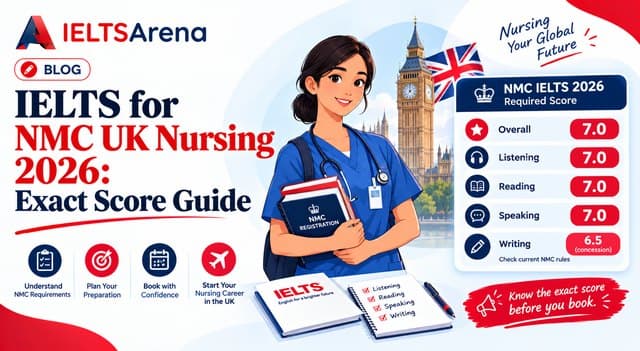
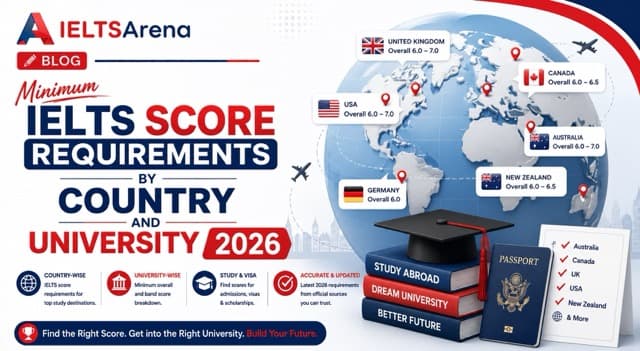
United Kingdom. For a UK student visa at degree level, the minimum IELTS score is overall 5.5 with at least 5.5 in each band, taken as IELTS for UKVI Academic. Universities ask for more: typically 6.0 to 6.5 overall for undergraduate study and 6.5 to 7.0 for postgraduate study. The UK Skilled Worker visa changed in January 2026. The English requirement rose from level B1 to level B2, which maps to IELTS for UKVI at 5.5 in each of the four skills.
Australia. Australia uses named English levels. Competent English is IELTS 6.0 in each band and is the common floor for skilled migration. Proficient English is 7.0 in each band, and Superior English is 8.0 in each band, both of which earn extra points toward permanent residency. For nursing and most healthcare registration through AHPRA, the minimum IELTS score is 7.0 in each band on IELTS Academic.
Canada. The Student Direct Stream was retired in November 2024, so all study permit applicants now use the standard process. The general study permit floor sits around overall 6.0 with no band below 5.5, while individual universities set their own bar, usually 6.0 to 6.5 for undergraduate and 6.5 to 7.0 for postgraduate programmes. For Canadian permanent residence through Express Entry, language is scored on the CLB scale. A common practical target is IELTS 6.0 in each band, which maps to CLB 7 and unlocks most skilled worker pathways, though higher bands earn more ranking points.
United States. US universities do not have a single national rule. Most undergraduate programmes ask for overall 6.0 to 6.5, and graduate programmes commonly want 6.5 to 7.0. Competitive universities and specific departments often set higher bands, so the required IELTS score is decided course by course.
New Zealand. New Zealand universities generally require overall 6.0 for undergraduate entry and 6.5 for postgraduate entry, usually with no band below 6.0. Skilled migration and many professional bodies look for 6.5 overall, with healthcare registration often requiring 7.0 in each band.
The single rule that runs through all of this: read both numbers, the overall and the per-band floor, every time.
How IELTSArena Helps You Hit Your Minimum IELTS Score
Once you know your exact target, the job is simple to describe and hard to do: lift your weakest skill above the floor without letting your stronger skills slip. This is precisely what IELTSArena is built for.
IELTSArena replicates the real IELTS computer-based test interface, including the highlighter, notepad, and navigation panel, so your practice scores reflect real exam conditions rather than relaxed home conditions. That gap is where many people lose half a band on test day.
Because Writing is the skill that fails most applications, IELTSArena gives instant AI Writing feedback with a band estimate and specific corrections on Task 1 and Task 2. You see exactly where you are losing marks on Task Response, Coherence and Cohesion, Lexical Resource, and Grammatical Range and Accuracy.
For the skill that matters most to your minimum IELTS score, IELTSArena also offers expert tutor feedback. A human tutor reviews your Writing and Speaking and tells you, in band terms, what is holding you below the line and how to fix it.
The progress analytics dashboard tracks every mock test, so you can watch your weakest band climb toward your target instead of guessing. Over 10,000 learners have used IELTSArena to reach the band score their visa, university, or licence demands.
You can practise both Academic and General Training on IELTSArena, which removes the risk of preparing for the wrong test type. Start free on IELTSArena.
Self-Diagnosis: Are You Ready to Hit Your Target?
Before you book your test, answer these five questions honestly.
- Do you know the exact minimum IELTS score for your specific country and purpose, including the per-band floor and not just the overall?
- Do you know which skill is currently your weakest, based on a timed mock test rather than a guess?
- Can you complete Writing Task 2 in 40 minutes and score at or above your required band?
- Have you practised on a real computer-based interface, or only on paper and in apps?
- Do you know whether your application needs Academic or General Training?
If you hesitated on even one of these, you have a gap that could cost you a retest fee and months of delay. A single honest mock test will turn every one of those guesses into a number.
Start Your Free Practice Today
You cannot hit a target you have not measured. The fastest way to find out whether you meet your minimum IELTS score is to sit one full, timed, computer-based mock test under real conditions.
In one free test on IELTSArena, you will see your band in every skill, spot the section that is pulling you below the line, and know exactly what to fix first. No credit card, no commitment.
Take a Free Mock Test on IELTSArena →
Your minimum IELTS score is decided by your weakest skill, not your average. Train the floor, not the mean.
Frequently Asked Questions
What is the minimum IELTS score I need for a UK skilled worker visa in 2026?
From January 2026, the UK Skilled Worker visa requires English at level B2, which maps to IELTS for UKVI with at least 5.5 in each of the four skills: Listening, Reading, Writing, and Speaking. You must meet 5.5 in every section, not just overall. This is higher than the previous B1 standard, so applicants who prepared using older guides should retest against the new floor. Always confirm the current requirement on the official UK government page, since rules can change. A timed mock test on IELTSArena will quickly show whether your weakest band clears the 5.5 line in every skill.
What IELTS band score do I need for a Canadian student visa?
There is no single fixed visa band, because the old Student Direct Stream was retired in November 2024 and all applicants now use the standard study permit process. In practice, a general floor sits around overall 6.0 with no band below 5.5, but your real target is set by your chosen university. Most Canadian universities ask for 6.0 to 6.5 for undergraduate programmes and 6.5 to 7.0 for postgraduate programmes. Check your specific course page, then prepare to clear both the overall band and any per-section floor it lists.
Does every university accept IELTS band 6 for postgraduate entry?
No. Band 6.0 overall is below what most postgraduate programmes require. Across the UK, Canada, Australia, and the USA, master's programmes commonly ask for 6.5 to 7.0 overall, often with a per-band floor such as no skill below 6.0 or 6.5. Highly ranked universities and writing-heavy subjects such as law, journalism, and humanities frequently set 7.0 or higher. Band 6.0 may be enough for some foundation or pre-master's pathways, but rarely for direct postgraduate entry. Always read the exact requirement for your programme rather than assuming a general number applies.
What is the minimum IELTS score for nursing registration in Australia?
Nursing and midwifery registration through AHPRA requires IELTS Academic with at least 7.0 in each of the four skills, with no single band below 7.0. A strong overall average will not rescue one weaker section, so Writing and Speaking, which are often the lowest bands, need direct attention. Under current rules you may combine your best section scores from two sittings taken within a short window, subject to AHPRA conditions. Because Writing is the skill that most often falls short, focused practice with band-level feedback, such as the AI and expert tutor feedback on IELTSArena, is usually the fastest route to 7.0 in every band.
Can I apply for Australian PR with an overall IELTS band of 6.0?
Yes, an overall band of 6.0 can meet the Competent English level used in many Australian skilled migration pathways, but only if you score 6.0 in each of the four skills, not just overall. Competent English earns you eligibility without bonus points. To gain extra points toward permanent residence, you would aim for Proficient English at 7.0 in each band or Superior English at 8.0 in each band. Since points often decide who receives an invitation, many applicants target a higher band than the 6.0 minimum to strengthen their overall ranking.