
You look at your Writing feedback and see the same pattern across three test attempts: Coherence and Cohesion at Band 7, Lexical Resource at Band 7, Grammatical Range at Band 7, Task Response at Band 5. Overall Writing band: 6.0. The three language criteria averaged Band 7, but the one Task Response cap dragged everything down. You spent six weeks studying vocabulary and grammar, and none of it moved the criterion that was actually holding you back. This is the Task Response paradox in IELTS Writing, and it explains why most retake attempts produce the same band as the first.
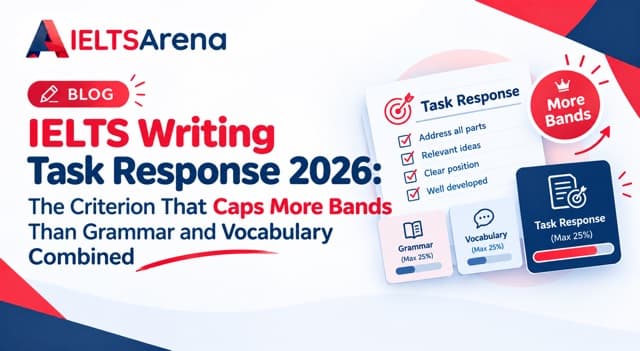
Quick answer: IELTS writing task response is one of the four assessment criteria, weighted at 25 percent of your Task 2 band. On Task 1 the equivalent criterion is called Task Achievement. Task Response checks four specific things: whether you addressed every part of the question, whether you took a clear position (on essays that ask for one), whether your ideas were fully developed rather than listed, and whether your response stayed on topic. Because the four criteria are averaged, a low Task Response score can drag a Band 7 language profile down to Band 5.5 overall. Fixing Task Response typically produces the fastest visible band movement of any Writing improvement.
What Task Response Actually Measures
IELTS writing task response is the criterion that assesses whether you addressed the question the examiner asked, not the question you wished had been asked. It applies to Task 2 in both Academic and General Training. On Task 1 the same underlying idea is measured under a criterion called Task Achievement, which checks whether you covered the visual information accurately and with an overview.
For Task 2, Task Response covers four specific things. First, whether you addressed every part of the question. A double question essay with two questions requires two answers; missing either half caps Task Response. Second, whether you took and defended a clear position on essays that ask for one, particularly opinion and advantages-outweigh essays. Third, whether your ideas were fully developed rather than listed shallowly. Fourth, whether your response stayed on the specific topic asked, without drifting into a related but different question.
Because these four checks are what Task Response measures, the criterion is uniquely sensitive to structural and argumentative mistakes rather than language mistakes. A candidate with weak vocabulary who addressed every part of the question with a defended position and developed ideas can score Band 7 on Task Response. A candidate with strong vocabulary who partially addressed the question or hedged their position gets capped at Band 5 or 6. This is why studying vocabulary rarely moves Task Response.
Advertisement
Task Response vs Task Achievement: The Task 1 Difference
The two criterion names are often used interchangeably in candidate discussion, but they measure different things. Task Achievement, on Task 1, checks whether you correctly identified the visual type, gave an overview of the main features, selected significant data (rather than listing exhaustively), and reported the data accurately. Task Response, on Task 2, checks the four things named above.
The reason the naming matters is that fixing one does not automatically fix the other. A Band 5 Task Achievement problem on Task 1 pie charts (listing every percentage) is a completely different fix from a Band 5 Task Response problem on Task 2 opinion essays (no clear position). If your feedback shows both criteria at Band 5, you have two separate fixes to make, and they should be tackled in separate practice sessions rather than together.
For the rest of this guide, when the same principle applies to both, we call it Task Response for readability. When the fix differs between Task 1 and Task 2, we name each specifically.
The Four Criteria and Why This One Caps Your Band
Your IELTS writing band is the average of your Task 1 and Task 2 scores, with Task 2 weighted twice as heavily. Each task is scored against four equally weighted criteria: Task Response or Task Achievement, Coherence and Cohesion, Lexical Resource, and Grammatical Range and Accuracy. Each criterion is worth 25 percent per task.
Because the four criteria are averaged rather than voted on, the weakest criterion has a bigger effect on the final band than most candidates realise. Here is what different criterion profiles produce as overall Task band scores.
| Task Response | Coherence | Lexical Resource | Grammatical Range | Overall Task band |
|---|---|---|---|---|
| 5 | 7 | 7 | 7 | 6.5 |
| 5 | 8 | 8 | 8 | 7.25 |
| 6 | 7 | 7 | 7 | 6.75 |
| 7 | 7 | 7 | 7 | 7 |
| 4 | 8 | 8 | 8 | 7 |
Notice the pattern: even a Band 8 profile on the three language criteria only lifts a Band 5 Task Response to a Band 7 overall. Fixing Task Response is almost always the fastest route to a higher band, because it is usually the lowest-scoring criterion, not because it is intrinsically more important.
The Band Descriptors from Band 5 to Band 9
Here is what the publicly available Task Response descriptors say, expressed in plain language rather than official jargon.
Band 5 Task Response. The response addresses the task only partially. The format may be inappropriate in places. Some main ideas are unclear, irrelevant, repetitive, or inadequately supported. A position, where required, is unclear or the candidate has not taken one.
Band 6 Task Response. The response addresses the task, although some parts may be more fully covered than others. A position is presented but may become unclear at times. Main ideas are relevant but may be insufficiently developed. Conclusions may be unclear or repetitive.
Band 7 Task Response. The response addresses all parts of the task. A clear position is presented and supported throughout. Main ideas are extended and supported but may occasionally over-generalise or lack focus.
Band 8 Task Response. The response sufficiently addresses all parts of the task. A well-developed position is presented in response to the question, with relevant, extended, and supported ideas.
Band 9 Task Response. The response fully addresses all parts of the task, with a fully developed position, relevant, fully extended, and well-supported ideas.
Two patterns emerge from this progression. First, "addresses the task" moves through partial (5), addressed (6), all parts (7), sufficiently all parts (8), fully all parts (9). Missing any part of the task, even a small part, caps Task Response at Band 6 regardless of everything else. Second, "position" moves through unclear (5), sometimes unclear (6), clear and supported (7), well developed (8), fully developed (9). Hedging or fence-sitting on a Task 2 prompt that asked for a position caps Task Response at Band 5 or 6.
The Four Task Response Mistakes That Cap Your Band
Four specific mistakes account for most Band 5 and Band 6 Task Response scores.
Mistake 1: Misreading the essay type. Task 2 has five essay types (opinion, discussion, advantages-disadvantages, problem-solution, double question), each requiring a different structure. Using the wrong structure signals you misread the task. Task Response drops to Band 5, sometimes Band 4. This is the single fastest way to cap your Writing band. See the dedicated guides for each type: opinion, discussion, advantages-disadvantages, problem-solution, double question.
Mistake 2: Hedging or fence-sitting. On opinion essays and advantages-outweigh essays, the prompt asks for your position. Presenting both sides without committing to one is not neutrality; it is a Band 5 Task Response outcome. The examiner needs to see a defended position from the introduction, developed across both body paragraphs, and restated in the conclusion.
Mistake 3: Shallow development. Listing three ideas in single sentences without developing any of them caps Task Response at Band 6. A Band 7 response develops two ideas fully (topic sentence, reason, example, closing link) instead of listing five ideas shallowly.
Mistake 4: Off-topic examples and drift. Candidates default to a familiar personal or country context regardless of what the prompt asked. Off-topic examples weaken Task Response because they signal the candidate is drawing from memorised material rather than responding to the specific question. Drift into a related but different question in a third body paragraph is the more damaging version.
On Task 1, the Task Achievement equivalents are: no overview paragraph (caps at Band 5), listing every data point instead of grouping (caps at Band 6), missing the second dimension of a table or the connection between two mixed charts (caps at Band 6), and inaccurate data reporting (drops by half a band per major error).
A Real Student's Story: Band 6.0 to Band 7.5 by Fixing Task Response Only
Amina, a paediatric nurse from Nairobi applying for NHS registration in the UK, sat the IELTS four times and scored Writing Band 6.0 each time. Overall band 7.0 because Speaking, Listening, and Reading pulled her up, but the NMC required Writing at 7.0 minimum.
I was paying for a premium grammar course and building a 500-word vocabulary list every week. My Task Response was Band 5 across all four attempts and I never once did anything about it. I was fixing the criteria that were already at Band 7.
Her diagnostic identified two specific problems: she was writing discussion-essay structures for opinion essays two attempts out of four, and she was hedging her position with "on the other hand" statements in every conclusion. She stopped studying vocabulary and grammar entirely for four weeks and drilled two things only: correct essay-type identification (30 seconds per prompt) and defended positions in the introduction (three sentences: topic paraphrase, position statement, roadmap). Her fifth attempt scored Task Response Band 7 for the first time, and overall Writing lifted to Band 7.5. NMC cleared. Total time from Band 6 to Band 7.5: four weeks of targeted practice, after six months of broad study that produced no movement.
The Data Behind This Criterion
Cambridge Assessment English publicly reports that Task Response and Task Achievement account for the largest single share of missed marks on Academic Writing in the Band 5 to Band 6.5 range, more than the three language criteria combined (Cambridge Assessment English, IELTS Test Statistics 2024 to 2025).
British Council examiner reports specifically flag misreading the essay type as the single most common cause of a capped Task 2 band, and the absence of the overview paragraph as the equivalent most common cause on Task 1. IELTS.org confirms the four assessment criteria for 2026 remain Task Response or Task Achievement, Coherence and Cohesion, Lexical Resource, and Grammatical Range and Accuracy, each weighted equally at 25 percent per task (IELTS.org, 2026 assessment framework).
Internal tracking on IELTSArena shows that among candidates scoring Writing Band 5.5 to 6.5, roughly 80 percent have Task Response as their lowest-scoring criterion, and that half a band of Task Response movement produces roughly half a band of overall Writing movement on average. The same tracking shows that half a band of Lexical Resource movement produces only a quarter band of overall Writing movement, because Lexical Resource is rarely the lowest-scoring criterion at Band 5 to 6.5 level. This is direct evidence that Task Response is the criterion to fix first for the majority of candidates.
The Right Approach: A Four-Week Fix Plan
Fixing IELTS writing task response at scale is a four-step process. Do not skip any step.
Step 1: Diagnose with three timed prompts. Write three Task 2 responses under timed conditions, on three different essay types (opinion, discussion, problem-solution, for example). Get each scored against all four criteria separately. If Task Response is the lowest-scoring criterion on two or more of the three, this fix plan is for you.
Step 2: Drill essay-type identification. For the next two weeks, do not write any full essays. Read one Task 2 prompt every day, name the essay type in one sentence, and outline the appropriate structure in bullet form. Do this for 20 prompts across the five essay types. This trains the 30-second question read that prevents the misread-type mistake.
Step 3: Drill defended positions. For the next week, write three-sentence introductions only. Paraphrase the prompt, state your position clearly, and preview the roadmap of your two body paragraphs. Do 15 to 20 of these across different prompts. A defended position in the introduction is what prevents fence-sitting later.
Step 4: Re-test. Write two full Task 2 responses under timed conditions, one opinion and one discussion, and score them against all four criteria. If Task Response moved from Band 5 to Band 6.5 or Band 7, the fix worked. If it did not move, your diagnosis was probably wrong or the drill was not focused enough.
This is the loop that produces Band 6 to Band 7 movement on Task Response in four weeks. It works because it strips out every other variable: no new vocabulary study, no new grammar rules, just structural discipline on the specific criterion that was scoring lowest.
The Same Question Answered at Band 5, Band 6, and Band 8
Here is what different Task Response levels look like on the same prompt. Grammar, vocabulary, and cohesion held roughly constant.
Prompt: "Some people believe that governments should ban private car ownership in city centres to reduce pollution. To what extent do you agree or disagree?"
Band 5 Task Response body paragraph (68 words, hedged position + shallow development): "On the one hand, cars cause pollution and this is bad for the environment. Some people think a ban is good. On the other hand, banning cars is difficult and inconvenient for citizens. Public transport is also not always available. In some cases, a ban may work, but in others it may not. Therefore, the issue is complicated and requires careful thinking by governments."
Task Response Band 5: no clear position, shallow ideas, no development, both sides presented without commitment.
Band 6 Task Response body paragraph (81 words, clear position but shallow support): "I agree that governments should ban private cars in city centres. Firstly, cars cause a lot of pollution which harms people's health. Secondly, cities become congested with traffic which slows down public services. Thirdly, banning cars would push people to use public transport. This would reduce carbon emissions in the long term. Therefore, a ban on private cars in city centres would improve both air quality and traffic flow for citizens."
Task Response Band 6: position taken, main ideas relevant, but every idea listed rather than developed. No specific example, no extension of any reason.
Band 8 Task Response body paragraph (98 words, developed position with specific evidence): "Banning private cars from city centres would remove the largest single source of urban air pollution overnight. In dense zones such as central London, transport-related emissions account for roughly two thirds of nitrogen dioxide, and pilot schemes in Amsterdam and Copenhagen have shown that even partial car bans reduce measured pollution by 20 to 35 percent within twelve months. The measure would also free road space for expanded cycling infrastructure and bus lanes, both of which improve public transport reliability and give former car users a viable alternative rather than a punishment."
Task Response Band 8: position clearly defended, one main idea fully developed with a specific example, extension into a supporting consequence. This is what "fully developed and supported ideas" looks like in the descriptor.
How IELTSArena Helps You Fix Task Response Specifically
IELTSArena's AI writing feedback scores every Task 1 and Task 2 submission against Task Response (or Task Achievement), Coherence and Cohesion, Lexical Resource, and Grammatical Range and Accuracy separately, so you can see immediately whether Task Response is your weakest criterion and by how much. The feedback names the specific Task Response mistake in your response: essay-type mismatch, hedged position, shallow development, or off-topic drift, so you know exactly which of the four fixes to drill next.
Expert tutors on IELTSArena review responses with a specific focus on Task Response for candidates scoring Band 5.5 to Band 6.5, because Task Response is the criterion most likely to be capping the whole Writing band at that level. The platform also provides model responses at Band 5, Band 6, and Band 8 on the same prompts, so you can compare your Task Response level against actual annotated examples rather than descriptions alone. More than 10,000 students have used IELTSArena to move their Writing band up by half a band or more.
Start your free IELTS practice on IELTSArena and diagnose your Task Response band this week.
Self-Diagnosis: Is Task Response Capping Your Band?
Work through these questions honestly against your last full Writing response.
Did you name the Task 2 essay type in one sentence before you started planning, or did you skip that step? Does every part of the question have a dedicated answer in your response, or did you skip one part? On an opinion or advantages-outweigh prompt, does your position appear clearly in the introduction, or does it emerge only in the conclusion, or not at all? Does each body paragraph develop one idea with a reason and a specific example, or does it list multiple ideas in single sentences? Did any of your examples come from a different topic area than the prompt asked about? On Task 1, did you write an overview paragraph as your second paragraph, without specific figures? Did your Task 1 response group data logically, or did you describe items in the order they appeared?
If you hesitated on more than two of these, Task Response is likely your lowest-scoring criterion. Drill the specific fix for four weeks and re-test.
Key Takeaways
- IELTS writing task response is one of the four assessment criteria, weighted at 25 percent of your Task 2 band. On Task 1 it is called Task Achievement.
- Because the four criteria are averaged, a Band 5 Task Response drags a Band 7 language profile down to Band 5.5 or Band 6 overall.
- Roughly 80 percent of candidates scoring Writing Band 5.5 to Band 6.5 have Task Response as their weakest criterion, making it the fastest fix for most candidates.
- The four Task Response mistakes that cap your band are: misreading the essay type, hedging your position, listing ideas without development, and off-topic examples or drift.
- The fix is structural, not linguistic. Four weeks of essay-type identification and defended-position drills typically produce half a band to a full band of movement.
- Stop studying vocabulary and grammar until you have moved Task Response up. Those criteria are almost never what is capping your band at Band 6 to 6.5 level.
Related Guides on IELTSArena
- IELTS Writing Task 2 Tips for Band 7 to 9
- IELTS Writing Task 2 Opinion Essay: Structure and Band 8 Sample
- IELTS Writing Task 2 Discussion Essay
- IELTS Writing Task 2 Advantage Disadvantage Essay
- IELTS Writing Task 2 Problem Solution Essay
- IELTS Writing Task 2 Double Question Essay
- IELTS Coherence and Cohesion
- IELTS Writing Band Score Explained
- IELTS Writing Mistakes to Avoid
See Where Your Task Response Band Stands Today
Try a free mock test at ieltsarena.com and see which criterion is capping your Writing band. In one free timed test, you will know whether Task Response is the specific gap holding your Writing band back, and which of the four Task Response mistakes is doing the damage.
Start your free IELTS practice on IELTSArena
Frequently Asked Questions
What is Task Response in IELTS writing? IELTS writing task response is one of the four assessment criteria for Task 2, weighted at 25 percent of your Task 2 band. It measures four specific things: whether you addressed every part of the question, whether you took a clear position on essays that ask for one, whether your ideas were fully developed rather than listed, and whether your response stayed on the specific topic asked. On Task 1 the equivalent criterion is called Task Achievement, which checks whether you correctly identified the visual, gave an overview, selected significant data, and reported it accurately. Both are structural criteria rather than language criteria, which means fixing them requires structural discipline rather than vocabulary or grammar study.
How do I improve Task Response in IELTS writing? Work through a four-step plan across four weeks. First, diagnose with three timed Task 2 prompts scored against all four criteria to confirm Task Response is your lowest-scoring criterion. Second, drill essay-type identification for two weeks by reading one Task 2 prompt daily and naming the essay type plus outline structure in bullet form. Third, drill defended-position introductions for one week by writing three-sentence introductions on 15 to 20 prompts. Fourth, re-test with two full responses to confirm Task Response moved up. This structural drill produces half a band to a full band of Task Response movement in four weeks, faster than any vocabulary or grammar programme at Band 5 to 6.5 level.
Why is my Task Response scored Band 5 in IELTS writing? Four specific mistakes cap Task Response at Band 5. First, misreading the essay type, for example writing a discussion structure for an opinion prompt or a problem-solution structure for an advantages-disadvantages prompt. Second, hedging or fence-sitting on an opinion or advantages-outweigh prompt by presenting both sides without committing to one. Third, listing multiple ideas in single sentences instead of developing two ideas fully. Fourth, drifting off-topic into a related but different question, most commonly in a third body paragraph. Any one of these caps Task Response at Band 5, and two together typically produce Band 4. All four are structural rather than linguistic, which means they can be fixed without any new vocabulary or grammar study.
What is the difference between Task Response and Task Achievement in IELTS? Task Response applies to Task 2 in both Academic and General Training, and it measures whether you addressed the question, took a clear position, developed your ideas, and stayed on topic. Task Achievement applies to Task 1 and it measures whether you correctly identified the visual, gave an overview, selected significant data, and reported it accurately. The two criteria assess different things and cannot be improved together. A Band 5 Task Achievement problem on Task 1 pie charts requires a different fix from a Band 5 Task Response problem on Task 2 opinion essays. If both criteria appear at Band 5 in your feedback, they are two separate fixes and should be tackled in separate practice sessions rather than combined.
How much does Task Response affect my IELTS writing band? Task Response is weighted at 25 percent of each Task band, but its practical impact is larger than 25 percent because the four criteria are averaged. A Band 5 Task Response combined with Band 7 in the three language criteria produces a Task band of 6.5. A Band 7 Task Response combined with Band 5 in the three language criteria produces a Task band of 5.5. So the weakest criterion has an outsized effect on the final band, and Task Response is the weakest criterion for roughly 80 percent of candidates at Band 5.5 to 6.5 level. This is why fixing Task Response almost always produces the fastest visible band movement for candidates in that range.
Last updated September 2026 by the IELTSArena Editorial Team, a team of IELTS tutors, certified CBT examiners, and Writing feedback specialists who publish weekly research-backed guides on ieltsarena.com.