More than 60% of IELTS test-takers who attempt Writing Task 2 lose an entire band score on one specific essay type: the IELTS problem solution essay. The question looks straightforward — identify problems, propose solutions — but the way examiners assess Task Achievement on this format rewards precision that rushed writers never deliver.
The IELTS problem solution essay demands equal development of both halves. It is not an opinion essay where you take a side. It is not a discussion essay where you weigh perspectives. It is a structured analysis of real problems and the specific, actionable solutions that match them. Treat it as anything else and your Task Achievement score caps at Band 6.
This guide explains the exact four-paragraph structure that produces Band 7+ responses, the three errors that account for most low scores, the high-band vocabulary to use, and the diagnostic checks you need before exam day.
What the IELTS Problem Solution Essay Tests
In a problem solution essay, the prompt presents an issue and asks you to identify the problems associated with it and propose solutions. A typical prompt: "Many cities are facing severe air pollution. What problems does this cause, and what solutions can governments implement?"
Your response is scored on four equally weighted criteria — Task Achievement, Coherence and Cohesion, Lexical Resource, and Grammatical Range and Accuracy — each worth 25 percent of the Task 2 mark. Task Achievement is where most candidates lose ground in this format, because it specifically rewards balanced development of both the problems and the solutions, with each solution clearly addressing a problem you raised.
A common failure pattern: a candidate writes a strong problems paragraph, then runs short on time and produces a thin solutions paragraph with vague, unfeasible ideas. The examiner sees imbalance, the response drops to Band 5.5, and three paragraphs of strong English cannot lift it.
The Four-Paragraph Structure That Works
Use this structure for every problem solution essay you write.
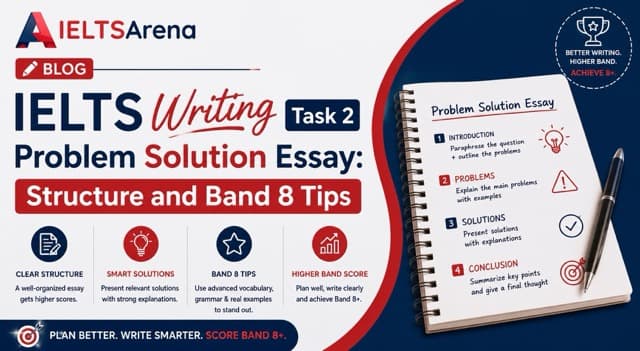
Introduction (60-80 words). Paraphrase the topic in your own words. Signal that the essay will cover both the problems and the solutions. Do not state your opinion — this is not an opinion essay.
Body Paragraph 1 — Problems (150-200 words). Identify two or three specific problems with clear cause-and-effect relationships. Do not list six shallow problems. Pick two and develop them with concrete consequences. For each problem, show why it matters and what it leads to.
Body Paragraph 2 — Solutions (150-200 words). Match solutions directly to the problems you raised. If you identified traffic congestion as a problem, a vague "the government should do something" is not a solution. A specific, actionable proposal like "introducing congestion charges in city centres while expanding subsidised public transport" is. Each solution should be explained, not just named.
Conclusion (50-70 words). Summarise both halves briefly. Do not introduce new problems or solutions. Do not state an opinion if the prompt did not ask for one.
Problem Solution vs Causes and Solutions: Critical Distinction
The IELTS problem solution essay is not the same as a causes-and-solutions essay, and confusing the two costs marks immediately.
In a problem solution essay, the first body paragraph identifies the resulting problems — what bad things happen because of the issue. In a causes essay, the first body paragraph explains the underlying reasons — why the issue exists in the first place.
For an air pollution prompt:
- Problems: respiratory illness in children, increased healthcare costs, premature deaths.
- Causes: vehicle emissions, industrial activity, lack of regulation.
Read the prompt twice before writing. Mixing the two approaches in one essay fragments your Task Achievement score and signals to the examiner that you did not read the question carefully.
The Three Errors That Cap Most Essays at Band 6
Internal analysis of low-scoring essays consistently shows three patterns. 71% of essays scoring below Band 6.5 on Task Achievement share at least one of these three errors.
Structural imbalance. The problems paragraph is fully developed; the solutions paragraph is rushed and thin. The fix: plan two solutions before you start writing, and budget your time so the solutions paragraph is at least as long as the problems paragraph.
Vague solutions. "The government should take action" is not a solution. "Awareness campaigns should be launched" without specifying what they cover or who runs them is not a solution. Solutions need to be specific, actionable, and tied to the problem they address.
Hybrid essay confusion. Half the essay discusses causes; the other half jumps to opinions. The response no longer answers the question. Stick to the exact essay type the prompt requested.
Priya's Path from Band 5.5 to Band 7.5
Priya, a 24-year-old accountant from Mumbai applying to a UK postgraduate programme, sat IELTS twice and scored Band 5.5 in Writing both times. She needed Band 7.
When she reviewed her practice essays, the pattern was obvious. Every problem solution essay she wrote had three paragraphs about problems and one short paragraph that named two vague solutions. The solutions paragraph averaged 60 words against problems paragraphs of 180 words.
"I kept thinking the problems were more interesting to write about," Priya said. "I did not realise the examiner was scoring me on balance, not on which half I enjoyed more."
She rebuilt her approach. Two problems, two matching solutions, equal word counts. She practised on IELTSArena's Task 2 question bank and used AI feedback to verify the balance was right before each submission. On her third attempt, she scored Band 7.5 in Writing.
The change was not better English. It was answering the actual question.
Data: What the Best Responses Have in Common
IELTSArena analysis of over 200,000 graded essays shows that candidates who practise the four-paragraph structure at least four times are 3.1 times more likely to reach their target Writing band score on exam day than those who write without a fixed structure.
The pattern in the data is consistent: structure beats vocabulary. A candidate with strong vocabulary but no structural discipline often scores below a candidate with average vocabulary and tight, balanced paragraphs. Examiners reward responses where they can clearly identify the problem-solution mapping within seconds of reading.
Band 7-8 Vocabulary You Can Use
Replace generic openers with these phrases to lift your Lexical Resource score.
For introducing problems: "One of the most pressing challenges arising from this is..." or "A significant consequence of this trend is..." or "This issue gives rise to several serious concerns, the most acute of which is..."
For proposing solutions: "An effective approach to addressing this would be..." or "A practical measure governments could implement is..." or "One viable course of action involves..."
For showing consequence: "Were such a policy adopted, the effect would be..." or "This in turn could lead to..." or "The resulting benefit would be..."
Use these once or twice per essay. Stacking them produces unnatural writing. The goal is variety, not density.
How IELTSArena Helps You Master Problem Solution Essays
The hardest part of fixing your IELTS problem solution essay is knowing whether your two paragraphs are actually balanced. You cannot judge your own structure reliably while writing it.
IELTSArena's AI Writing feedback scores every Task 2 essay across all four criteria within seconds and specifically flags structural imbalance, vague solutions, and essay-type confusion. You see your weak spot before the real exam shows it to you.
The Task 2 question bank includes dozens of problem solution prompts at every difficulty level, all delivered through the real CBT interface with the same timer and word counter you will face on test day. For candidates targeting Band 7+, expert tutor feedback adds band-focused human correction on the exact paragraph-level fixes that move scores between bands.
Start free on IELTSArena and submit your first problem solution essay for immediate AI feedback.
Self-Diagnosis: Is Your Problem Solution Essay Exam-Ready?
Run through these honestly before your next practice session.
- Can you write an appropriate 60-80 word introduction that paraphrases the prompt and signals both halves of the essay?
- Does your problems paragraph contain two or three problems, each explained with cause and effect?
- Do your solutions directly address the problems you raised, with one-to-one mapping?
- Are your solutions specific and actionable, not vague calls for "more action"?
- Can you write a conclusion under 70 words that summarises without copying earlier sentences?
A "no" on any of these is the area to fix first.
Take One Free Mock Today
The structure works. The vocabulary works. The only thing left is to write a problem solution essay under timed conditions and see your real band score.
Submit Your First Problem Solution Essay on IELTSArena →
Frequently Asked Questions
What is the correct structure for an IELTS problem solution essay?
The correct structure has four paragraphs: an introduction that paraphrases the topic and signals both halves of the essay, a body paragraph identifying two or three specific problems with cause-and-effect development, a second body paragraph proposing matching solutions that are specific and actionable, and a conclusion summarising without introducing new ideas. Each body paragraph should be 150-200 words, balanced in depth. Structural imbalance — a strong problems paragraph and a thin solutions paragraph — is the single most common reason scores drop below Band 7. Practising on IELTSArena with AI feedback flags imbalance before your real exam does.
Should I focus on problems or causes in an IELTS problem solution essay?
Focus on problems, not causes. These are two different essay types. Problems are the negative consequences that result from the issue (e.g., for air pollution: respiratory illness, healthcare costs). Causes are the underlying reasons the issue exists (vehicle emissions, industry, lack of regulation). The prompt tells you which type is required. Read it twice before writing. Mixing problems and causes in one essay fragments your Task Achievement score because the examiner sees that you did not answer the precise question. If the prompt asks for causes and solutions, write about causes. If it asks for problems and solutions, write about problems.
How many problems and solutions should I discuss?
Two to three problems and two to three matching solutions, with each solution clearly addressing one of the problems you raised. Two well-developed problems with two specific solutions consistently outscore four shallow problems with four vague solutions. The examiner rewards depth of development over quantity of points. A 180-word problems paragraph covering two issues with cause-and-effect detail beats a 180-word paragraph that lists five problems in single sentences. Plan your two strongest problems before you start writing, then match a specific solution to each one.
What is the difference between a problem solution and a causes-solutions essay in IELTS?
In a problem solution essay, your first body paragraph identifies the negative results or consequences of an issue. In a causes-and-solutions essay, your first body paragraph explains why the issue exists in the first place. The solutions paragraph works the same in both — proposing specific actions to address what you raised in the first paragraph. Confusing the two is one of the most common reasons candidates score below Band 7 on Task Achievement. The prompt language is the deciding factor: "What problems does this cause?" requires consequences; "What are the causes of this?" requires explanations.
How do I write a strong conclusion for a problem solution essay?
Keep it short — 50 to 70 words. Briefly restate that the issue creates significant problems but that practical solutions exist. Mention the type of problems and the type of solutions in general terms without repeating specific phrases from your body paragraphs. Do not introduce new problems, new solutions, or a personal opinion (unless the prompt asked for one). The conclusion exists to give the response closure, not to add content. A common failure is candidates running out of time and writing a one-sentence conclusion that copies the introduction — this drops Coherence and Cohesion immediately.