
The examiner spends roughly 90 seconds reading your first paragraph. In that time, they form a band impression that shapes how they read the rest of your essay.
A weak opening costs you marks before you have made a single argument. A strong one signals control, clarity, and a clear position from the very first line.
Most test-takers know their introduction matters. Very few know what a high-scoring IELTS Writing Task 2 introduction actually contains, or how to build one in under five minutes under exam pressure.
This guide breaks the opening paragraph into a simple, repeatable formula you can use on any question type.
What the IELTS Writing Task 2 Introduction Actually Needs to Do
Your introduction has one job: show the examiner you understand the question and you have a clear position on it.
That is it. It does not need fancy idioms, a memorised quote, or a dramatic statistic. It needs to be accurate, focused, and direct.
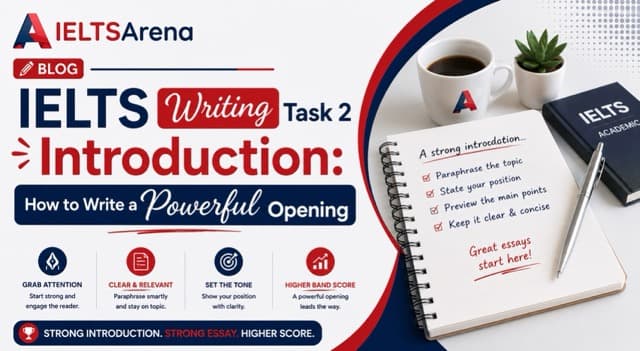
A complete IELTS Writing Task 2 introduction has two essential parts. First, a paraphrase of the question that proves you understood the topic. Second, a thesis statement that states your answer or your position clearly.
Some question types benefit from a third sentence that outlines the two ideas you will develop. This is optional, not required.
Task 2 gives you 40 minutes and asks for a minimum of 250 words. The introduction should take three to four minutes and run between 40 and 60 words. Anything longer eats into the body paragraphs where the real marks live.
Remember that all four scoring criteria carry equal weight: Task Response, Coherence and Cohesion, Lexical Resource, and Grammatical Range and Accuracy. Your introduction touches every one of them in the first 60 words.
Advertisement
Why Common Approaches to the Opening Paragraph Fail
The biggest mistake is the memorised template. Test-takers learn a line like "In today's modern world, there are many controversial issues that people argue about" and paste it onto every essay.
Examiners read this exact sentence hundreds of times. It says nothing about the specific question, so it scores nothing for Task Response and signals a rehearsed answer.
The second mistake is copying the question word for word. If you repeat the task statement directly, the examiner does not count those words toward your 250, and you lose Lexical Resource marks for not paraphrasing.
The third failure is the missing position. Many essays open with background and never state what the writer actually thinks. When the thesis is unclear, the examiner cannot follow your line of argument, and Coherence and Cohesion suffers immediately.
The fourth is overwriting. Some test-takers spend ten minutes crafting an elaborate opening, then run out of time for the body. A long introduction is not a strong introduction.
The fifth is the general knowledge dump. Opening with a random statistic or a sweeping historical claim wastes words and often introduces grammar errors that drag your score down.
A Realistic Student Story
Daniel, a nurse from the Philippines, needed Band 7.0 in Writing for professional registration in Australia. He kept scoring Band 6.0 despite strong vocabulary and detailed body paragraphs.
When he reviewed his essays, the pattern was clear. Every introduction started with the same memorised opener and then copied the question almost word for word.
"I thought a long, formal introduction made me sound advanced," Daniel said. "I did not realise the examiner could see I was not actually answering the specific question."
He rebuilt his opening using a two-sentence structure: one clean paraphrase, one clear thesis. He practised it on twenty different questions until it became automatic.
His next two mock essays scored Band 7.0. The body paragraphs had not changed much. The introduction now set up a clear position the examiner could follow, and the rest of the essay finally made sense as one argument.
Daniel's case shows a common truth. A weak IELTS Writing Task 2 introduction can cap an otherwise capable essay at Band 6.0.
Data and Insight on the Opening Paragraph
The British Council reports that Task Response is one of the most common reasons capable test-takers stall below Band 7.0. A vague or off-topic introduction is the first place Task Response breaks down.
IDP IELTS preparation guidance consistently identifies paraphrasing skill as a Lexical Resource marker that separates Band 6 from Band 7 writers. The introduction is where that skill is first tested.
Across published examiner commentary, essays that state a clear position in the opening paragraph tend to maintain stronger Coherence and Cohesion throughout, because the writer has committed to a direction before paragraph two.
Consider the practical maths. If your introduction is 90 words of repeated question text, only around 160 of your remaining words count as original argument. That is dangerously close to the point where essays get penalised for being underdeveloped.
A focused 50-word introduction leaves you 200-plus words of genuine analysis. That margin alone can move an essay from Band 6.5 to Band 7.0.
The introduction does not win you the essay, but a weak one can quietly lose it before the examiner reaches your best ideas.
The Right Approach: A Three-Sentence Formula
Here is a structure that works for every Task 2 question type, from opinion essays to discussion and problem-solution prompts.
Step 1: Paraphrase the topic in one sentence.
Restate the question using different vocabulary and a slightly different grammatical structure. Change the nouns to synonyms, switch active to passive where natural, and reorder the clauses. Do not copy more than two or three unavoidable keywords.
Step 2: State your thesis in one sentence.
Answer the question directly. For an opinion essay, say whether you agree, disagree, or partly agree. For a discussion essay, state which view you find more convincing. For problem-solution, signal that causes and solutions exist.
Step 3 (optional): Outline your two main ideas in one sentence.
This works well for discussion and advantage-disadvantage essays. Name the two areas your body paragraphs will cover, without explaining them yet.
Here is a worked example. The question reads: "Some people think children should start formal education at a very early age. Others believe they should not start school until they are older. Discuss both views and give your opinion."
A strong opening: "There is ongoing debate about whether young children benefit from beginning structured schooling early or whether a later start serves them better. While early education can build foundational skills, this essay will argue that delaying formal schooling supports healthier long-term development."
That is 45 words. It paraphrases, takes a clear position, and gives the examiner a direction. No memorised filler, no copied phrases.
For an opinion question that asks "to what extent do you agree or disagree," your thesis must take a measurable stance. Avoid sitting on the fence with "there are both advantages and disadvantages." That phrasing signals you have not committed to a position, and Task Response drops.
Practise paraphrasing as a separate drill. Take ten past questions and rewrite each topic sentence three different ways. The faster you can paraphrase accurately, the more time you keep for the body.
How IELTSArena Helps You Master the Opening Paragraph
The hard part of the introduction is not understanding the formula. It is knowing whether your paraphrase is accurate and whether your thesis actually answers the question. You cannot judge that alone.
This is where IELTSArena changes how you practise. When you write a Task 2 essay on IELTSArena, the AI Writing Feedback analyses your introduction against all four criteria and shows you exactly where your paraphrase is weak or your thesis is unclear.
IELTSArena's AI feedback flags when you have copied the question instead of paraphrasing it, which is one of the most common ways an IELTS Writing Task 2 introduction loses Lexical Resource marks.
For test-takers who want examiner-level judgement, IELTSArena also offers expert tutor feedback. A human tutor reads your opening and tells you whether your position is clear enough to score Band 7 or above, something AI-only platforms struggle to assess with full nuance.
Because IELTSArena replicates the real IELTS CBT interface, you practise typing your introduction in the same environment you will face on test day, with the same timer and the same on-screen tools.
IELTSArena's progress analytics then track your Writing scores across every mock test, so you can see whether your introduction work is actually moving your band score upward.
More than 10,000 learners have used IELTSArena to turn weak openings into confident, examiner-ready paragraphs. You can write your first essay and get feedback on your introduction within minutes on IELTSArena.
The combination of real CBT practice, instant AI feedback, and expert tutor correction is what makes IELTSArena different from platforms that only give you a test or only give you a score.
Self-Diagnosis: Is Your Introduction Costing You Marks?
Ask yourself these five questions honestly before your next mock test.
- Can you write a complete IELTS Writing Task 2 introduction in under four minutes without a memorised template?
- When you paraphrase the question, do you change the vocabulary and structure, or do you mostly copy the original words?
- Does your opening paragraph state a clear position that directly answers the specific question asked?
- Is your introduction between 40 and 60 words, or does it run long and eat into your body paragraph time?
- Could the examiner predict the direction of your essay from your introduction alone?
If you hesitated on even two of these, your opening paragraph is likely holding your band score down. The fix is structured practice with real feedback, not more memorised phrases.
Start Practising Your Opening Today
You do not need to guess whether your introduction works. You need to write one, get it scored against the real criteria, and fix the exact weakness.
Take a Free Writing Practice on IELTSArena →
Frequently Asked Questions
How do I write a strong introduction for IELTS Writing Task 2?
A strong IELTS Writing Task 2 introduction uses two essential sentences. First, paraphrase the question topic using your own vocabulary and a slightly different structure to show you understood it. Second, write a thesis statement that directly answers the question and states your position. Keep the whole paragraph between 40 and 60 words and spend no more than four minutes on it. Avoid memorised openers and never copy the question word for word. A clear position in the opening helps your Coherence and Cohesion across the entire essay, because the examiner can follow your argument from the start.
Should I paraphrase the task statement word for word in my IELTS introduction?
No. Copying the task statement word for word is a mistake. The examiner does not count copied words toward your 250-word minimum, and you lose Lexical Resource marks for failing to show paraphrasing ability. Instead, restate the topic using synonyms, a changed grammatical structure, and reordered clauses. Keep only the two or three keywords that cannot be replaced naturally. Effective paraphrasing in the opening is one of the clearest signals that separates a Band 6 writer from a Band 7 writer, so practise rewriting question topics until accurate paraphrasing becomes fast and automatic.
How long should the introduction paragraph be in an IELTS Writing Task 2 essay?
Your introduction should be between 40 and 60 words and take three to four minutes to write. That length is enough for one paraphrase sentence and one thesis sentence, with an optional outline sentence for discussion essays. A longer introduction eats into the body paragraphs where most of your Task Response marks are earned. Since Task 2 requires a minimum of 250 words in 40 minutes, a tight opening leaves you around 200 words for genuine analysis. On IELTSArena you can practise timing your introduction inside the real CBT interface so the length becomes second nature.
Do I need a thesis statement in my IELTS Writing Task 2 introduction?
Yes. A thesis statement is essential. It is the sentence where you directly answer the question and state your position, and it is one of the strongest signals of Task Response. For an opinion essay, say clearly whether you agree, disagree, or partly agree. For a discussion essay, state which view you find more convincing. Without a clear thesis, the examiner cannot follow your line of argument, and your Coherence and Cohesion score drops. Avoid vague phrases like "there are both advantages and disadvantages," because they fail to commit to a measurable position.
What are the most common mistakes in IELTS Writing Task 2 introductions?
The most common mistakes are memorised template openers that ignore the specific question, copying the task statement word for word, failing to state a clear position, writing an overly long introduction that wastes time, and opening with a random statistic or sweeping claim that adds grammar errors. Each of these damages either Task Response, Lexical Resource, or Coherence and Cohesion. The fix is a simple two-sentence structure: one accurate paraphrase and one clear thesis. Practising this with AI feedback on IELTSArena shows you exactly which of these mistakes you are still making.