
You spend 38 minutes building a strong essay, then run out of time and scribble one rushed line at the end. The examiner reads that line last, and it shapes the score they write down.
The IELTS writing task 2 conclusion is the final 40 to 55 words of your essay, yet it carries weight far beyond its length. A weak ending can pull a Band 7 essay down to Band 6.5. A clear, confident one signals control to the examiner right when they finalise your band.
Most test-takers treat the conclusion as an afterthought. That is the mistake this guide fixes. By the end, you will know exactly how to end your essay with a closing paragraph that locks in a Band 8 impression.
Why the Conclusion Decides Your Final Impression
The essay carries 250 words minimum across four to five paragraphs. The conclusion is the shortest part, but it is the last thing the examiner reads before scoring.
Examiners assess Task 2 on four equal criteria: Task Response, Coherence and Cohesion, Lexical Resource, and Grammatical Range and Accuracy. The conclusion touches three of these four directly.
Task Response wants your position restated clearly. Coherence and Cohesion wants a logical close that signals the essay is complete. Lexical Resource wants you to paraphrase your thesis, not copy it word for word.
A missing conclusion is a serious problem. An incomplete essay, one without a proper ending, is capped at Band 6 for Task Response no matter how good the body paragraphs are. That single rule turns many strong essays into average scores.
So the closing paragraph is not decoration. It is the part that confirms you answered the question fully and finished what you started.
Advertisement
Why Common Approaches to the Conclusion Fail
Most students fail their conclusion in one of four predictable ways. Knowing them helps you avoid every one.
The first failure is running out of time. The clock hits 60 minutes, panic sets in, and the conclusion becomes a single half-sentence. Examiners spot a rushed ending instantly.
The second failure is adding new ideas. Some writers introduce a fresh argument or example in the last paragraph. This breaks Coherence and Cohesion because a conclusion should close the discussion, not open a new one.
The third failure is copying the introduction. Students repeat their thesis using the exact same words. This caps Lexical Resource because it shows no ability to paraphrase, one of the clearest Band 7 signals.
The fourth failure is vagueness. Lines like "So this is a very important topic and governments should think about it" say nothing. They restate no position and add no value.
The honest truth is that a generic conclusion you could attach to any essay is worth almost nothing. The examiner needs to see that your ending belongs to this specific essay and this specific question.
A conclusion that could be pasted onto any essay tells the examiner you stopped thinking before you stopped writing.
A Real Student Story: From Band 6.5 to Band 7.5
Daniel, a 29-year-old nurse from the Philippines, needed Band 7 across all four sections for his registration in Australia. His overall was 7.0, but Writing kept landing at 6.5.
His body paragraphs were strong. His introductions were clear. When he reviewed his practice essays with feedback, the pattern was obvious: every conclusion was either rushed or repetitive.
"I was copying my thesis straight from the introduction," Daniel said. "I thought repeating it made my position clear. I did not realise the examiner reads that as weak vocabulary."
He changed two things. He started writing his conclusion in the final five minutes as a fixed habit, never skipping it. And he learned to paraphrase his thesis with different words and a slightly different sentence shape.
Within three weeks of focused practice, his Writing rose to 7.5. The body of his essays barely changed. The conclusion was the lever that moved the score.
Daniel's case is common. Many test-takers are closer to their target band than they think, and the IELTS writing task 2 conclusion is often the cheapest fix available.
What the Data Says About Essay Endings
The global mean for IELTS Academic Writing has sat around Band 5.9 to 6.0 in recent years, according to figures published by the official IELTS test partners. Writing is consistently the lowest-scoring of the four skills.
One reason is structural control, and the conclusion is a measurable part of that. In examiner training material referenced across British Council and IDP preparation resources, an unfinished essay is repeatedly cited as a common reason Task Response is capped.
Consider what a missing or broken conclusion costs in band terms. Task Response is 25 percent of your Writing score. If a weak ending pulls that single criterion from 7 to 6, your overall Writing band can drop by 0.5, because the four criteria are averaged.
Half a band is the difference between meeting and missing many visa and university requirements. Australia skilled migration often needs Band 7. Nursing and medical registration frequently needs Band 7 across all sections.
The pattern in the data is consistent. Test-takers who lose marks on Writing rarely lose them on ideas. They lose them on control, timing, and finishing, and the conclusion sits at the centre of all three.
The Right Approach: How to Write a Band 8 Conclusion
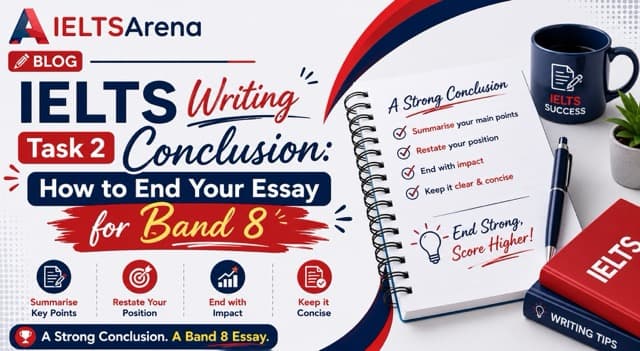
A high-scoring IELTS task 2 closing paragraph follows a tight, repeatable shape. Use these steps every time.
Step 1: Signal the close clearly. Open with a phrase that tells the examiner the essay is ending. Use "In conclusion" or "To conclude." These are accepted, examiner-friendly signposts. Avoid overcomplicated openers that waste words.
Step 2: Paraphrase your thesis, never copy it. Restate the position you took in the introduction, but with different vocabulary and a different sentence structure. If your thesis said "governments should fund public transport," your conclusion might say "state investment in public transport networks is the more effective solution."
Step 3: Summarise your two main points in one sentence. Pull together the core ideas from your body paragraphs without repeating examples or details. This shows the examiner your essay is unified.
Step 4: End with a final stance, not a new idea. Close with a clear restatement of your opinion or a measured forward-looking comment. Do not introduce anything you have not already discussed.
Step 5: Keep it to 40 to 55 words. That is two to three sentences. Long conclusions risk new errors and eat time you do not have. The IELTS task 2 last paragraph should be concise and controlled.
Match the conclusion to the essay type. An opinion essay restates your opinion. A discussion essay restates which view you found stronger. A problem and solution essay restates the key solution. A two-part question essay confirms both answers briefly.
Here is a Band 8 example for an opinion essay on remote work:
"In conclusion, while remote working offers clear flexibility, the loss of collaboration and structure makes a hybrid model the stronger long-term choice for most organisations. Companies that balance home and office time are likely to retain both productivity and team cohesion."
That is 44 words. It signals the close, paraphrases the thesis, summarises the argument, and ends on a clear stance with no new information.
How IELTSArena Helps You Master the Conclusion
You can read every rule about conclusions and still not know whether yours actually hits Band 7. The only way to find out is to write under timed conditions and get your essay marked against the four criteria.
This is where IELTSArena solves the exact problem. You write your full Task 2 essay in the real CBT interface, and IELTSArena's AI writing feedback scores your essay instantly, including how well your conclusion paraphrases the thesis and closes the argument.
The feedback is specific. It flags when your IELTS writing task 2 conclusion repeats the introduction word for word, when it adds new information, or when it is too short to count as a complete ending.
For test-takers who want examiner-level depth, IELTSArena also offers expert tutor feedback. A human tutor reviews your closing paragraph and shows you exactly how to lift it from a Band 6 restatement to a Band 8 close.
You also practise in the real exam environment. IELTSArena replicates the IELTS CBT interface with the on-screen word counter, so you learn to leave five minutes for your conclusion every time. The word counter alone helps thousands of test-takers stop running out of time.
Over 10,000 learners have used IELTSArena to track their Writing progress mock by mock. The progress analytics show whether your Task Response score is climbing, so you know your conclusion work is paying off.
You can write your first essay on IELTSArena, get an instant band estimate, and see exactly where your conclusion stands today. That single data point is worth more than any generic tip.
Self-Diagnosis: Is Your Conclusion Costing You Marks?
Answer these five questions honestly about your last practice essay.
- Can you write a complete conclusion in under five minutes without running out of time?
- Does your IELTS task 2 closing paragraph paraphrase your thesis with different words, or do you copy the introduction?
- Have you ever added a new idea or example in your final paragraph?
- Does your conclusion clearly restate your position, or does it trail off into a vague general statement?
- When was the last time you had your conclusion marked against the real Task Response criterion, not just self-assessed?
If any answer made you pause, your conclusion is likely leaving marks on the table. The good news is that this is one of the fastest parts of the essay to fix.
See Where Your Writing Band Stands Today
You do not need to guess whether your conclusion is Band 6 or Band 8. You can find out in one timed essay.
Write a Free Task 2 Essay on IELTSArena →
Frequently Asked Questions
How do I write a conclusion for IELTS writing task 2?
Write your IELTS writing task 2 conclusion in three steps. Start with a clear signpost such as "In conclusion," then paraphrase the position you stated in your introduction using different words. Next, summarise your two main points in a single sentence without repeating examples. Finish with a clear final stance. Keep the whole paragraph to 40 to 55 words, which is two to three sentences. Never add new ideas, and always leave around five minutes at the end of your 40-minute Task 2 window to write it properly. A complete, well-paraphrased conclusion protects your Task Response score and signals control to the examiner.
Should I add new information in my IELTS writing task 2 conclusion?
No. Adding new information in your conclusion is one of the most common Band 7 mistakes. The conclusion exists to close your discussion, not to open a new one. Introducing a fresh argument, example, or piece of evidence in the final paragraph breaks Coherence and Cohesion, because the examiner expects a unified essay that wraps up the points you already made. If you realise you have an important idea while writing the conclusion, it belongs in a body paragraph, not the ending. Keep your closing paragraph focused on restating your position and summarising what you have already argued.
How long should the conclusion be in an IELTS task 2 essay?
An IELTS task 2 conclusion should be 40 to 55 words, which is usually two to three sentences. This is shorter than a body paragraph by design. The conclusion needs to do three things only: signal the close, paraphrase your thesis, and summarise your main points. A longer conclusion risks new grammar errors and wastes time you need for checking the rest of your essay. With a 250-word minimum for the whole essay, a tight conclusion leaves enough words for two strong body paragraphs. Practising timed essays on IELTSArena helps you build the habit of a concise, complete ending every time.
Does the IELTS conclusion paragraph affect my task achievement score?
Yes, significantly. Task Response, also called Task Achievement, is one of four equally weighted criteria worth 25 percent of your Writing band. An essay without a proper conclusion is treated as incomplete, and an incomplete essay is capped at Band 6 for Task Response regardless of how strong the body paragraphs are. Because the four criteria are averaged, losing half a band on Task Response can pull your overall Writing score down by 0.5. That is often the difference between meeting and missing a university or visa requirement. A clear, complete conclusion is one of the cheapest ways to protect your score.
What is the best way to paraphrase my thesis in an IELTS task 2 conclusion?
The best way to paraphrase your thesis is to change both the vocabulary and the sentence structure, not just one synonym. If your introduction said "the government should invest in renewable energy," your conclusion might say "shifting public funding toward clean energy sources is the wiser long-term policy." Notice the changed nouns, the changed verb, and the reordered sentence. Avoid copying your introduction word for word, because that caps your Lexical Resource score. Strong paraphrasing is a clear Band 7 signal. IELTSArena's AI writing feedback flags when your conclusion repeats your introduction too closely, so you can practise rephrasing until it scores well.