You spent 40 minutes on a Task 2 essay. You used advanced vocabulary, varied your sentence structures, and built a careful introduction-body-conclusion shape. The score came back: Band 6.0.
The natural reaction is to assume your English needs another six months of work. But for most candidates whose first attempt sits at Band 6.0 or 6.5, the issue is not English ability. It is a misunderstanding of how the IELTS writing band score is actually calculated — and which of the four criteria is the single biggest gap between the score you have and the score you want.
This guide explains exactly how examiners reach a Writing band, the three misconceptions that quietly cap most candidates at Band 6, and the systematic approach to lifting your weakest criterion to a 7 or above.
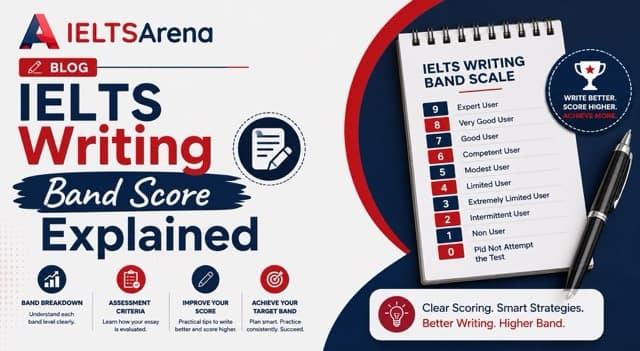
How the IELTS Writing Band Score Is Calculated
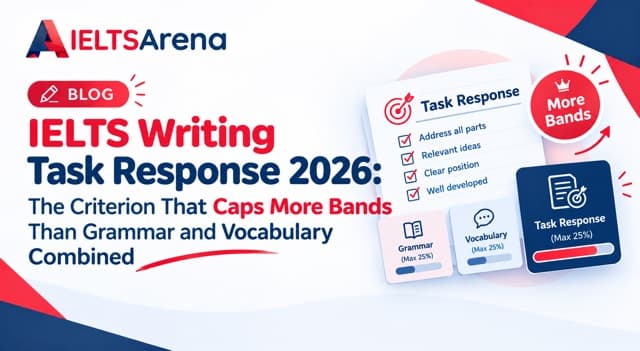
Your Writing band score is not a single number an examiner assigns based on overall impression. It is the average of four independent criterion scores, each worth exactly 25 percent of the total.
The four criteria are:
- Task Achievement (for General Training Task 1) or Task Response (for Academic Task 1 and all Task 2 essays)
- Coherence and Cohesion
- Lexical Resource
- Grammatical Range and Accuracy
Each criterion is scored on the 0 to 9 band scale independently. The four scores are then averaged to produce your final IELTS writing band score.
This averaging matters enormously. A candidate who scores Band 8 in Grammar and Band 5 in Task Response gets a 6.5 average — far below where the strong grammar would have placed them on its own. The whole essay is held back by the weakest criterion.
Understanding this scoring model is the first strategic advantage. The second is knowing which criterion you are weakest in, and why.
Advertisement
Three Misconceptions That Cap Most Candidates at Band 6
The most common reasons candidates plateau at Band 6 are not language gaps. They are strategic gaps in how they prepare.
Misconception 1: Grammar fixes everything. Candidates spend weeks drilling tenses, articles, and complex sentence structures. Grammar matters — but it accounts for only 25 percent of your Writing mark. Task Achievement and Coherence together represent 50 percent. Time spent on grammar exclusively is time stolen from the two criteria that move your band more.
Misconception 2: Bigger vocabulary equals higher Lexical Resource. Candidates memorise lists of "Band 7 words" and force them into essays where they do not fit. Examiners are not rewarding complexity. They are rewarding range, precision, and the ability to paraphrase effectively. Using "ubiquitous" awkwardly in place of "common" loses marks rather than gaining them.
Misconception 3: Formulaic structure guarantees Coherence. Candidates memorise a rigid five-paragraph template with "Firstly," "Secondly," and "In conclusion" at fixed positions. Examiners trained to spot this pattern actively penalise overuse of mechanical cohesive devices. Coherence at Band 7 means logical argument flow, not visible scaffolding.
A Real Candidate Story: Priya From the Philippines
Priya, a 27-year-old engineer applying for a Canadian work permit, sat IELTS Academic twice and scored Band 6.0 in Writing both times.
She had been using a template and a Band 7 vocabulary list. Her grammar was strong. Her essays looked structured. But she did not know why she kept landing at 6.0.
When she submitted her practice essays for criterion-level feedback, the picture cleared instantly. Her Task Response was scoring Band 5. The question for her second attempt had asked specifically whether governments should be responsible for housing migrants. She had written an excellent essay about immigration broadly — its benefits, its challenges, its history — but had not directly addressed government responsibility in either body paragraph.
"I had no idea I was writing the wrong essay," she said. "The grammar was fine, the words were fine, but I was answering a different question than the one on the page."
For her third attempt she practised one thing relentlessly: identifying every instruction in the prompt and writing body paragraphs that addressed the precise question, not the general topic. Her Task Response moved from Band 5 to Band 7. Her overall Writing band rose to 7.0, and her Canadian application moved forward.
What the Data Says About Writing Performance
Global IELTS data and platform analytics from preparation tools consistently reveal a few patterns about the IELTS writing band score.
Approximately 67 percent of candidates score lower in Writing than in any other skill on their first attempt. Writing is reliably the weakest of the four sections for most test-takers worldwide.
The gap between a candidate's strongest and weakest criterion within a single essay often reaches 1.5 to 2.0 bands. A candidate can score Band 7 in Grammar and Band 5 in Task Response on the same essay. This gap is invisible to the candidate without criterion-level feedback.
Task Response on Task 2 carries the highest proportion of Band 5 scores globally. The single most common reason: candidates answer the topic rather than the precise question.
Overusing linking words like "furthermore," "moreover," and "in addition" is penalised, not rewarded. Examiners flag mechanical cohesive devices as a Band 6 indicator. Band 7+ Coherence uses referencing, substitution, and varied connectives, not the same five words on repeat.
A Systematic Strategy to Lift Each Criterion
To move from Band 6 to Band 7+ you do not need to improve every criterion at once. You need to identify which one is dragging your average and fix that one specifically.
For Task Achievement or Task Response:
- Read the question three times before writing anything. Identify the topic, the precise question being asked, and the position you need to take.
- Confirm that every body paragraph directly answers the question — not just the broader topic.
- For Academic Task 1, cover every key feature in the data, not just the most obvious one.
- For General Training Task 1, address all three bullet points fully.
For Coherence and Cohesion:
- Write one central idea per paragraph. State that idea in the opening sentence.
- Use varied cohesive devices: pronouns, synonyms, demonstrative references, not only "firstly, secondly, finally."
- Read your essay aloud after writing it. If the argument flows when spoken, the coherence is working.
For Lexical Resource:
- Paraphrase keywords from the question prompt in your introduction. Use synonyms, not the prompt's exact wording.
- Learn vocabulary in collocations rather than as isolated words. "Make a decision," not "do a decision."
- Use less common vocabulary only where it fits naturally. Forced unusual words reduce your score.
For Grammatical Range and Accuracy:
- Mix simple and complex sentences across your essay. Repeated complex constructions cluttered with errors score lower than clean simple sentences with one or two correct complex sentences.
- Verify every sentence contains both subject and verb.
- Review articles and prepositions — the two error categories that appear most often in candidate essays.
- Proofread from the last paragraph backwards. This breaks the flow of your own argument and helps you see errors you would otherwise skim over.
How IELTSArena Helps You Identify and Fix Your Weakest Criterion
The challenge with Writing improvement is that you cannot reliably diagnose your own weakest criterion. Without external feedback, you address the criterion you assume is weakest, which is rarely the one actually capping your score.
IELTSArena solves this directly. The AI Writing feedback evaluates every Task 1 and Task 2 essay across all four criteria simultaneously. You receive an estimated band score for each criterion individually, not just an overall number.
The feedback identifies sentences that weaken your Task Response, flags overused linking words that are pulling your Coherence down, highlights repetitive vocabulary patterns, and marks recurring grammatical errors so you can see your own consistent patterns rather than treating each essay as a fresh problem.
Examiner-written, annotated model essays at Band 6, 7, and 8 are available for comparison alongside your own work. You see exactly what a Band 7 Task Response looks like versus a Band 6, in the same essay structure on the same prompt.
Candidates using IELTSArena consistently report being able to identify and fix their weakest criterion within two to three weeks of daily practice. Once you know whether your Writing 6.0 is a Task Response problem or a Lexical Resource problem, the path to 7.0 becomes specific and trainable.
Register free and submit your first essay for full criterion feedback today.
Self-Diagnosis: Where Is Your Writing Band Actually Coming From?
Run through these honestly before your next practice essay:
- Can you explain what each criterion measures at Band 6, 7, and 8 specifically — not just generally?
- When you read your last essay, can you identify the clear position taken in each body paragraph?
- How many different cohesive devices did you use, and did any feel forced?
- Did you use any word in your essay you would not confidently use in real conversation?
- When proofreading, do you check for specific known error patterns or scan generally?
If you hesitate on any of these, your preparation has a gap that criterion-level feedback can close in weeks rather than months.
Start Submitting Essays for Criterion-Level Feedback
The IELTS writing band score is decided by four independent criteria averaged together. You cannot improve what you cannot measure, and you cannot measure your own work the way an examiner does.
Get Your First Essay Scored Free on IELTSArena →
Frequently Asked Questions
How do IELTS examiners calculate the writing band score from four criteria?
Each criterion — Task Achievement or Task Response, Coherence and Cohesion, Lexical Resource, and Grammatical Range and Accuracy — is scored independently on the 0 to 9 band scale. The four individual scores are then averaged to produce the final IELTS writing band score. Each criterion carries equal weight at 25 percent. This means a strong score in one criterion cannot fully compensate for a weak score in another, and the weakest criterion has a larger effect on your final band than most candidates realise.
Can I get different scores in different IELTS writing criteria in the same essay?
Yes. This is extremely common. A single essay can receive Band 7 for Grammatical Range and Accuracy and Band 5 for Task Response from the same examiner. The gap between a candidate's strongest and weakest criterion within one essay often reaches 1.5 to 2.0 bands. Without criterion-level feedback, this gap is invisible to candidates, who only see their averaged overall Writing band and assume their English needs general improvement when in fact a single criterion is responsible for the entire gap.
What writing mistakes take me from Band 6 to Band 5 in IELTS?
The most common causes are: not fully addressing all parts of the question (Task Response), overusing the same linking words like "furthermore" and "moreover" (Coherence and Cohesion), limited vocabulary variation with words repeated across paragraphs (Lexical Resource), and systematic grammatical errors that affect the clarity of meaning (Grammatical Range and Accuracy). A single criterion dropping from Band 6 to Band 5 pulls the overall average down by 0.25 bands, which can move your reported Writing band from 6.0 to 5.5.
Why is my IELTS Writing score lower than my other sections?
Writing requires active language production under timed conditions, which is fundamentally different from the receptive Reading and Listening skills. Many candidates have strong passive comprehension but limited timed writing experience. Writing also has four equally weighted criteria, any one of which can pull the overall band down. Reading and Listening are scored against a single raw-score-to-band table, so a candidate with strong comprehension naturally scores well. Writing requires deliberate practice across all four criteria simultaneously.
How do I find out exactly what band score I got in each writing criterion?
Official IELTS results do not include criterion-level breakdowns for most formats. If you believe your reported Writing band is incorrect, you can request an Enquiry on Results (EOR), which provides more detail on the scoring. For practice essays, IELTSArena's AI Writing feedback gives you a full criterion-by-criterion estimate on every submission, so you can identify which of the four criteria is holding your score below your target band — without waiting for the official exam result.