
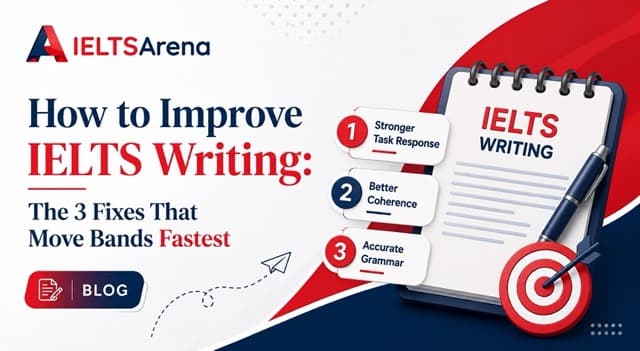
Learning how to improve IELTS writing does not require reading another 20-item list of mistakes or memorising the entire band descriptor. It requires three specific fixes, applied in a specific order, because these three move your band score faster than anything else in the marking system.
The three fixes come directly from where the public band descriptors set the gap between Band 6 and Band 7. If you are currently plateaued at Band 6 or 6.5, one of these three is almost certainly the reason. Fix it in the order below, and you will see movement within four to six weeks.
Fix 1: Address Every Part of the Prompt, Fully
Task Response is where the majority of Band 6.5 candidates lose the half-band that separates them from Band 7. This is not a language issue. It is a planning issue.
The band descriptors are precise. Band 6 "addresses all parts of the task although some parts may be more fully covered than others." Band 7 "addresses all parts of the task" clearly and "presents a clear position throughout the response." The difference is whether every part of the prompt gets developed treatment, not just a passing mention.
Most Band 6.5 essays follow the same pattern: the writer identifies the main question, writes a strong response, then adds a thinner paragraph on the secondary question or counter-view. That thin paragraph is what caps the score.
The fix: before you write a single sentence, note every part of the prompt separately on the notepad. A prompt asking "do the advantages outweigh the disadvantages" has two parts plus a position statement. A prompt asking "what are the causes and what solutions can be suggested" has two parts (causes, solutions). Plan one paragraph per part, and check when you finish that each paragraph is roughly the same length and depth.
Before: "International tourism brings economic benefits to local communities. However, there are also environmental concerns. In conclusion, the advantages generally outweigh the drawbacks."
After: Two full body paragraphs, one on economic benefits with two developed examples, one on environmental costs with two developed examples, followed by a position statement that weighs the two based on the evidence.
This single fix, applied consistently over three to four weeks, moves Task Response from Band 6 to Band 7 for most candidates. It is the highest-leverage change in learning how to improve IELTS writing.
Advertisement
Fix 2: Replace Transitional Adverbs With Referencing
Coherence and Cohesion is the second most common bottleneck. Most Band 6 essays are cohesive in a mechanical way: they use "Moreover," "Furthermore," "In addition," and "However" as their primary connectors. The descriptors call this "faulty or mechanical" cohesion, which is what caps the score at Band 6.
Band 7 essays use cohesive devices "flexibly" with only "some inaccuracies or some over/under use." In practice, this means using referencing (this approach, such measures, the former, the latter) and substitution (doing so, this trend) alongside transitional adverbs, and letting some paragraphs flow without any explicit connector.
The fix: in your next revision, count how many sentences start with "Moreover," "Furthermore," "In addition," or "However." If more than one per paragraph, that is your Coherence and Cohesion gap. Replace at least every third one with a reference back to the previous idea, or delete it entirely and let the paragraph flow on logic alone.
Before: "Firstly, technology has transformed education. Moreover, it has made learning more accessible. Furthermore, it has enabled remote study. However, there are drawbacks."
After: "Technology has transformed education by making learning more accessible and enabling remote study. These changes have democratised access to knowledge, though they have also introduced significant drawbacks."
Same ideas, tighter cohesion. This shift alone typically raises Coherence and Cohesion by half a band within two to three weeks of deliberate practice.
Fix 3: Choose the Precise Word, Not the Fancier One
Lexical Resource is where most candidates practice in the wrong direction. Standard advice says "use less common vocabulary," so candidates memorise "significant" to replace "important" and "utilise" to replace "use." The result is often less precise, not more.
The Band 6 to Band 7 descriptor gap on Lexical Resource is specifically about precision, not size. Band 6 has "an adequate range of vocabulary" and "attempts to use less common vocabulary but with some inaccuracy." Band 7 "uses a sufficient range of vocabulary to allow some flexibility and precision" and "uses less common lexical items with some awareness of style and collocation."
The key phrase is "flexibility and precision." Band 7 examiners reward the writer who picks the exact right word for the exact meaning, even when that word is short and common. "Important" is often better than "significant." "Big problem" is often more precise than "significant challenge." What matters is fit, not fanciness.
The fix: after writing each essay, review every noun and verb. Ask whether each is the most precise choice or a generic filler. Generic filler examples: "things," "issues," "aspects," "factors." Specific replacements: "policies," "regulations," "trade-offs," "outcomes."
Before: "Many things affect the housing crisis. Different factors contribute to the problem."
After: "Population growth, restrictive zoning, and rising construction costs contribute to the housing crisis."
Same intent, dramatically higher Lexical Resource score. This fix is slower than the other two because it requires topic-specific vocabulary building over weeks, but it compounds. Every essay you write in the current topic area gets better once you have built the specific vocabulary bank for it, and it is the piece of learning how to improve IELTS writing that most rewards long-term consistency.
Why These Three, Not the Standard 20-Item Lists on How to Improve IELTS Writing
Every generic guide lists 15 to 30 things to work on: essay structure, vocabulary range, grammar variety, linking words, time management, prompt analysis, paragraph unity. The problem is not that any of these are wrong. The problem is that they treat all improvements as equal, and they are not.
The three fixes above map directly to the criteria that most consistently cap Band 6.5 candidates. Task Response is 25% of your Writing band. Coherence and Cohesion is another 25%. Lexical Resource is another 25%. Fixing all three raises three of the four criteria that make up your score.
The fourth criterion, Grammatical Range and Accuracy, matters too, but it moves slower than the other three and it responds less predictably to short-term work. Fixing your Task Response and Coherence first buys you a half-band or more within a month. Grammar improvements typically take longer to show up.
A Realistic Student Story
Maria, a Buenos Aires-based project manager preparing for a Canadian permanent residency application, had been stuck at Band 6.5 on Writing for four months. She was reading mistake lists, using a checker three times a week, and rewriting essays diligently. Her band score would not move.
She started with Fix 1 only. For two weeks, every essay was mapped against the prompt before she began, with one paragraph per part. Her Task Response rose from 6 to 7 by the end of week two.
She moved to Fix 2. For the following two weeks, she halved her use of "Moreover" and "Furthermore" and added referencing across every essay. Her Coherence and Cohesion rose from 6.5 to 7 by the end of week four.
She started Fix 3 in week five. By the end of week six, her Writing band on the weekly benchmark essay hit 7.0. Two weeks later, on a mock test, it hit 7.5.
Her English had not changed. She stopped trying to fix everything at once and worked on the three fixes that actually mattered, in the order they mattered.
If your Writing has been plateauing despite consistent practice, run one of your recent essays through IELTSArena's free Writing checker and diagnose which of the three fixes applies to you first.
The Order to Follow When Learning How to Improve IELTS Writing
The order matters more than most candidates realise.
Fix 1 (Task Response) first, because it is a planning discipline that shows results within one to two weeks and requires no vocabulary building. Fix 2 (Coherence and Cohesion) second, because it is a habit change that stacks on top of the planning discipline. Fix 3 (Lexical Resource) last, because it takes longer, and you want your first two fixes locked in before you add slower-moving work.
Do not try to apply all three simultaneously. Pick one, drill it for two weeks, move to the next.
Where IELTSArena Fits
IELTSArena's Writing checker gives you a separate band for each of the four criteria, so you can see exactly which of the three fixes above applies to you. Sentence-level feedback quotes the specific text that raised or lowered each criterion score, which is what makes the "before/after" work in real practice sessions. Start from the full practice test hub for the Writing checker alongside CBT Reading, Listening, and Speaking simulations.
For candidates within half a band of their target, optional expert human tutor review is available on essays flagged by the AI as scoring below target, closing the accuracy gap that any AI-only tool leaves open before your actual test.
A Quick Self-Check
Do you know your current band for each of the four Writing criteria separately, or only your overall Writing band? Have you diagnosed which specific criterion is your bottleneck? Are you applying fixes in priority order (Task Response first, then Coherence, then Lexical Resource)? Have you actually rewritten essays after receiving criterion-level feedback, or moved to new essays every time?
If any of these are unclear, that is where the path from Band 6.5 to Band 7 is quietly stalling.
Start With Fix 1 This Week
The single most useful thing you can do in the next seven days is diagnose which of the three fixes applies to you, and start with that one. Take a free Writing check on IELTSArena and see your criterion-by-criterion band estimate before your next practice session.
FAQ
Which IELTS Writing change raises my band the fastest? For most Band 6.5 candidates, addressing every part of the prompt fully (Task Response) raises the band fastest, because it responds to a planning discipline that can be applied immediately. Improvement typically shows within one to two weeks of deliberate practice on prompt-mapping. Coherence and Cohesion improvements come second, and Lexical Resource takes the longest.
Why is my IELTS Writing score not improving? The most common reason is practicing without a criterion-level diagnosis. Writing more essays without knowing which of the four criteria is your bottleneck trains the wrong muscle. If your Task Response is Band 5.5 and your Grammatical Range is Band 7, writing more grammar-focused essays does nothing for your overall band. Diagnose first, then drill the specific criterion that is capping you.
How do I move from Band 6 to Band 7 in Writing? Apply the three fixes in order: Task Response (address every part of the prompt fully), Coherence and Cohesion (replace transitional adverbs with referencing), Lexical Resource (choose the precise word, not the fancier one). Sequential focus over three to six weeks produces faster movement than trying to raise all four criteria simultaneously.
Is grammar or vocabulary more important for IELTS writing? Neither is the fastest lever for most Band 6.5 candidates. Task Response and Coherence and Cohesion, both process improvements rather than language ones, typically move bands faster than pure grammar or vocabulary work. Grammatical Range and Accuracy is 25% of your score but moves more slowly, so prioritize it last unless it is genuinely your weakest criterion.
How long until my IELTS Writing improves? For candidates currently at Band 6.5, focused practice on the correct criterion typically shows a 0.5-band improvement in three to six weeks. For candidates at Band 6, allow six to ten weeks. The variable is not English ability but whether you are diagnosing your weakest criterion and drilling it deliberately, in sequence.