Over 60% of IELTS Writing Task 2 questions involve opinion-based formats, yet many test-takers struggle most with this essay type. Structural weaknesses frequently cause candidates to plateau at Band 5.5 or 6.
The IELTS writing opinion essay — also called agree/disagree or "to what extent" essay — requires taking a clear position supported by logic and evidence. Examiners evaluate Task Response, Coherence and Cohesion, Lexical Resource, and Grammatical Range and Accuracy simultaneously, each weighted at 25% of the Writing score.
This guide explains exactly how examiners assess opinion essays, the structure that consistently produces Band 7+ responses, and a full Band 8 sample with annotated analysis.
Why Common Approaches Fail
A widespread mistake involves discussing both sides before stating an opinion. This "fence-sitting" approach fails Task Response evaluation. Examiners specifically identify when candidates avoid committing to a position, and the resulting Task Response score caps the whole Writing band.
Additional common errors include vague thesis statements ("this is complicated," "there are many perspectives on this issue") and padding to reach the word count requirement. A 280-word essay with a clear position outscores a 350-word essay that wanders between viewpoints.
The IELTS writing opinion essay rewards clarity of position, not balance of perspective.
Advertisement
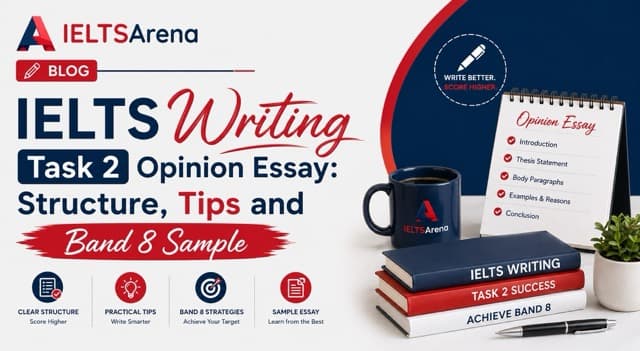
The Right Structure for an Opinion Essay
Introduction (2-3 sentences). Paraphrase the question and state your position directly.
Example: "Many argue that governments should ban private car ownership in city centres to reduce pollution. While this proposal has merit in densely populated areas, I firmly agree that such a ban would be the most effective solution to urban air quality and traffic congestion."
Body Paragraph 1 (5-7 sentences). Topic sentence stating your first supporting reason, developed with explanation, supported by example or evidence.
Body Paragraph 2 (5-7 sentences). A distinct second supporting reason using the same structure. Advanced writers may include a concession sentence acknowledging opposing views before dismissing them.
Conclusion (2-3 sentences). Restate your position in different words and briefly summarise supporting points. Do not introduce new ideas.
Thesis Statement Template
The thesis is the single most important sentence in your IELTS writing opinion essay. Use this reliable template:
"I [completely / strongly / firmly] agree / disagree that [restated topic], because [reason 1] and [reason 2]."
For "to what extent" questions, state the degree of agreement: "I largely agree with this view" or "I disagree with this statement to a significant extent." Nuanced positions are acceptable if defended consistently throughout.
What the Data Says About Writing Performance
According to British Council and IDP IELTS score data, Writing averages 5.9 compared to 6.2 for Reading and 6.8 for Listening globally. Task Response is where candidates most frequently lose marks, with unclear positioning accounting for approximately 40% of Writing Task 2 score drops.
IELTSArena platform data indicates candidates practising five structured opinion essay responses with AI feedback improve Task Response by an average of 0.5 bands within four weeks. The improvement comes from one specific change: writing essays that state a position in the introduction and defend it consistently through both body paragraphs.
A Band 8 Sample Response
Question: Some people believe that unpaid community service should be compulsory for all secondary school students. To what extent do you agree or disagree?
Response:
Mandatory volunteering in secondary schools has become a contentious topic in education policy discussions. I strongly agree that making unpaid community service compulsory for all secondary students would produce significant social and personal benefits that outweigh the drawbacks of removing student choice.
To begin with, structured community service builds the kind of civic responsibility that classroom education alone cannot develop. When students commit time to local charities, hospitals, or environmental projects, they encounter social realities outside their own experience. This exposure reduces self-centredness and builds empathy in a measurable way. Research from the Corporation for National and Community Service in the United States found that students with mandatory service learning demonstrated 12% higher civic engagement scores compared to peers without such requirements.
Furthermore, the skills developed through community service are directly valued by universities and employers. Communication under pressure, teamwork with strangers, and problem-solving in uncontrolled environments are precisely the competencies that differentiate candidates in competitive application processes. Schools that require service programmes consistently report higher university acceptance rates, suggesting that the obligation creates real long-term advantage.
In conclusion, compelling secondary students to complete community service is an investment in both individual development and social cohesion. The evidence from educational research and graduate outcomes supports the view that this requirement produces gains that students would be unlikely to seek voluntarily.
Examiner Analysis
The thesis appears in the introduction ("I strongly agree...") and remains consistent across both body paragraphs. Each body paragraph directly supports the stated position with a topic sentence, development, and concrete evidence. The conclusion paraphrases the thesis without repetition and does not introduce new ideas.
Vocabulary range is precise rather than performative: "contentious," "civic responsibility," "self-centredness," "differentiate," "social cohesion" are used naturally where they fit, not forced for show. Sentence structure varies between simple, complex, and conditional forms with consistent grammatical control.
This is the kind of clear, focused IELTS writing opinion essay that consistently earns Band 8.
Self-Diagnosis: Is Your Opinion Essay on Track?
Before your next practice essay, ask yourself:
- Does the introduction state your position explicitly, or does it use vague language?
- Do both body paragraphs directly support the stated position?
- Is the thesis restated in the conclusion using different words?
- Are three or more different linking phrases used across the essay?
- After rereading, could an examiner summarise your position in one sentence?
If you hesitate on any of these, your Task Response score is at risk regardless of how strong your vocabulary or grammar is.
How IELTSArena Helps You Master the Opinion Essay
IELTSArena's AI Writing feedback analyses Task 2 responses across all four examiner criteria, identifying exactly where Task Response breaks down — whether thesis clarity falters, whether body paragraphs diverge from topic, or whether conclusions introduce new ideas.
The platform provides model answer comparisons for opinion essays at Band 7, 8, and 9 levels. Candidates can read Band 8 samples on the same questions and compare thesis and paragraph structure to their own work, seeing the specific vocabulary and grammatical patterns that distinguish high-scoring responses.
The Task 2 question library includes separate practice sets for agree/disagree, to what extent, two-part questions, problem-solution, and discussion essays. For IELTS writing opinion essay preparation specifically, the agree/disagree and to what extent sections provide dozens of timed practice opportunities with instant scoring.
Expert human tutor feedback is available for candidates who want personalised written comments from qualified examiners alongside AI scoring.
Submit Your First Opinion Essay on IELTSArena →
Frequently Asked Questions
Should I give both sides in an opinion essay?
For pure agree/disagree essays, give only your view defended with two clear supporting points. Presenting both sides equally without favouring one results in low Task Response. You may briefly acknowledge the opposing view in one concession sentence, but the thesis and both body paragraphs must support your position throughout. Examiners assess whether you take and defend a clear position, not whether you discuss multiple viewpoints fairly.
What is the correct structure for an agree/disagree essay?
The standard Band 7+ structure has four paragraphs: an introduction with a clear thesis, body paragraph 1 with the first supporting reason, body paragraph 2 with the second supporting reason, and a conclusion restating the position. This structure keeps responses focused with every paragraph supporting the stated view. Five-paragraph or three-paragraph variations rarely outperform the clean four-paragraph form under timed exam conditions.
How do I write a thesis statement?
Your thesis is the final introduction sentence stating your position directly: "I strongly agree that..." or "I disagree with this view because..." Follow with a brief preview of two supporting reasons. The thesis must remain consistent; contradicting body paragraphs significantly harm Task Response. A clear thesis sentence is often the single most score-relevant change a Band 6 writer can make to reach Band 7.
How many body paragraphs should an opinion essay have?
Write exactly two body paragraphs. Each should cover one distinct supporting reason with a topic sentence, explanation, and example. Two well-developed paragraphs score higher than three underdeveloped ones. Examiners value depth of reasoning over quantity of points. A 130-word body paragraph with a clear claim, explanation, and example outscores three 80-word paragraphs that touch on different angles without development.
Can I get Band 8 with an opinion essay?
Yes. Band 8 distinguishes through a precise thesis, fully developed body paragraphs with real evidence, sophisticated grammatical structures with minimal errors, and wide vocabulary used accurately rather than performatively. IELTSArena provides Band 8 samples with examiner annotations so you can see the specific features that move a strong Band 7 essay into Band 8 territory.