Your employer has sponsored you for a UK Skilled Worker visa. Your English is solid — you have worked professionally in English for years. But your IELTS certificate shows B1, and you applied after January 8, 2026. The UK Home Office refused your application.
This is happening to real candidates right now. The UK skilled worker visa IELTS requirement 2026 changed on January 8, when the B1 English standard was replaced by B2 across the Skilled Worker, Scale-up, and High Potential Individual (HPI) visa routes. The shift was announced in the May 2025 UK Immigration White Paper and took effect as scheduled.
If you have a job offer, a sponsoring employer, and an old B1 English certificate, this guide tells you exactly what you need now, which test to take, and how to get there.
What Changed on January 8, 2026
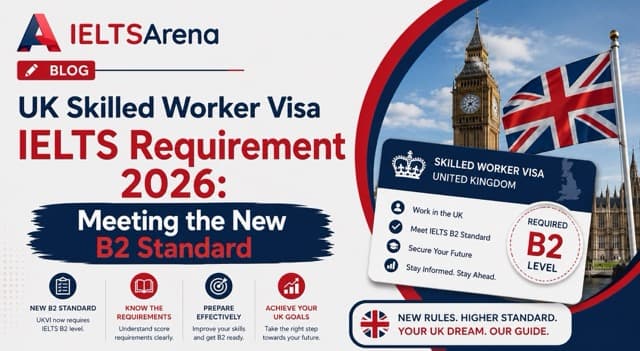
The UK skilled worker visa IELTS requirement 2026 is B2 on the Common European Framework of Reference for Languages (CEFR). For IELTS for UKVI, B2 means a minimum score of 5.5 in each of the four skills individually: Listening, Reading, Writing, and Speaking.
The previous standard was B1, which mapped to roughly 4.0-4.5 per skill on IELTS for UKVI. The gap is not small. A candidate who scored 5.0 in Writing under the B1 era now falls short by half a band, and the application fails.
Three visa routes are affected by the new standard:
- Skilled Worker visa
- Scale-up visa
- High Potential Individual (HPI) visa
One important exception applies: if you were granted a Skilled Worker visa before January 8, 2026, and you are extending on the same route, you remain under the B1 standard for that renewal. The B2 requirement applies to all new applications filed from January 8, 2026, onward.
Advertisement
Why Many Candidates Fail the New Standard
Most candidates who fail the UK skilled worker visa IELTS requirement 2026 make one of three specific mistakes.
Mistake 1: Using IELTS Academic instead of IELTS for UKVI. IELTS Academic is accepted for university admissions in the UK but is not accepted for UK visa applications. The Home Office requires a Secure English Language Test (SELT), and only IELTS for UKVI qualifies among IELTS test types. An Academic certificate — regardless of band score — will result in a refused application.
Mistake 2: Scoring 5.5 overall but below 5.5 in one skill. The requirement is 5.5 in each band separately, not 5.5 on average. A candidate who scores Listening 6.5, Reading 6.0, Speaking 5.5, and Writing 5.0 has a 5.75 average but does not meet the standard. Writing at 5.0 fails the threshold.
Mistake 3: Using an expired certificate. IELTS for UKVI results are valid for two years. A certificate older than two years at the time of application will not be accepted regardless of the score.
For most non-native English speakers, Writing is where the B1-to-B2 gap is widest. Getting from Band 5.0 to 5.5 in Writing is about structured essay organisation, vocabulary range, and consistent grammatical accuracy.
Emmanuel's Story: From B1 to B2 in Eight Weeks
Emmanuel, 32, is a software developer from Lagos, Nigeria. He received a Skilled Worker visa sponsorship letter from a technology firm in Leeds in February 2026. When he checked the new UK skilled worker visa IELTS requirement 2026, he found that his existing IELTS Academic certificate from 2024 was the wrong test type and did not count.
He booked IELTS for UKVI and scored 5.5 in Listening, 6.0 in Reading, and 5.5 in Speaking — but only 4.5 in Writing. The B2 threshold requires 5.5 in Writing. His application could not proceed.
"I was writing in a rush and not using paragraphs the way the examiners expect," he said. "I thought fluency was enough. It was not."
Emmanuel spent eight weeks working specifically on Task 2 essays every day. He used AI writing feedback to identify exactly where he was losing marks on Task Achievement and Coherence and Cohesion. On his second attempt, Writing reached 5.5. His visa was approved three weeks later.
The feedback showed me exactly which paragraph transitions were failing. That was the specific problem. Without seeing that, I would have kept writing the same way and failed a third time.
How Many Workers Are Affected
According to the UK Home Office, the Skilled Worker visa is the UK's largest work visa route. Nigeria, the Philippines, Pakistan, Zimbabwe, and India are consistently in the top source countries for Skilled Worker applications. For all of these markets, a significant proportion of applicants use IELTS for UKVI as their chosen SELT.
IELTS.org notes that IELTS for UKVI is among the most common English tests used specifically for UK immigration. Immigration specialists at Jobbatical (January 2026) noted that with the B1-to-B2 change, employers sponsoring candidates from non-English-speaking countries now need to build 3 to 6 months of additional lead time for English preparation before visa applications are filed.
A candidate who was at B1 level before the change typically needs 3 to 6 months of focused preparation to reach B2, depending on starting point and study consistency.
What B2 Means in Each Skill for IELTS for UKVI
B2 is not just a CEFR label — it has a specific IELTS for UKVI score target in each section. Understanding these numbers is the first step in planning your preparation.
Listening (minimum 5.5). B2 Listening means understanding the main ideas and details of complex speech, including talks, workplace conversations, and announcements. In IELTS for UKVI Listening, you hear four recordings. Section 4 — a monologue on a more formal topic — is typically the hardest. Scoring 5.5 corresponds to approximately 23 correct answers out of 40.
Reading (minimum 5.5). IELTS for UKVI uses the General Training Reading format: notices, workplace documents, and extended prose passages. Approximately 23-26 correct answers out of 40 corresponds to a 5.5. True/False/Not Given questions are the most common drop-off point for candidates moving from 5.0 to 5.5.
Writing (minimum 5.5). Writing is the most common barrier for candidates targeting B2. General Training Writing Task 1 is a letter (formal, semi-formal, or informal depending on the prompt). Task 2 is a discursive essay. The four criteria — Task Achievement, Coherence and Cohesion, Lexical Resource, and Grammatical Range and Accuracy — are each weighted equally at 25 percent. B2 Writing requires clear paragraph organisation, varied vocabulary, and mostly accurate grammar with only minor errors.
Speaking (minimum 5.5). Speaking at 5.5 means maintaining a conversation with some hesitation, using a range of vocabulary with minor errors that do not impede understanding. The examiner interview is face-to-face and runs 11 to 14 minutes across three parts: an introduction and interview, a cue card monologue, and a two-way discussion.
How to Prepare for IELTS for UKVI: A Four-Section Strategy
The UK skilled worker visa IELTS requirement 2026 is a workplace English standard, not an academic hurdle. Your preparation should reflect that.
Listening: Practice with recordings at B2 level — professional podcasts, BBC radio programmes, and workplace scenario simulations. Take full timed listening tests to build stamina and note-taking speed. Focus practice on Section 4 monologues, which is where most candidates at 5.0 drop marks.
Reading: Practice under timed conditions. General Training Reading contains multiple text types with different question formats. Allocate roughly 20 minutes per passage and build scanning and skimming skills for heading-matching and True/False/Not Given questions specifically.
Writing (highest priority for the B1-to-B2 jump): Write one Task 1 letter and one Task 2 essay every two days. Focus specifically on paragraph structure, linking cohesion, and vocabulary precision. Get external feedback on every essay you write — not self-review, but marking against the four assessment criteria. The difference between Band 5.0 and Band 5.5 in Writing is most commonly found in Coherence and Cohesion: candidates at 5.0 have the ideas but connect paragraphs loosely. At 5.5, each body paragraph has a clear topic sentence, developed support, and a controlled move to the next point.
Speaking: Record yourself answering Part 2 cue card questions. Review the recordings for hesitation patterns, vocabulary gaps, and repetition. Extend every answer with a reason and an example — Part 3 answers at 5.5 need at least two minutes of developed response.
How IELTSArena Bridges the B1-to-B2 Gap
Preparing for IELTS for UKVI on your own is possible. Knowing exactly where you are losing marks is much harder without structured feedback.
IELTSArena's computer-based test interface replicates the exact IELTS CBT environment — the same highlighter, notepad, and navigation panel you will encounter on test day. If you are practicing on printed materials and your real test is on screen, you are not building the right skills. The UK skilled worker visa IELTS requirement 2026 is tested on computer, so your practice environment should match.
For Writing, IELTSArena's AI feedback gives you an instant band score estimate and specific notes on each of the four criteria — Task Achievement, Coherence and Cohesion, Lexical Resource, and Grammatical Range and Accuracy — immediately after every essay you submit. This is the mechanism Emmanuel used to identify the exact paragraph structure issue capping his Writing at 4.5.
For candidates who want a second layer, IELTSArena's Expert Tutor service provides human examiner-style corrections on your Writing and Speaking submissions. AI feedback is fast. Expert tutor feedback shows you the nuanced decisions an examiner makes — why a response scores 5.0 and not 5.5, and specifically what one targeted change would improve.
IELTSArena's Progress Analytics tracks your performance across every mock test, so you can see your skill-by-skill trend over time. If your Listening is already at 6.0 and your Writing is at 4.5, you know exactly where to focus your next four weeks.
Over 10,000 students have used IELTSArena to reach their target band score. Start your free practice today and take one full timed mock test. Within that single session, you will know which skill is blocking your B2 and how far you are from 5.5 in each band.
Self-Diagnosis: Are You Ready for IELTS for UKVI B2?
Before booking your test date, work through these questions honestly:
- Can you write a 250-word Task 2 essay in 40 minutes that has a clear introduction, two developed body paragraphs, and a conclusion — without stopping to think about paragraph structure mid-way?
- When you write a General Training Task 1 letter, do you adjust your tone and vocabulary between formal, semi-formal, and informal registers depending on the instruction?
- Can you answer a Part 2 Speaking cue card for two full minutes without running out of content or repeating the same words more than twice?
- In a timed IELTS for UKVI Listening test, can you maintain concentration through all four sections — including the longer Section 4 monologue at the end?
- When you sit a full timed General Training Reading test, do you finish all 40 questions with enough time to review your answers?
If the answer to any of these is "not yet," you have a clear preparation priority before booking IELTS for UKVI.
Start Your Free IELTS for UKVI Preparation on IELTSArena
The B2 bar is clear. The IELTS for UKVI test format is specific. And the gap between your current level and the 5.5-per-skill threshold is something you can measure and close with targeted practice.
Take a Free IELTS for UKVI Mock on IELTSArena →
Frequently Asked Questions
What IELTS score do I need for a UK Skilled Worker visa in 2026?
Since January 8, 2026, UK Skilled Worker visa applicants must demonstrate B2 English on the CEFR scale. For IELTS for UKVI, this means a minimum of 5.5 in each of the four skills: Listening, Reading, Writing, and Speaking. The 5.5 minimum applies to each skill individually — scoring 5.5 overall while falling below 5.5 in any one skill will result in a refused application. This B2 standard also applies to the Scale-up and High Potential Individual (HPI) visa routes. It does not affect extensions filed under the previous B1 standard before January 8, 2026, on the same visa route. (Source: UK Home Office, January 2026; ielts.org)
Is my old B1 IELTS certificate still valid for the UK Skilled Worker visa after January 2026?
A B1 IELTS for UKVI certificate is no longer sufficient for a new UK Skilled Worker visa application made on or after January 8, 2026. The English standard has been raised to B2. However, if you already held a Skilled Worker visa before that date and you are renewing on the same route, you continue to meet the requirement under the original B1 standard for that renewal. For any new application filed from January 8, 2026, you need a valid IELTS for UKVI certificate showing 5.5 in every skill, and the test must have been taken within the past two years. (Source: UK Home Office; Davidson Morris, January 2026)
What is the difference between IELTS Academic and IELTS for UKVI for a UK work visa?
IELTS Academic and IELTS for UKVI are different products from the same test providers. IELTS Academic is designed for university admissions and is not accepted for UK visa applications. IELTS for UKVI is a Secure English Language Test (SELT) approved by the UK Home Office for immigration purposes. It has the same four-skill structure as IELTS Academic but is taken at UKVI-approved centres with stricter identity verification. If you are applying for a UK Skilled Worker, Scale-up, or HPI visa, you must take IELTS for UKVI specifically. Submitting an IELTS Academic certificate will result in a refused application regardless of the band score.
How long does it take to improve from B1 to B2 English for a UK Skilled Worker visa?
Most candidates who are comfortable at B1 need 3 to 6 months of focused preparation to reach B2, according to immigration specialists at Jobbatical (2026). The timeline depends on your starting band score, how consistently you practice, and which skill is your weakest. Writing and Speaking typically take the longest to improve because they require structured feedback and deliberate practice — not just exposure to English. Candidates who use AI-powered Writing feedback tools and work with expert tutors can reduce this timeline by identifying and fixing specific errors faster than self-study allows. Building in 4 to 6 weeks for test booking before your visa application deadline is also recommended.
Which English tests are accepted for the UK Skilled Worker visa in 2026?
The UK Home Office accepts several Secure English Language Tests (SELTs) for Skilled Worker visa applications: IELTS for UKVI (offered by British Council and IDP), PTE Academic UKVI, LanguageCert International ESOL SELT, and Trinity College London SELT. All tests must be taken at UKVI-approved testing centres and must be less than two years old at the time of your visa application. IELTS Academic, standard PTE Academic, and TOEFL are not accepted for this visa route. Always confirm your chosen test is on the current Home Office SELT list before booking. (Source: gov.uk/skilled-worker-visa; ielts.org, 2026)