You found a master's place in Dublin, the fees look manageable, and Ireland speaks English, so the test feels like a formality. Then the offer letter lands with one line that stops you: overall 6.5, no band below 6.0. Suddenly the IELTS score for Ireland is the only thing between you and an autumn intake.
This is where most applicants lose weeks. They assume one number works everywhere, send a 6.0 with a 5.5 in Writing, and watch the application stall.
The truth is that the IELTS requirement for Ireland is not a single figure. It changes with your route: a student visa, a Critical Skills work permit, a specific university, or professional registration. This guide gives you the exact band for each, with 2026 rule changes, so you stop guessing and start preparing.
What IELTS Score Do You Actually Need for Ireland in 2026
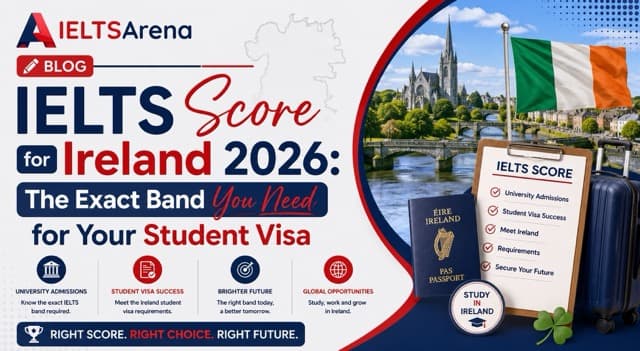
The minimum IELTS band for Ireland on the student route is usually 6.0 to 6.5 overall, with no individual band below 5.5 to 6.0 for a degree programme. That single sentence covers most applicants, but the detail matters.
For the Stamp 2 student permission that lets you study full time, Irish universities and the immigration service expect a credible academic English level. Most degree courses set 6.0 to 6.5 overall as the floor, and many cap the minimum per section at 5.5 or 6.0.
The exact band you submit is set by the university, not by a single national rule. Ireland has no government-mandated IELTS number for general work visas, so your offer letter and the professional body are the documents that decide your target.
That is why two students with the same 6.5 overall can get different outcomes. One has 6.5 across the board and clears every condition. The other has a 5.5 in Writing and fails a "no band below 6.0" rule.
Advertisement
IELTS Score for Ireland by Route: Study, Work, and Registration
Treat your IELTS for Ireland as a route-specific target. Here is how the main paths break down in 2026.
Student visa (Stamp 2). Most undergraduate and taught master's courses ask for 6.0 to 6.5 overall, with a per-section minimum of 5.5 or 6.0. Research and competitive programmes can ask for 7.0.
Top universities. Trinity College Dublin and University College Dublin commonly list 6.5 overall with 6.0 in each section for many courses, and some schools, such as law, journalism, or medicine, push the requirement to 7.0 overall.
Critical Skills Employment Permit. Ireland does not attach a fixed national IELTS number to the permit itself, but many employers and professional bodies expect roughly 6.5 overall with no band below 6.0 for skilled roles. From 1 March 2026, the salary thresholds rose to 40,904 euro for occupations on the Critical Skills list and 68,911 euro for others, per Ireland's Department of Enterprise, Trade and Employment (enterprise.gov.ie, 2026), which makes a strong English profile more important for competitive hiring.
Nursing and healthcare registration. The Nursing and Midwifery Board of Ireland (NMBI) typically expects around 7.0 overall with 7.0 in Listening, Reading, and Speaking and at least 6.5 in Writing, or an accepted OET result. Healthcare is the route where the band jumps the most.
So when someone asks what IELTS score do I need for Ireland student visa 2026, the honest answer is: usually 6.0 to 6.5 overall for study, higher for healthcare, and whatever your specific offer letter states.
Why Common Approaches to the IELTS Score for Ireland Fail
The first mistake is treating Ireland like an easy English market. Because the country is English-speaking, applicants relax, skip structured practice, and underestimate the per-section minimum.
The second mistake is the overall-band trap. You can score a comfortable 6.5 overall and still be rejected because one skill, almost always Writing, sits below the line the university set.
The third mistake is leaving the test until the deadline. Ireland's popular intakes fill fast, and a retake takes time you may not have. A weak Writing band found two weeks before the visa deadline becomes a missed intake.
The fourth mistake is preparing on paper for a test that is now computer-delivered for many candidates. If you practise with a pen and then sit a computer-based test, the interface itself costs you marks under time pressure.
Real Student Story: Daniel from Nigeria, Targeting an MSc in Dublin
Daniel, a 26-year-old engineering graduate from Lagos, Nigeria, secured a conditional offer for an MSc at a Dublin university. The condition read 6.5 overall, no band below 6.0.
His first attempt looked fine on the surface: 7.0 Listening, 6.5 Reading, 7.0 Speaking. Then he saw Writing: 5.5. The overall averaged to 6.5, but the 5.5 in Writing broke the per-section rule, and the offer stayed conditional.
Daniel had prepared by reading sample essays and writing a few by hand. He had never timed a Task 2 essay under exam conditions or had his structure assessed against the four Writing criteria.
He changed his approach. He practised Task 1 and Task 2 to the clock, submitted essays for instant band-level feedback, and rewrote each one until his Task Response and Coherence and Cohesion were consistently at Band 6.5.
"The moment I saw my Writing was the only thing holding me back, everything got simple," Daniel said. "I stopped studying everything and fixed one band."
Six weeks later he retook the test and scored 6.5 in Writing, 7.0 overall. The offer became unconditional, and he made the September intake.
Your IELTS result for Ireland is rarely about your weakest day. It is about your weakest band on test day.
The Data: Why Ireland Demand Is Surging in 2026
Ireland is not a quiet backup option anymore. International enrolments reached 44,535 in 2024/25, a rise of 10.2 percent year on year and a fourth straight year of growth, with international students now making up 13.7 percent of the higher education population (Higher Education Authority data, reported by ICEF Monitor, March 2026).
More applicants means more competition for places, and English evidence is the first filter universities apply. A clean per-section profile moves your file to the top of the pile.
The 2026 rule changes add pressure. The new Critical Skills salary thresholds from 1 March 2026 mean employers are hiring selectively, and a confident English profile helps you compete for those higher-paid roles. For English-language students, a new short-term permission window applies from 1 July 2026 (Citizens Information, 2026), so timing your test and your application correctly now matters more than ever.
The takeaway is simple: the IELTS requirement for Ireland is becoming a competitive advantage, not just a box to tick.
The Right Way to Hit Your Target Band for Ireland
Follow a route-first plan instead of generic study.
- Read your offer letter or professional body rule first. Write down the overall band and the per-section minimum. That is your real target, not a number from a forum.
- Diagnose with a full timed mock test. Find your weakest skill on a real computer-based interface before you build any plan.
- Fix the lagging band, not everything. For most study applicants this is Writing or Reading. Spend 60 percent of your time on the skill that is below the line.
- Train against the four criteria. For Writing, that is Task Response, Coherence and Cohesion, Lexical Resource, and Grammatical Range and Accuracy. Vague practice does not move a 5.5 to a 6.5.
- Practise on the computer-based format. Get used to the on-screen timer, the word count, and selecting answers, because the interface affects your pace.
- Leave a retake buffer. Book your first attempt at least eight weeks before the visa deadline so a retake never costs you the intake.
How IELTSArena Helps You Hit Your Ireland Band Target
Once you know your target band and your weak skill, you need a way to practise the real exam and get feedback that targets that exact gap. That is the practical job IELTSArena does.
IELTSArena replicates the real IELTS computer-based test interface, including the on-screen timer, navigation panel, and notepad, so the Ireland-bound, computer-delivered test feels familiar before you walk in.
For someone in Daniel's position, the AI Writing feedback is the difference maker. It scores your Task 1 and Task 2 against the four Writing criteria and shows the exact sentences costing you marks, so you can lift a 5.5 to a 6.5 instead of guessing.
The progress analytics track every mock test, so you can see your weakest band fall over the weeks rather than hoping. If you need band-focused human review, expert tutor feedback on Writing and Speaking gives you examiner-style correction.
Start free and confirm your current band today on IELTSArena, then build a plan around the route you actually need.
Self-Diagnosis: Are You Ready for Your Ireland Band Target?
Answer these honestly before you book your test.
- Do you know the exact overall band and per-section minimum your Irish offer or professional body requires?
- Can you write a Task 2 essay in 40 minutes and reach the per-section band your course demands?
- Have you taken a full mock test on a computer-based interface, not on paper?
- Do you know which single skill is currently below your target band?
- Have you left at least eight weeks before your visa deadline for a possible retake?
If you answered no to two or more, you are preparing on hope, not evidence. A single timed mock test will replace every guess with a number.
Start Your Free Practice and See Where You Stand
You do not need months of blind study to reach your target band for Ireland. You need to know your weak band and fix it with focused practice.
Take a Free Ireland-Targeted Mock on IELTSArena →
Frequently Asked Questions
What IELTS score do I need for an Ireland student visa in 2026?
For most degree programmes the IELTS score for Ireland is 6.0 to 6.5 overall, usually with no individual band below 5.5 or 6.0. The exact number is set by your university, not by a single national rule, so the requirement on your offer letter is your real target. Competitive courses such as law, medicine, and journalism can ask for 7.0 overall. Always confirm the per-section minimum, because a strong overall score with one weak band, often Writing, is the most common reason an otherwise good application stalls before the visa stage.
Is IELTS required for the Ireland Critical Skills Employment Permit?
Ireland does not attach a fixed national IELTS number to the Critical Skills Employment Permit itself, so there is no single mandated band for the permit. In practice, many employers and professional bodies expect around 6.5 overall with no band below 6.0 for skilled roles, and stronger English helps you compete. From 1 March 2026 the salary thresholds rose to 40,904 euro for Critical Skills list occupations and 68,911 euro for others, per the Department of Enterprise, Trade and Employment, which makes a confident English profile valuable for higher-paid jobs.
What is the minimum IELTS score to study in Ireland?
The minimum IELTS score to study in Ireland is generally 6.0 overall for many courses, rising to 6.5 for most taught master's programmes and 7.0 for competitive or research-heavy fields. Universities also set a per-section floor, commonly 5.5 or 6.0, so you must clear each skill, not just the average. Because Ireland's intakes are filling faster as enrolments grow, aim to exceed the minimum where you can, since a buffer protects you if one band comes in lower than expected on test day.
Do I need IELTS for an Ireland work visa?
For general employment permits Ireland does not impose a fixed national IELTS requirement, so the test is not always mandatory for the visa itself. However, your employer, the role, and any professional registration body usually expect clear evidence of English, and skilled roles often look for around 6.5 overall. Regulated professions are stricter: nursing registration through the NMBI typically requires about 7.0 overall with 6.5 or higher in Writing, or an accepted OET result. Check the registration body for your profession before assuming you can skip the test.
How much IELTS score is needed for Trinity College Dublin and UCD?
Trinity College Dublin and University College Dublin commonly require 6.5 overall with at least 6.0 in each section for many undergraduate and taught master's courses. Specific schools set higher bars: some programmes in law, medicine, journalism, and education ask for 7.0 overall, sometimes with 6.5 or 7.0 in individual skills. Always check the exact course page, since requirements vary by department and can change each intake. Practising on a real computer-based interface, like the one on IELTSArena, helps you reach and hold that per-section target under exam conditions.