You want to study in the United States, but one question keeps stalling your plan: does IELTS even work for American universities, or do you have to take TOEFL instead?
This confusion costs applicants time, money, and sometimes an entire admission cycle. Many people assume the United States is a TOEFL-only country, prepare for the wrong test, and only later discover that IELTS would have been accepted everywhere they applied.
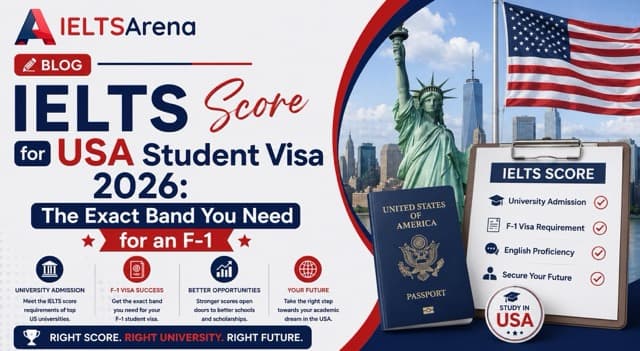
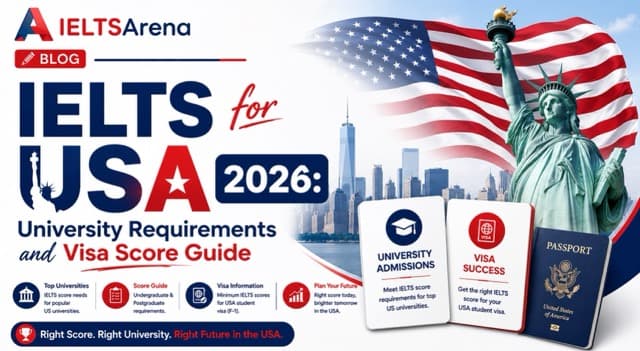
Taking IELTS for USA admissions is not only possible, it is now mainstream. More than 3,400 US institutions accept IELTS scores as proof of English proficiency. This guide explains exactly what score you need, how the student visa fits in, and how to prepare so your band opens the doors you want.
What "IELTS for USA" Actually Requires
Studying in the United States as an international student involves two separate things: getting admitted to a university, and getting an F-1 student visa to enter the country. English test scores matter mostly for the first.
US universities use your IELTS score to confirm you can cope with academic English. Most institutions ask for an overall band somewhere between 6.0 and 7.5, depending on the course and the selectivity of the programme.
The typical sweet spot is Band 6.5 to 7.0 overall. Many universities accept 6.0 for some courses, while competitive or postgraduate programmes often expect 7.0 or higher. Always check the exact figure on the programme page.
For IELTS for USA admissions, you usually take the Academic version of the test, not General Training. Academic is built around the kind of reading and writing you meet in degree study, which is what universities want to assess.
Some universities also publish minimum scores for individual sections, not just the overall band. A programme might want 6.5 overall but no less than 6.0 in any one skill, so a low Writing or Speaking band can hold back an otherwise strong result.
Advertisement
Why Many Applicants Get the USA Plan Wrong
The first mistake is assuming the United States only accepts TOEFL. This was closer to true years ago, but it is outdated. Today IELTS for USA applications is widely accepted, and skipping it can mean preparing for the wrong exam.
A second error is treating the F-1 student visa as having its own English score cutoff. It does not. The visa decision does not set a separate IELTS number, so people who hunt for a "visa band" are chasing something that does not exist.
Many applicants also aim for a single overall band and ignore section minimums. They hit 6.5 overall but score 5.5 in Writing, then find the programme rejects them on the per-section rule.
Another common slip is targeting the wrong score level. Some students over-prepare for Band 8.0 when their course needs 6.5, wasting months. Others aim too low and fall short of a selective programme's real requirement.
Finally, people leave English testing too late in a packed application timeline. Between transcripts, recommendation letters, and statements of purpose, the IELTS for USA score becomes an afterthought, and a weak band undermines an otherwise excellent file.
In the United States, the visa does not set your English score. Your university does, and that number is the one to plan around.
A Real Student Situation: Joseph from Kenya
Joseph, a 23-year-old engineering graduate from Nairobi, planned to apply for a master's programme in the United States. He spent two months preparing for TOEFL because he believed IELTS was not accepted there.
"A cousin told me American universities only want TOEFL," Joseph said. "Then I actually read the admissions pages of my target schools, and every single one accepted IELTS. I had nearly prepared for the wrong test."
He switched to IELTS Academic. His target programmes wanted an overall Band 6.5 with at least 6.0 in each section, a realistic goal for him.
Joseph's first practice attempts showed Band 6.0 overall, with Writing dragging him down to 5.5. The section minimum, not the overall band, was his real obstacle.
He focused his preparation on Writing Task 2, using timed practice and detailed feedback. Eight weeks later he scored Band 7.0 overall with 6.5 in Writing, clearing both the overall and the per-section requirements.
"Once I understood that IELTS for USA was accepted, and that my section scores mattered as much as the overall band, everything became simpler," he said. "I stopped guessing and started fixing the one skill that was holding me back."
Data and Insight on IELTS for US Study
IELTS acceptance in the United States is broad. According to 2026 guidance summaries from study-abroad services such as Leap Scholar and Nomad Credit, more than 3,400 US higher education institutions accept IELTS scores for international admissions.
On score levels, the same 2026 guidance reports a typical requirement of Band 6.0 to 7.5 overall, with Band 6.5 the most common minimum for general admission and 7.0 or higher for selective and postgraduate programmes.
On the visa, guidance is consistent: the F-1 student visa has no separate IELTS cutoff. A strong band of 6.5 or above still helps, because it signals to a consular officer that you are ready for the academic demands of US study, even though no official number is fixed.
The competitive landscape is also shifting. Alternatives such as TOEFL iBT, the Duolingo English Test, and PTE Academic are widely accepted too, with the Duolingo test gaining popularity for its lower cost and fast results, according to 2026 admissions reporting.
The practical insight is reassuring. For most applicants, IELTS for USA is fully viable, the score you need is usually moderate rather than extreme, and the smartest strategy is to target your specific programme's requirement, including any section minimums, rather than chasing a vague high band.
The Right Way to Plan IELTS for USA
Follow this sequence to set the correct target and prepare efficiently.
- Confirm acceptance and the exact score for each programme. Open the admissions page of every target university and note the overall band and any section minimums.
- Choose the Academic test. For university study in the United States, take IELTS Academic, since it reflects the reading and writing demands of degree-level work.
- Set a single clear target band. Use the highest requirement among your chosen programmes as your goal, so one strong result covers all of them.
- Protect your weakest skill. Identify which section threatens the per-section minimum and prioritise it, because a low band in one skill can block admission even with a good overall score.
- Separate the visa step in your mind. Prepare for the university requirement, and treat the F-1 visa as a documentation and interview process, not an additional English test.
- Build your timeline backwards. Count from your application deadline, leave a retake buffer of about eight weeks, and book your test so the score is ready and valid when you submit.
- Practise under real exam conditions. Familiarity with the computer-based format reduces anxiety and protects your score on test day.
This plan removes the guesswork that derails so many IELTS for USA applications and keeps your preparation focused on the number that actually matters.
How IELTSArena Gets You to Your US Target Band
The biggest risk in any IELTS for USA plan is a single weak section pulling you below a programme's minimum. IELTSArena is built to find and fix exactly that.
IELTSArena's progress analytics track your performance across every mock test, so you immediately see whether Writing, Speaking, Reading, or Listening is the skill threatening your section minimum. You target the real gap, not a guess.
For Writing, IELTSArena's AI feedback gives an instant band estimate and pinpoints mistakes in Task 1 and Task 2 against the four criteria of Task Response, Coherence and Cohesion, Lexical Resource, and Grammatical Range and Accuracy. This is the section that most often blocks US admission, and it is where fast feedback matters most.
For Speaking, IELTSArena scores fluency, pronunciation, vocabulary, and grammar, and expert tutors add band-focused human correction where AI alone cannot capture the nuance between bands.
IELTSArena also replicates the real IELTS computer-based test interface, including the highlighter, notepad, and navigation panel, so the exam format feels routine by test day. More than 10,000 learners have used IELTSArena to reach their target band.
If you are planning IELTS for USA study, start with a free full mock test on IELTSArena and find out, in one session, exactly which skill stands between you and your target programme.
Self-Diagnosis: Are You Ready for US Admission?
Answer these to check whether your IELTS for USA plan is on track.
- Have you confirmed the exact overall band and section minimums for every programme on your list, rather than assuming one general number?
- Are you preparing for the Academic version, which US universities require for degree study?
- Do you know which single skill is most likely to fall below a section minimum, and are you prioritising it?
- Do you understand that the F-1 visa sets no separate English score, so your university requirement is the real target?
- Have you taken at least one full timed mock test under real exam conditions to see your current band?
If any answer is no, a single diagnostic mock test will show you precisely what to fix before you commit to a test date.
See Where Your US Target Band Stands
The smartest first move for any US applicant is to measure your current band against your target programme today.
Take a Free US-Targeted Mock on IELTSArena →
Frequently Asked Questions
Which US universities accept IELTS instead of TOEFL in 2026?
In 2026, more than 3,400 higher education institutions in the United States accept IELTS scores for international admissions, according to study-abroad guidance summaries. This includes a very wide range of public and private universities across nearly every state, so for most applicants IELTS for USA is fully viable. Acceptance is now the norm rather than the exception, and many institutions list IELTS, TOEFL, the Duolingo English Test, and PTE Academic as equally valid options. Because requirements vary by programme, the safest step is to confirm on each university's admissions page that IELTS is accepted and to note the exact overall band and any section minimums it asks for.
What IELTS score do I need for a US student visa F-1 in 2026?
The F-1 student visa does not set a separate IELTS score requirement in 2026. There is no official "visa band", so your target should be driven entirely by your chosen university's admission requirement. That is typically an overall Band 6.0 to 7.5, with 6.5 the most common minimum and 7.0 or higher for selective programmes. A strong band of 6.5 or above still helps at the visa stage indirectly, because it signals to a consular officer that you can handle the academic demands of US study. In short, meet your university's requirement, and your IELTS for USA score will comfortably support the visa process.
Is IELTS or TOEFL better for applying to US universities?
Neither test is universally better for US applications, since most institutions accept both equally. IELTS for USA is widely recognised, and your choice should depend on which test suits your strengths and study style. IELTS includes a face-to-face speaking section with an examiner, which many candidates prefer over recording answers to a computer. TOEFL is fully computer-based and has long been familiar to US schools. The Duolingo English Test is also popular for US admissions because it is cheaper and faster. Pick the test you can score highest on, confirm your target universities accept it, and then prepare consistently. Practising on a realistic platform like IELTSArena helps you decide if IELTS fits you.
Do Ivy League universities like Harvard and MIT accept IELTS?
Highly selective US universities generally accept IELTS alongside TOEFL and other recognised English tests, so applying with IELTS for USA admission at top institutions is realistic. The key difference at this level is the required band, which tends to be higher, often around 7.0 to 7.5 overall, sometimes with section minimums. Because policies and exact figures can change and differ by programme, always confirm the current requirement directly on the specific university and department admissions pages before you apply. Aim for the highest band among your target schools so one strong result covers all of them, and prioritise any section that risks falling below a stated minimum.
How do I prepare for IELTS to meet US university requirements?
Start by confirming the exact overall band and section minimums for each US programme on your list, then take the Academic version of the test. Set your target as the highest requirement among your chosen universities so one result covers every application. Identify your weakest skill, since a single low section can block admission even with a good overall band, and focus your practice there. Train under real exam conditions to reduce test-day anxiety. IELTSArena helps with this directly: its AI feedback pinpoints Writing and Speaking mistakes, its analytics reveal your weakest skill, and its real CBT interface makes the format routine. Begin with a free mock test to measure where you stand.