You score an overall Band 6.5 and assume the UK is open to you. Then you open your dream university's admissions page and read: "7.0 overall, with no component below 6.5." Your 6.5 is suddenly half a band short of the course you wanted.
This is the moment most international students discover the truth about studying in Britain. There is no single IELTS score for UK university entry. The requirement swings from 5.5 to 7.5 depending on which type of institution you apply to and at which level.
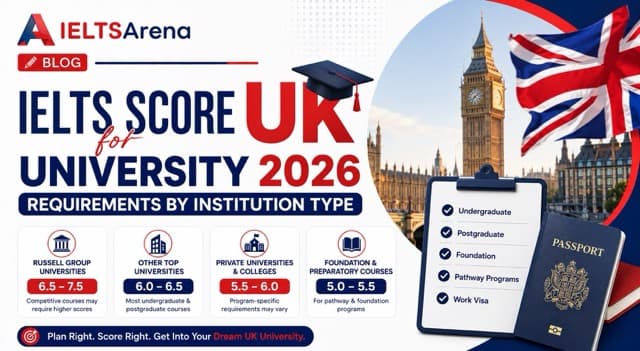
A foundation pathway might accept 5.0. A mid-ranked university often wants 6.0 to 6.5. A Russell Group university usually demands 7.0. Oxford and Cambridge can ask for 7.5. Same country, four very different targets.
This guide maps the IELTS score for UK university entry in 2026 by institution type, level, and the per-band rules that decide most applications, so you apply to the right places with the right band.
Why There Is No Single IELTS Score for UK University Entry
Every UK university sets its own English requirement. There is no national admissions standard, so the IELTS score for UK university study is decided course by course, not by the government.
This is the first thing to understand. The UK student visa has its own English floor, which is overall 5.5 with 5.5 in each band at degree level. But the visa floor is almost always lower than the university floor. You must satisfy both, and the university requirement is the one that usually decides your application.
The second thing is that requirements rise with academic level. A postgraduate programme almost always asks for a higher band than the undergraduate version of the same subject, because master's study involves heavier reading and writing loads.
The third factor is subject. Writing-heavy courses such as law, journalism, medicine, and the humanities set higher bands than science, engineering, or mathematics, where less written English is produced.
So when you ask what IELTS score for UK university you need, the honest answer is another question: which university, what level, and what subject? Once you fix those three, the number becomes clear. The rest of this guide gives you the typical bands for each institution type in 2026.
Advertisement
Why Students Apply With the Wrong IELTS Band
The most common mistake is treating the UK as one requirement. Students see "6.5 gets you into the UK" on a forum and aim for that, then find their chosen Russell Group course needs 7.0. They are half a band short on results day.
The second mistake is ignoring the per-component rule. A typical UK requirement is "6.5 overall with no band below 6.0." A student who scores 7.5, 7.5, 7.5, and 5.0 has a 6.5 overall but fails on the 5.0 in one skill. The overall band looked fine and the application was still rejected.
The third mistake is preparing for the visa floor instead of the university floor. Some students train only to reach 5.5 because that is the visa requirement, then discover their actual course needs much more.
The fourth mistake is leaving IELTS too late. Universities often want your result before they confirm an unconditional offer, and many international students need a retest to lift one weak band. Starting late means a rushed second attempt or a deferred place.
Each of these errors comes from the same root: assuming a single IELTS score for UK university entry exists. It does not. The fix is to find your specific course requirement early and prepare for the exact band, including the per-section floor.
Priya's Story: Half a Band From Her Offer
Priya, a 22-year-old graduate from Nepal, had a conditional offer for a master's in international relations at a Russell Group university. The condition was IELTS 7.0 overall with no band below 6.5.
She had prepared casually and scored overall 6.5: Listening 7.0, Reading 7.0, Speaking 7.0, and Writing 5.5. Her offer was withdrawn.
"I was so close on three skills," Priya said. "My Writing 5.5 cost me the whole place. I did not realise the condition meant every band, not just the average."
Her subject made it harder. International relations is writing-heavy, which is exactly why the university set a firm per-component floor. Priya's strong Speaking and Listening could not compensate.
She gave herself seven weeks and trained only Writing. She learned how examiners score Task 2 across Task Response, Coherence and Cohesion, Lexical Resource, and Grammatical Range and Accuracy, and she rewrote essays based on detailed band-level feedback.
Her retest came back at overall 7.0 with Writing 6.5, exactly clearing the condition. Her offer was reinstated for the next intake.
"The university did not want a higher average," she said. "It wanted me to clear the floor in every skill, especially Writing."
The Data Behind UK University IELTS Requirements
The pattern across UK institutions is consistent enough to plan around. Guides covering 2026 admissions report that most UK universities ask for overall 6.0 to 6.5 for undergraduate entry and 6.5 to 7.0 for postgraduate entry.
The 24 Russell Group universities sit above that range. Most require overall 7.0 with no component below 6.5, and the most selective courses go higher. This is the band gap that surprises students who aim for a general 6.5.
Oxford and Cambridge are stricter still. Both typically ask for around 7.0 to 7.5 overall with 7.0 in each component, and certain demanding courses set the bar at the top of that range.
The quiet detail in all of this is the per-component rule. Almost every UK requirement attaches a floor to each skill, and Writing is the band that most often falls short. Across global test data, Writing trails the other three skills by roughly half a band on average, which is why it sinks so many UK applications.
Lower-tariff universities and foundation pathways form the other end. Many newer or post-1992 universities accept overall 6.0, and foundation or pre-sessional English routes can accept 5.0 to 5.5, designed for students who are close but not yet at degree level.
The takeaway from the data is simple. Decide your institution tier first, then prepare for its band, and treat Writing as the skill most likely to decide your result.
Required IELTS Score for UK University by Institution Type
Here are the typical 2026 bands by tier. Always confirm the exact requirement on your specific course page, because individual programmes can set their own higher bar.
Oxford and Cambridge. The required IELTS score for UK university entry at this level is the highest in the country. Expect around 7.0 to 7.5 overall with 7.0 in each component. The most competitive and writing-heavy courses, such as law and medicine, sit at the top of that band. Apply here only if you can clear 7.0 in every skill.
Russell Group universities. The 24 research-intensive universities, including UCL, Imperial College London, Edinburgh, Manchester, and the London School of Economics, typically require overall 7.0 with no band below 6.5. Some social science and humanities programmes add a higher Writing floor, often 7.0 in Writing. This is the most common serious target for international postgraduates.
Top 20 and mid-ranked universities. Many strong universities outside the Russell Group ask for overall 6.5 with no band below 6.0 for undergraduate study, rising to 6.5 to 7.0 for postgraduate study. This tier offers excellent options for students sitting comfortably at 6.5.
Lower-tariff and post-1992 universities. Many newer universities accept overall 6.0, sometimes with no band below 5.5. These institutions have the lowest direct-entry requirements and are realistic targets for students just above the visa floor.
Foundation and pre-sessional pathways. If your band is below direct-entry level, a foundation or pre-sessional English programme can accept overall 5.0 to 5.5. These are bridging routes that prepare you for degree study and let you start in the UK while building your English. Band 6.0 is usually enough for foundation entry, though not for direct degree entry at most universities.
The rule across every tier: read both the overall band and the per-component floor for your exact course before you apply.
How IELTSArena Helps You Hit Your UK University Band
Once you know your target tier, the task is to clear the overall band and the per-component floor without letting your weakest skill drag you down. This is exactly what IELTSArena is built to help you do.
Because Writing is the skill that fails most UK applications, IELTSArena gives instant AI Writing feedback with a band estimate and detailed corrections on Task 1 and Task 2. You see precisely where you lose marks against Task Response, Coherence and Cohesion, Lexical Resource, and Grammatical Range and Accuracy.
For the band that decides Russell Group and Oxbridge conditions, IELTSArena also offers expert tutor feedback. A human tutor reviews your Writing and Speaking and tells you, in band terms, what is keeping you under 7.0 and how to fix it before your retest.
IELTSArena replicates the real IELTS computer-based test interface, so your mock scores reflect genuine exam conditions rather than relaxed home practice. The progress analytics dashboard tracks every skill across your mock tests, so you can watch your weakest band climb toward your university's floor.
You can practise full Academic mock tests on IELTSArena, which is the test type UK universities require, and track each skill separately. Over 10,000 learners have used the platform to reach the band their offer demanded.
Start free on IELTSArena and find out which UK university tier your current band can reach.
Self-Diagnosis: Can You Reach Your Target University?
Answer these five questions before you apply.
- Do you know the exact IELTS requirement for your specific course, including the per-component floor and not just the overall band?
- Do you know which university tier matches your current band: foundation, lower-tariff, mid-ranked, Russell Group, or Oxbridge?
- Can you score at or above 6.5 in Writing, the skill that fails most UK applications?
- Have you sat a full, timed Academic mock test recently, or are you guessing your band?
- Do you have enough time to retest if one skill falls below the floor?
If any answer is unclear, you have a gap that could cost you an offer. A single timed mock test turns every guess into a number and tells you which tier is realistic today.
Start Your Free Practice Today
You cannot choose the right UK university until you know your real band in every skill. The fastest way to find out is to sit one full, timed, computer-based Academic mock test under exam conditions.
In one free test on IELTSArena, you will see your band in each skill, spot the section pulling you below your target university's floor, and know exactly what to fix first. No credit card, no commitment.
Take a Free UK-Targeted Mock on IELTSArena →
The IELTS score for UK university entry is not one number. It is a band per skill, and Writing is usually the one that decides your offer.
Frequently Asked Questions
What IELTS score do I need for a Russell Group university in the UK?
Most of the 24 Russell Group universities require an overall band of 7.0 with no individual skill below 6.5. Some writing-heavy programmes in law, humanities, and social sciences add a higher Writing floor, often 7.0. Because this sits above the general UK average of 6.0 to 6.5, many students who aim for a typical 6.5 fall half a band short. The per-component rule matters most here, since a strong overall band cannot rescue one weak skill. Always check your specific course page, then prepare to clear both the overall 7.0 and the per-skill floor. Practising full Academic mocks on IELTSArena shows whether your weakest band clears 6.5.
Does every UK university require IELTS band 6.5 for undergraduate admission?
No. Requirements vary widely by institution tier. Many lower-tariff and post-1992 universities accept overall 6.0 for undergraduate entry, sometimes with no band below 5.5. Mid-ranked universities commonly ask for 6.5 with no skill below 6.0, while Russell Group universities usually want 7.0. Foundation and pre-sessional pathways can accept 5.0 to 5.5. So 6.5 is a common middle target, not a universal rule. The right band for you depends entirely on which university and course you choose. Find your specific course requirement first, then prepare for that exact band rather than assuming a single national figure applies to every UK institution.
What IELTS score does Oxford and Cambridge require for postgraduate study?
Oxford and Cambridge set the highest IELTS requirements in the UK. For postgraduate study, both typically ask for around 7.0 to 7.5 overall with at least 7.0 in each of the four skills. The most demanding and writing-heavy courses sit at the top of that range. This means you must clear 7.0 in Listening, Reading, Writing, and Speaking, with no weak skill. Writing is usually the hardest band to lift, so it deserves the most preparation time. Confirm the exact figure on the specific course page, as requirements differ slightly by department, then build a plan that targets every skill rather than only your overall average.
Is IELTS band 6 enough for a UK foundation programme entry?
In most cases, yes. Foundation and international year-one programmes are designed as bridging routes for students who are close to, but not yet at, direct degree-entry level. Many accept an overall band of 5.5 to 6.0, sometimes with no skill below 5.5. Band 6.0 is usually comfortable for foundation entry, though it is rarely enough for direct undergraduate or postgraduate admission at competitive universities. A foundation route lets you start studying in the UK while improving your English and academic skills before progressing to a full degree. Always confirm the exact band on the specific foundation programme page, since requirements vary between providers and pathways.
Which UK universities have the lowest IELTS requirements for international students?
The lowest direct-entry requirements are usually found at newer and post-1992 universities, many of which accept an overall band of 6.0, sometimes with no skill below 5.5. Below that, foundation and pre-sessional English programmes accept 5.0 to 5.5 as bridging routes. However, a low requirement should not be your only filter, since course quality, location, and graduate outcomes matter just as much. Rather than searching only for the lowest band, identify universities whose requirement matches your realistic IELTS score, then choose by course fit. A timed Academic mock test on IELTSArena will show your current band so you can target institutions you can genuinely reach.