If you are applying to study in the UK this year, one number now decides whether your visa is approved: your English test score in every single section. The UK student visa English requirement 2026 is no longer something you can satisfy with a strong overall band while one skill lags behind. Each of the four sections has to clear the line on its own.
This matters more in 2026 than in any recent year. University sponsor compliance rules tightened on June 1, 2026, the English standard for several work and dependant routes rose in January 2026, and from March 22, 2026 the test itself must be taken on a computer. The rules around your studies are moving at the same time, with a shorter Graduate Route and higher money-in-the-bank requirements.
The good news is that the academic English bar for a degree-level course has not become impossible. It sits at CEFR B2, which maps to IELTS 5.5 in each part. The catch is the words "each part". Plenty of capable applicants meet the overall score and still get refused because one section, usually Writing, came in half a band low.
Here is exactly what the UK student visa English requirement 2026 asks of you, which tests count, where applicants slip up, and how to prepare so every section clears the bar.
What the UK Student Visa English Requirement 2026 Actually Demands
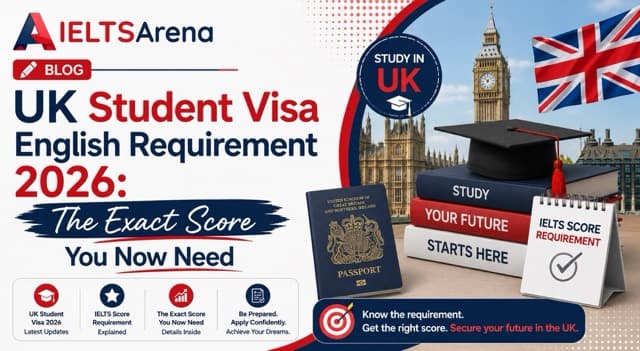
The UK student visa English requirement 2026 for a degree-level course is CEFR Level B2, evidenced through an approved Secure English Language Test (SELT). For IELTS for UKVI, that means a minimum of 5.5 in each of the four components: Listening, Reading, Writing, and Speaking, according to GOV.UK guidance on knowledge of English (2026) and UK university admissions pages such as the University of Edinburgh and the University of Manchester (2026).
Read that requirement carefully. It is not an overall 5.5. It is 5.5 in every section. An applicant who scores Listening 7.0, Reading 7.0, Speaking 6.5, and Writing 5.0 has an excellent overall band but does not meet the standard, because Writing fell below 5.5.
For courses below degree level, the requirement is B1, which is a lower bar. But the overwhelming majority of international applicants are heading to undergraduate or postgraduate study, so B2 and the 5.5-per-section rule is the line that matters for most readers.
Individual universities can and do set the bar higher. Competitive programmes in law, medicine, business, and journalism often ask for an overall 6.5 or even 7.0, sometimes with a minimum of 6.0 or 6.5 in Writing. So there are really two thresholds to clear: the visa floor of B2 set by UK Visas and Immigration, and the academic offer condition set by your university, which is frequently higher.
Advertisement
Why 2026 Is Different: The Rules Tightened on Several Fronts
The UK student visa English requirement 2026 does not stand alone. It is one piece of a broader tightening that followed the 2025 Immigration White Paper, and several changes have arrived in close sequence.
From January 8, 2026, new applicants for Skilled Worker, Scale-up, and High Potential Individual visas have needed CEFR B2 English, raised from the previous B1, according to the House of Commons Library briefing CBP-10267 (2026). For the first time, English language obligations now extend to adult dependants of both workers and students. If you plan to bring a partner, that change may affect your application too.
From March 22, 2026, UK visa applicants worldwide are required to sit a fully computer-delivered English test. This is significant for preparation. If you have been practising on paper, your exam-day experience will not match the screen, the on-screen highlighter, the typed Writing answers, and the navigation panel you will actually use.
University sponsor compliance rules changed on June 1, 2026, raising the bar institutions must meet to keep recruiting international students. The practical effect for applicants is that universities are scrutinising English evidence more closely, because their own licences depend on it.
Two further changes shape the decision around studying in the UK. The Graduate Route, the post-study work visa, is being shortened to 18 months for students starting courses from January 2026, down from 24 months, with PhD graduates retaining a longer term, according to ICEF Monitor (May 2025) and UKCISA (2026). And from November 11, 2025, student financial maintenance rose to 1,529 pounds per month for London and 1,171 pounds per month outside London, per the House of Commons Library (2026). None of these are English tests, but together they mean the cost of a refused or delayed visa is higher than ever.
Why Strong Applicants Still Get the English Requirement Wrong
The single most common mistake is treating the requirement as an overall score. Applicants prepare to hit a comfortable average, then discover that the CEFR B2 English UK student visa standard is judged section by section.
The second mistake is neglecting the weakest skill. Most candidates pour their study time into the sections they already enjoy. Reading and Listening tend to climb fastest with practice, which feels reassuring. Writing and Speaking, the productive skills, move more slowly and are exactly where applicants fall half a band short.
The third mistake is the wrong test format. With UK applicants now required to take the computer-delivered test, anyone preparing on paper is rehearsing the wrong exam. Typing a Task 2 essay under time pressure is a different skill from handwriting one. Reading on a screen and using a digital highlighter changes how you locate answers. Practising in the format you will not sit is a quiet way to lose marks.
The fourth mistake is misreading which IELTS to book. For a UK visa you generally need IELTS for UKVI, a version delivered at approved SELT centres, not the standard IELTS. Booking the wrong one is an avoidable but costly error.
A Real Applicant Story: Amara From Nigeria
Amara, a 24-year-old from Lagos, Nigeria, had an offer for a master's in public health at a UK university. The offer condition was an overall IELTS 6.5 with no section below 6.0. She booked IELTS for UKVI feeling confident, because her spoken and written English at work was strong.
Her first result told a different story. Listening 7.5, Reading 7.0, Speaking 6.5, Writing 5.5. Her overall band was 6.5, which looked like a pass at a glance. But Writing at 5.5 sat below both her university's 6.0 condition and was uncomfortably close to the visa floor. Her offer could not be confirmed.
"I assumed my average was what counted," Amara said. "I had never been told the score is read one section at a time. My Writing was the only thing standing between me and my place."
Amara spent six focused weeks on Writing alone. She practised Task 1 and Task 2 under the real 60-minute clock, typing on a screen, and reviewed feedback on her Task Achievement and Grammatical Range after every essay. On her next attempt her Writing rose to 6.5, lifting her overall to 7.0. Her offer was confirmed and her visa followed. The lesson was not that Amara lacked English. It was that she had been preparing for the wrong target with the wrong tools.
The Data Behind the English Requirement
The numbers explain why Writing is the section that derails so many UK applications. Across global IELTS results, Writing is consistently the lowest-scoring of the four skills, with mean Writing bands typically trailing Speaking, Reading, and Listening by roughly half a band, based on annual IELTS test-taker performance data (2024 to 2026).
That gap is the whole problem. When the requirement is judged section by section, the skill most likely to fall short is the one most candidates score lowest in to begin with. An applicant aiming for an overall 6.5 who scores 7.0 in the receptive skills can still be capped by a 5.5 in Writing.
There is a second pattern worth knowing. Test-takers who do targeted, single-skill practice with feedback tend to improve their weakest section faster than those who keep retaking full mock tests. The reason is simple: a full mock spends three-quarters of your effort on skills that are already strong enough. Diagnosing the weak skill and drilling it directly is where the band movement happens.
The UK does not refuse strong students. It refuses applications where one section quietly fell half a band short of a line nobody pointed out.
The Right Way to Prepare for IELTS for UKVI in 2026
A focused preparation plan for IELTS for UKVI in 2026 looks like this.
First, confirm two targets. Write down the visa floor (B2, meaning 5.5 in every section) and your university's offer condition (often higher, sometimes with a Writing minimum). Prepare to the higher of the two in each skill.
Second, book the correct test. For a UK visa this is almost always IELTS for UKVI, taken at an approved SELT centre. Confirm with your university which version they accept.
Third, practise on a computer. Since UK applicants now sit the computer-delivered test, rehearse on screen: typed Writing, digital highlighting in Reading, and the on-screen Listening answer entry.
Fourth, diagnose your weakest section first. Sit one full mock under exam timing, then read your section scores honestly. Whichever skill is closest to the line gets the majority of your study time.
Fifth, drill the productive skills with feedback. For Writing, you cannot improve what you cannot see. You need correction on Task Achievement, Coherence and Cohesion, Lexical Resource, and Grammatical Range and Accuracy after every essay, not just a score.
Sixth, track each section separately. Watching one number is misleading. Track Listening, Reading, Writing, and Speaking on their own so you know exactly which line is still below target.
How IELTSArena Helps You Clear Every Section
The UK student visa English requirement 2026 punishes a single weak skill, so the smartest preparation isolates and fixes that skill in the real exam format. This is exactly what IELTSArena is built for.
IELTSArena replicates the real IELTS CBT interface, including the on-screen highlighter, notepad, and navigation panel, so when you sit the now-mandatory computer-delivered test, the screen is familiar rather than a fresh source of stress. You practise in the format you will actually face.
For the section that sinks most UK applications, IELTSArena's AI Writing feedback gives you an instant band estimate plus specific corrections on Task 1 and Task 2, naming where you lose marks across all four Writing criteria. For applicants who want examiner-style depth, expert tutors provide one-to-one, band-focused correction on Writing and Speaking, the productive skills AI-only platforms handle less precisely.
IELTSArena's progress analytics track every mock across all four sections, so you can see at a glance whether your Writing has cleared 6.0 or your Speaking is still sitting at 5.5. That section-by-section visibility is precisely what a per-component requirement demands. More than 10,000 learners have used IELTSArena to reach their target band. Start free and see all four of your individual band scores in your first sitting.
Are You Ready for the UK English Requirement? Self-Diagnosis
Ask yourself these questions honestly:
- Do you know your university's exact offer condition, including any minimum Writing or Speaking score, not just the overall band?
- Have you confirmed you are booking IELTS for UKVI rather than standard IELTS?
- Can you type a Task 2 essay that reaches Band 6.5 within 40 minutes on a computer?
- Do you know which of your four sections is currently closest to falling below the line?
- Have you sat a full mock in the computer-delivered format, not on paper?
If you hesitated on any of these, that hesitation is the gap between an approved and a refused application. The fix is not more generic study. It is a clear diagnosis and targeted practice in the right format.
See Where Your Band Score Stands Today
You do not have to guess whether you meet the UK student visa English requirement 2026. In one free mock test on IELTSArena, you will see your score in every section and know exactly which skill still needs work before you book the real exam.
Take Your First Free Mock on IELTSArena →
Frequently Asked Questions
What IELTS score do I need for a UK student visa in 2026?
For a degree-level course, the UK student visa English requirement 2026 is CEFR Level B2, which for IELTS for UKVI means a minimum of 5.5 in each of the four sections: Listening, Reading, Writing, and Speaking, according to GOV.UK guidance (2026). This is judged section by section, not as an overall average, so every part must reach 5.5. For courses below degree level the requirement is B1. Many universities set higher conditions, often an overall 6.5 or 7.0 with a minimum in Writing, so always prepare to the higher of the visa floor and your university's offer.
Is CEFR B2 the same as IELTS 5.5 for a UK student visa?
For UK student visa purposes, CEFR B2 corresponds to a minimum IELTS for UKVI score of 5.5 in each section. The CEFR is a scale that describes language ability, and B2 represents an upper-intermediate level. UK Visas and Immigration maps the degree-level Student Route requirement to B2, and IELTS for UKVI evidences that level at 5.5 per component. Remember the standard is per section: an overall 5.5 with one skill below 5.5 does not satisfy the requirement. Practising each skill separately on a platform like IELTSArena helps ensure no single section drops below the B2 line.
Did the UK raise the English requirement for student visas in 2026?
The degree-level student requirement remains CEFR B2, but the surrounding rules tightened in 2026. From January 8, 2026, Skilled Worker, Scale-up, and High Potential Individual visa applicants now need B2 rather than the previous B1, and English obligations extended to adult dependants for the first time, per the House of Commons Library (2026). From March 22, 2026, UK visa applicants must sit a fully computer-delivered test, and university sponsor compliance rules changed on June 1, 2026. So while the student threshold itself held at B2, the broader environment, including test format, became stricter.
Which English tests does UKVI accept for a student visa in 2026?
UK Visas and Immigration accepts Secure English Language Tests (SELTs) from approved providers. These include IELTS for UKVI Academic and General Training, IELTS Life Skills, Trinity College GESE and ISE, LanguageCert International ESOL SELT, PSI Skills for English UKVI, and Pearson PTE Academic UKVI, according to GOV.UK and the British Council (2026). For most degree-level applicants, IELTS for UKVI Academic is the standard choice. Confirm with your university which test and version they accept before booking, since you must take the test at an approved SELT centre.
How do I prepare for IELTS for UKVI if I need 5.5 in every section?
Start by sitting one full mock test in the computer-delivered format to find your weakest section, then give that skill the majority of your study time. Because the requirement is judged per section, your strategy should be to lift whichever skill is closest to the line, usually Writing or Speaking. Practise typed essays under the 60-minute clock and get feedback on all four Writing criteria after each one. IELTSArena replicates the real CBT interface, gives instant AI feedback on Writing and Speaking, and tracks each section separately, so you always know which skill still needs work. Start free on IELTSArena.