Most Band 7+ candidates do not lose marks on IELTS listening map questions because their English is weak. They lose marks because the question type demands a skill no other Listening section tests: tracking spatial information in real time while a speaker describes movement through a location. One moment of inattention, one missed direction, and you lose your position on the map and all subsequent answers become guesses.
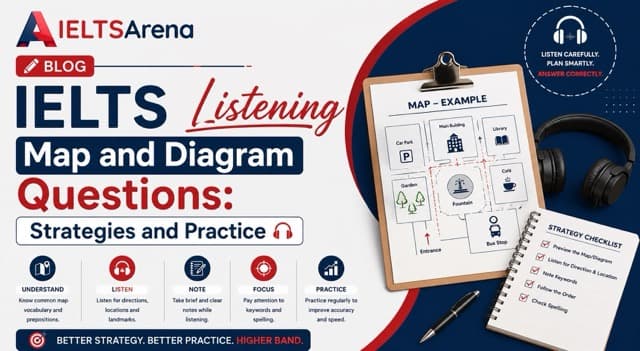
IELTS listening map questions typically appear in Section 2, where a single speaker delivers a monologue — often a guided tour, a museum overview, or directions through a building. The map is on your screen. The speaker walks you through it. You have to follow.
This guide breaks down why this question type catches so many candidates unprepared, the directional vocabulary you need automatically, the five-step strategy that keeps you on the map, and the specific practice that lifts your accuracy from 55% to 90%+ within six sessions.
What Makes Map Questions Different
The other three Listening sections test sequential information processing: hear a date, write it down; hear a name, spell it correctly. Maps demand dual-task processing: listening for directional language while simultaneously tracking movement on a visual map.
This is why even strong listeners with Band 8 scores in Sections 1, 3, and 4 sometimes drop to 5/10 in Section 2 when a map appears. The cognitive load is qualitatively different from any other Listening task.
The structure is consistent. You see a map with several locations or features. Six to ten of them are labelled. The remaining locations have letters or numbers. The speaker describes a route through the area, naming each location as they reach it. Your job is to match the names from the audio to the unlabelled positions on the map.
One missed turn and you lose your spatial position. From that point on, every answer is a guess.
Why Standard Listening Preparation Fails for Maps
Three preparation gaps explain why even well-prepared candidates underperform on this question type.
Maps appear infrequently in practice tests. Across ten typical IELTS practice papers, map questions might appear two or three times. That is not enough exposure to build the specific skill the question demands. Candidates practise dozens of form-completion questions but only a handful of map-tracking questions.
Directional vocabulary requires automaticity. Words and phrases like "directly opposite," "diagonally across from," "just past," "at the far end," and "adjacent to" must be understood instantly when heard. There is no time to translate. A candidate who pauses for half a second to think about what "opposite" means relative to the speaker's path has already missed the next direction.
Reading time is misused. The 30 seconds you get to preview the map before the audio starts is often spent trying to memorise the labels. Memorising does not help. Strategic preparation — identifying the starting point, the cardinal directions, and the obvious landmarks — does. Platform data shows strategic reading-time users outperform candidates who try to memorise the map by an average of two correct answers per map section.
Performance Data by Band Level
Map question accuracy correlates strongly with band level, but the gap between bands is larger here than in any other Listening question type.
- Band 6 candidates: 55-60% accuracy on map questions
- Band 7 candidates: approximately 75% accuracy
- Band 8 candidates: 88-92% accuracy
The jump from Band 6 to Band 7 on map questions is roughly 15 percentage points — much larger than the typical 5-point gap on other Listening question types. This means map questions are disproportionately responsible for the difference between a 6.5 and a 7.5 Listening band.
Students completing five dedicated map practice sets show an average improvement of 2.3 correct answers per map section compared to their baseline. That improvement comes from method, not from general listening ability.
Yemi's Jump from Band 6.5 to Band 7.5
Yemi, a 31-year-old engineer from Lagos, Nigeria, was preparing for a Canadian Express Entry application that required CLB 9 — 8.0 in Listening. He was scoring 7.0 in Listening practice tests consistently, but Section 2 with map questions was costing him three or four marks every time.
"I would lose my place on the map within the first 90 seconds," he said. "I would write down whatever sounded right for the remaining questions and hope for the best. It felt like guessing, because it was."
He shifted to targeted map practice: six dedicated sessions over three weeks using IELTSArena's question-type-filtered Listening practice. Each session ended with a transcript review where he traced the speaker's exact path against his answers and identified where he lost track.
By session five, his map question accuracy reached 90%. On his next mock test he scored Band 8 in Listening overall, hitting his CLB 9 target.
The key insight, he said, was that the directional vocabulary needed to be automatic. "I had to stop translating 'opposite' or 'just past' in my head. Once those phrases became reflexes, I could focus on tracking the map instead of decoding the words."
The Five-Step Strategy for Map Questions
Use this approach every time a map appears in a Listening section.
Step 1: Use the reading time strategically. Identify the starting point (usually marked as "you are here" or referenced in the section preview). Note the cardinal orientation if shown. Identify two or three fixed landmarks (entrance, car park, information desk) you can use as anchor points. Do not try to memorise specific labels.
Step 2: Master the core directional vocabulary in advance. Build automatic recognition of: "on your left/right," "directly opposite," "diagonally opposite," "adjacent to," "next to," "beside," "just past," "beyond," "further along," "at the far end," "in the corner of," "in the centre," "at the top," "turn left/right," "go straight," "carry on past."
Step 3: Keep your pencil moving. Physically trace the path on the map as the speaker describes it. Note the question number at each labelled location. The physical act of tracing locks your spatial position in working memory and makes it harder to drift.
Step 4: Use landmarks as anchor points. When the audio mentions a fixed landmark you identified in your reading time, use it to confirm your position. If the speaker says "now we pass the information desk on our right" and you have lost track, the landmark resets your orientation immediately.
Step 5: Trust the sequence. Answers follow the logical route described in the audio. If you missed a direction, the next named location should still be in a logical position relative to the last one you captured. Do not skip back to earlier answers when you hear later ones — the speaker moves forward.
Essential Directional Vocabulary
Build these phrases into automatic recognition through practice. Hearing them should not require any translation effort.
Positional language: on your left, on your right, opposite, directly opposite, diagonally opposite, adjacent to, next to, beside.
Distance markers: just past, beyond, further along, a short distance from, at the far end, at the near end, halfway between.
Action verbs: turn left, turn right, go straight, head north, head south, carry on, continue.
Spatial relationships: in the corner of, in the centre, at the top, at the bottom, between X and Y, surrounded by, facing.
IELTSArena's Listening practice presents this vocabulary in real audio context, so you hear the phrases delivered at native speaker speed before exam day. Listening to them isolated in a vocabulary list does not produce the same recognition speed.
How IELTSArena Helps You Master Map Questions
Map questions reward targeted, repeated practice with transcripts that show you exactly where you lost your position on the map.
IELTSArena's Listening practice library lets you filter by question type, so you can drill map questions specifically rather than waiting for them to appear randomly across full mock tests. The audio plays in the real CBT interface with the on-screen notepad and timer.
Every map question comes with a full transcript and answer explanation. After completing the section, you can replay the audio while tracing the speaker's path against the transcript — the practice that builds automatic directional recognition faster than any other method.
For candidates targeting Band 8 in Listening, expert tutor feedback adds commentary on the specific tracking habits that cost you marks across multiple sessions.
Start free on IELTSArena and access dedicated map question practice with transcripts.
Self-Diagnosis: Are You Ready for Map Questions?
Five questions to test your readiness.
- Can you identify the starting point on a map within the 30-second reading window?
- Do you understand phrases like "directly opposite," "diagonally across," and "at the far end" instantly without translation?
- Are you physically tracing the speaker's route on the map as the audio plays?
- When you lose track, do you re-anchor using the next mentioned landmark, or do you guess for the rest?
- Have you completed four to five timed map practice sets in the last two weeks?
A "no" on any of these is the specific gap to close.
Take a Free Map Question Practice Today
The fastest way to fix map questions is targeted practice with audio, transcripts, and review of the exact moments you lost your position.
Start Your Free Map Question Practice on IELTSArena →
Frequently Asked Questions
How do I follow IELTS Listening map descriptions without losing my position?
Trace the speaker's route physically on the map with your pencil as the audio plays. The act of tracing locks your spatial position in working memory and makes it harder to drift. Use landmarks (entrance, car park, information desk) as anchor points to re-orient if you lose track. Build the core directional vocabulary — "directly opposite," "diagonally across," "adjacent to," "just past" — into automatic recognition through targeted practice so you do not pause to translate during the audio. IELTSArena's map question practice with transcripts shows exactly where you lost your position so you can fix the habit.
What directional vocabulary do I need for IELTS Listening map questions?
You need automatic recognition of positional language ("on your left/right," "opposite," "diagonally opposite," "adjacent to," "next to"), distance markers ("just past," "beyond," "further along," "at the far end"), action verbs ("turn left," "go straight," "carry on past"), and spatial relationships ("in the corner of," "in the centre," "between X and Y"). The key is automaticity — hearing these phrases should not require translation effort. Practising on IELTSArena where this vocabulary appears in real audio context builds recognition speed faster than memorising isolated word lists.
Which IELTS Listening section contains map questions?
Map questions typically appear in Section 2, which is a single-speaker monologue, often delivered as a guided tour, a museum overview, or directions through a building or facility. Section 2 covers everyday social topics rather than academic ones. Diagram-labelling questions, which work similarly but use technical diagrams rather than location maps, can appear in Section 4. Both require the same dual-task processing skill: listening for spatial or directional language while simultaneously tracking position on a visual representation.
How do I prepare for diagram labelling questions in IELTS Listening?
Diagram labelling questions work like map questions but use technical or scientific diagrams (the parts of a machine, the layout of an experiment, the structure of an object). The same five-step strategy applies: use reading time to identify orientation and major components, understand the spatial vocabulary instantly, trace the speaker's description physically, anchor to fixed reference points, and trust the logical sequence. The difference is the vocabulary is more technical. IELTSArena's Listening practice includes diagram-labelling sets across the academic topic range so you build familiarity with the formal vocabulary that appears in Section 4.
How should I use the reading time before a map question audio begins?
Spend the 30 seconds identifying the starting point, the cardinal orientation if shown, and two or three fixed landmarks you can use as anchor points (entrance, car park, information desk, main building). Do not try to memorise specific labels — the audio will name them. Strategic reading-time users outperform candidates who try to memorise the map by an average of two correct answers per map section, based on IELTSArena practice data. The goal is orientation, not memorisation: you want to know where you are on the map the moment the audio starts.