
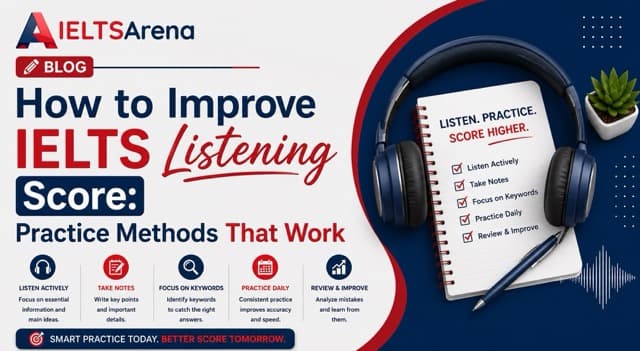
You understand spoken English fine. You follow movies, you chat with colleagues, you watch lectures online. Then the IELTS Listening recording starts, you blink, and suddenly three answers have slipped past while you were still writing the last one.
This gap between everyday comprehension and IELTS Listening performance is the most common frustration for test-takers. The good news is also the most important news: Listening is the most trainable of the four IELTS skills. Learning how to improve IELTS listening is far less about your raw English level and far more about technique, prediction, and focused practice.
This guide breaks down the IELTS Listening structure, the five most common failure points, the seven practical methods that actually move band scores, and the routine that lifts a Band 6 to a Band 7.5 in a few focused weeks.
How IELTS Listening Is Structured
The Listening test has four sections, 40 questions total, and runs approximately 30 minutes plus answer transfer time on paper tests. On the computer-based test, there is no separate transfer window — you type answers as you go.
Section 1 is a conversation between two people in an everyday social context, such as booking accommodation or registering for a class.
Section 2 is a single-speaker monologue on a general topic, often a tour, an announcement, or a public information talk.
Section 3 is a conversation between two to four people in an academic context, such as a tutorial discussion.
Section 4 is a single-speaker academic lecture, typically the hardest section. It runs as an unbroken five-minute talk on a specialised topic.
You hear each recording only once. There is no rewind, no pause, no replay. Every answer must be captured in real time.
Advertisement
Why Common Approaches Fail
Five recurring mistakes explain why strong English speakers stall at Band 6.5 or 7.0.
Passive exposure without specific training. Watching English shows builds general comprehension but does not train the specific test skills: predicting answers, catching information in a single play, and transcribing accurately under time pressure.
Not reading questions during preparation time. Each section gives you a few seconds to preview the questions before the audio starts. Many candidates do not use this window strategically. They wait for the audio instead of reading ahead and predicting what answer type each question needs.
Freezing after a missed answer. Miss one answer, panic, and the chain reaction begins. You are still thinking about the missed answer when the next one passes you. One missed mark becomes three.
Spelling and grammar errors in transcription. A correctly heard word spelled wrong scores zero. Plurals missed, wrong word forms, exceeded word limits — all count as wrong, regardless of whether you understood the audio.
Ignoring question type strategy. Multiple choice, form completion, matching, and map labelling each have different optimal approaches. Treating them all the same costs marks on every section.
A Real Student Story: Amara from Nigeria
Amara, a 27-year-old graduate from Lagos applying to a Canadian master's program, needed Band 7 in Listening for her admission requirement. She scored Band 6.0 on her first attempt and Band 6.5 on her second, even though she watched English-language news daily.
"I understood the recordings perfectly," she said. "But I was always one step behind. I would write down an answer and the audio had already moved on to the next question."
The pattern was twofold. She wasn't predicting answer types in the preparation seconds — she was waiting for the audio passively. And in Section 4, she was losing concentration around the four-minute mark and missing two or three answers in quick succession.
Amara changed her approach. She drilled the question-preview habit until reading ahead became automatic. She practised typing answers cleanly under timing. She built a personal spelling list of words she kept getting wrong: accommodation, Wednesday, February, separate.
Within three weeks she scored Band 7.5 in Listening on a full mock. Her English never changed. Her technique did.
What the Data Shows
According to test performance data published by the IELTS partners, the global mean Academic Listening band sits around 6.2 to 6.4, consistently above the global mean Writing band. Listening responds well to training because the gap between everyday comprehension and IELTS-specific performance is closable in weeks, not months.
Examiner reports consistently note that many lost marks in Listening come from spelling mistakes, missed plurals, and answers that exceed the word limit, rather than from failure to understand the audio. These are technique errors, not English errors.
Question types are not evenly distributed across the test. Section 1 leans heavily on form completion and short-answer questions. Section 2 often includes map labelling. Section 3 frequently uses matching and multiple choice. Section 4 uses note completion and sentence completion most often. Knowing what type of question to expect in each section sharpens your preparation.
The single biggest lever is question prediction during the preparation window. Candidates who train to read ahead and predict answer types in those few seconds consistently outscore candidates who use the time passively.
Seven Practical Methods That Work
These are the seven habits that consistently lift Listening band scores.
1. Use preparation seconds to read and predict answer types. Before each section, scan the questions and ask: is the answer a name, a number, a date, a noun, a plural? This primes your brain to catch the right information.
2. Practise simultaneous listening and writing. This is a learnable skill. Train it by doing dictation exercises: play a sentence, write it as you hear it, check accuracy. Build up to longer chunks.
3. Drill spelling of common test answers. Words like accommodation, Wednesday, February, separate, opportunity, and necessary appear repeatedly. Keep a personal list of words you misspell and review it weekly.
4. Train with all four accents. IELTS Listening uses British, Australian, North American, and New Zealand accents. Each pronounces vowels, dates, and numbers slightly differently. Practise with all four so no accent surprises you on test day.
5. Learn each question type separately. Drill multiple choice on its own. Drill matching on its own. Drill map labelling on its own. Once each is automatic, combine them in full mock tests.
6. Do full timed sections for stamina. Section 4 demands sustained concentration for five minutes. Build that stamina by completing full Listening tests under timed conditions at least twice a week.
7. Review every wrong answer with the transcript. After each mock, listen to the recording again with the transcript open and identify the exact moment you lost each answer. This precise diagnosis is what closes the gap from one mock to the next.
How IELTSArena Helps You Improve Listening
The fastest way to improve Listening is targeted practice with feedback that shows you where each lost mark came from. IELTSArena gives you that diagnostic visibility.
The platform delivers full Listening tests in the real CBT interface, with authentic audio and the single-play format you will face on test day. The audio rotates across all four accents so you are not surprised by any voice in the real exam.
After each test, IELTSArena shows your accuracy by question type and section, so you can see whether your losses cluster in Section 4 lectures, in matching questions, or in spelling errors. The transcript is available for every recording, so you can replay any moment you missed and review the exact word or phrase that cost you the mark.
For candidates targeting Band 8 in Listening, IELTSArena's progress dashboard tracks your section-by-section accuracy across every mock, so you can confirm your weakest section is climbing before exam day.
Start your free Listening practice on IELTSArena and take a full mock in the real CBT interface today.
Self-Diagnosis: Is Your Listening Practice Working?
Run through these honestly before your next session.
- Do you read and predict during the preparation seconds, or do you wait passively for the audio?
- Can you note one answer while tracking the next, or does the audio overtake you?
- Do you spell common test answers correctly under pressure?
- Are you comfortable with all four accents IELTS uses?
- Can you maintain concentration through a full five-minute Section 4 lecture?
A "no" on any of these is the precise habit to target in your next practice session.
Take a Free Listening Mock Today
Stop guessing why your Listening score is stuck. Take one free timed Listening test on IELTSArena and you will see your accuracy section by section, with the transcript ready for the exact moments you lost marks.
Take Your First Free Listening Mock on IELTSArena →
Frequently Asked Questions
How do I improve from Band 6 to Band 7.5 in IELTS Listening?
Moving from Band 6 to Band 7.5 usually means cutting mechanical errors and lifting concentration in the harder sections. Focus on four specific habits: read and predict answer types during the preparation seconds rather than waiting for the audio, drill the spelling of common test answers like accommodation and Wednesday, build stamina for Section 4 with full timed sections, and review every wrong answer against the transcript to identify the exact miss point. IELTSArena's question-type accuracy breakdown shows which patterns are costing you the most marks, so your practice targets the real gap.
What is the best daily routine to improve IELTS Listening?
A 45 to 60 minute daily session works well for most candidates. Combine one full timed section with transcript review identifying the exact moments you lost marks, plus targeted spelling and accent drills. Three times a week, complete a full four-section test under timed conditions to build stamina. Consistency matters more than volume, so practising daily for three weeks beats occasional marathon sessions. IELTSArena's progress dashboard tracks your section-by-section improvement across every mock so you can confirm the routine is producing real gains.
How do I get used to different accents in IELTS Listening?
Train all four accents specifically: British, Australian, North American, and New Zealand. Each pronounces vowels, dates, and numbers slightly differently, which is exactly where candidates lose marks when an unfamiliar accent appears. Practise with audio that rotates across all four rather than sticking to the accent you find most comfortable. Focus on how each accent pronounces common answer points like months, days of the week, and numbers. IELTSArena's Listening audio rotates across all four accents so no voice surprises you on test day.
Why do I understand English easily but still score low in IELTS Listening?
This is one of the most common frustrations, and it has nothing to do with your English level. The test measures specific skills beyond comprehension: predicting what information to wait for, catching answers in a single play, transcribing them accurately within word limits, and staying focused through a long Section 4 lecture. Casual comprehension does not train these skills. Targeted practice with feedback on where you lose marks — spelling, distractor traps, lost concentration — closes the gap. Most fluent English speakers can lift Listening by a full band within three to four weeks of focused practice.
Do English movies and TV shows help improve IELTS Listening?
Watching English shows helps, but only as a supplement to structured practice. It builds general comprehension, exposes you to natural speech speed, and familiarises you with different accents, all of which support your Listening. However, it does not train the specific exam skills: question prediction, single-play accuracy, transcription under time pressure, and stamina through a five-minute academic lecture. For real band improvement, combine entertainment listening with timed IELTS practice tests on a platform like IELTSArena that gives you scored feedback and transcripts for review.
![Best IELTS Book for Self Study [2026]: The 2-Book Rule Nobody Tells You](/_next/image?url=%2Fblog%2Fcover-best-ielts-book-for-self-study.jpeg&w=3840&q=75&dpl=dpl_DXyM63YUHjigMzg2B75HT6s5tc1D)