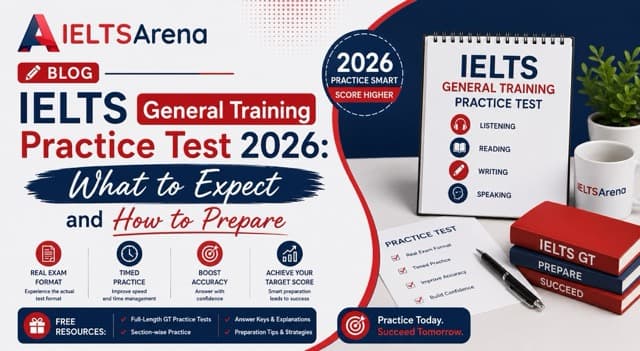
Most people preparing for the IELTS General Training test discover one uncomfortable truth about three weeks before exam day: practicing with Academic materials for months has left them unprepared for the specific format they will actually face. The reading texts are different. The writing task is different. Even the way band scores are applied differs between the two versions. If you are taking General Training for a work visa, permanent residency, or immigration purposes, you need an IELTS general training practice test that mirrors the real exam, not a generic IELTS drill that misses the mark entirely.
What Makes IELTS General Training Different from Academic
The IELTS General Training test shares its Listening and Speaking modules with the Academic version, but the Reading and Writing sections are completely distinct.
In the Reading module, General Training candidates read three sections of text. The first section contains short, everyday texts such as notices, advertisements, schedules, and workplace signs. The second section features texts related to work, such as job descriptions, company policies, and training documents. The third section is a longer, more complex passage similar in difficulty to Academic reading, but still grounded in real-world contexts rather than academic research.
The Writing module is where the difference is most significant. Instead of describing a graph or chart in Writing Task 1, General Training candidates write a formal, semi-formal, or informal letter of at least 150 words. This requires a completely different skill set, including knowledge of appropriate salutations, register awareness, and how to structure a request or complaint clearly.
Listening and Speaking are identical across both versions. Band score calculation uses the same nine-band scale, but the raw score required to achieve a given band in the Reading module is slightly different because the text difficulty is calibrated differently.
Understanding this distinction is the first step. The second step is practicing with the right materials.
Advertisement
Why Candidates Consistently Underperform on General Training Reading
The most common mistake candidates make when preparing for IELTS General Training is treating all three reading sections with the same strategy.
Section 1, which contains short functional texts, rewards fast and accurate scanning. There is no time to read every word. Candidates who slow down to read carefully in Section 1 often run out of time before reaching Section 3. But candidates who rush through Section 3 with the same scanning speed miss the inference questions that require deeper comprehension.
A second problem is unfamiliarity with workplace language. Many candidates who have not worked in English-speaking environments struggle with the vocabulary in Section 2, which frequently uses terms related to HR policies, health and safety guidelines, and professional communication. Without deliberate exposure to these text types during preparation, the vocabulary feels unfamiliar under exam conditions.
A third issue is letter writing. Most candidates preparing for GT Writing Task 1 know the general format but have never practiced matching tone to the situation. A formal letter to a bank manager and a semi-formal letter to a landlord require different registers, different closing phrases, and different levels of directness. Without structured feedback on tone, candidates often blend registers inappropriately and lose marks in the Task Achievement band.
Why Common Preparation Approaches Fail GT Candidates
Many candidates preparing for the IELTS general training practice test rely on two approaches that consistently fall short.
The first is using Academic IELTS practice books as their primary resource. Publishers often bundle GT and Academic content together, but the Academic reading passages are harder and the GT reading sections are genuinely different in structure. Drilling on Academic texts builds comprehension skill but does not build the fast-scanning and skimming strategies that GT Reading requires.
The second approach is practicing writing without feedback. A candidate can write fifty letters but not improve if no one is checking whether the tone is appropriate, whether the three bullet points in the task prompt have been addressed, or whether the word count is accurate. Self-review has limits. Without an external evaluator using the IELTS marking criteria, candidates repeat the same errors and entrench bad habits.
Amara's Experience: From Repeated Setbacks to a Band 7
Amara Okonkwo, a nurse from Nigeria preparing to apply for a skilled worker visa in Canada, sat the IELTS General Training test twice before changing her approach. After both attempts, her Writing score was consistently one band below her target.
"I kept writing letters that I thought were formal, but the examiner kept scoring me lower for coherence and task achievement," she said. "I realized I was addressing the bullet points from the prompt but not in the right order, and my tone was mixing formal and casual phrases in the same paragraph."
On her third attempt, Amara used IELTSArena to run full timed general training practice tests, submitted her letters for AI writing feedback, and received detailed comments on tone, structure, and whether each bullet point had been fully developed. She scored a Band 7 overall, with a 7.0 in Writing, which met her visa requirements.
Data on General Training Candidate Performance
Based on published IELTS data and testing research, several patterns emerge consistently among General Training candidates globally.
Around 68 percent of GT candidates score lower in Writing than in any other module on their first attempt, with Task Achievement being the most frequently penalized criterion in Task 1. This reflects a widespread gap in letter-writing preparation compared to essay-writing practice.
In Reading, the average score gap between Section 3 and Sections 1 and 2 is significant, with many candidates losing points specifically on inference and vocabulary-in-context questions in the longer passage. Research on IELTS preparation indicates that candidates who complete at least five full timed GT reading tests before their exam date score on average 0.5 to 1.0 bands higher than those who practice reading in untimed conditions.
For Listening, performance is broadly similar between GT and Academic candidates, but GT candidates who specifically practice multiple-choice and form-completion question types within authentic listening scenarios perform better than those who only practice with Academic listening extracts from lectures and academic talks. GT Listening uses conversations and monologues from everyday and professional contexts, not university lectures.
The Right Approach to IELTS General Training Preparation
A structured, format-specific preparation strategy for the IELTS general training practice test should include the following steps.
First, take one full diagnostic test under timed exam conditions before you begin studying. Score each section honestly using the official marking criteria. This gives you a baseline and shows you exactly where the gaps are, rather than where you assume they are.
Second, dedicate specific practice sessions to each section type. Practice GT Reading Section 1 with a strict 15-minute limit. Practice Section 2 with attention to workplace vocabulary. Practice Section 3 with a focus on inference questions. Do not merge all three sections into generic comprehension practice.
Third, write at least one full Task 1 letter every three days and seek detailed feedback on tone, task achievement, and coherence. Use the three bullet points in the task prompt as a checklist and confirm that each has been addressed fully and in the correct order.
Fourth, practice Listening with a mix of monologues and conversations from professional and everyday contexts. Pay attention to spelling during note-taking exercises since incorrect spelling on the answer sheet costs marks.
Fifth, record yourself for Speaking practice. Listen back and assess fluency, use of connectors, and whether you are developing answers or stopping too early. For Part 3, practice giving extended responses on societal topics even when you are not an expert on the topic.
Sixth, schedule at least two full mock exams in the final three weeks before your test date, including all four modules in one sitting to simulate actual exam endurance.
How IELTSArena Supports General Training Candidates
IELTSArena is built specifically to support candidates across all four IELTS modules, including full General Training practice tests that replicate the exact format of the real exam.
The IELTSArena Reading module includes GT-specific practice tests with Section 1 everyday texts, Section 2 workplace documents, and Section 3 extended passages, all timed to match official exam conditions. Each test is followed by detailed answer explanations that teach you why the correct answer is correct, not just what it is.
For Writing, IELTSArena provides AI-powered feedback on GT Task 1 letters that evaluates tone appropriateness, task achievement, cohesion, and lexical resource. You receive a breakdown by band descriptor, so you know exactly which criterion is holding your score back and what to do about it.
The Speaking module on IELTSArena lets you record Part 1, Part 2, and Part 3 responses and receive automated feedback on fluency, vocabulary range, and pronunciation patterns. You can also access expert tutor feedback from certified IELTS examiners for a more detailed assessment.
IELTSArena tracks your progress across every practice session, so you can see improvement trends over time and identify whether your weak areas are improving or plateauing. For candidates preparing for visa or immigration purposes with a firm exam date, IELTSArena's progress analytics help you adjust your preparation strategy before it is too late.
Self-Diagnosis: Where Are You in Your GT Preparation?
Use these questions to evaluate your current readiness for the IELTS General Training test.
Can you complete GT Reading Section 1 accurately in under 15 minutes while still checking your answers? If you are spending longer than this, your scanning speed needs work before exam day.
Have you written at least five GT Task 1 letters covering formal, semi-formal, and informal register? If your letter practice has only covered one register or one topic type, you are exposed to a wide range of potential task scenarios.
Do you know the specific vocabulary associated with workplace documents such as job descriptions, health and safety policies, and training schedules? If this vocabulary feels unfamiliar, Section 2 of the Reading module will be harder than it needs to be.
Have you taken at least one full IELTS general training practice test under proper timed conditions, all four modules in one sitting? Stamina and time management across four hours is a skill that only practice can build.
Have you received any external feedback on your Writing from a source that uses the official IELTS band descriptors? Self-assessment has a ceiling. Without criteria-referenced feedback, you cannot know what band your letters would actually receive from an examiner.
Start Your IELTS General Training Practice on IELTSArena
If your exam date is approaching or you are planning your preparation now, the most important next step is to practice with materials built specifically for the General Training format.
IELTSArena gives you access to full IELTS GT mock tests, AI writing feedback, speaking practice with automated scoring, and progress tracking designed around your target band and timeline.
Take Your First Free GT Mock on IELTSArena →
Frequently Asked Questions
What is in the IELTS General Training practice test that is different from Academic?
The Reading and Writing modules differ significantly. GT Reading includes short functional texts (notices, advertisements, workplace documents) across three sections, while Academic Reading uses three longer, academic-style passages. GT Writing Task 1 requires a letter of at least 150 words, while Academic Task 1 requires a description of a graph, chart, table, or diagram. Listening and Speaking are identical across both versions.
How hard is the IELTS General Training test compared to Academic?
The General Training Reading module is generally considered less linguistically complex than Academic Reading, but this does not mean it is easier to score highly. The question types and time constraints require fast scanning and skimming rather than deep reading. Many candidates find the letter-writing requirement in GT Writing Task 1 challenging because tone and register precision are strictly assessed.
Where can I take a free IELTS General Training practice test online?
IELTSArena offers free IELTS General Training practice tests that replicate the full exam format, including GT-specific reading sections and writing tasks. After registering at ieltsarena.com, you can access timed mock tests with detailed feedback and scoring.
Is the IELTS General Training Reading easier than Academic Reading?
GT Reading texts are generally less academic in vocabulary and complexity than Academic Reading passages, but the time pressure and question variety make it challenging in its own way. Sections 1 and 2 require fast scanning across multiple short texts, which candidates who are accustomed to slower, deeper reading often find difficult under timed conditions.
How do I prepare for IELTS General Training Writing Task 1 letter writing?
Start by understanding the three register types: formal (to an organization or person in authority you do not know), semi-formal (to someone you know in a professional context), and informal (to a friend or family member). Practice writing letters that address all three bullet points in the task prompt, in the correct order, without mixing registers. Use IELTSArena's AI writing feedback to assess whether your tone is appropriate and whether your task achievement meets the band descriptor requirements.