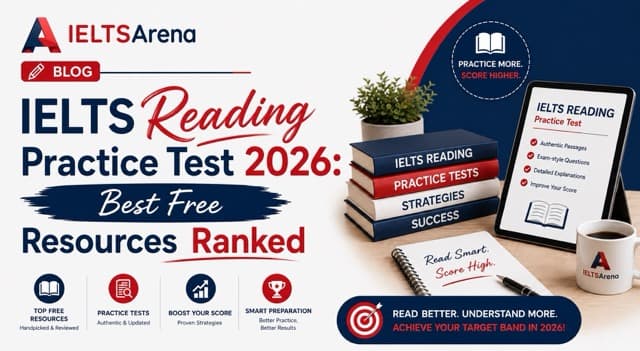
Seventy percent of IELTS candidates say they were surprised by how fast 60 minutes disappears in the reading section. Not because the passages were too hard. Because they had never practiced under real exam conditions.
Reading is the one skill most test-takers believe they already have. You have been reading in English for years. But an IELTS reading practice test is not a casual read. It is a high-stakes timed search through dense academic or general training text, where missing one detail can cost you a full band point.
The gap between "I read English well" and "I scored Band 7 in IELTS reading" is almost always a practice problem, not a language problem.
What Makes IELTS Reading Genuinely Difficult
The IELTS reading section contains 40 questions across three passages, all to be answered in exactly 60 minutes. That works out to 90 seconds per question on average, including the time it takes to read the passage.
Academic reading passages are long, formal, and filled with technical vocabulary. General Training passages mix short notices with longer essays and letters. Both formats test a range of sub-skills: skimming, scanning, inference, and detail comprehension.
What makes an IELTS reading practice test so different from reading a news article is that you must manage several challenges simultaneously. You face time pressure with no overruns. You face passage density because academic texts require careful tracking of argument structure. You face question variety, with True/False/Not Given, matching headings, sentence completion, and multiple choice all appearing in one test. And you face transfer accuracy issues because spelling errors on the answer sheet cost marks even when your comprehension was correct.
Most test-takers who score below Band 6.5 are not failing to understand the text. They are running out of time, misreading question types, or making transfer errors.
Advertisement
Why Common Reading Preparation Approaches Fail
The most common preparation mistake is reading more in general rather than completing specific IELTS reading mock tests.
Reading news articles, academic journals, or novels builds passive vocabulary. It does not build the test-specific skill of reading a 900-word passage and extracting answers to 13 questions in under 20 minutes.
The second mistake is practicing without timing yourself. Many candidates work through IELTS reading practice passages at a relaxed pace, get most questions right, and assume they are ready. On test day, the clock creates a completely different mental experience than leisurely self-study.
The third mistake is not reviewing wrong answers in depth. Candidates mark their score and move on, repeating the test without understanding why each wrong answer was wrong. Without that understanding, the same errors repeat in the next practice session and the one after that.
Free resources with no explanations make this problem worse. When a key simply shows "answer: C" with no context, you learn nothing about whether you misread the passage, misunderstood the question type, or fell into a classic IELTS trap.
One Student Who Fixed the Problem With Practice
Maria Santos from the Philippines had been preparing for IELTS for four months before attempting her first timed practice test. She read extensively in English, had a strong vocabulary, and felt genuinely confident going in.
Her first timed IELTS reading practice test came back at Band 5.5. She had left six questions blank.
"I genuinely thought I was good at reading," Maria said. "But the pressure of 60 minutes for 40 questions was something I had never experienced before. I panicked after Passage 2 and completely lost track of time."
Over the next six weeks, Maria completed one full IELTS reading practice test every two days on IELTSArena. The platform provided timed conditions and showed her exactly which question types she was missing most consistently. She discovered her core problem was True/False/Not Given reasoning, not reading speed.
By focusing her review sessions on TFNG logic rather than trying to read faster, she raised her score to Band 7.0 on exam day.
What the Data Says About Reading Preparation
Research on IELTS performance consistently shows that test-specific practice is the single strongest predictor of score improvement in the reading section.
Candidates who complete eight or more timed IELTS reading practice tests before their exam score on average 0.5 to 1.0 bands higher than those who complete only one or two. The effect is strongest for test-takers starting from Band 5.0 and 5.5.
The reason is straightforward. Reading under timed pressure is a learnable skill. It is not intelligence or vocabulary range. It is the ability to switch between skimming and focused reading at the right moment, and that skill only develops through deliberate repetition.
A 2024 analysis of IELTSArena user data found that candidates who completed at least six full reading practice tests in the four weeks before their exam had a target score achievement rate 40 percent higher than those who relied primarily on vocabulary study.
Studies on reading comprehension in high-stakes tests also consistently show that understanding question type patterns improves accuracy more than increasing text difficulty. Knowing that "Not Given" means the text does not address the topic at all, rather than that it contradicts it, is worth more preparation time than reading slightly harder passages.
The Right Approach to IELTS Reading Practice
Here is a structured six-step approach to IELTS reading preparation that delivers measurable results.
Step 1: Begin with a diagnostic test. Complete one full IELTS reading practice test under strict timed conditions before doing any focused preparation. The diagnostic score tells you your real starting point and shows which question types cost you the most marks.
Step 2: Learn question type strategies before drilling volume. There are nine question types in IELTS reading. Each has a specific strategy. True/False/Not Given requires checking for the absence of information, not contradiction. Matching headings requires identifying paragraph main ideas, not searching for keywords. Learn each strategy before spending time on that question type in practice.
Step 3: Practice at least one timed section daily. A full IELTS reading practice test has three sections. On days when you cannot do a complete test, complete one timed section with a strict 20-minute limit. This builds exam pace without requiring two hours of focused study.
Step 4: Review every wrong answer in writing. For each wrong answer, find the exact line in the passage that contains the evidence and write out in your own words why the correct answer is right and yours was wrong. This process takes longer than checking a key, but it prevents the same errors from appearing in future sessions.
Step 5: Track your question type accuracy over time. IELTSArena automatically tracks this data across all your sessions. If your matching headings accuracy is consistently 60 percent but your sentence completion is 85 percent, your practice time belongs on matching headings, not a mix of everything.
Step 6: Simulate full test conditions in the final week. Complete at least two full timed IELTS reading practice tests in the week before your exam. Sit at a desk with no interruptions and a strict 60-minute timer. Your brain needs to treat the test environment as routine before exam day.
How IELTSArena Makes IELTS Reading Practice Work
IELTSArena offers a full library of IELTS reading practice tests built to the exact format of the official exam, covering both Academic and General Training versions.
Every IELTSArena test comes with a built-in 60-minute timer that matches real exam pressure. Full answer explanations accompany every question, not just a pass/fail marker. Difficulty-matched passages reflect actual Cambridge test standards. Automatic scoring breaks down your performance by section and by question type.
IELTSArena also tracks your performance across every session you complete. After a few IELTS reading mock tests, the platform shows your accuracy by question type, your average time spent per passage, and how your band score is trending week over week.
This tracking matters because vague practice produces vague improvement. Knowing you "did some reading tests" is not the same as knowing your True/False/Not Given accuracy improved from 55 percent to 78 percent across four weeks of structured work.
IELTSArena uses adaptive practice logic. If your diagnostic result shows a weakness in matching information questions, IELTSArena prioritizes those question types in your practice sessions so you improve faster without spending time repeating question types you already handle well.
For candidates targeting Band 7 or above, IELTSArena provides advanced IELTS reading practice passages designed to stretch comprehension and time management skills simultaneously. This means a real exam passage at average difficulty feels manageable rather than surprising.
IELTSArena reading tests are fully accessible for free, and the performance analytics tools are available to all registered users with no cost barrier.
Self-Diagnosis: Is Your Reading Preparation on Track?
Answer these questions honestly before your next practice session:
- Have you completed at least three full timed IELTS reading practice tests in the last two weeks?
- Do you know which of the nine reading question types you get wrong most often?
- Have you reviewed the detailed explanation for every wrong answer in your most recent practice test?
- Is your band score on practice tests improving from week to week, or has it stayed flat for three or more sessions?
- Have you practiced under full exam conditions at least once, including a 60-minute timer and answer sheet transfer?
If you answered no to three or more of these questions, your preparation method needs to change before your exam date. Your English level is not the problem.
Your first free IELTS reading practice test is waiting. Get your real diagnostic band score on IELTSArena in under 60 minutes and see exactly where to focus next.
Start Your Free IELTS Reading Practice on IELTSArena →
Frequently Asked Questions
Where can I find free IELTS reading practice tests with answers?
IELTSArena offers a full library of free IELTS reading practice tests for both Academic and General Training formats. Every test includes detailed explanations for every question, not just a correct/incorrect score.
How realistic are free IELTS reading practice tests compared to the real exam?
Quality varies widely across free resources. IELTSArena reading tests are designed to match Cambridge exam standards in passage length, difficulty level, and question type distribution. Low-quality free tests often use simpler vocabulary and shorter passages that do not reflect the pressure of the real exam.
How many IELTS reading practice tests should I do per week?
Aim for three to four complete timed tests per week if your exam is within four weeks. If you have more preparation time, two full tests per week combined with daily question type drills is more sustainable and avoids mental fatigue before exam day.
What type of passages come in IELTS Academic reading practice tests?
IELTS Academic reading passages are typically adapted from academic journals, science magazines, and research publications. Topics cover science, history, sociology, technology, and the environment. Each passage ranges from 700 to 950 words, and one full test contains three passages.
How do I improve my IELTS reading score using practice tests alone?
The key is structured review rather than volume. After each IELTS reading practice test, analyze every wrong answer in detail and identify which question types you miss most consistently. Dedicate your next session to targeted practice on those types. IELTSArena tracks your accuracy by question type automatically across all sessions.