
Section 3 of the IELTS Listening test is where distractors do the most damage. It is a 2 to 4 speaker academic discussion where speakers agree, disagree, change their minds, correct each other, and interrupt. If you keep catching the first opinion mentioned instead of the final confirmed one, start a free Section 3 practice on IELTSArena to diagnose exactly where in the conversation you are losing marks. This is the single most common Band 6.5 pattern we see in IELTSArena Listening analytics, and it is fixable in four weeks with the right framework.
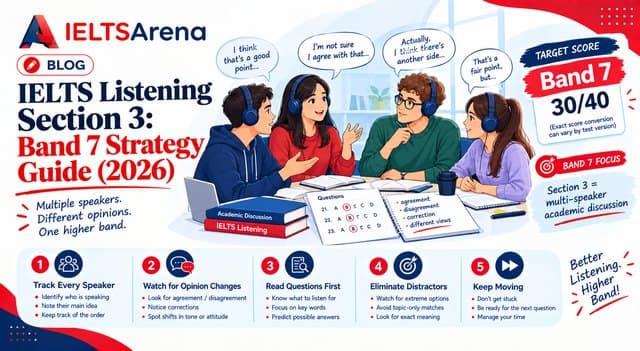
Quick answer: IELTS listening section 3 is the third section of the Listening test. It is an academic conversation between 2 to 4 speakers (typically students discussing coursework with a tutor, or two students planning a project). The audio runs approximately 7 to 8 minutes and contains 10 questions, usually a mix of multiple choice, matching, and sentence completion. Section 3 is scored on the same 40-question raw-score scale as the rest of the Listening test. The core challenge is not vocabulary. It is tracking which speaker holds which view through conversational distractors like corrections, interruptions, and false-start opinions. Candidates who master speaker-tracking lift their Section 3 scores by 3 to 4 marks within four weeks of focused drilling.
Try it before you read. If you suspect Section 3 is dragging your Listening band, drill one timed Section 3 under exam conditions before continuing. Take a free IELTS Listening practice test on IELTSArena and come back with your baseline. If accuracy is below 7 out of 10, the frameworks in this guide are specifically designed for the gap you are seeing.
In This Guide
- What Section 3 Actually Is
- Why Section 3 Is a Distractor Battlefield
- How Section 3 Compares to Sections 1, 2, and 4
- The 3 Speaker-Tracking Traps Unique to Section 3
- Section 3 Raw Scores and What They Mean for Your Band
- A Real Student's Story: 5/10 to 9/10 on Section 3 in Four Weeks
- The Data Behind This Section
- The Right Approach: A 4-Week Section 3 Fix Plan
- The Speaker-Tracking Notation System Band 8 Candidates Use
- The 5 Most Common Section 3 Distractor Patterns
- Sample Section 3 Excerpt with Speaker-Tracking Walkthrough
- How IELTSArena Helps You Drill Section 3 Specifically
- Self-Diagnosis: Is Section 3 Capping Your Band?
- Key Takeaways
- Frequently Asked Questions
Advertisement
What Section 3 Actually Is
IELTS listening section 3 is the third of four Listening sections. It is a multi-speaker academic conversation delivered at natural speed, typically running 7 to 8 minutes. The section contains 10 questions, which combine with the other three sections to make up the 40-question Listening test (full raw-score-to-band conversion published in our IELTS Band Score Chart and calculated instantly in the IELTS Band Score Calculator).
The number of speakers varies between tests. The most common formats are two students discussing a joint project, a student in a one-to-one tutorial with a lecturer, or a group of three students planning coursework with occasional input from a tutor. Up to four speakers can appear, though this is less common. Each speaker has a distinct voice, usually a different accent, and the conversation includes natural features like interruptions, agreements, disagreements, and corrections.
The question types in Section 3 skew heavily toward multiple choice (covered in depth in our dedicated guide on IELTS Listening Multiple Choice) and matching. Matching questions typically ask you to assign opinions, features, or responsibilities to specific speakers. Sentence completion and short answer questions also appear. Map labelling, which is a Section 2 feature, almost never appears in Section 3 (see the IELTS Listening Map Questions guide for where that question type does appear).
Why Section 3 Is a Distractor Battlefield
The single most important thing to understand about Section 3 is that it is designed to measure your ability to track speaker attribution under conversational pressure, not your ability to understand academic vocabulary.
Consider the mechanic. In Section 1 (two-speaker social conversation), one speaker is almost always the information-giver (the booking agent, the receptionist, the course coordinator) and the other is the information-receiver. Attribution is simple. In Section 2 (one-speaker social monologue), there is only one voice and no attribution problem at all. In Section 4 (one-speaker academic monologue, covered in detail in our IELTS Listening Section 4 guide), there is again only one voice, and the complexity shifts to sustained academic listening endurance.
Section 3 is the only section where tracking who said what is a required skill. The questions actively exploit this. A multiple choice question might ask "What does Maria think is the main problem with the research?" and the audio will contain three different opinions voiced in sequence by three different people, with Maria's actual view coming last after she listens to the others. Candidates who hear the first opinion and lock it in as the answer get the question wrong, because the first opinion was not Maria's.
This design pattern repeats throughout Section 3. The techniques covered in our general IELTS Listening Tips 2026 guide apply across all four sections, but Section 3 needs its own speaker-tracking framework on top of them to produce reliable Band 7-plus performance.
How Section 3 Compares to Sections 1, 2, and 4
Understanding where Section 3 sits in the overall Listening test is the fastest way to stop preparing for it the wrong way.
| Section | Format | Speakers | Context | Main challenge |
|---|---|---|---|---|
| Section 1 | Social conversation (booking, enquiry) | 2 | Everyday social | Spelling, numbers, dates |
| Section 2 | Social monologue (tour, announcement) | 1 | Everyday social | Topic shifts, lists |
| Section 3 | Academic conversation (students, tutor) | 2 to 4 | Academic | Speaker attribution, distractors |
| Section 4 | Academic monologue (lecture, talk) | 1 | Academic | Sustained concentration, note-taking |
Three distinctions matter most. First, Section 3 is the only section with 2 to 4 speakers. Every other section has either 1 or 2 speakers in a fixed information-giver / information-receiver pattern. Second, Section 3 is academic in register, which places it alongside Section 4 for the vocabulary load (environmental research, education policy, business studies, psychology, social sciences). Third, Section 3 question types skew heavily toward multiple choice and matching, both of which are built to exploit speaker attribution confusion.
For Band 6.5 candidates targeting IELTS Band 7 or Band 7.5, Section 3 and Section 4 together account for roughly 60 percent of the marks lost at this plateau. Drilling both sections in parallel over the same four-week window is the fastest known path from 6.5 to 7. Candidates aiming higher at Band 8 or Band 8.5 need near-perfect accuracy on Section 3 (9 out of 10 or 10 out of 10), which only comes from speaker-tracking mastery.
The 3 Speaker-Tracking Traps Unique to Section 3
Three specific traps account for most Section 3 marks lost at the Band 6 to Band 7 level.
Trap 1: Locking in the first opinion mentioned. Candidates hear speaker A give an opinion, decide that is the answer, and stop listening to speakers B and C who then disagree, modify, or override A's view. The correct answer is almost always the final confirmed position, not the first position stated. Fix: train yourself to hold three or four candidate answers in parallel until the question's named speaker explicitly commits to one.
Trap 2: Missing speaker-change cues. The audio uses subtle cues to signal who is about to speak: a name mentioned by another speaker ("What do you think, Maria?"), a change in voice characteristics, a specific interjection ("Actually, I would argue..."). Candidates who focus only on content words miss these cues and lose track of attribution. Fix: build a mental tag for each speaker (voice characteristics, typical interjections, position in the discussion) during the first 60 seconds of audio, then track the tags for the remaining 7 minutes.
Trap 3: Confusing agreement with endorsement. When speaker A says "Yes, that is interesting, but..." they are not agreeing with the previous speaker. The "but" signals the real position is about to be stated. Candidates who hear the "yes" and move on miss the actual answer. Fix: train yourself to recognise agreement markers (yes, exactly, right, true) as topic-continuation signals, not endorsement signals. The real position comes after the pivot word (but, however, although, that said, on the other hand).
These three traps are covered in training materials across the IELTS tutor industry, but structured drilling against them is the only intervention that produces reliable improvement. Candidates who read about the traps but do not drill against timed Section 3 practice almost always see no measurable improvement in their mock test scores.
Section 3 Raw Scores and What They Mean for Your Band
Section 3 scores on the same 1-mark-per-question scale as the rest of the test. Here is what different Section 3 performance patterns typically mean for your overall Listening band, assuming average performance across the other three sections.
If you consistently score 5 out of 10 on Section 3 with 8 out of 10 on Sections 1, 2, and 4, your overall raw score is roughly 29, which maps to Listening Band 6.5. This is the exact pattern that caps most candidates at Band 6.5 overall. Lifting Section 3 alone to 8 out of 10 pushes the overall raw score to 32, which maps to Listening Band 7. Lifting Section 3 to 9 out of 10 and maintaining 8 across the others reaches 33, which maps to Listening Band 7.5.
Combined with Section 4 improvement (see the dedicated IELTS Listening Section 4 guide for the parallel programme), fixing both weak sections in parallel is the fastest way to move from Band 6.5 to Band 7.5 overall. For context on how overall Listening band maps to visa and immigration requirements, see our IELTS Score for Canada PR 2026, IELTS Score for Australia PR 2026, and IELTS for UK Visa requirements guides.
Mid-article check. If your Section 3 accuracy is currently 4 to 6 out of 10 and your target is Band 7 overall, Section 3 drilling is likely your fastest path forward. Start structured Section 3 practice on IELTSArena with section-filtered question sets and automatic distractor-pattern analysis.
A Real Student's Story: 5/10 to 9/10 on Section 3 in Four Weeks
Hadi, a civil engineer from Beirut applying for Canadian Express Entry, needed CLB 9 for competitive CRS points. That meant IELTS General Training Listening Band 8 overall. His first two attempts returned Listening 7, held almost entirely by Section 3. Scores of 5 out of 10 and 6 out of 10 across the two sittings, against 8 to 9 out of 10 in the other three sections.
I could handle Section 4. The academic monologue was actually easier for me because it is just one person explaining something, and that is how my engineering training works. But Section 3 destroyed me every time. Three students arguing about a research project, nobody agreeing on anything, one person changing her mind halfway through. I kept hearing the first opinion and selecting it. By the time I realised the answer had moved, the audio was already on question 4.
His diagnostic showed two specific problems. First, he was not building speaker tags during the opening 60 seconds, so by minute 3 he could not reliably remember which voice belonged to which speaker name. Second, he was treating "yes" and "right" as endorsement signals rather than conversational continuation markers, which meant he was consistently selecting pre-pivot opinions instead of post-pivot positions.
He fixed both over four weeks. Week 1: speaker-tag drilling. He listened to the first 60 seconds of 20 different Section 3 recordings and practised writing a one-line tag for each speaker (voice type, accent, discussion role). Week 2: pivot-word training. He drilled recognition of pivot words (but, however, although, on the other hand) across TED Talks and BBC Radio podcasts. Week 3: full Section 3 drills under timed conditions, 3 sections per day. Week 4: full Listening mocks with Section 3 focus. His third sitting scored Section 3 at 9 out of 10. Overall Listening band: 8. Canada CRS score cleared the Express Entry draw cutoff two months later.
The techniques Hadi used are covered in the IELTS Study Plan 3 Months and the IELTS 30-Day Study Plan guides, and in the dedicated IELTS Score for Canada PR 2026 guide for the specific CLB 9 target. Candidates using the One Skill Retake route to lift Listening alone should see the IELTS One Skill Retake 2026 guide.
The Data Behind This Section
Cambridge Assessment English publicly reports that Section 3 and Section 4 together account for the majority of marks lost by candidates at the Band 6 to Band 7 plateau, with Section 3 specifically showing higher error rates on multiple choice and matching questions where speaker attribution is tested (Cambridge Assessment English, IELTS Test Statistics 2024 to 2025).
British Council guidance identifies "difficulty tracking multiple speakers under time pressure" as the primary cause of Section 3 underperformance at the Band 6.5 to Band 7 threshold. IELTS.org confirms the Listening test structure remains unchanged in 2026, with Section 3 continuing as a multi-speaker academic conversation of 7 to 8 minutes with two preview windows (IELTS.org, 2026 test specification).
For visa and immigration purposes, the specific listening skills tested in Section 3 (tracking multi-party professional discussions, identifying the final confirmed position, filtering corrections and interruptions) directly simulate workplace meetings. This is why Section 3 performance carries disproportionate practical weight for routes like the UK Skilled Worker Visa (B2 minimum 5.5 in each skill from January 2026), the NMC nursing registration, and Canadian Express Entry.
The Right Approach: A 4-Week Section 3 Fix Plan
Fixing IELTS listening section 3 is a focused four-week process. Treat it as a dedicated project separate from general Listening practice. The techniques overlap only partially.
Week 1: Build speaker-tag drilling. Spend 20 minutes per day on the opening 60 seconds of Section 3 recordings. Listen once, pause, and write a one-line tag for each speaker: voice characteristics (deep, high, soft, loud), accent (British, Australian, American, mixed), role in the discussion (asking questions, giving opinions, leading, following), and typical interjection patterns. Do this with 10 different Section 3 openings over the week. By end of Week 1, you should be able to generate a speaker tag within 60 seconds of audio automatically.
Week 2: Drill pivot-word recognition. Spend 15 minutes per day on pivot-word identification. Use real-world academic podcasts (BBC Radio 4 "The Life Scientific" is excellent for this, as is "In Our Time") and pause the audio each time you hear "but", "however", "although", "that said", "on the other hand", "actually", or "the thing is". These are the words that signal the real position is about to be stated. Train yourself to hear them as answer-location signals, not conversational filler.
Week 3: Full Section 3 drills under timed conditions. Do 3 Section 3 practice sections per day. Score each one and categorise your misses: speaker-attribution errors (you heard the opinion but assigned it to the wrong person), distractor-locking errors (you heard the first opinion and did not update when the final position was stated), or vocabulary errors (you did not understand the content). The error distribution tells you which sub-skill still needs work. The techniques in IELTS Listening Tips 2026 cover the general cross-section skills; this week focuses specifically on Section 3.
Week 4: Full Listening mocks with Section 3 focus. Take 2 full timed Listening mocks per week and track Section 3 accuracy specifically. Target 8 out of 10 or above consistently. If you reach that threshold, your Section 3 fix is complete. If you fall short, extend the plan by two weeks on the specific sub-skill (speaker tagging, pivot words, or distractor resistance) that is still weakest.
Parallel Section 4 drilling is highly recommended. The two sections together produce the Band 6.5 to Band 7 breakthrough. See the IELTS Listening Section 4 guide for the companion programme.
The Speaker-Tracking Notation System Band 8 Candidates Use
Section 3 note-taking is different from Section 4 note-taking. In Section 4, you track topic structure and factual content for a single speaker (framework explained in the Section 4 guide). In Section 3, you track speaker attribution and position changes across multiple voices.
The notation system Band 8 candidates use has three components.
Component 1: Speaker tags. As soon as the audio starts, assign each speaker a one-letter tag: T for the tutor, S1 for the first student, S2 for the second student. If voices sound similar, use voice characteristics instead: deep male voice, soft female voice, loud accented voice. The tag must be fast to write (one or two characters maximum).
Component 2: Position markers. When a speaker commits to an opinion, write their tag followed by a two-to-four word summary of the position: "S1: too expensive" or "T: method flawed". If a position changes mid-conversation, strike through the old position and write the new one: "S1: too expensive now says acceptable with modifications".
Component 3: Pivot flags. When you hear a pivot word (but, however, although), draw an arrow after the current speaker tag to signal that the real position is coming next: "S2 → ...". This visual flag reminds you not to lock in the pre-pivot statement as the answer.
With this three-component system, by the end of a Section 3 recording your notes should show a clear map of who said what, which positions changed, and where the final confirmed answer lies. Candidates targeting Band 7, Band 7.5, Band 8, or Band 8.5 should drill this notation daily until it becomes automatic.
The 5 Most Common Section 3 Distractor Patterns
Section 3 distractors follow five recurring patterns. Recognising them in real time is the Band 7-plus skill.
Pattern 1: The abandoned opinion. Speaker A gives an opinion. Speaker B presents a counter-argument. Speaker A hears it and says "You know what, you are right, I had not thought of it that way." The answer is Speaker B's position, not Speaker A's original.
Pattern 2: The self-correction. A single speaker starts a sentence, interrupts themselves, and restates. "I thought the main cause was... actually no, that is not quite right, the main cause is X." The answer is X, not the pre-correction statement.
Pattern 3: The hypothetical. A speaker presents a position as a possibility they are considering, not a conclusion they have reached. "Some might argue it is X, but..." signals that X is not the answer. The answer comes after the "but".
Pattern 4: The multi-position fence-sitter. A speaker lists two or three possible views without committing to one. Then a direct question forces commitment. The answer is the final committed position, not any of the earlier possibilities.
Pattern 5: The silenced minority. In a 3-speaker discussion, two speakers agree and one disagrees. The question asks about the group consensus, not the dissenting view. Candidates who focus on the loudest or most-interrupted voice get this wrong.
Each pattern has a signature verbal marker. The abandoned opinion signals with "you are right", "I had not thought of it", or "fair point". The self-correction signals with "actually", "wait", "sorry". The hypothetical signals with "some might argue", "you could say", "in theory". The multi-position fence-sitter signals with "on the one hand... on the other hand". The silenced minority appears when the discussion moves on from a dissenting view without addressing it. Drill these five markers for one week and your pattern-recognition accuracy will visibly improve.
Sample Section 3 Excerpt with Speaker-Tracking Walkthrough
Here is a sample Section 3 excerpt covering a university coursework discussion, with notes a Band 8 candidate would take during the audio.
Audio excerpt (approximately 70 seconds of a longer discussion):
Tutor: So Maria, Jun, how is the research project coming along? What have you found so far on urban cycling adoption?
Maria: Well, we started by looking at infrastructure. We thought the main driver was dedicated cycle lanes. The data from Amsterdam seemed to confirm it. But then Jun pointed out we had missed something important.
Jun: Right. The Amsterdam data looks compelling until you compare it with Copenhagen. Both cities have similar lane coverage, but Copenhagen has 40 percent higher cycling adoption. So infrastructure alone cannot be the main driver.
Tutor: Interesting. So where did that lead you?
Jun: We shifted focus to cultural attitudes toward cycling. In Copenhagen, cycling is seen as the default adult transport mode. In Amsterdam too, but less strongly. In Melbourne, where we also pulled data, cycling is still viewed as recreational rather than as transport.
Maria: Which brings us to our current thinking: infrastructure is necessary but not sufficient. The real driver is cultural normalisation. Without that, cycle lanes get built and underused.
Tutor: That is a more sophisticated conclusion. Did you consider weather and topography as confounding variables?
Jun: Yes, but when we controlled for both, the cultural factor still explained more variance than any other single variable.
Band 8 candidate's notes during the audio:
"Topic: urban cycling adoption S1 (Maria, soft Spanish-accented): initially infrastructure, specifically cycle lanes. Amsterdam data. S2 (Jun, deeper voice): disagreed, cited Copenhagen counter-example. 40% higher adoption same infra. T: asked where that led. S2: shifted to cultural attitudes. Copenhagen vs Amsterdam vs Melbourne. S1 (position change): now says infra necessary but not sufficient, cultural normalisation is real driver. T: asked about weather/topography. S2: controlled for both, cultural factor still strongest."
Notice how the notes capture: speaker tags (S1, S2, T), initial positions, position changes (Maria moved from "infrastructure is main driver" to "cultural normalisation is main driver"), and the current confirmed conclusion. A multiple choice question asking "What do Maria and Jun now consider the primary driver of cycling adoption?" has one correct answer: cultural normalisation. Candidates who locked in Maria's opening position (infrastructure) got it wrong.
For practice with Section 3 excerpts at multiple band levels, see the Free IELTS Listening Practice Test 2026. Candidates also need to drill the sibling IELTS Listening Multiple Choice and IELTS Listening Map Questions question types for complete Listening coverage.
How IELTSArena Helps You Drill Section 3 Specifically
IELTSArena's Listening library lets you filter practice by section, so you can drill Section 3 in isolation without taking a full 40-question test every session. Each Section 3 practice runs the CBT interface used in the real exam, with the two preview windows timed exactly as in the official test and the audio delivered by trained voice actors covering the full range of IELTS accents (British, Australian, American, Canadian, mixed-international).
The platform's analytics track your Section 3 accuracy separately from Sections 1, 2, and 4, which is critical for the diagnostic work this guide describes. If your Section 1 average is 9 out of 10 and your Section 3 average is 5 out of 10, that four-point gap is the specific intervention point, and IELTSArena's dashboard surfaces it directly.
IELTSArena's question-type analytics also break down your Section 3 errors by category (multiple choice, matching, sentence completion), so you can see whether the issue is attribution-based or vocabulary-based. For candidates targeting Band 7, Band 7.5, or above, this granularity is what makes four-week improvement realistic. The platform also provides full Academic Practice Tests, General Training Practice Tests, and section-by-section results.
Start your free IELTS Listening practice on IELTSArena and take a Section 3 practice section this week.
Self-Diagnosis: Is Section 3 Capping Your Band?
Work through these questions honestly against your last Listening practice session or mock test.
Compare your Section 3 score to your Section 1 score. Is there a gap of 2 marks or more? When a multiple choice question in Section 3 asks about a specific speaker's opinion, do you reliably attribute views to the correct speaker, or do you sometimes select the first opinion you heard without checking whose view it was? Do you notice pivot words (but, however, although) in real time, or do you only recognise them after the audio has moved on? Can you build a mental tag for each speaker within the first 60 seconds of audio, or do voices blur together by minute 3? When one speaker self-corrects mid-sentence, do you update your answer, or do you lock in the pre-correction statement? When two speakers agree and one disagrees, can you identify which position the question is asking about?
If you hesitated on more than two of these, Section 3 is likely the specific gap holding your Listening band below your target. Drill speaker tagging and pivot-word recognition for four weeks and re-test.
For a broader cross-skill diagnostic, see our guides on IELTS Writing Mistakes to Avoid, IELTS Speaking Common Mistakes, and How to Practise IELTS Speaking Alone for parallel work on the productive skills.
Key Takeaways
- IELTS listening section 3 is a 7 to 8 minute academic discussion between 2 to 4 speakers with 10 questions. It is the only Listening section where tracking speaker attribution is a required skill.
- Section 3 is a distractor battlefield. The questions actively exploit speaker-attribution confusion, position changes, and pivot words. The correct answer is almost always the final confirmed position, not the first opinion stated.
- The three structural traps are: locking in the first opinion mentioned (fix with parallel candidate-answer tracking), missing speaker-change cues (fix with speaker tagging in the first 60 seconds), and confusing agreement with endorsement (fix with pivot-word recognition drilling).
- A three-component speaker-tracking notation system (speaker tags, position markers, pivot flags) is what Band 8 candidates use. Drill it until automatic.
- The five recurring distractor patterns (abandoned opinion, self-correction, hypothetical, multi-position fence-sitter, silenced minority) have signature verbal markers. Learn to spot them in real time.
- Four weeks of focused Section 3 drilling (speaker tagging, pivot words, timed sections, full mocks) typically moves accuracy from 5 out of 10 to 8 or 9 out of 10 for most candidates. Combine with parallel Section 4 drilling for the fastest Band 6.5 to Band 7.5 breakthrough.
Related Guides on IELTSArena
Listening cluster:
- IELTS Listening Section 4: The Academic Monologue Guide
- Free IELTS Listening Practice Test 2026: Audio and Full Answers
- IELTS Listening Multiple Choice: Why Students Lose Marks
- IELTS Listening Map Questions: Complete Strategy Guide
- IELTS Listening Tips 2026: Score Band 8-9 in Every Section
Reading cluster:
- IELTS Reading Tips: 10 Proven Strategies to Score Band 8
- IELTS Reading Skimming vs Scanning Explained
- IELTS Matching Headings: Stop Getting It Wrong
- IELTS Academic Reading vs General Training Reading
Band target posts:
- IELTS Band 6: How to Reach It
- How to Get Band 7 in IELTS
- How to Get Band 7.5 in IELTS
- How to Get Band 8 in IELTS
- How to Get Band 8.5 in IELTS
Visa and immigration routes:
- IELTS for UK Visa: Score Requirements
- UK Skilled Worker Visa IELTS Requirement 2026
- IELTS Score for Canada PR 2026
- IELTS Score for Australia PR 2026
- IELTS for NMC UK Nursing
Speaking cluster (parallel productive skill):
- IELTS Speaking Fluency and Coherence
- IELTS Speaking Mistakes to Avoid
- How to Practise IELTS Speaking Alone
Study plans and tools:
- IELTS Study Plan 3 Months: Zero to Band 7 in 90 Days
- IELTS 30-Day Study Plan: Prepare and Score Band 7
- IELTS One Skill Retake 2026: Complete OSR Guide
- IELTS Band Score Chart 2026
- IELTS Band Score Calculator 2026
- IELTS Practice Tests Online 2026
- IELTS General Training Practice Test 2026
- IELTS General Training 2026: Full Test Guide
Fix Section 3 This Month
Take a free Section 3 Listening practice on ieltsarena.com, apply the three-component speaker-tracking notation system, and start identifying the five distractor patterns in real time. In four weeks you will know whether Section 3 is still capping your Listening band.
Start your free IELTS practice on IELTSArena
Frequently Asked Questions
Why is IELTS Listening Section 3 so hard? Section 3 is the only section where tracking speaker attribution is a required skill, and that is where most Band 6.5 candidates lose marks. In Sections 1 and 2 there is a clear information-giver and information-receiver (or just one monologue voice). In Section 4 there is also only one voice, and complexity shifts to sustained concentration. Section 3 has 2 to 4 speakers who agree, disagree, correct themselves, and change their minds, and the multiple choice and matching questions specifically test whether you can follow who holds which view through all of that. The academic register also loads the vocabulary. Candidates who prepare for Section 3 the same way they prepare for Section 1 or 2 almost always underperform, because the attribution-tracking skill does not come from general Listening practice. It requires dedicated speaker-tagging and pivot-word drilling.
How do I improve IELTS Listening Section 3 scores? Follow a four-week structured plan. Week 1: drill speaker tagging on the opening 60 seconds of 10 different Section 3 recordings until you can automatically generate a one-line tag for each speaker (voice characteristics, accent, discussion role). Week 2: drill pivot-word recognition (but, however, although, actually, that said, on the other hand) using academic podcasts, pausing each time you hear one and noting what position change follows. Week 3: do 3 timed Section 3 practice sections per day and categorise your misses by error type (attribution, distractor-locking, vocabulary). Week 4: take 2 full timed Listening mocks per week and target 8 out of 10 or above on Section 3 consistently. Parallel Section 4 drilling is highly recommended because the two sections together produce the Band 6.5 to Band 7 breakthrough.
What is in IELTS Listening Section 3? Section 3 is an academic conversation between 2 to 4 speakers, delivered at natural speed for approximately 7 to 8 minutes. The most common formats are two students discussing a joint project, a student in one-to-one tutorial with a lecturer, or a small group of students planning coursework with occasional tutor input. The section contains 10 questions, which skew heavily toward multiple choice and matching (particularly matching opinions, features, or responsibilities to specific speakers). Sentence completion and short answer questions also appear. Map labelling almost never appears in Section 3. The section includes two preview windows: one before questions 1 to 5 and another before questions 6 to 10. The vocabulary load is academic (research methods, academic policy, scientific concepts, educational practice) and the register is formal to semi-formal.
How many speakers are in Section 3 of IELTS Listening? Section 3 of IELTS Listening has 2 to 4 speakers. The most common formats are: two students discussing a joint project (2 speakers), a student in a one-to-one tutorial with a lecturer (2 speakers), three students planning coursework together (3 speakers), or three students with occasional tutor input (4 speakers). Each speaker has a distinct voice and typically a different accent, so voices are distinguishable if you listen carefully in the first 60 seconds. Band 8 candidates assign a one-letter tag to each speaker during that opening window (S1, S2, T for tutor, or voice-based tags like "deep male" or "soft female") and track positions by tag through the rest of the audio. This is the single most important Section 3 technique.
How do I track speakers in IELTS Listening Section 3? Use a three-component notation system. Component 1: speaker tags. In the first 60 seconds, assign each speaker a one-letter tag based on voice characteristics (T for tutor, S1 for first student, S2 for second student) or distinctive features (deep male, soft female). The tag must be fast to write. Component 2: position markers. When a speaker commits to an opinion, write their tag followed by a two-to-four word summary of the position. If the position changes mid-discussion, strike through the old position and write the new one so you have a visible record of the final confirmed view. Component 3: pivot flags. When you hear a pivot word (but, however, although, actually, that said), draw an arrow after the current speaker tag to flag that the real position is coming next. This reminds you not to lock in the pre-pivot statement as the answer. Drill the full three-component system for one week and it becomes automatic.
Last updated September 2026 by the IELTSArena Editorial Team, a team of IELTS tutors, certified CBT examiners, and Listening preparation specialists who publish weekly research-backed guides on ieltsarena.com.