You are about to book your IELTS test and the booking page asks one question that stops you cold: Academic or General Training? You are not sure which one your visa needs, and choosing wrong means paying again and waiting weeks for another test date.
This is one of the most common mistakes test-takers make. They book the wrong module, prepare for the wrong content, and only discover the problem when an immigration officer rejects the result.
IELTS General Training is the version built for migration, work, and most permanent residency applications. It shares two sections with the Academic test but differs sharply in Reading and Writing. Getting these differences right is the difference between a smooth application and a costly restart.
This guide covers the full IELTS general training format, how it differs from Academic, who needs it, and exactly how to prepare for it in 2026.
What IELTS General Training Is
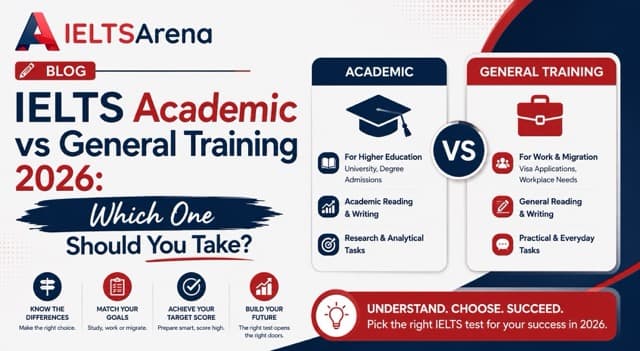
IELTS General Training is one of the two versions of the IELTS test. The other is IELTS Academic. Both test the same four skills: Listening, Reading, Writing, and Speaking. Both use the same 1 to 9 band scale.
The difference lies in purpose. IELTS Academic is designed for people entering university or professional registration that requires academic English. IELTS General Training is designed for people migrating, working, or training in an English-speaking country, and it focuses on everyday and workplace English rather than academic language.
The IELTS general training test still runs across all four skills in a single sitting. Listening and Speaking are identical to the Academic version. Only Reading and Writing change.
This matters because many test-takers assume the whole test is different. It is not. If you have seen Academic Listening and Speaking material, that knowledge transfers directly to the IELTS general module.
The IELTS General Training Format Section by Section
Here is exactly what you face in each section of the IELTS general training test.
Listening. Four sections, 40 questions, 30 minutes plus transfer time on paper. Identical to Academic. You hear everyday conversations and monologues, such as a phone call about accommodation or a talk about a local event.
Reading. Three sections, 40 questions, 60 minutes. This is where General Training differs most. The texts come from notices, advertisements, company handbooks, and workplace documents rather than academic journals. The three sections move from short everyday texts, to work-related texts, to one longer general-interest passage.
Writing. Two tasks, 60 minutes. Task 1 is a letter, not a graph. You write a letter responding to a situation, such as complaining to a landlord or requesting time off. Task 2 is an essay on a general topic, similar to Academic but usually phrased in more everyday language.
Speaking. Three parts, 11 to 14 minutes, face to face. Identical to Academic. Part 1 is an interview, Part 2 is a cue card long turn, and Part 3 is a discussion.
So two sections are shared and two are different. That is the core of the IELTS general training format you need to remember.
Why People Get the Choice Wrong
The most common mistake is assuming General Training is "the easy one" and choosing it to dodge difficulty. This backfires. If your university or professional body requires Academic, a General Training result will not be accepted, no matter how high your band.
The second mistake is the reverse. People preparing for migration over-prepare with Academic Writing Task 1, learning to describe bar charts and line graphs they will never see, while neglecting the letter-writing task they actually face.
The third mistake is underestimating the General Training Reading section. Because the texts look simple, candidates rush. But there are still 40 questions in 60 minutes, and the workplace and notice texts contain tricky detail. Many test-takers run out of time on the final long passage.
The fourth mistake is treating the letter task casually. The Task 1 letter has its own rules about tone, format, and the three bullet points you must cover. Writing a vague, informal letter loses marks even when the English is good.
A Real Student Story
Carlos, a welder from Bogota in Colombia, needed Band 6.0 across all four skills for his Australian skilled migration visa. He booked IELTS Academic by mistake because a friend told him "Academic looks better."
"I spent three weeks learning how to describe graphs," Carlos said. "Then a migration agent told me my visa needed General Training, not Academic. I had prepared for the wrong test."
Carlos rebooked the IELTS general module and switched his preparation. The Listening and Speaking work carried over completely. He only had to relearn Reading strategy for everyday texts and practise the Task 1 letter.
He used IELTSArena to practise full General Training mock tests under real exam timing. The progress dashboard showed his Reading speed improving section by section as he got used to the everyday text style.
On test day, Carlos scored Band 6.5 overall, comfortably above his target. The wasted three weeks taught him an expensive lesson about choosing the right module first.
What the Data Shows
A large share of all IELTS tests taken worldwide are General Training, driven by migration to countries like Canada, Australia, the UK, and New Zealand. Migration and work applications make up a significant portion of total IELTS demand according to information published by the IELTS partners.
Band requirements for General Training are often lower than for academic study, which is one reason candidates assume it is easier. For example, many skilled migration routes ask for Band 6.0, while competitive university courses can ask for Band 7.0 or higher.
But "lower requirement" does not mean "less effort." Examiner reports published by the IELTS partners show that Writing remains the lowest-scoring section for General Training candidates too, largely because of the letter task and underdeveloped Task 2 essays.
The takeaway is that the IELTS general training test is not automatically easy. It is differently focused. You still need a clear strategy for Reading speed and letter writing to hit your target band.
How to Prepare for IELTS General Training
Here is a focused preparation plan for the IELTS general module.
1. Confirm your module first. Before anything else, check with your university, employer, or immigration authority whether you need General Training or Academic. Get this in writing if you can. This single step prevents the most expensive mistake.
2. Master the letter task. Learn the three letter types: formal, semi-formal, and informal. Practise identifying the tone from the prompt and covering all three bullet points. The letter is 20 minutes of your Writing time.
3. Build Reading speed. The General Training Reading section has three parts and 40 questions in 60 minutes. Practise skimming everyday texts like notices and handbooks for specific information. Save the longest passage for last and watch your time.
4. Reuse your Listening and Speaking prep. Since these are identical to Academic, any quality practice material works. Do not buy separate General Training material for these two sections.
5. Practise full mock tests under timing. The biggest gains come from sitting complete IELTS general training tests in real conditions so the format becomes automatic.
How IELTSArena Supports General Training Prep
The challenge with IELTS general training is finding practice material that matches the real test format, especially for the letter task and the everyday Reading texts. Generic practice often mixes Academic content in, which wastes your time.
IELTSArena gives you dedicated General Training practice that mirrors the real exam. You practise the letter task, the three-part Reading section, and the Task 2 essay in the same CBT interface you will use on test day, with the on-screen highlighter, notepad, and timer.
The AI writing feedback on IELTSArena scores your General Training letter and essay instantly against all four criteria, so you learn whether your letter tone and structure are correct before the real test. This is exactly the feedback that closes the gap on the lowest-scoring section.
For test-takers who want human guidance, the expert tutor feedback on IELTSArena reviews your letters and essays with band-focused corrections. The progress analytics dashboard tracks your Reading speed and Writing band over every mock test, so you can see your General Training readiness improving.
IELTSArena supports both Academic and General Training, so if you are still confirming your module, you can explore both before committing. More than 10,000 learners have used IELTSArena to prepare for the exact test their visa or job requires.
Start a free General Training practice test on IELTSArena today.
The most expensive IELTS mistake is not a low band. It is preparing for the wrong test entirely.
Self-Diagnosis: Are You Ready for General Training?
Ask yourself these five questions.
- Have you confirmed in writing that your visa, job, or course actually requires IELTS General Training rather than Academic?
- Can you identify whether a letter prompt needs a formal, semi-formal, or informal tone within ten seconds?
- Can you finish the three-part Reading section and transfer all 40 answers within 60 minutes?
- Do you know that your Listening and Speaking preparation transfers directly from Academic material?
- Have you written at least one full General Training letter and had it scored against the official criteria?
If any of these gave you pause, that is your starting point. The format is learnable quickly once you know exactly what changes.
Book the Right Test, Prepare the Right Way
IELTS General Training is the test for migration, work, and most residency applications. Two sections match Academic, and two are different. Once you know which module you need, preparation becomes straightforward.
Take a Free General Training Mock on IELTSArena →
Frequently Asked Questions
What is in the IELTS General Training test and how is it different from Academic?
IELTS General Training tests the same four skills as Academic: Listening, Reading, Writing, and Speaking. Listening and Speaking are identical in both versions. The difference is in Reading and Writing. General Training Reading uses everyday and workplace texts like notices, advertisements, and handbooks across three sections, while Academic uses journal-style passages. General Training Writing Task 1 is a letter rather than a graph description, and Task 2 is an essay on a general topic. The General Training version targets migration and work English rather than academic English.
Is IELTS General Training easier than Academic and by how much?
General Training is not automatically easier, it is differently focused. The Reading and Writing content uses everyday English rather than academic language, which many find more familiar. However, band requirements are often lower for migration, with many routes asking for Band 6.0 compared with Band 7.0 for competitive university courses, which is why it feels easier. Examiner data shows Writing remains the lowest-scoring section in both versions. You still need strong Reading speed and a solid letter strategy. Practising full General Training mock tests on IELTSArena shows you your real readiness.
Which countries and visa types require IELTS General Training rather than Academic?
General Training is typically required for skilled migration, work visas, and permanent residency in countries like Canada, Australia, the United Kingdom, and New Zealand. It is also used for secondary education and some training programmes. Academic is required for university study and professional registration that needs academic English, such as nursing or medical bodies in many countries. Requirements vary by program and immigration route, so always confirm directly with your university, employer, or immigration authority before booking. Choosing the wrong module means your result may not be accepted.
How do I prepare for the IELTS General Training Reading section which has three parts?
The General Training Reading section gives you 40 questions in 60 minutes across three parts that move from short everyday texts, to work-related documents, to one longer general-interest passage. Practise skimming notices, advertisements, and handbooks for specific details rather than reading every word. Build speed early, because the final long passage takes the most time, and aim to leave enough time to transfer all answers. Practising timed three-part Reading sets on IELTSArena helps the everyday text style become automatic so you do not run out of time.
Can a student who prepared for IELTS Academic switch to General Training easily?
Yes, the switch is usually quick. Listening and Speaking are identical in both versions, so all of that preparation transfers directly with no changes. You only need to adjust two areas. Replace Academic Writing Task 1 graph description with the General Training letter task and its tone rules, and adapt to the everyday text style in the General Training Reading section. Most students make this switch in one to two weeks. IELTSArena supports both modules, so you can practise General Training letters and Reading without starting your preparation over.