
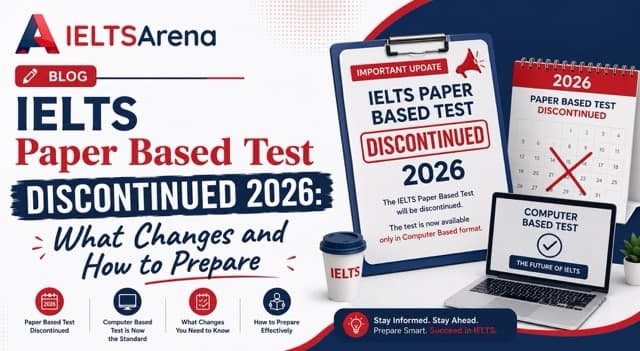
The version of IELTS that millions of people grew up practicing is about to disappear. After 27 June 2026, the IELTS paper based test will no longer be offered in most countries, and every test taker will sit the exam on a computer instead. If you have been preparing with a pencil, an answer sheet, and a printed booklet, your exam day is going to look very different.
The British Council, IDP Education and Cambridge English confirmed this jointly in March 2026. They are not changing the questions, the band scale, or what examiners reward. They are changing the surface you write on. That single change trips up more candidates than most expect, because speed, navigation, and on-screen reading are skills of their own.
This is not a reason to panic. It is a reason to switch your practice now, while you still have time to get comfortable with the screen.
What Is Actually Changing in 2026
The paper format is being retired and replaced by computer-delivered IELTS in most markets from mid-2026, with 27 June 2026 set as the final paper date (IELTS.org, "Updates to IELTS test delivery", 2026). From that point, Listening, Reading and Writing all happen on a computer at the test centre.
The content is identical. Academic and General Training still exist. The four skills are still scored the same way, on the same 1 to 9 band scale, against the same criteria: Task Achievement, Coherence and Cohesion, Lexical Resource, and Grammatical Range and Accuracy.
What changes is the medium. You read passages on a screen, you type your essays, and you click through questions instead of flipping pages. In selected markets a new "Writing on Paper" option lets you handwrite the Writing section while taking the rest on computer, but this will not be available everywhere (British Council, takeielts.britishcouncil.org, 2026).
One part does not change at all. The Speaking test remains a face-to-face interview with a certified examiner, exactly as before.
Advertisement
Why "Just Show Up" Is the Wrong Plan
Most candidates assume that because the questions are the same, the move from paper to computer is cosmetic. It is not. The way you interact with the test decides whether you finish on time.
On paper, you underline with a pencil, scribble in the margin, and scan a full page at a glance. On screen, you highlight with a cursor, type notes into a digital notepad, and scroll. If you have never practiced these actions under timed pressure, you lose minutes you cannot afford in Reading, where you face 40 questions in 60 minutes with no extra transfer time.
Writing is where the gap shows most. Typing speed and on-screen editing change how you plan and revise a 250-word Task 2 essay. Candidates who draft on paper in their head and then type often run out of time. Candidates who never check their typed word count can fall under the minimum and lose marks on Task Response.
The students who struggle are not weaker in English. They simply prepared for a test that will no longer exist.
A Real Student Story: Mariam in Lagos
Mariam, 24, from Lagos, Nigeria, had been preparing for the IELTS paper based test for three months. She was aiming for Band 7.0 for a master's program in the United Kingdom and had been scoring around 6.5 on printed mock papers at home.
When her test centre confirmed her July 2026 sitting would be computer-delivered, she panicked. "I had never typed an essay under exam conditions in my life," she said. "My first computer mock was a disaster. I scored 5.5 in Writing because I spent ten minutes just figuring out the screen."
Mariam spent her final five weeks practicing only on a computer-based interface. She learned to highlight on screen, type her essays directly, and watch the live word count. On exam day she scored an overall Band 7.0, with 7.0 in Writing.
The questions were never the problem. The screen was. Once I practiced where I would actually sit, my real band score finally showed up.
Her story is common. The skill gap in 2026 is rarely about grammar. It is about fluency with the computer-based format.
The Data: Faster Results and a Format Shift
Computer-delivered IELTS does more than change the surface. It returns results in three to five days, compared with about 13 days for the paper based test, which is roughly a 70% faster turnaround (IELTS.org, 2026). For anyone racing a university or visa deadline, that speed is a real advantage.
Computer delivery has also been growing for years. Across many markets the computer format already accounts for the majority of IELTS sittings, and the 2026 change simply completes a shift that was well underway (British Council, 2026). The candidates most exposed are those in regions where paper was still the default and where home practice still relies on printed booklets.
The lesson in the numbers is simple. The format is becoming standard, the results come back faster, and the candidates who adapt early are the ones who protect their band score.
The Right Way to Prepare for Computer-Based IELTS
The fix is not more grammar drills. It is changing where and how you practice. Here is the order that works.
First, switch every mock to a screen. Stop printing papers. From today, take your full-length mocks on a computer so the interface stops being a distraction on exam day.
Second, train the on-screen tools. Practice using the highlighter and the digital notepad in Reading until they feel automatic. In a real ielts computer based test 2026 sitting, fumbling with these tools is pure lost time.
Third, type every essay. Write both Task 1 and Task 2 by typing, never by hand, and always check the live word count before you finish. Aim to leave three minutes for on-screen proofreading.
Fourth, rebuild your timing. Reading on a screen is slower for most people at first. Practice scanning and locating answers by scrolling so your pace recovers before test day.
Fifth, get feedback on the typed version of your work, not a handwritten draft. Examiners will score what you type, so that is what you need corrected.
Where IELTSArena Fits In
This is exactly the problem IELTSArena was built to solve. IELTSArena replicates the real IELTS CBT interface, including the on-screen highlighter, the notepad, and the navigation panel, so the screen feels familiar long before you reach the test centre. You are not practicing on paper and hoping it transfers. You are practicing the exact environment you will sit in.
When you type a Task 2 essay, IELTSArena's AI writing feedback gives you an instant band estimate and pinpoints your exact mistakes on Task Response, Coherence and Cohesion, Lexical Resource, and Grammar. For deeper correction, expert tutors give you band-focused feedback on the typed essay itself, which is what the examiner will actually score.
IELTSArena also tracks every mock across one dashboard, so you can see whether your Reading pace on screen is improving week to week. More than 10,000 learners have used it to move toward their target band. You can start free and take a full computer-based mock today, or explore the latest tests.
Check Yourself Before Exam Day
Be honest with these five questions about your readiness for the computer-based format.
Can you type a 250-word Task 2 essay in 40 minutes and still leave time to proofread on screen?
Can you use an on-screen highlighter and digital notepad in Reading without slowing down?
Do you check your live word count before submitting, every single time?
Have you taken at least three full-length mocks on a computer, not on paper?
Do you know your current band on each skill from a timed computer-based test, not a guess?
If you hesitated on any of these, the gap is the format, not your English. That is the easiest gap to close with the right practice.
Start Where the Real Test Lives
The IELTS paper based test is ending, but your band score does not have to suffer for it. The candidates who win in 2026 are the ones who practice on the same screen they will be tested on.
Take one free computer-based mock and you will know exactly where your band stands today, format and all. No credit card, no commitment, just the real interface and real feedback.
Take Your First Free CBT Mock on IELTSArena →
Frequently Asked Questions
Is the IELTS paper based test being discontinued in 2026?
Yes. The British Council, IDP Education and Cambridge English confirmed in March 2026 that IELTS is moving to computer delivery worldwide from mid-2026, with 27 June 2026 set as the final paper-based test date in most markets. After that, Listening, Reading and Writing are taken on a computer at the test centre. The questions, the Academic and General Training versions, and the 1 to 9 band scale all stay the same. Only the medium changes. In some markets a "Writing on Paper" option will let you handwrite the Writing section while the rest is on computer, but this will not be offered everywhere.
When does paper IELTS end?
In most markets the final paper-based IELTS date is 27 June 2026, after which all tests are computer-delivered (IELTS.org, 2026). Exact timelines vary slightly by country and test centre, so check your local centre when you book. If you have a paper booking before that date it still goes ahead as normal, but any new booking from mid-2026 onward will almost certainly be on computer. The safest move is to start practicing on a screen now, regardless of your test date, because the computer format is quickly becoming the only option.
What is the difference between paper and computer IELTS?
The content is identical. The difference is how you interact with the test. On paper you write with a pencil and read from a booklet. On computer you type your answers, read passages on a screen, and use an on-screen highlighter and digital notepad. Listening, Reading and Writing are all on the computer, while Speaking stays a face-to-face interview with an examiner either way. Computer-delivered results also arrive faster, usually in three to five days versus about 13 days for paper. The scoring criteria and band scale do not change at all.
Will my IELTS score change on computer?
Your underlying English ability does not change, and the band scale and criteria are identical. What can change is your performance if you are not used to the format. Candidates who have never typed an essay under timed conditions or used on-screen tools often lose time and score below their true level on the first attempt. The fix is to practice on a computer-based interface before test day. On a platform like IELTSArena, which replicates the real CBT environment, you can remove the format disadvantage so your real band score shows up on exam day.
How do I prepare for the computer based IELTS test?
Switch all your practice to a computer immediately. Take full-length mocks on screen, learn the on-screen highlighter and notepad until they feel automatic, type every essay while watching the live word count, and rebuild your Reading timing for scrolling. Get feedback on the typed version of your writing, since that is what the examiner scores. IELTSArena lets you do all of this in one place with a real CBT interface, instant AI feedback, and expert tutor corrections. Aim for at least three full computer-based mocks before your test so the screen feels routine.
![Best IELTS Software for Institutes [2026]: The 4-Path Buying Decision Nobody Explains](/_next/image?url=%2Fblog%2Fcover-best-ielts-software-for-institutes.jpeg&w=3840&q=75&dpl=dpl_GYEKaGV5BCFmb21AbDnxrbdK56fd)
![IELTS Listening Changes [2026]: 4 Confirmed Shifts, the You-Are-Here Marker, and the Global-Accents Drill](/_next/image?url=%2Fblog%2Fcover-ielts-listening-changes-2026.jpeg&w=3840&q=75&dpl=dpl_GYEKaGV5BCFmb21AbDnxrbdK56fd)