You have heard that the IELTS paper test is ending on June 27, 2026. You have spent weeks worrying about typing your Task 2 essay on screen. Then someone tells you there is still a way to write by hand on your IELTS test day.
That option is real. It is called IELTS Writing on Paper, and it launched in selected countries from mid-2026. Right now, as the June 27 deadline approaches, thousands of candidates are searching urgently for what this hybrid format actually means, whether they can use it, and — critically — whether it is accepted for their specific visa or university application.
The answers matter enormously. Because this new option is not available for every purpose, every country, or every visa route. Before you book, you need the full picture.
What Is IELTS Writing on Paper?
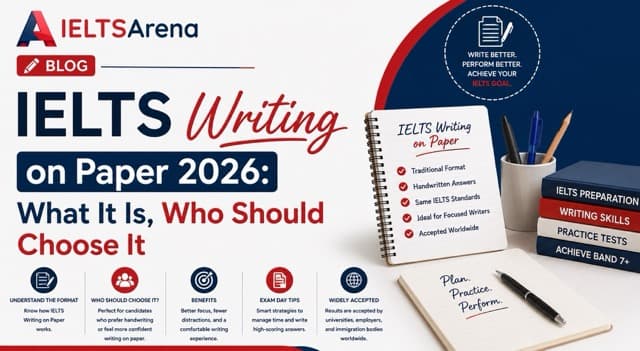
IELTS Writing on Paper is a hybrid test format introduced in mid-2026 by IELTS — jointly owned by British Council, IDP Education, and Cambridge University Press and Assessment. It allows you to complete the Listening and Reading sections on a computer while handwriting your Task 1 and Task 2 Writing responses on a physical answer sheet.
The hybrid format works exactly as the name suggests. During your test session, the Writing tasks appear on your screen. You receive a pen and a standard IELTS Writing Answer Sheet. You write your responses by hand — Task 1 in 20 minutes, Task 2 in 40 minutes — while sitting at the same computer station used for Listening and Reading. Speaking remains a face-to-face interview with a certified IELTS examiner, as always.
What does not change: the task types, scoring criteria, timing, and band scale are identical across all delivery formats. Task 2 is still 250 words minimum, still worth twice the marks of Task 1, and still assessed across Task Response, Coherence and Cohesion, Lexical Resource, and Grammatical Range and Accuracy. The examiner who marks your essay will not know or be told whether you typed or handwrote your responses. Your results form will not specify which format you used.
IELTS has confirmed through its own research that scores are comparable across delivery methods, both overall and within individual band scores (IELTS.org, 2026). Choosing this hybrid option does not disadvantage you in scoring relative to candidates who typed their responses.
For candidates who feel their written English flows more naturally by hand than by keyboard — and there are many, particularly those who completed all their schooling and university work using pen and paper — this format removes one significant source of exam anxiety.
Why the Paper Test Ending Created This Gap
The global discontinuation of paper-based IELTS did not happen overnight. The shift toward computer delivery has been underway for years, accelerated by the efficiency gains it brings: results in three to five days instead of thirteen, faster administrative processing across test centres, and a more consistent testing environment globally.
However, British Council and IDP both recognised that for a large proportion of the global IELTS population, typing is genuinely unfamiliar territory. In much of Sub-Saharan Africa, South Asia, and Southeast Asia, students complete schoolwork, national exams, and university assessments by hand. For those candidates, sitting a three-hour test with typed essays represents a compounded challenge: they are not just demonstrating their English, they are navigating an unfamiliar input method under timed pressure.
This new hybrid option addresses exactly that gap. It removes the typing requirement from the Writing component while keeping the speed and administrative efficiency of computer delivery for Listening and Reading — the two sections where keyboard skill has no impact on performance. You still need to navigate a screen to answer Listening questions and click through Reading passages. But the section where typing anxiety is most damaging — Writing — can now be completed by hand at participating test centres.
This is not a minor accommodation. For candidates whose Writing score has been dragged down by unfamiliarity with keyboard input rather than genuine English language gaps, IELTS Writing on Paper could mean the difference between a Band 6.0 and a Band 6.5, or a Band 5.5 and a Band 6.0.
The Restriction Most Candidates Miss
Here is the most important fact about IELTS Writing on Paper in 2026 — and the one that does not appear prominently in most general summaries.
IELTS Writing on Paper is not available for IELTS for UKVI tests. If you are applying for a UK visa or immigration route that requires a Secure English Language Test (SELT), you must sit the full computer-delivered IELTS format. The UK Home Office requires SELT tests to be fully digital, and the hybrid option does not satisfy this requirement regardless of your test centre's capabilities or location.
The hybrid format has not yet received regulatory approval for Australian visa applications. IELTS.org states directly on its official page that candidates planning to study, work, or migrate to Australia must take the full IELTS on computer option until the Australian Government's Department of Home Affairs completes its regulatory review (IELTS.org, 2026). This is not a rumour or a general caution — it is an explicit restriction from the test's governing body.
This means two of the world's most significant IELTS destination countries have restrictions:
- UK immigration routes (UKVI): the handwritten Writing option is not permitted.
- Australian visa applications: not yet approved for this delivery mode.
If your goal is Canada PR under Express Entry, New Zealand work or study, university admission in the UK using IELTS Academic (not UKVI-designated), Ireland, Germany, or professional registration in most contexts, IELTS Writing on Paper may be an option. But you must confirm with both your test centre and the specific authority or institution that will receive your results before booking.
The question is not whether Writing on Paper is better or worse. The question is whether it is accepted for your specific visa, university, or professional registration body.
Fatima's Decision: Writing on Paper or Full Computer?
Fatima Adebayo, a registered nurse from Lagos, Nigeria, had been preparing for her Canadian Permanent Residency application for seven months. She needed IELTS General Training with a minimum of 6.0 in each band under the Federal Skilled Worker programme. Canada's IRCC accepts IELTS General Training results, including those completed using IELTS Writing on Paper at eligible test centres (IRCC, 2026).
Her Listening and Reading practice scores were consistently at 7.0 and above. Writing was her weak point, hovering around 5.5 in practice sessions. Part of the problem, she explained to her preparation coach, was her keyboard use: she kept second-guessing her vocabulary when typing, deleting half-written sentences, and running out of time.
"When I write by hand, the ideas come out in order. When I type I keep stopping and starting," she said.
When Fatima's test centre in Lagos announced it would offer the hybrid Writing option from July 2026, she confirmed directly with the Canadian immigration authority that results from this format were accepted for her application type. She booked it, sat Listening and Reading on screen, and handwrote both Writing tasks on the answer sheet provided.
Her results: Listening 7.0, Reading 7.5, Writing 6.0, Speaking 6.5 — enough to submit her EOI with a competitive points total.
Her preparation had one additional component: she spent the six weeks before her test practising Listening and Reading on a computer interface, because those sections remained fully on-screen. The format change helped her Writing output. It did not help her if she was unfamiliar with clicking through passages or navigating the CBT timer for Listening.
What the Research Shows About Format and Scores
IELTS conducted research before launching the hybrid format to confirm that handwritten and typed responses would receive comparable scores from trained examiners. The research confirmed that scores across delivery methods are statistically equivalent at the overall band level and within individual components (IELTS.org, 2026).
This matters for two reasons. First, you are not penalised for choosing the hybrid format if it is accepted for your purpose. Second, you are not advantaged either — if you choose Writing on Paper expecting to write longer or more complex essays than you could type, the examiner's criteria remain constant. Band 7 in Writing requires the same Task Response, Coherence, Lexical Resource, and Grammar regardless of whether the examiner reads typed or handwritten text.
According to IDP Education's 2025 IELTS Test Taker Survey, over 50% of candidates from test centres in West Africa and the Philippines identified typing speed or keyboard comfort as a moderate concern ahead of their Writing component. The percentage was lower (around 28%) among candidates from East Asia and Latin America, where digital literacy rates are higher. IELTS Writing on Paper directly addresses the documented performance anxiety in these markets.
Should You Choose IELTS Writing on Paper? A Clear Decision Framework
Not every candidate should choose this format. Here is a direct framework.
Choose IELTS Writing on Paper if:
- Your visa, university, or professional body accepts results from this format (confirm before booking)
- You are not applying for a UK immigration route requiring IELTS for UKVI
- You are not applying for an Australian visa (until Australian Home Affairs confirms approval)
- You genuinely find typing disrupts your writing flow, pacing, or vocabulary production
- Your test centre has confirmed this format is available
- You can handwrite legibly at a pace that produces 250+ words in 40 minutes without physical strain
Do not choose IELTS Writing on Paper if:
- You are applying for a UK visa or settlement route requiring a SELT
- You are applying for an Australian student, work, skilled migration, or partner visa
- You are comfortable with typing and have practised on a computer interface
- Your test centre has not confirmed availability of this format
- Your handwriting speed is slow enough to put you at a disadvantage vs your typing speed
One practical note: your results arrive within five days regardless of which format you choose. The speed advantage of computer delivery is retained in the hybrid format.
How IELTSArena Prepares You for Both Options
Whether you choose IELTS Writing on Paper or the full computer format, three of the four IELTS components remain entirely on-screen: Listening, Reading, and the display of Writing tasks. For most candidates, this means significant preparation needs to go into navigating the CBT interface, managing the on-screen timer, and using the digital highlighter and notepad tools that appear in real IELTS CBT sessions.
IELTSArena replicates the real IELTS CBT interface precisely — including the highlighter tool, the on-screen notepad, the section navigation panel, and the timed countdown. If you are choosing IELTS Writing on Paper because handwriting suits you better, you still need full CBT practice for the three sections you will complete on-screen. That interface familiarity is what IELTSArena provides.
IELTSArena's AI Writing Feedback analyses your Task 1 and Task 2 essays and gives you an instant band score with specific feedback on each of the four writing criteria. Even if you plan to handwrite on test day, the feedback you receive from typed practice translates directly: your examiner's criteria do not change based on your writing tool. Knowing which criterion is holding your score at 5.5 instead of 6.0 is valuable whether you discover it through a typed practice session or a handwritten draft.
For candidates who want human-level correction before their test date, IELTSArena's Expert Tutor Feedback provides band-focused corrections from human tutors on your actual essays — the layer that identifies precisely what is preventing your score from moving between bands.
Over 10,000 students globally have used IELTSArena to reach their target band score. Start free on IELTSArena and run a full mock test before you decide which format suits your preparation level.
Self-Diagnosis: Are You Ready for the Format Decision?
Before you book your test, ask yourself these five questions.
- Have you confirmed with the specific authority or institution receiving your results that IELTS Writing on Paper is accepted for your application type?
- Can you handwrite a Task 2 essay of 250+ words in 40 minutes with clear structure, without cramping or losing pace in the second half?
- When you practise Writing by typing, do you delete and rewrite sentences rather than drafting forward — and does this leave you short of time or words?
- Have you practised IELTS Listening and Reading on a computer interface, including using the on-screen highlighter and the section timer?
- Do you know which of the four IELTS skills is currently your weakest, and are you targeting that skill specifically in your preparation?
If your answer to question 1 is not a confirmed yes, stop and verify before anything else. If you answered yes to question 3 and your handwriting is fast enough, Writing on Paper may genuinely help your Task 2 performance. If you answered no to question 4, you have CBT interface practice to complete before your test date regardless of your Writing format choice.
Start Free on IELTSArena Before Your Test Date
If your test date is in July or August 2026 and you are weighing up IELTS Writing on Paper vs full computer delivery, your next step is a diagnostic mock test under real conditions.
Take a Free Full Mock on IELTSArena →
Frequently Asked Questions
What is IELTS Writing on Paper in 2026?
IELTS Writing on Paper is a hybrid test format that launched in selected countries from mid-2026. Candidates complete Listening and Reading on a computer, then handwrite their Task 1 and Task 2 Writing responses on a physical IELTS Writing Answer Sheet. Speaking remains a face-to-face examiner interview. The scoring criteria, task types, timing, and band scale are identical to the full computer-delivered test. IELTS confirmed that scores are comparable across formats, and your results document does not indicate which writing method you used. The format is not available for IELTS for UKVI tests, and has not yet been approved for Australian visa applications as of mid-2026.
Is IELTS Writing on Paper available in my country?
IELTS Writing on Paper is being introduced in selected countries from mid-2026, and availability depends on your specific test centre. You need to check directly with your local British Council or IDP IELTS test centre when booking. The rollout is ongoing across 2026, and not all countries or centres have confirmed availability yet. Even in countries where the format is offered, not every test centre within that country will necessarily offer it. Always verify with your booking centre before assuming availability.
Can I use IELTS Writing on Paper for a UK visa application?
No. IELTS Writing on Paper is explicitly not available for IELTS for UKVI tests. If you are applying for a UK visa or settlement route that requires a Secure English Language Test (SELT) — including Skilled Worker, Student, or settlement routes — you must sit the fully computer-delivered IELTS format. The UK Home Office requires SELTs to be fully digital, and the Writing on Paper hybrid format does not satisfy this requirement regardless of your location or test centre.
Is IELTS Writing on Paper accepted for Australian visa applications in 2026?
Not yet, as of mid-2026. IELTS.org states on its official Writing on Paper page that candidates applying for Australian student, work, or migration visas must take the full IELTS on computer option until the Australian Department of Home Affairs completes its regulatory review and grants approval. This is a formal restriction from the IELTS governing body itself, not a general caution. Check the IELTS.org news and insights page for updates if your test date is several months away.
How is IELTS Writing on Paper different from the old paper-based IELTS test?
The old paper-based IELTS delivered all sections on paper: Listening used printed answer sheets, Reading used a physical booklet, Writing was handwritten, and Speaking was with a live examiner. IELTS Writing on Paper is fundamentally different: it is a computer-delivered test where only the Writing responses are handwritten. Listening and Reading are completed entirely on screen. The old paper-based IELTS ended globally on June 27, 2026. IELTS Writing on Paper is a new hybrid format, not the old paper test under a different name. It does not restore paper-based Listening or Reading.