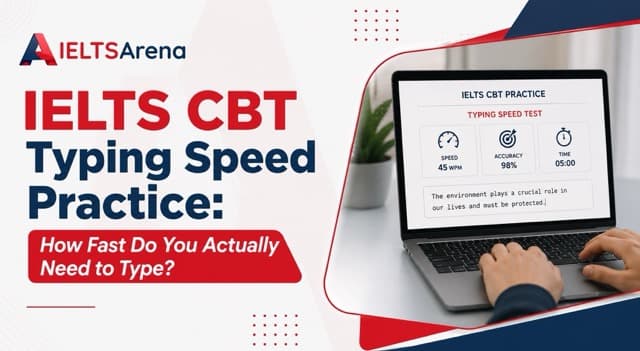
IELTS CBT typing speed practice matters because Writing Task 2 gives you 40 minutes to plan, write, and review roughly 250 words, and if typing itself is slow or effortful, that time gets consumed by mechanics instead of thinking. There is no official minimum typing speed required for IELTS, but candidates who cannot type comfortably without hunting for keys typically lose meaningful planning and review time that faster typists keep.
Since paper-based IELTS ended worldwide on 27 June 2026, typing has stopped being optional for nearly everyone taking the exam, which makes this one of the more overlooked but fixable parts of CBT preparation.
Why Typing Speed Gets Overlooked
Most IELTS preparation focuses heavily on vocabulary, grammar, and essay structure, all of which matter more than typing speed in the band criteria themselves. But typing speed is not scored directly, it is a mechanical bottleneck that eats into the time available for the things that are scored. A candidate with excellent ideas and strong grammar who types at 20 words per minute may still run out of time to write a complete, well-organized response, while a slower thinker who types quickly may finish comfortably.
How Fast Is Fast Enough
There is no published official benchmark, but a useful practical target is being able to type around 30 to 40 words per minute comfortably, without needing to look at the keyboard constantly. At that pace, a 250-word Task 2 response takes roughly six to eight minutes of pure typing time, leaving the bulk of your 40 minutes for planning, thinking, and reviewing rather than mechanical output.
Candidates well below this pace often find themselves still typing their conclusion as the section timer runs out, regardless of how strong their ideas were.
A Realistic Student Story
Rahul, a mechanical engineer in Pune preparing for a Canadian Express Entry application, had strong written English but had rarely typed anything longer than short messages before starting IELTS preparation.
"I could write a great essay by hand in 25 minutes," he said. "The first time I typed one under timed conditions, it took nearly 35 minutes just to get the words down, before any real editing or review time was left."
He added ten minutes of dedicated typing practice to his daily routine, unrelated to IELTS content, simply typing paragraphs from articles to build raw speed and comfort. Within three weeks, his typing speed rose enough that a full Task 2 response took under ten minutes to type, leaving him real time to plan and revise. His Writing score moved from Band 6.0 to Band 7.5 across that period, a shift he attributed as much to typing comfort as to any content changes.
The words in his head had always been strong. Getting them onto the screen fast enough was the part nobody had told him to practice.
Want to know how your own typing speed holds up under real Task 2 timing? Take a free CBT mock test on IELTSArena and find out today.
What the Data Shows
For confident typists, CBT Writing is often faster overall than handwriting, since typing speed frequently exceeds handwriting speed, and on-screen editing is significantly easier than crossing out and rewriting by hand. For candidates less comfortable with typing, handwriting may still feel more natural during early practice, but the format itself now requires typed responses for nearly all candidates following the retirement of paper-based testing.
This is exactly why dedicated IELTS CBT typing speed practice has become such a common addition to preparation plans in 2026. It was rarely mentioned in older guides built around a paper format that never required it, but it is now one of the few genuinely mechanical skills separating candidates who use their full 40 minutes productively from those who spend a chunk of it simply catching up on typing.
How to Build IELTS CBT Typing Speed Practice Into Your Routine
Practice typing full-length paragraphs daily, unrelated to IELTS content if needed, purely to build raw speed and reduce how often you look at the keyboard. Once comfortable typing generally, shift to typing full Task 1 and Task 2 responses under real 40-minute and 20-minute timing, so speed and content practice combine. Use the live word counter during practice, the same tool available in the real exam, to build awareness of pacing without needing to count manually. Avoid switching between handwriting and typing practice interchangeably in your final weeks, since the exam will require typing exclusively.
Where IELTSArena Fits
IELTSArena's Writing practice includes the same live word counter used in the real CBT exam, so you can build IELTS CBT typing speed practice and pacing awareness under authentic conditions rather than guessing. Every practice essay is typed, exactly as the real exam requires, with AI feedback identifying whether score gaps come from content, structure, or simply running out of time due to typing pace. The full practice test hub lets you test this across full Task 1 and Task 2 sessions, not just short drills.
A free mock test lets you time your own Task 2 typing speed today and see exactly how much planning and review time you currently have left over, or are currently losing.
A Quick Self-Check on Your Own IELTS CBT Typing Speed Practice
- Have you ever typed a full Task 2 essay under real 40-minute timing, or only handwritten practice essays?
- Do you know roughly how many words per minute you type comfortably?
- Does your current practice leave time for reviewing and editing, or does the timer run out while you are still writing?
If typing speed is an unknown, it is one of the fastest gaps to close with focused daily practice, and a week of consistent IELTS CBT typing speed practice is often enough to see a measurable difference.
Test Your Typing Speed Under Real Conditions
Reading about typing speed will not tell you your own.
Start a Free Mock Test on IELTSArena →
Frequently Asked Questions
How fast do I need to type for IELTS CBT writing?
There is no official minimum, but comfortably typing around 30 to 40 words per minute is a practical target. At that pace, a 250-word Task 2 response takes roughly six to eight minutes to type, leaving most of your 40 minutes for planning and review rather than mechanical typing.
Does slow typing actually hurt my IELTS writing score?
Not directly, since typing speed is not part of the scoring criteria. Indirectly, yes, because slow typing consumes time that would otherwise go toward planning, organizing, and reviewing your response, all of which do affect your Task Achievement and Coherence and Cohesion scores.
How do I practice typing speed specifically for IELTS?
Practice typing full-length paragraphs daily to build general speed, then shift to typing complete Task 1 and Task 2 responses under real timed conditions using a live word counter. This combines raw typing speed practice with the actual pacing the real exam requires.
Is handwriting practice useless for IELTS CBT preparation?
Not entirely, since planning and idea generation skills transfer regardless of input method. But since nearly all candidates now type their responses following the retirement of paper-based IELTS, handwriting practice alone will not prepare you for the actual time pressure of typing under exam conditions.
What typing speed is considered good enough for Task 2?
Around 30 to 40 words per minute comfortably is generally sufficient to complete a 250-word response with adequate time left for planning and review. Below that pace, candidates often find themselves still typing as the section timer approaches its end.