
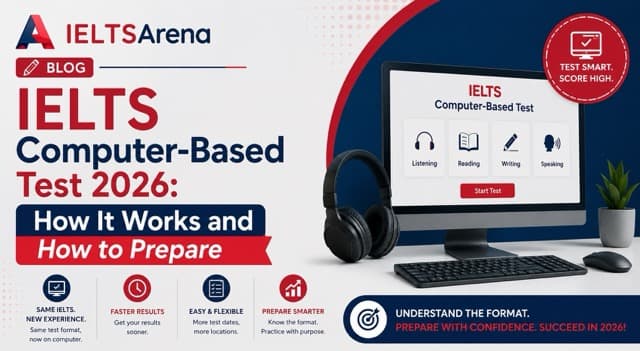
In 2026, more IELTS candidates are choosing the computer-based format than ever before. Test centres across dozens of countries now offer the IELTS computer based test as the primary option, with paper-based sittings limited to specific dates and locations.
If you have not sat the IELTS computer based test before, the interface and experience are significantly different from what you might expect. Understanding exactly how it works before exam day can mean the difference between a smooth performance and a stressful one.
What Is the IELTS Computer-Based Test and How Does It Work?
The IELTS computer based test delivers the Listening, Reading, and Writing sections entirely on a computer at an approved test centre. The Speaking section is still conducted face to face with a certified IELTS examiner, either on the same day or within a day or two of the computer test.
The content of the IELTS computer based test is identical to the paper-based version. The same question types appear. The same marking criteria apply. The same band descriptors are used to assess Writing. The test is not easier or harder because you sit it on a computer. What changes is the delivery format and the tools available to you.
During Listening, you hear the audio through headphones and type your answers directly into fields on screen. During Reading, you scroll through passages and click or type your answers. During Writing, you type your essays using a standard keyboard in a word processing interface.
The IELTS computer based test is available at much greater frequency than the paper-based test. Depending on your test centre, you may be able to book a sitting within days rather than weeks. Results are also delivered faster: typically three to five business days after the computer-based test, compared to up to thirteen days for some paper-based sittings.
Advertisement
Why Candidates Struggle with the IELTS CBT Interface
The IELTS computer based test introduces tools and features that are genuinely useful, but candidates who encounter them for the first time in the real exam often do not use them effectively.
The on-screen highlighter in Reading lets you mark important information in passages. Candidates unfamiliar with it either do not use it at all, missing an efficiency gain, or overuse it, highlighting half the passage and gaining nothing.
The word counter in Writing shows your real-time word count. This sounds helpful, and it is, but candidates who have not practised with it often either ignore it completely or check it so frequently that they lose their writing flow.
In Listening, the audio plays once and cannot be replayed. Candidates used to replaying audio during practice are caught off guard. There is no second chance if your attention drifts.
For the Writing section, candidates who are accustomed to handwriting sometimes find that typing slows their thinking, or that they type faster than they think and produce essays with structural problems they would have caught when writing by hand.
None of these challenges are insurmountable. But they all require specific practice before the exam, not just familiarity with the content.
One Candidate Whose CBT Preparation Made the Difference
Fatima, a 31-year-old teacher from Bangladesh, had taken the paper-based IELTS twice and scored Band 6.5 each time. She needed Band 7 for a professional registration application. When her test centre shifted to computer-based only, she was worried.
"I had never typed an essay in an exam before," she said. "I was afraid my Writing would get worse."
Fatima spent four weeks practising on IELTSArena's CBT simulation before her third attempt. She practised typing essays under timed conditions, used the on-screen tools deliberately in every Reading session, and completed full Listening sections with headphones rather than speakers.
On exam day, the interface felt familiar. She finished her Writing tasks with time to review. Her overall score: Band 7.5, with Band 7 in Writing.
"IELTSArena felt exactly like the real exam," she said. "I was not surprised by anything on the day."
What the Data Shows About the IELTS CBT Format in 2026
According to IDP Education and British Council data, the IELTS computer based test now accounts for a significant majority of IELTS sittings globally. Adoption has increased year on year since 2019, and in many markets the CBT is now the default format.
Results data from IELTS shows that average scores across all four skills are comparable between the computer-based and paper-based tests. This confirms that the format itself does not disadvantage candidates relative to paper. However, format-naive candidates, those who sit the CBT without having practised it, show higher rates of below-target performance than those who have completed CBT simulation practice.
A survey of IELTS test-takers found that approximately 62% of those sitting the IELTS computer based test for the first time reported feeling unfamiliar with at least one interface feature during the exam. Among those who had practised on a simulation platform before the exam, that figure dropped to under 15%.
The CBT also delivers results significantly faster. For candidates on visa or immigration timelines, this speed advantage makes the IELTS computer based test the practical choice regardless of personal format preference.
How to Prepare for the IELTS Computer-Based Test: Step by Step
The following approach prepares you specifically for the CBT format, not just the content.
Step 1: Understand the on-screen tools before exam day. Familiarise yourself with the highlighter in Reading, the word counter in Writing, the on-screen notepad, and the navigation panel. Each of these tools is available during the real exam. If you know how to use them efficiently, they give you a genuine advantage. If you encounter them for the first time on exam day, they become distractions.
Step 2: Practise typing essays under timed conditions. If you normally write essays by hand, you must practise typing them before the IELTS computer based test. Aim for at least three to four timed typing sessions per week in the weeks before your exam. This builds typing fluency and helps you identify whether typing changes your writing flow or structure.
Step 3: Use a simulation platform, not a word processor. Practising in Microsoft Word or Google Docs does not replicate the IELTS CBT interface. Use a dedicated simulation platform such as IELTSArena, which replicates the exact layout, tools, and timing of the real exam. This is the single most effective way to build CBT-specific familiarity.
Step 4: Complete Listening practice with headphones only. During the IELTS computer based test, audio is delivered through headphones. Practising with speakers does not replicate this experience. Use headphones for every listening practice session in your CBT preparation. You will also want to practise managing the headphone volume and adjusting to the acoustic quality before exam day.
Step 5: Build your typing speed to a comfortable level. You do not need to type at high speed. For IELTS Writing, a comfortable typing pace of 40 to 50 words per minute is more than sufficient. What matters more is accuracy. Practise typing without looking at the keyboard and reviewing your work before submitting.
Step 6: Replicate full exam conditions at least once per week. Complete a full CBT simulation in sequence: Listening, Reading, Writing, with the correct time limits. This builds the stamina and focus required for the real exam. IELTSArena offers full-length CBT simulations that mirror the real test experience across all three sections.
Step 7: Review your CBT performance with analytics. After each simulation, review your performance by section and question type. IELTSArena provides detailed analytics so you can identify whether your CBT-specific performance differs from your paper-based practice scores. If it does, the analytics help you pinpoint exactly where the format is affecting your results.
How IELTSArena Prepares You for the IELTS Computer-Based Test
IELTSArena is a CBT-native platform. Every feature of the IELTSArena practice environment is designed to match the real IELTS computer based test interface.
When you practise Reading on IELTSArena, you use the same on-screen highlighter and navigation panel you will encounter in the real exam. When you practise Writing, the IELTSArena word counter and essay submission interface work exactly as they do in the actual test. When you practise Listening, you use headphones and type your answers into the same style of answer fields.
IELTSArena offers full-length CBT simulations under real time conditions. You complete Listening, Reading, and Writing in sequence, with the same time limits as the actual exam. By the time you sit the real IELTS computer based test, the interface feels like familiar territory.
The IELTSArena platform also provides instant results and criterion-level feedback on Writing after every practice session. You see your approximate band score for each Writing criterion within seconds of submitting your essay. This immediacy supports faster improvement than waiting for a tutor to provide feedback days later.
For candidates who want human review alongside AI feedback, IELTSArena tutors can annotate your CBT practice essays directly. This gives you expert guidance without leaving the simulation environment.
IELTSArena also tracks your progress over time, so you can see whether your CBT simulation scores are improving week by week as your exam approaches.
Whether you are preparing for the Academic or General Training version of the IELTS computer based test, IELTSArena covers both formats with full question banks, timed simulations, and detailed feedback.
Self-Diagnosis: Are You Ready for the IELTS Computer-Based Test?
Before your next practice session, answer these questions:
- Have you ever completed a full IELTS CBT simulation in a realistic environment? If not, your first priority is a complete simulation before any further topic-specific preparation.
- Do you know what on-screen tools are available during the IELTS computer based test? If you cannot name the tools available in Reading and Writing, spend time with a simulation platform before focusing on content.
- Are you comfortable typing essays of 250+ words in 40 minutes? If typing feels significantly slower or more effortful than handwriting for you, add dedicated typing practice to your preparation schedule.
- Have you practised Listening through headphones specifically? If your practice has been through speakers or open audio, replicate the headphone experience in your remaining preparation sessions.
- Do you know how fast your CBT simulation scores compare to your paper-based practice scores? If there is a gap, the format is affecting your performance and requires specific attention.
The IELTS computer based test is now the standard format for most test-takers in 2026. Format familiarity is no longer optional. It is preparation.
Start Your Free CBT Simulation on IELTSArena →
Frequently Asked Questions
What is the IELTS computer-based test and how is it different from paper-based?
The IELTS computer based test delivers Listening, Reading, and Writing on a computer at an approved test centre. Speaking remains face to face with an examiner. The content and marking criteria are identical to the paper-based test. Key differences include: candidates type their answers and essays, on-screen tools such as a highlighter and word counter are available, results are delivered in three to five business days, and the test is available much more frequently at most centres.
Does the IELTS computer-based test give faster results than paper-based?
Yes. The IELTS computer based test typically delivers results within three to five business days. Paper-based results can take up to thirteen days depending on your test centre and location. For candidates with visa or application deadlines, this speed advantage makes the computer-based format the practical choice.
How do I practise for the IELTS CBT if I am used to writing by hand?
Start by completing typed practice essays at least three to four times per week. Use a simulation platform like IELTSArena that replicates the actual CBT writing interface, including the word counter and submission format. This builds typing fluency and shows you whether the format affects your writing structure or pace, so you can address any gaps before the real exam.
Is it easier to type essays on the IELTS computer test or write by hand?
This depends on your typing experience. For confident typists, the CBT Writing section is often faster because typing speed exceeds handwriting speed, giving more time for planning and review. For those less comfortable with typing, handwriting may feel more natural. The best preparation is to practise typing essays under timed conditions until the format feels comfortable, not to choose based on a general preference.
What tools are available during the IELTS computer-based test like highlighter and notepad?
During the IELTS computer based test, Reading includes an on-screen highlighter for marking important text and a navigation panel for moving between questions. Writing includes a real-time word counter. All sections include an on-screen notepad for notes. These tools are not available in the paper-based test and represent genuine advantages for candidates who know how to use them. IELTSArena's simulation platform includes all of these tools so you can practise using them before the real exam.
![Best IELTS Software for Institutes [2026]: The 4-Path Buying Decision Nobody Explains](/_next/image?url=%2Fblog%2Fcover-best-ielts-software-for-institutes.jpeg&w=3840&q=75&dpl=dpl_2sNYisMeFMxzdZaDp7gTaeytuEus)
![IELTS Listening Changes [2026]: 4 Confirmed Shifts, the You-Are-Here Marker, and the Global-Accents Drill](/_next/image?url=%2Fblog%2Fcover-ielts-listening-changes-2026.jpeg&w=3840&q=75&dpl=dpl_2sNYisMeFMxzdZaDp7gTaeytuEus)