
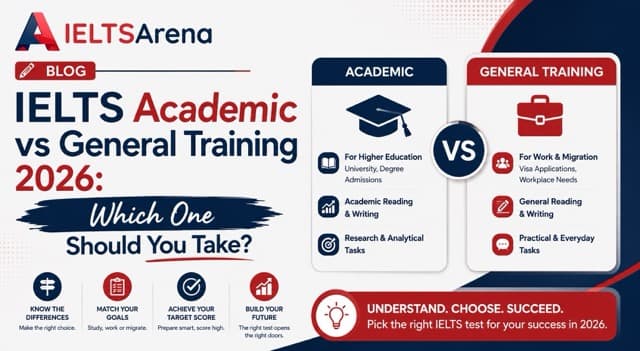
Choosing the wrong IELTS test type is one of the most costly mistakes a candidate can make. If you apply for a university programme with General Training results when the institution requires Academic, your application will be rejected regardless of your band score.
More than 3.5 million people take IELTS each year across 140 countries. A significant number sit the wrong test type, not because they are uninformed, but because the difference between IELTS Academic and General Training is frequently misunderstood or misrepresented online.
This guide covers what you need to know to choose correctly, and to confirm that choice before spending a single week on preparation.
What Is the Difference Between IELTS Academic and General Training?
IELTS Academic and IELTS General Training share two sections: Listening and Speaking. These are identical across both test types, using the same format, the same question types, and the same band score system.
The difference lies in Reading and Writing.
Reading
In IELTS Academic, the three Reading passages are taken from academic journals, research articles, and newspaper reports aimed at educated general audiences. The vocabulary is complex, the topics are academic, and the texts are long and dense.
In IELTS General Training, the Reading section has three parts. Part 1 consists of short practical texts from everyday contexts, like notices, advertisements, and timetables. Part 2 covers workplace-related documents such as employee handbooks and job descriptions. Part 3 is a longer general interest text, comparable in challenge level to Academic Reading but without the specialist academic vocabulary.
Writing
In IELTS Academic Writing Task 1, you describe a graph, chart, table, diagram, or process in at least 150 words. The task requires objective data reporting and analytical language.
In IELTS General Training Writing Task 1, you write a letter, formal, semi-formal, or informal, of at least 150 words in response to a given situation.
Writing Task 2 is the same for both test types: a discursive, argumentative, or opinion essay of at least 250 words.
Understanding IELTS academic vs general begins with these two section differences, but the real question is: which one does your specific institution, employer, or immigration authority actually require?
Advertisement
The Misconceptions That Cost Candidates Their Applications
The most dangerous misconception about IELTS academic vs general is: "General Training is easier, so I will take that one."
General Training Reading Parts 1 and 2 are less academically demanding than Academic Reading. But the test types are different in design, not simply in difficulty. Taking the wrong test type means your results cannot be used for your intended purpose, regardless of the band score you achieve.
The second misconception is that universities accept both test types. Most universities in the UK, Australia, Canada, and the USA specifically require IELTS Academic for undergraduate and postgraduate admission. Submitting General Training results to a university that requires Academic means your application is considered invalid.
The third misconception runs in the opposite direction: candidates assume that visa and immigration authorities accept Academic results. Many skilled worker visa programmes and immigration pathways specifically require IELTS General Training, and may not accept Academic as a substitute.
Choosing the wrong test wastes your exam fee, your preparation time, and potentially delays a university admission or visa application by months.
A Decision Made Too Late
Ahmed, from Pakistan, had been preparing for IELTS for six weeks before he discovered he had been studying General Training materials for a university admission application. His target programme, a postgraduate engineering degree in the UK, required IELTS Academic.
"I had already paid for a General Training test date," Ahmed said. "I had to cancel, lose the fee, and rebook for Academic. I also had to restart my Writing Task 1 preparation from scratch because the format is completely different."
Selecting your test type before your first preparation session is not a minor administrative step. It determines which materials you study, which practice tests you take, and what you need to score in specific components.
When Ahmed registered on IELTSArena, he selected IELTS Academic as his test type. The platform delivered Academic Reading passages and graph description Writing Task 1 prompts from the start. His practice conditions matched his actual exam. He sat the Academic test in March 2026 and achieved the Band 7.0 his programme required.
IELTS Academic vs General: Who Each Test Is For
Understanding the IELTS academic vs general difference is clearer when you look at the specific purposes each test serves.
Take IELTS Academic if you are applying for:
- University undergraduate or postgraduate admission in the UK, Australia, Canada, USA, New Zealand, or Ireland.
- Professional registration in medicine, nursing, pharmacy, or other regulated healthcare professions, as most registration bodies require Academic.
- Academic research roles or fellowships that specify IELTS Academic.
- Scholarships that state a minimum Academic IELTS band score requirement.
Take IELTS General Training if you are applying for:
- A skilled worker visa or work permit in Australia, Canada, the UK, or New Zealand.
- Permanent residency or citizenship through skilled migration pathways.
- Spousal or family reunification visas in countries that accept IELTS for immigration purposes.
- Training programmes, vocational qualifications, or secondary school programmes in English-speaking countries.
Always verify the exact requirement directly from the official website of the institution or authority you are applying to. Third-party immigration websites and forums sometimes carry outdated information.
Is IELTS General Training Easier Than Academic?
This question comes up in every conversation about IELTS academic vs general. The honest answer is that the comparison is not straightforward.
For Reading, General Training Parts 1 and 2 are more accessible than Academic Reading. The texts are shorter and the vocabulary is closer to everyday English. General Training Part 3 is comparable in difficulty to the easier Academic Reading passages.
For Writing Task 1, many candidates find the letter format of General Training more familiar than the data analysis required in Academic Task 1. Academic Task 1 asks you to describe graphs, processes, or diagrams using specific objective language and a particular structure. This is unfamiliar to most test-takers, and can take several weeks to practise effectively.
For Writing Task 2, both test types use the same format and are assessed against identical criteria.
For Listening and Speaking, both test types are identical. There is no difference in these sections between Academic and General Training.
Global band score averages for General Training candidates tend to be slightly higher than for Academic candidates, partly because the test population differs. General Training candidates often include experienced working adults with strong English communication skills, while Academic candidates include a large proportion of full-time students sitting the test for the first time.
What the data does not support is the idea that General Training is simply easier. It is differently configured. If you are not comfortable writing formal, semi-formal, and informal letters under timed conditions, IELTS Writing Task 1 General will present its own challenge.
What the Data Tells Us About Test Type Selection
IDP and British Council data from 2024 show that candidates who prepare for the wrong IELTS test type lose between four and eight weeks of preparation time on average. This happens when a candidate realises late in their preparation, or after their first test attempt, that their institution requires the other test type.
The cost is not just time. It is the re-learning of an entirely different Writing Task 1 format, a different approach to Reading, and the psychological reset of starting over.
Among IELTS Academic vs General test-takers, the most common preparation error is spending time on the wrong Reading material. Academic Reading passages require specific strategies, such as skimming for main ideas, using paragraph headings as navigation tools, and handling complex vocabulary in context, that are less applicable to General Training Reading Part 1 and 2.
Correct test type selection from the start is the single highest-leverage preparation decision a candidate makes.
How IELTSArena Supports Both Test Types
IELTSArena covers both IELTS Academic and General Training with full practice test sets, AI-powered writing feedback, and expert tutor review. When you register on IELTSArena, you select your test type. The platform then delivers practice materials matched to your format.
Academic candidates on IELTSArena practise graph description Writing Task 1 prompts, complex Reading passages drawn from academic and analytical texts, and full four-section Listening mock tests with CBT-format audio. General Training candidates practise formal, semi-formal, and informal letter writing for Task 1, alongside functional Reading tasks that replicate the three-part General Training Reading structure.
IELTSArena's CBT interface replicates the real IELTS computer-based exam for both test types, including the highlighter, notepad, and navigation panel used on exam day. This means your practice environment on IELTSArena transfers directly to the actual test room.
For Writing, IELTSArena's AI feedback assesses your Task 1 response against the relevant criteria for your specific test type. Academic candidates receive feedback on their data description accuracy and objective language. General Training candidates receive feedback on register consistency and bullet point coverage. The feedback is calibrated to the test type you are sitting.
IELTSArena also connects you to expert tutors who provide hand-corrected, band-focused review on both Academic and General Training Writing responses. This human layer is particularly valuable when AI feedback alone is not sufficient to identify subtle register or analytical errors.
More than 10,000 students preparing for both IELTS Academic and General Training have used IELTSArena to reach their target band scores. The platform handles both pathways in one place.
The most expensive preparation mistake is spending six weeks on General Training materials when your application requires Academic. Confirm your test type today.
Start free on IELTSArena and select your correct test type at registration.
Confirm Your Test Type Before You Practise Another Day
Before your next preparation session, answer these five questions:
- Does the institution, immigration authority, or registration body you are applying to specifically state IELTS Academic or IELTS General Training as a requirement?
- Have you confirmed this requirement directly from the official website of that organisation, not from a third-party forum or agent?
- Are the practice materials you are currently using, Reading passages, Writing Task 1 prompts, matched to the correct test type?
- Do you know the minimum band score required for each component, not just the overall band?
- Have you completed at least one scored full mock test in the correct test type under timed conditions?
If you answered no to any of these, clarify the requirement before your next practice session. The IELTS academic vs general question is not a minor technical distinction. It determines everything about how you prepare and what your results can be used for.
Choose Your Test Type and Prepare With the Right Platform
Once you know which test type you need, the preparation path is clear. IELTSArena supports both IELTS Academic and General Training with real CBT practice, AI-scored feedback, expert tutor correction, and a full practice test library.
Try a Free Mock in Your Test Type on IELTSArena →
Frequently Asked Questions
What is the difference between IELTS Academic and General Training in 2026?
IELTS Academic and General Training share identical Listening and Speaking tests. The difference is in Reading and Writing. Academic Reading uses three complex journal and research passages; General Training Reading uses practical everyday texts in Part 1, workplace documents in Part 2, and a longer general text in Part 3. Academic Writing Task 1 requires describing a graph, chart, or diagram; General Training Writing Task 1 requires writing a formal, semi-formal, or informal letter. Writing Task 2, the 250-word essay, is the same for both. The choice between the two depends entirely on your goal: university and professional registration applications typically require Academic, while skilled migration and work visa applications typically require General Training.
Is IELTS General Training easier than Academic?
Not simply or consistently. The Reading sections are differently configured: General Training Parts 1 and 2 use more accessible texts than Academic Reading, but Part 3 is comparable in challenge. Writing Task 1 is different in format: Academic requires data analysis and objective description of graphs, which many candidates find technically demanding; General Training requires letter writing, which some find more familiar. Listening and Speaking are identical across both test types. Overall difficulty depends on your background. Candidates with strong academic reading experience often find Academic more comfortable. Candidates with strong professional communication skills may find General Training Writing more natural.
Can I take IELTS Academic for a work visa or do I need General Training?
It depends on the destination country and the specific visa type. Most skilled worker visas and immigration pathways in Australia, Canada, the UK, and New Zealand specifically require IELTS General Training. Some pathways accept either test type. Healthcare professionals are a frequent exception: even for migration purposes, most medical and nursing registration bodies require Academic IELTS, not General Training. Always verify the exact requirement with the relevant immigration authority or professional registration body for your destination. Do not rely on information from immigration forums or agents without confirming on the official government or registration body website.
Which IELTS test is accepted by Australian universities: Academic or General Training?
Australian universities require IELTS Academic for undergraduate and postgraduate admission. General Training is not accepted for university admission in Australia. IELTS General Training is accepted for Australian skilled migration visas, partner visas, and permanent residency applications processed through the Department of Home Affairs. If you are applying to study at an Australian university, you must book IELTS Academic. If you are applying for an Australian migration visa, most pathways require General Training, unless you are a healthcare professional also applying for professional registration, which requires Academic.
If I am applying for immigration to Canada, which IELTS test should I take?
Canada's Express Entry system and most provincial nominee programmes require IELTS General Training for immigration applications. The minimum scores required depend on your National Occupational Classification code and the specific stream. For the Federal Skilled Worker Programme, a minimum CLB 7 is typically required, which corresponds to approximately Band 6.0 in each component on IELTS General Training. Healthcare professionals applying for Canadian professional registration may additionally need IELTS Academic for licensing purposes, separate from their immigration application. Always verify the current requirement directly with Immigration, Refugees and Citizenship Canada or the relevant provincial authority before booking your test.
![IELTS Listening Changes [2026]: 4 Confirmed Shifts, the You-Are-Here Marker, and the Global-Accents Drill](/_next/image?url=%2Fblog%2Fcover-ielts-listening-changes-2026.jpeg&w=3840&q=75&dpl=dpl_CSryhsKXh5FnzVPtp2geB5BjE2vm)
![IELTS Reading Changes [2026]: What Shifted, Why Matching Sentence Endings Now Dominates, and the 10-Day Retraining Drill](/_next/image?url=%2Fblog%2Fcover-ielts-reading-changes-2026.jpeg&w=3840&q=75&dpl=dpl_CSryhsKXh5FnzVPtp2geB5BjE2vm)