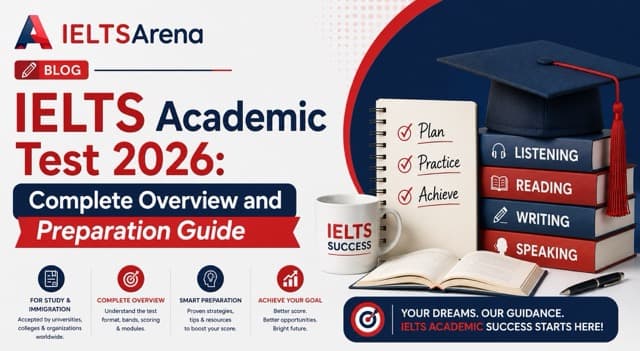
You have decided to study abroad, and almost every university on your list asks for one thing first: the IELTS Academic test. But what does it actually contain, how hard is it, and how should you prepare so you hit the band your course demands?
The IELTS Academic test measures whether your English is ready for university-level study in English. It has four sections, a strict timing structure, and reading passages pulled from journals and research papers, which is exactly why it feels harder than a casual English conversation.
This guide gives you a complete overview of the IELTS academic test in 2026, breaks down each section, explains the scores top universities expect, and lays out a preparation strategy that targets the parts most candidates find hardest.
What the IELTS Academic Test Is and Who It Is For
The IELTS Academic test is the version of IELTS used for higher education and professional registration. If you are applying to a university, a postgraduate programme, or a professional body such as a medical or nursing council, this is almost always the module you need.
There are two IELTS modules: Academic and General Training. They share identical Listening and Speaking sections, but the Reading and Writing sections differ. The Academic module uses university-style texts and tasks, while General Training uses everyday and workplace material.
You take the IELTS academic test if your goal involves studying or professional registration in an English-speaking environment. You take General Training for most work visas and migration routes.
Choosing the wrong module is a costly mistake, because a General Training result will not be accepted by a university that asks for Academic. Always confirm which module your institution requires before you book.
Advertisement
The IELTS Academic Test Format, Section by Section
The IELTS academic test has four sections taken in the same order. Listening, Reading, and Writing are completed in one sitting of about two hours and forty minutes, with Speaking either on the same day or within a few days.
Listening: 30 minutes, 40 questions. Four recordings move from everyday conversation to academic discussion and a final monologue, such as a lecture. The Listening section is identical for Academic and General Training candidates.
Reading: 60 minutes, 40 questions, 3 passages. This is where the Academic module differs sharply. The texts come from books, journals, magazines, and newspapers, and they are written for a general academic audience. There is no extra transfer time, so you record answers as you go.
Writing: 60 minutes, 2 tasks. Task 1 gives you 20 minutes to describe a graph, chart, table, or diagram in at least 150 words. Task 2 gives you 40 minutes to write an essay of at least 250 words responding to an argument or problem. Both tasks are marked on four equally weighted criteria.
Speaking: 11 to 14 minutes, 3 parts. Part 1 is a short interview, Part 2 is a long turn from a cue card with one minute to prepare, and Part 3 is a deeper two-way discussion. Speaking is the same for both modules.
Understanding the IELTS academic test format is the foundation of any sensible study plan, because each section rewards different skills and timing strategies.
Why Common Approaches to the Academic Module Fail
The most common error is treating the IELTS academic test like a general English exam. Students study vocabulary and grammar in isolation, then panic when faced with a dense research-style passage under a strict clock. The test rewards exam technique as much as language.
A second error is underestimating Academic Reading. With 40 questions in 60 minutes and no transfer time, candidates who read every passage word for word run out of time before the final questions. Speed-reading technique matters as much as comprehension here.
A third error is misreading the Writing tasks. Many candidates write a strong essay but ignore Task 1, even though both tasks count. In Academic Writing Task 1 you must describe data accurately, which is a specific skill that everyday English practice never builds.
A fourth error is practising only on paper. Most test-takers now sit the computer-based version, and walking in unfamiliar with the on-screen highlighter, timer, and navigation costs easy marks that have nothing to do with English ability.
A Real Student Who Got It Right
Mateus, a graduate from the Philippines applying for a master's degree in the United Kingdom, needed an overall Band 7.0 with no section below 6.5. His first practice attempt left him at 6.0, dragged down by Academic Reading.
"I could understand the passages," he said. "My problem was time. I kept reading every line carefully and never reached the last set of questions. I was losing marks I was perfectly capable of earning."
Mateus rebuilt his preparation around the IELTS academic test format. He learned to skim each passage first, locate keywords, and answer in passage order. He practised full timed Reading sections three times a week and reviewed every wrong answer.
Within five weeks his Academic Reading band rose from 6.0 to 7.5, and his overall band reached 7.5. His English had not transformed. His exam technique for the Academic module had.
What the Data Says About Academic Test Difficulty
The IELTS academic test is taken by a large share of all IELTS candidates worldwide each year, the majority of whom are heading into higher education. Across that population, Writing and Speaking consistently record the lowest average bands, while Listening tends to be the highest.
For candidates from non-English-speaking backgrounds, Academic Reading and Academic Writing Task 1 are frequently the steepest parts, because both demand specific exam skills rather than general fluency. According to data published by the IELTS partners, the gap between an average band and a top band usually sits in these technique-driven sections.
Most universities in the UK, Australia, Canada, and New Zealand ask for an overall band between 6.0 and 7.5, often with a minimum in each section. Competitive postgraduate courses and professional registration bodies frequently set the bar at 7.0 or higher in specific skills.
The IELTS academic test does not only measure your English. It measures how well you perform under timing and format pressure, and that is exactly what you can train.
The Right Approach: How to Prepare for the IELTS Academic Test
Here is a preparation strategy that targets where the marks are actually lost.
- Diagnose with a full timed mock. Take a complete IELTS academic test under exam conditions and record your band in each section. This tells you whether Reading, Writing, Listening, or Speaking is your real weak point.
- Master Academic Reading technique. Practise skimming for structure, scanning for keywords, and answering in order within 60 minutes. Reading speed and question strategy are where most band gains hide.
- Build Academic Writing Task 1 as a separate skill. Learn to identify the key trends in a graph or chart and report them accurately in 20 minutes. Treat it as its own discipline, not a smaller version of the essay.
- Train on the computer-based interface. If you are sitting the CBT, practise with the real on-screen tools so the format feels routine on test day.
- Get feedback on Writing and Speaking. These two sections carry the lowest averages and benefit most from correction. Feedback that scores all four criteria shows you exactly where marks are slipping.
- Simulate the full test before exam day. Take at least two more complete timed mocks so stamina and pacing across all four sections feel natural.
Following these IELTS academic tips in order means you spend your time on the technique-heavy sections that decide most band scores.
How IELTSArena Prepares You for the Academic Module
The two hardest parts of the IELTS academic test, accurate diagnosis and real feedback, are exactly what IELTSArena is built to deliver. The platform supports both Academic and General Training, so you practise the correct module from day one.
IELTSArena replicates the real IELTS computer-based test interface, with the highlighter, notepad, and navigation panel you will use on exam day. That makes your full Academic mock tests feel like the real thing and removes the format surprises that cost marks.
For Academic Writing, IELTSArena's AI feedback scores your Task 1 and Task 2 responses instantly on Task Achievement, Coherence and Cohesion, Lexical Resource, and Grammatical Range and Accuracy. For Speaking, the AI scores fluency, vocabulary, grammar, and pronunciation, and expert tutors add band-focused human correction.
The progress analytics dashboard on IELTSArena tracks every Academic mock test you take, so you can see your Reading speed and Writing band improve over time. More than 10,000 learners have used IELTSArena to reach their target band.
You can take a free Academic mock test today on IELTSArena and find out exactly where your band sits in every section.
Self-Diagnosis: Are You Ready for the Academic Test?
Run through these before you book your exam.
- Do you know for certain that your university or registration body requires the Academic module rather than General Training?
- Can you finish all 40 Academic Reading questions within the strict 60 minutes, including the final passage?
- Are you confident describing a graph or chart accurately in Academic Writing Task 1 within 20 minutes?
- Have you practised on the actual computer-based interface, or only on paper?
- Does anyone give you feedback on your Writing and Speaking against the four official criteria?
Every no on this list is a specific, fixable gap in your IELTS academic preparation for 2026, and each one is worth real marks.
Take Your First Academic Mock Test Today
The IELTS academic test is demanding, but it is also predictable. The format does not change on you, the criteria are public, and the sections that trip people up are the same ones you can train deliberately.
Take a free, full-length Academic mock test on IELTSArena and you will know exactly where your band stands in Reading, Writing, Listening, and Speaking before you commit to a test date. From there, your preparation becomes targeted instead of guesswork.
Take a Free Academic Mock on IELTSArena →
Frequently Asked Questions
What is included in the IELTS academic test and how is it structured?
The IELTS academic test has four sections taken in the same order: Listening, Reading, Writing, and Speaking. Listening lasts 30 minutes with 40 questions, Reading lasts 60 minutes with 40 questions across three academic passages, and Writing lasts 60 minutes with two tasks, a 150-word data description and a 250-word essay. Speaking lasts 11 to 14 minutes across three parts. Listening and Speaking are identical to General Training, while Reading and Writing use academic material. The whole written test runs about two hours and forty minutes, with Speaking on the same day or within a few days.
Who needs to take the IELTS academic test instead of general training?
You take the IELTS academic test if you are applying to a university, a postgraduate programme, or a professional registration body such as a medical, nursing, or engineering council. The Academic module proves your English is ready for university-level study and academic reading and writing. General Training, by contrast, is used for most work visas, migration, and secondary education routes. Always confirm with your specific institution or registration body, because an Academic requirement cannot be met with a General Training result. When in doubt, the Academic module is the safer choice for higher education.
How hard is the IELTS academic test for students from non-English speaking countries?
The IELTS academic test is challenging mainly because of its timing and academic format rather than its raw language difficulty. For candidates from non-English-speaking backgrounds, Academic Reading and Academic Writing Task 1 are often the steepest parts, since both reward specific exam technique. With focused preparation, strong bands are very achievable, and many such candidates score Band 7 or higher. The key is training the technique-heavy sections, not just general fluency. Taking full timed mock tests on a platform like IELTSArena, with feedback on Writing and Speaking, closes the gap between everyday English and exam performance.
What is the most difficult part of the IELTS academic test for most candidates?
For most candidates, Academic Writing and Academic Reading are the hardest. Writing records some of the lowest average bands globally because Task 1 demands accurate data description and Task 2 requires a structured argument under time pressure. Reading is difficult because there are 40 questions in 60 minutes with no transfer time and dense academic passages, so pacing decides many scores. Speaking can also challenge candidates who lack practice. The common thread is that these sections reward exam technique, which is why targeted, feedback-driven practice on these areas tends to produce the biggest band gains.
How do I prepare specifically for the IELTS academic reading section?
Start by taking a full timed Reading section to find your current band and your pacing problem. Then practise skimming each passage for structure, scanning for keywords, and answering questions in the order they appear, all within 60 minutes. Do not read every line word for word, because there is no transfer time and the final passage is often the hardest. Review every wrong answer to learn the question type that trips you up. Practising complete Reading sections on the IELTSArena computer-based interface builds both speed and familiarity, which together lift your Academic Reading band.
![IELTS Test Day Rules [2026]: The Complete Checklist, 8 Confirmed Changes, and 5 Disqualifying Mistakes](/_next/image?url=%2Fblog%2Fcover-ielts-test-day-rules-2026.jpeg&w=3840&q=75&dpl=dpl_Aqz3ysBMoiqhQVPsvpyewic5RwdT)