
You open the Academic Writing paper expecting a bar chart or a line graph. Instead, you see a diagram with seven stages and arrows pointing in every direction. Or worse, two maps of the same town, one from 1990 and one from today, and you have no idea where to start.
This is the moment most test-takers panic. They have spent weeks practising graphs and tables, then a process or a map appears and their whole plan falls apart.
The good news is that a process diagram or map question is actually easier to score well on once you know the structure. The IELTS process diagram writing task 1 question rewards clear sequencing and accurate language, not creative interpretation. This guide shows you exactly how to handle both.
What a Process Diagram and Map Task 1 Really Tests
In IELTS Academic Writing Task 1, you get 20 minutes to describe visual information in at least 150 words. Most students prepare only for charts. But the examiner can give you four visual types: graphs, tables, process diagrams, and maps.
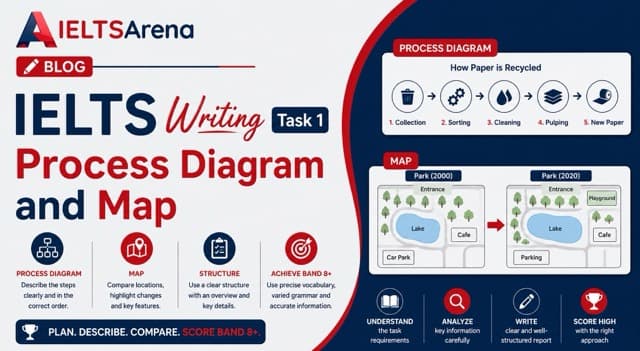
A process diagram shows how something is made or how a natural cycle works. Think of how cement is produced, how a water filter operates, or how a butterfly develops. The arrows tell you the order of the stages, and an IELTS process diagram writing task 1 question is built around following that order.
A map task shows changes to a location over time, or sometimes two versions of a place such as a current layout and a proposed redevelopment. You describe what was added, removed, relocated, or expanded.
The IELTS process diagram writing task 1 question is marked on the same four criteria as every Task 1 response. Task Achievement, Coherence and Cohesion, Lexical Resource, and Grammatical Range and Accuracy each count for 25 percent. The skill is selecting the key features and sequencing them clearly.
Advertisement
Why Most Students Lose Marks on Process and Map Tasks
The biggest mistake is treating a process diagram like a data chart. Students try to find a trend or an increase, but a process has no numbers to compare. There is nothing to go up or down. This confusion wastes minutes they do not have.
The second mistake is poor sequencing. Students describe stage four before stage two, or they jump around the diagram. The examiner cannot follow the order, so Coherence and Cohesion drops.
A third common error is the wrong grammar. Many test-takers write a process in the active voice when the passive is usually more natural. "They heat the mixture" sounds weaker than "the mixture is heated."
With map tasks, students often forget to use compass directions and location language. They write "a building was built here" without explaining where "here" is. The examiner has the same map, but your writing must stand alone.
Finally, many people write an opinion. A process diagram IELTS writing task 1 answer is purely descriptive. There is no conclusion about whether the process is good or bad. Adding opinion costs marks under Task Achievement.
How Priya Turned a Band 6 Into a Band 7.5
Priya, a nurse from the Philippines preparing for registration abroad, kept scoring Band 6.0 in Writing. Her charts were fine, but every practice process diagram pulled her score down.
"I froze every time a diagram appeared," she said. "I knew vocabulary for graphs, but I had no language for stages and steps. I would write five sentences and run out of words."
Her problem was not English ability. It was that she had never learned a repeatable structure for the IELTS process diagram writing task 1 question. She was inventing a new approach each time under pressure.
She spent two weeks practising only processes and maps. She learned sequencing phrases, practised the passive voice, and timed every attempt at 20 minutes. By her exam, she described a glass recycling process with a clear overview and ordered stages.
Priya scored Band 7.5 in Writing. "Once I had a formula, the diagram stopped being scary," she said. "I actually hoped for a process on test day."
What the Data Says About Task 1 Performance
Writing is consistently the lowest-scoring section for IELTS Academic candidates worldwide. According to IELTS test performance data published by the official partners, the global average Writing band sits around 5.8 to 6.0, lower than Listening, Reading, and Speaking.
Task 1 carries one third of your total Writing score, while Task 2 carries two thirds. Many students over-invest in Task 2 and treat Task 1 as a warm-up. That imbalance shows in results.
Process and map questions appear less often than charts, which is exactly why they catch people off guard. Industry estimates from major preparation providers suggest diagrams and maps make up roughly 20 to 25 percent of Academic Task 1 questions. That is too frequent to ignore.
When students practise all four visual types rather than only graphs, their Task 1 consistency improves sharply. Familiarity removes the panic response that costs the most marks.
The diagram is not testing your knowledge of cement or recycling. It is testing whether you can sequence steps in clear, accurate English.
The Right Approach to Process Diagrams and Maps
Use a structured method so you never freeze. The same four-part shape works for both task types, and it is the backbone of every strong IELTS process diagram writing task 1 answer.
Step 1: Write an introduction by paraphrasing the question. For a process, say what the diagram illustrates and how many stages it has. For a map, state the location and the time period being compared.
Step 2: Write an overview. This single short paragraph is the most important part of any IELTS process diagram writing task 1 answer. For a process, state whether it is natural or man-made, whether it is linear or a cycle, and how many main stages exist. For a map, summarise the biggest overall change, such as a rural area becoming urban.
Step 3: Describe the stages in order for a process. Start at the first stage and follow the arrows. Use sequencing words like first, next, after that, subsequently, and finally. Use the passive voice where the agent is unknown or unimportant. "The clay is crushed and then mixed with water."
Step 4: Describe changes by location for a map. Group your description logically, often by area or by direction. Use the past tense and the passive for completed changes. "A car park was constructed in the north, while the trees to the east were removed."
For both tasks, aim for 160 to 190 words. You need at least 150, but going slightly over shows range. Do not exceed 200, or you risk repetition and timing problems on Task 2.
Keep tenses consistent. A natural process or a present-day man-made process usually takes the present passive. A map showing past change takes the past passive. A future or proposed map takes future forms such as "will be built."
How IELTSArena Helps You Master Process and Map Tasks
The fastest way to improve is to write real process and map responses and get them scored against the official criteria. This is where IELTSArena makes the difference.
On IELTSArena, you practise Task 1 inside a real CBT interface that mirrors the actual computer-based exam, including the timer, the word counter, and the on-screen layout. You learn to manage 20 minutes the way you will on test day.
When you submit a process diagram IELTS writing task 1 answer, the AI writing feedback on IELTSArena gives you an instant band estimate and pinpoints exact errors in sequencing, tense, and passive voice. You see precisely why a sentence is weak.
For deeper correction, expert tutors on IELTSArena review your Writing and give band-focused feedback that an AI alone cannot match. They show you how to lift Task Achievement and Coherence on map and process answers specifically.
IELTSArena also tracks your performance across every mock test, so you can see whether your diagram answers are improving over time. More than 10,000 learners have used IELTSArena to reach their target band score, and the platform supports both Academic and General Training.
Because IELTSArena lets you practise at your own pace, you can drill ten process diagrams in a week and watch your speed and accuracy climb. Start free on IELTSArena without any commitment.
Self-Diagnosis: Are You Ready for a Process or Map Task?
Answer these honestly before your exam.
- Can you write a clear overview sentence for a process diagram in under two minutes?
- Do you know at least eight sequencing phrases to order the stages naturally?
- Can you switch confidently between the present passive and the past passive depending on the task?
- For a map, can you describe location using compass directions and prepositions without hesitating?
- Can you finish a full process or map answer in 20 minutes and still have time to check it?
If you hesitated on any of these, you have a clear gap to close. The fix is targeted practice with feedback, not more reading about theory.
Start Practising Process and Map Tasks Today
You will not know your true Task 1 level until you write under timed conditions and get it scored. Guessing your band is the slowest way to improve.
Submit a Process or Map Response on IELTSArena →
Frequently Asked Questions
How do I describe a process diagram in IELTS writing task 1?
Start with a one-sentence introduction that paraphrases what the diagram shows and how many stages it has. Then write an overview stating whether the process is natural or man-made and whether it is linear or cyclical. Next, describe each stage in order, following the arrows and using sequencing words like first, then, and finally. Use the passive voice where the doer is unknown, for example "the material is heated." Aim for 160 to 190 words. Practising this exact structure on IELTSArena with instant AI feedback helps you build speed and accuracy before test day.
What is the difference between describing a map and a process in IELTS task 1?
A process diagram shows how something is made or how a cycle works, so you describe stages in sequence using linking words and usually the present passive. A map shows how a place changed over time, so you describe additions, removals, and relocations using location language, compass directions, and usually the past passive. A process has a fixed order set by arrows, while a map is organised by area or direction. Both still need an introduction and a clear overview, and both are purely descriptive with no personal opinion.
Do I need passive voice when writing about an IELTS process diagram?
The passive voice is usually the most natural choice for a man-made process because the person performing the action is not important. For example, "the bottles are washed and crushed" reads better than "workers wash and crush the bottles." However, for a natural process such as a life cycle, the active voice can be appropriate, as in "the larva hatches from the egg." The key is consistency and accuracy. Strong control of both voices improves your Grammatical Range and Accuracy score, which counts for 25 percent of your Writing band.
How do I sequence the steps in a process description for IELTS task 1?
Follow the arrows from the starting point to the end, and never jump around the diagram. Use a varied set of sequencing markers so your writing does not feel repetitive. Begin with words like initially, first, and to begin with. Move through the middle with next, after that, once this is complete, and subsequently. Close with finally and in the last stage. For a cyclical process, mention that the cycle then repeats. Clear sequencing is what earns marks under Coherence and Cohesion, so practise ordering several diagrams on IELTSArena until the linking language becomes automatic.
How many words should a process diagram IELTS writing task 1 response have?
The official minimum is 150 words, but writing exactly 150 leaves no margin for error and limits the detail you can show. Aim for 160 to 190 words. This range lets you include a proper introduction, a clear overview, and a full description of every stage without padding. Going far beyond 200 words risks repetition and eats into the 40 minutes you need for Task 2, which carries twice the marks. Practise hitting this word range within 20 minutes so it becomes second nature on exam day.