
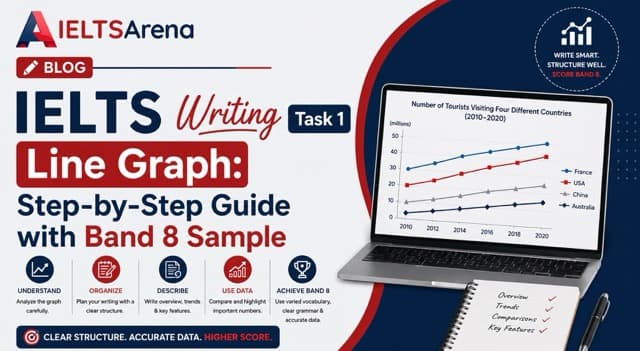
You have 20 minutes, a line graph with three wiggly lines, and no idea where to start. Most candidates lose their Task 1 band score in the first two minutes — not because their English is weak, but because they describe every data point in order and run out of words before they show the examiner what the chart actually means.
The IELTS line graph writing task 1 is not testing whether you can read a chart. It is testing whether you can select, group, and report data in clear, organised English. The examiner does not reward how many numbers you mention. They reward how clearly you show what those numbers mean.
This guide gives you the exact four-paragraph structure that consistently produces Band 7+ responses, the trend vocabulary that lifts your Lexical Resource, and the discipline that separates a strong line graph response from a list of disconnected facts.
What IELTS Line Graph Writing Task 1 Actually Tests
In Academic Writing Task 1 you have 20 minutes to write at least 150 words describing visual information. The line graph is one of the most common formats and can appear in three variations: a single line showing one trend over time, multiple lines comparing trends, or a line graph paired with a second chart in the same question.
Your response is marked on the four equally weighted criteria: Task Achievement, Coherence and Cohesion, Lexical Resource, and Grammatical Range and Accuracy. Each is worth 25 percent. Task Achievement is where most candidates lose ground on line graph questions, because it specifically rewards the presence of a clear overview and the selection of significant data points rather than exhaustive description.
The line graph question is descriptive, not analytical. You are not asked to explain why the data looks the way it does, just to describe what it shows clearly and accurately.
Advertisement
The Four-Paragraph Structure That Works
Use this structure for every line graph response. It works for single-line, multi-line, and combined-chart questions.
Paragraph 1: Introduction. Paraphrase the question in one or two sentences. State what the graph shows, the time period covered, and the unit of measurement.
Paragraph 2: Overview. This is the single most important part of your response. Write two or three sentences summarising the biggest trends across the whole graph, with no specific numbers. For a multi-line graph, name the highest line, the lowest line, and any line that moves differently from the others.
Paragraph 3: Detail. Group the data logically. For a multi-line graph, group lines that move similarly. Include specific figures, peaks, troughs, starting values, ending values, and any crossing points.
Paragraph 4: Second Detail. Cover the remaining contrasts. Save the most striking comparison for this paragraph.
The overview paragraph is the line that decides whether the examiner can award Band 7 or higher on Task Achievement. Without it, your score is capped at Band 6 no matter how good the rest of your writing is.
Trend Vocabulary That Lifts Your Score
You need at least five different verbs in a strong response. Repeating "increased" four times in a row caps your Lexical Resource at Band 6.
Upward movement: rose, increased, climbed, surged, grew, jumped, soared, escalated.
Downward movement: fell, declined, dropped, dipped, decreased, plummeted, sank, slipped.
Stability: remained stable, levelled off, held steady, plateaued, stayed constant, hovered around.
Pair these verbs with adverbs that show magnitude: sharply, gradually, dramatically, slightly, steadily, modestly, significantly, marginally.
So instead of "the figure increased and then increased again," you write "the figure climbed steadily before surging dramatically." Same idea, far stronger Lexical Resource score.
Why Common Approaches Fail
Three habits keep candidates stuck at Band 6.
Describing every data point. A line graph with twenty data points does not need twenty sentences. You pick the starting value, ending value, peaks, troughs, and any moment where lines cross or change direction. Everything else clutters your writing and wastes the 20 minutes you have.
Writing sequentially across time. Many students describe what happened in 2000, then 2001, then 2002, marching through the years. This produces a list, not analysis. Group by similarity instead: "Both the museum and the historic site lines climbed steadily, while the theme park line fluctuated."
Skipping the overview. Some candidates write a strong introduction, then dive straight into details. Without an overview paragraph, the examiner cannot award Band 7+ on Task Achievement regardless of the quality of the rest.
A Real Candidate Story: Daniel from the Philippines
Daniel, a 28-year-old marketing analyst applying for a Canadian Express Entry profile, sat IELTS twice and scored Band 6.0 in Writing both times. His Task 2 essays were Band 7 quality. His Task 1 line graph responses were dragging the whole Writing band down.
When he reviewed his practice responses, the pattern was obvious. He was describing every data point sequentially, with no overview. His responses read like data dumps with no shape.
"I was treating it like a memory test," Daniel said. "I tried to include every number. I never stepped back to say what the graph as a whole was showing."
He rewrote his approach around the four-paragraph structure. Paraphrase, overview, two grouped detail paragraphs. Within three weeks his Writing band moved from 6.0 to 7.0 in practice. On his third real attempt he scored Writing 7.0, lifting his overall to 7.5 and clearing his Express Entry threshold.
How IELTSArena Helps You Master Line Graphs
The line graph response rewards repeated practice with feedback on whether your overview is genuinely capturing the main trends, not just describing them in different words.
IELTSArena's AI Writing feedback scores every Task 1 response across all four criteria within seconds and specifically flags a missing or weak overview, repeated trend verbs, and data points that are listed instead of grouped. You see the issue immediately and can rewrite before the real exam.
The platform delivers Task 1 prompts in the real CBT interface with the same timer, word counter, and on-screen layout you will face on test day. Expert tutor feedback adds the human, examiner-level correction on Task 1 responses for candidates targeting Band 7.5+.
Start free on IELTSArena and submit your first line graph response for immediate AI feedback.
Self-Diagnosis: Is Your Line Graph Response Ready?
Answer these honestly before your next practice session.
- Can you write a clear overview paragraph in two sentences with no specific numbers?
- Can you finish a complete IELTS line graph writing task 1 response in 20 minutes including planning?
- Do you use at least five different trend verbs across the response?
- Do you group lines logically rather than describing each one sequentially?
- Do you select significant data points (starting/ending values, peaks, troughs, crossing points) rather than describing every point?
A "no" on any of these is the specific habit to fix first.
Start Writing Line Graph Responses Today
The structure works. The vocabulary works. The only thing left is to write a line graph response under timed conditions and see your real band score.
Submit Your First Line Graph Response on IELTSArena →
Frequently Asked Questions
How do I describe trends accurately in an IELTS line graph response?
Use precise trend verbs paired with adverbs of magnitude and clear time references. Instead of "the figure went up," write "the figure climbed steadily between 2005 and 2010, then surged dramatically until 2015." Avoid describing every data point in order, which clutters your writing and wastes time. Focus on the starting value, ending value, peaks, troughs, and any moment where the line changes direction sharply. Group lines that move similarly to show comparison rather than listing each one separately. The examiner rewards meaningful description over exhaustive coverage.
What vocabulary should I use for IELTS line graph trends?
Rotate at least five different verbs per response to demonstrate range. For upward movement use rose, climbed, surged, grew, and jumped. For downward use fell, declined, dropped, dipped, and plummeted. For stability use remained stable, levelled off, plateaued, and held steady. Pair each verb with an adverb of magnitude such as sharply, gradually, dramatically, slightly, or steadily. Repetition of the same verb caps your Lexical Resource at Band 6, while a controlled mix of these verbs and adverbs lifts you into Band 7+ territory.
Which data points should I select to describe in an IELTS line graph?
Report the starting value, the ending value, the highest and lowest points, and any crossing points between lines. Add one or two intermediate values only if they show a significant change in direction or rate. Describing every data point is one of the most common mistakes and it lowers your Coherence and Cohesion score because the response reads as a list rather than a structured description. Selection is a skill the examiner specifically rewards, so be deliberate about which figures you include.
How do I write an overview for a multi-line IELTS graph?
Write the overview as a separate second paragraph and include no specific numbers. Keep it to two or three sentences. For a multi-line graph, identify the line with the highest values across the period, the line with the lowest, and any line that moves in a clearly different pattern from the others. The overview signals the big picture before you go into detail. Without an overview the examiner cannot award Band 7 or above on Task Achievement, regardless of how strong the rest of your writing is.
How long should my IELTS line graph response be?
Aim for 160 to 190 words. The minimum is 150, but writing exactly 150 leaves no room to show range and risks an under-length penalty. Going beyond 200 words typically means you are listing data rather than selecting it, and it eats into the 40 minutes you need for Task 2 which carries twice the marks. Plan for 20 minutes total: three minutes planning, fourteen writing, three checking. Practising timed responses in the real CBT interface on IELTSArena trains you to hit the right length within the time limit.