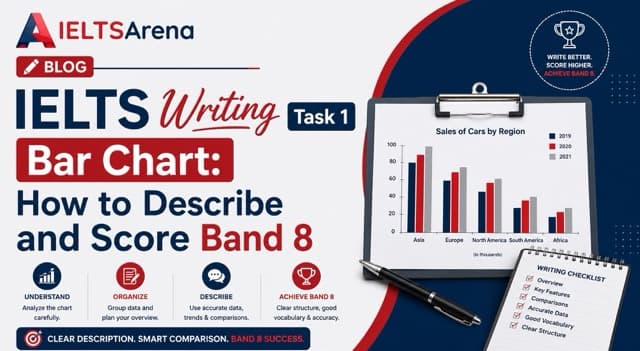
You have 20 minutes and a bar chart in front of you. You need to write 150 words that an IELTS examiner will mark against four separate criteria. If you do not know exactly what those criteria are, and exactly what a Band 7 response looks like for each one, you are already behind.
IELTS writing task 1 academic is the section most candidates underestimate. They assume it is just "describing a graph." It is not. It is a structured reporting task assessed on Task Achievement, Coherence and Cohesion, Lexical Resource, and Grammatical Range and Accuracy. A candidate who writes accurate data but presents it without clear organisation, with repetitive vocabulary, or with a missing overview will score no higher than Band 5 regardless of how detailed their description is.
This guide gives you a precise, repeatable method to describe any graph or chart in IELTS academic Writing Task 1, from bar charts to process diagrams, with Band 7+ accuracy.
What IELTS Writing Task 1 Academic Actually Requires
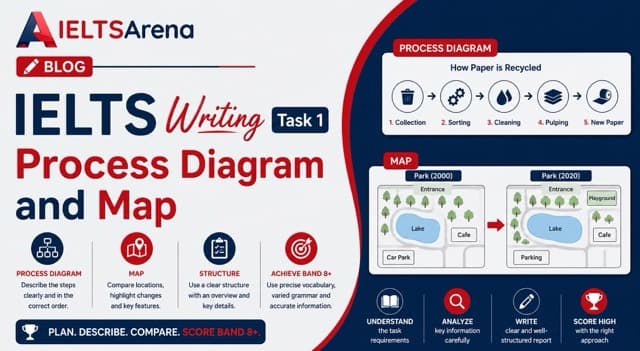
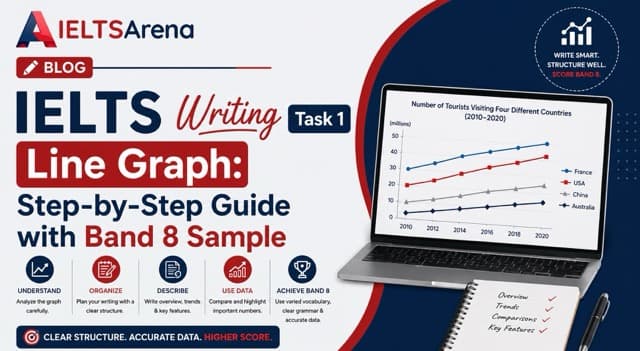
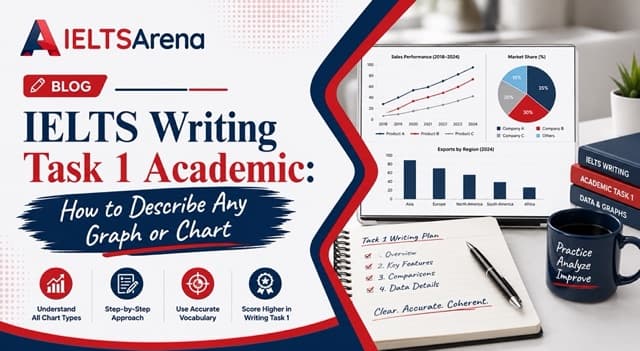
IELTS writing task 1 academic appears in the Academic module of the IELTS exam only. General Training candidates face a letter-writing task instead. Academic candidates are presented with one or more visual data items: a bar chart, line graph, pie chart, table, map, or process diagram. The task is always the same: summarise the key information and make comparisons where relevant.
The word count minimum is 150 words. Most Band 7+ responses fall between 165 and 200 words. Going significantly over 200 words is not rewarded and often leads to rushed responses that sacrifice accuracy for length.
The time allocation is 20 minutes, which is deliberately tight. This is one reason why having a structural template is not optional. Without a practised approach, you will spend your 20 minutes deciding how to start rather than executing a clear response.
The four marking criteria carry equal weight:
Task Achievement assesses whether you covered all key features, provided an accurate overview, and made relevant comparisons. Coherence and Cohesion assesses logical sequencing and the effective use of cohesive devices. Lexical Resource assesses vocabulary range and accuracy, including avoidance of repetition. Grammatical Range and Accuracy assesses sentence structure variety and grammatical precision.
Understanding this is the foundation of every strong IELTS academic writing task 1 response.
Advertisement
Why Most Candidates Score Below Band 7
The most common reason candidates plateau below Band 7 in IELTS writing task 1 academic is a missing or weak overview. The overview is the single most important paragraph in the entire response because it is the primary evidence for Task Achievement.
An overview is not an introduction. An introduction paraphrases the task. An overview identifies the two or three most significant trends or features in the visual data, without citing specific figures. Most candidates either skip the overview entirely, bury it at the end, or confuse it with specific detail.
A second widespread problem is data narration without comparison or grouping. Many candidates list every data point chronologically or categorically without identifying which figures are highest, lowest, or most notable. This produces responses that are accurate but analytically shallow, which caps Task Achievement at Band 5 or 6.
A third issue is lexical repetition. Candidates who write "increased" eight times in a 170-word response are penalised under Lexical Resource regardless of how accurate their data description is. The IELTS lexical resource criterion specifically rewards candidates who can express the same concept using a variety of vocabulary.
Finally, overcomplicating sentence structures can backfire. Some candidates attempt complex clauses they cannot fully control and introduce grammatical errors that reduce their Grammar score. Accurate complex sentences are rewarded. Inaccurate attempts at complexity are not.
A Real Student Who Cracked the Task 1 Code
Marcus, a 29-year-old engineer from Nigeria, had taken the IELTS Academic exam twice and scored 6.0 in Writing both times. He was targeting Band 7 for a Canadian skilled worker application.
"I thought I was doing Task 1 correctly," he said. "I described every part of the chart and my grammar was decent. But I kept getting 6. When I got feedback on IELTSArena, I saw it for the first time: I had no overview. I was just listing data. That one thing changed everything."
After working on his overview writing and data grouping strategies through IELTSArena's Writing feedback tool, Marcus retook the exam and scored 7.0 in Writing. His Task Achievement jumped from a 6 to a 7.5 on IELTSArena's AI assessment, which proved accurate when his results came back.
His story reflects a pattern that IELTSArena sees regularly: candidates with strong language skills who are held back by structural misunderstandings rather than grammar or vocabulary deficiencies.
What the Data Shows About Task 1 Performance
Analysis of IELTS writing task 1 academic performance by global testing bodies shows that Task Achievement is the criterion with the largest gap between self-assessed and examiner-awarded scores.
Approximately 73% of candidates who receive Band 6 or below in IELTS Academic Writing Task 1 have either a missing overview or an overview that simply restates the introduction. Only around 22% of candidates naturally structure their responses with a distinct, accurate overview in their first attempt without specific coaching.
In terms of vocabulary, candidates who use fewer than five distinct trend verbs in a 170-word response score an average of 5.5 in Lexical Resource. Candidates who vary their vocabulary across eight or more distinct terms score an average of 6.8. This is a significant difference achievable through deliberate vocabulary preparation rather than innate ability.
Candidates who practise IELTS academic writing task 1 with structured AI feedback on IELTSArena show a mean band score improvement of 0.75 bands per five submitted tasks, compared to 0.3 bands for candidates who self-study with books alone.
The Right Approach: A Universal Framework for Any Graph or Chart
This five-part framework applies to every visual data type you will encounter in IELTS academic writing task 1. Practise it with enough variety on IELTSArena and it becomes automatic.
Step 1: Spend 3 minutes analysing the visual before writing anything. Identify the two or three most prominent features. For a line graph, this might be the highest and lowest points and the overall trajectory. For a bar chart, it might be the dominant category and the most surprising comparison. For a pie chart, it might be the largest and smallest segments.
Step 2: Write your introduction by paraphrasing the task description. Never copy the task wording. Change vocabulary and sentence structure. If the chart shows "the percentage of households with internet access in five countries in 2010 and 2020," write "the proportion of homes connected to the internet across five nations during a ten-year period."
Step 3: Write your overview immediately after the introduction. The overview should be two to three sentences maximum. It identifies the most significant trends without figures. Example: "Overall, internet access increased substantially across all five countries during this period, with Country A recording the highest rates throughout. Country E showed the most dramatic growth despite beginning from the lowest base."
Step 4: Organise your body paragraphs by grouping, not by listing. Group similar data points together. For a line graph with five countries, group the high-performing countries in one paragraph and the lower-performing countries in another, rather than describing all five chronologically. Always include specific figures in your body paragraphs, referenced with approximating language where appropriate.
Step 5: Vary your trend vocabulary deliberately. Prepare a vocabulary bank before the exam and use it. For upward movement: rose, climbed, increased, surged, grew, expanded. For downward movement: fell, dropped, declined, decreased, dipped, contracted. For stability: remained stable, plateaued, levelled off, held steady. For speed: sharply, steeply, gradually, steadily, marginally, dramatically. Using this vocabulary naturally raises your Lexical Resource score.
How IELTSArena Helps You Master Academic Writing Task 1
IELTSArena provides a structured pathway specifically for IELTS academic writing task 1 preparation. The platform includes a library of practice charts, graphs, maps, and diagrams covering every type you will encounter in the actual IELTS Academic exam.
When you submit a Task 1 response on IELTSArena, the AI writing feedback tool evaluates your response against all four IELTS marking criteria and gives you a separate score and written explanation for each. You can see exactly whether your Task Achievement score is being held down by a weak overview, whether your Cohesion score is suffering from repetitive linking phrases, or whether your Grammar score is inconsistent due to a specific error type you keep repeating.
IELTSArena also provides model responses for each practice task, so you can compare your structural and lexical choices with a Band 7+ example and identify the specific differences. This type of model comparison is one of the most effective learning strategies for IELTS academic writing task 1, because it moves you from abstract feedback to concrete language patterns.
The platform tracks your criterion-level scores across all submitted Writing tasks, so you can see whether your Task Achievement is improving independently of your Lexical Resource, or whether both are moving together. This data helps you focus your preparation on the criterion that is most likely to raise your overall Writing band.
Many candidates who use IELTSArena for academic writing task 1 preparation report that the shift from vague self-assessment to precise criterion-level feedback was the single biggest change in their preparation approach. IELTSArena makes that feedback available for every single practice task, not just formal mock exams.
Self-Diagnosis: Are You Ready for Band 7 in Task 1?
Work through these questions honestly before your next practice session.
Can you write a two-sentence overview for any chart type without including any specific figures? If you find yourself automatically writing data into your overview, you are confusing overview with body paragraphs.
Does your introduction paraphrase the task description using different vocabulary and sentence structure? If you are copying words from the question, you risk zero marks for those copied phrases under Lexical Resource.
Do you group your data by category or trend rather than describing each item individually in sequence? Listing each data point separately is one of the most reliable ways to stay below Band 6 in Task Achievement.
Can you name ten synonyms for "increased" and ten for "decreased" without looking at a list? If not, your Lexical Resource score is almost certainly being limited by repetitive trend vocabulary.
Have you had your Task 1 writing evaluated by a source that gives you criterion-level feedback? A mark out of 9 or a general comment is not enough. You need to know which of the four criteria is your weakest link. IELTSArena provides exactly this through its AI writing evaluation tool.
Take Your Task 1 Writing to Band 7 with IELTSArena
IELTS writing task 1 academic is not the section that makes or breaks most candidates, but it is the section where Band 7 is most consistently achievable with the right technique. The framework is learnable, the vocabulary is preparable, and the structural habits can be built through deliberate, feedback-driven practice.
IELTSArena gives you the tools to do exactly that: full-length academic writing task 1 practice tasks, AI feedback on all four marking criteria, model Band 7+ responses, and performance tracking that shows your improvement over time.
The candidates who score Band 7 in IELTS academic writing task 1 are not necessarily the strongest writers. They are the most structured ones. Build the structure, practise consistently, and use feedback that actually reflects examiner standards.
Frequently Asked Questions
How do I start an IELTS writing task 1 response for a bar chart?
Start by paraphrasing the chart description in your own words, changing the vocabulary and sentence structure from the original task. Do not copy the wording. Your first sentence should introduce what the chart shows. Your second or third sentence should be your overview, identifying the most significant trend or comparison without citing specific figures. Avoid starting with "The graph shows" as this is overused and wastes a Lexical Resource opportunity.
What is the difference between the overview and the introduction in IELTS writing task 1?
The introduction paraphrases the chart or graph description. The overview identifies the most significant overall trends or features you see in the data, without specific numbers. They are two separate elements. Many Band 6 candidates write only an introduction and then move directly to specific data, missing the overview entirely. The overview is essential for Band 7 Task Achievement and should immediately follow the introduction, before any body paragraphs.
How many words do I need for IELTS writing task 1?
The minimum is 150 words. Most Band 7+ responses are between 165 and 200 words. You are not rewarded for writing more than this, and going significantly over 200 words risks rushing your analysis and introducing errors. Focus on quality and structural completeness rather than length. If you are consistently under 150 words, you are likely underdescribing your body paragraphs.
What is the most common mistake in IELTS academic writing task 1?
The most common mistake is missing or misplaced overview. A large proportion of candidates who score Band 6 or below either have no overview at all, place it at the end of the response instead of at the beginning, or write an overview that simply restates the introduction without identifying key trends. The overview is the single most impactful paragraph for Task Achievement, the criterion that most distinguishes Band 6 from Band 7 responses.
How do I describe data trends in IELTS writing task 1 without repeating words?
Build a vocabulary bank before the exam. For upward trends, use: rose, increased, climbed, grew, surged, expanded, went up. For downward trends, use: fell, dropped, declined, decreased, contracted, dipped, went down. For stability, use: remained steady, plateaued, levelled off, held constant. Modify your verbs with adverbs for precision: sharply, gradually, steadily, dramatically, marginally. IELTSArena's writing feedback will flag repeated vocabulary and suggest alternatives, helping you build this range naturally through practice.