Most test-takers lose their Task 1 band score in the first 90 seconds, before they write a single sentence about the data. They glance at the bar chart, panic at the number of bars, and start describing every column from left to right. Forty minutes later they have written 230 words that list figures with no shape, no comparison, and no overview.
That single habit is why so many capable writers stay stuck at Band 6.0 on the academic paper. The bar chart is one of the most common Task 1 question types, and it rewards a very specific skill: the ability to see the big picture first and the detail second.
This guide breaks down exactly how to handle an IELTS bar chart writing task 1 response, what examiners look for in each band, and how to structure a Band 8 answer that you can write in 20 minutes. You will see the exact data language that moves your score up, and a clear method you can repeat in the real exam.
What the IELTS Bar Chart Writing Task 1 Actually Tests
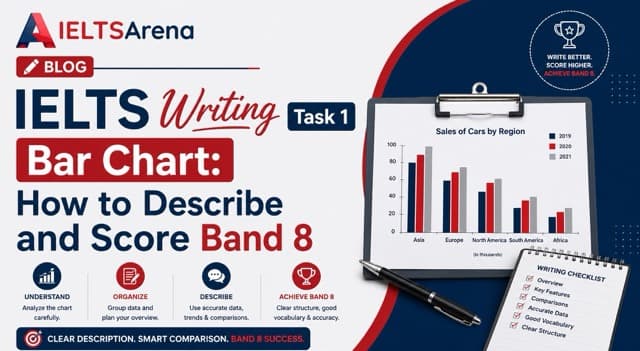
In Academic Writing Task 1 you get 20 minutes and a minimum of 150 words. The bar chart shows data as vertical or horizontal columns, and your job is to summarise the main information and make relevant comparisons.
You are not asked for an opinion. You are not asked to explain why the data looks the way it does. The examiner wants a clear, accurate description of what the chart shows.
A bar chart can appear in three forms. A single bar chart compares one set of values across categories, like the number of visitors to five museums. A double or grouped bar chart compares two or more sets, like male and female visitors across those museums. A bar chart over time shows the same category measured across different years.
Each form needs the same response skeleton, but the comparisons change. The IELTS bar chart writing task 1 question is graded on four equally weighted criteria: Task Achievement, Coherence and Cohesion, Lexical Resource, and Grammatical Range and Accuracy. Each is worth 25 percent of your Task 1 score.
The most common reason writers miss Band 7 is Task Achievement. They describe data but never give an overview, so the examiner cannot award the higher bands no matter how good the grammar is.
Why Common Approaches Fail
The biggest mistake is writing with no overview. Many students dive straight into figures and never tell the reader what the chart shows as a whole. Without that overview paragraph, your score is capped, often at Band 5 for Task Achievement.
The second mistake is listing every single number. A bar chart with eight columns has eight values, but you do not describe all of them. Band 8 writing selects the highest, the lowest, and the most striking comparisons. It groups the rest.
The third mistake is mechanical repetition. Writers use the same sentence pattern again and again: "The figure for X was Y. The figure for Z was W." This kills your Coherence score and your Lexical Resource score at the same time.
A fourth mistake is misreading the axis. If the vertical axis shows thousands and you write the raw number, your data is wrong, and inaccurate data pulls down Task Achievement directly.
The last mistake is time. Writers spend 30 minutes on Task 1 because they have no method, then rush Task 2, which carries twice the weight. A clear structure fixes this.
A Realistic Student Story
Daniel, a mechanical engineer from Nigeria, needed Band 7.0 overall for a master's place in Australia. His Reading and Listening were strong, but his Writing stayed at 6.0 across three attempts.
When he reviewed his Task 1 answers, the pattern was obvious. "I was describing the bar chart like a robot reading a table," he said. "Every bar got its own sentence. I never stepped back to say what the chart actually showed."
He rebuilt his approach around two ideas. First, write the overview before the details. Second, group the data instead of listing it. He practised eight bar chart tasks over two weeks, submitting each one for feedback and rewriting based on the corrections.
"The moment that changed everything was when a tutor circled my body paragraphs and wrote one word: group," Daniel said. His next mock test scored Band 7.0 on Writing. On the real exam he reached Band 7.0 overall and got his place.
The overview is not a summary you add at the end. It is the sentence that decides whether the examiner can give you Band 7 or higher at all.
Data and Insight: What Examiners Reward
Public IELTS performance data published by the test partners shows that Writing is consistently the lowest-scoring skill for academic candidates worldwide, with global average Writing bands sitting around 5.5 to 6.0 across recent reporting years. That is below the Reading and Listening averages for the same groups.
The gap matters because Writing often holds back the overall band. A candidate with 7.0 in three skills and 5.5 in Writing lands at an overall 6.5 after rounding, half a band short of many university and visa requirements.
Within Task 1, examiner training materials are clear on one point. To reach Band 7 for Task Achievement, a response must present a clear overview of main trends, differences, or stages. Without that overview, Band 6 is the ceiling, regardless of vocabulary or grammar.
This is the single highest-value fix in the whole task. An overview takes two sentences and around 30 seconds, and it can move a capped Band 6 response into Band 7 territory on one of the four criteria.
The Right Approach: Structure a Band 8 Bar Chart Response
Use the same four-paragraph structure every time. It works for single bar charts, grouped bar charts, and charts over time.
Step 1: Paraphrase the question. Write one sentence that restates what the chart shows, using different words from the prompt. If the prompt says "The chart below shows the number of visitors," you might write "The bar chart illustrates how many people visited four attractions."
Step 2: Write the overview. Start with "Overall" and give the two or three biggest features. For a single chart, name the highest and lowest categories. For a grouped chart, name the dominant group and the clearest pattern. Do not include specific numbers here.
Step 3: Write body paragraph one. Describe the most significant group of data with exact figures. Select the highest values and the key comparison. Use accurate numbers from the correct axis.
Step 4: Write body paragraph two. Describe the remaining data, again grouped logically. Compare the lower or middle values and note any exception that stands out.
Step 5: Manage the data language. Use comparison structures rather than listing. Phrases like "almost twice as high as," "slightly lower than," "the same as," and "by contrast" show range. For a chart over time, use trend verbs like rose, fell, peaked, and remained stable.
Step 6: Check your timing. Spend 3 minutes planning, 14 minutes writing, and 3 minutes checking. Aim for 160 to 190 words. Going far over 200 wastes time you need for Task 2.
How IELTSArena Helps You Master Task 1
Knowing the structure is not the same as being able to produce it under exam pressure. The fix is repeated practice with feedback on every attempt, which is exactly where IELTSArena is built to help.
On IELTSArena you write your bar chart response inside the real CBT interface, the same screen layout, word counter, and timer you will face on test day. This removes the shock of the computer-based format, which still surprises many candidates in the exam room.
When you submit a Task 1 answer, the AI writing feedback on IELTSArena gives you an instant band estimate across all four criteria and flags the exact problems, including a missing overview, listed data that should be grouped, and repeated sentence patterns. You see precisely why your IELTS bar chart writing task 1 response sits where it does.
For deeper correction, expert tutors on IELTSArena review your writing and show you band-focused improvements an algorithm alone cannot judge, like whether your comparisons are genuinely relevant. The progress analytics then track your Task 1 scores across every attempt, so you can watch your Task Achievement climb from one mock to the next.
More than 10,000 learners have used IELTSArena to move their Writing band upward, and the platform supports both Academic and General Training, so you always practise the correct Task 1 type.
Self-Diagnosis: Is Your Task 1 Ready?
Answer these honestly before your next mock test.
- Can you write a clear overview paragraph in under one minute, without including specific numbers?
- When you look at a bar chart, can you instantly identify the highest value, the lowest value, and the single most important comparison?
- Do you group your data into two logical body paragraphs, or do you describe each bar in its own sentence?
- Can you finish a complete IELTS bar chart writing task 1 response in 20 minutes and still leave 40 minutes for Task 2?
- Do you use at least four different comparison structures in a single answer, rather than repeating "the figure for X was Y"?
If you hesitated on any of these, that is your priority area. The good news is that each one is a trainable habit, not a fixed limit.
Start Practising Your Bar Chart Response Today
You do not need another grammar book. You need to write bar chart tasks, get feedback, and rewrite until the structure becomes automatic.
Submit Your First Bar Chart Response on IELTSArena →
Frequently Asked Questions
How do I write an overview for an IELTS bar chart in writing task 1?
Begin a separate sentence with the word "Overall" and describe the two or three biggest features of the chart without using specific numbers. For a single bar chart, state which category is highest and which is lowest. For a grouped chart, name the dominant group and the clearest overall pattern. The overview is the most important part of the response, because Band 7 and above for Task Achievement requires it. Place it right after your paraphrased introduction, before the detailed body paragraphs. On IELTSArena, the AI writing feedback flags a missing or weak overview instantly, which is the fastest way to fix this common Band 6 ceiling.
What data should I include when describing an IELTS bar chart?
You should not describe every bar. Select the highest value, the lowest value, and the most striking comparisons, then group the remaining figures logically. A good response usually covers four to six specific figures across two body paragraphs, with accurate numbers taken from the correct axis. Always include units, such as thousands or percentages, exactly as the chart shows them. The goal is a clear summary of main features, not a complete data dump. Examiners reward selection and comparison far more than they reward listing every single number in the chart.
How do I group data effectively in an IELTS writing task 1 bar chart response?
Group by similarity or by ranking. You can put the highest values together in one paragraph and the lower values in another, or you can group by category type if the chart suggests natural sets. The aim is to compare rather than list, so use linking language like "similarly," "in contrast," and "whereas." Effective grouping keeps your two body paragraphs focused and improves both your Coherence and Cohesion score and your Task Achievement score. Practising grouped responses on IELTSArena with feedback helps you build this habit until it becomes automatic under exam timing.
What is the difference between describing a single bar chart and a double bar chart in IELTS?
A single bar chart compares one set of values across categories, so your comparisons run between categories, such as which museum had the most visitors. A double or grouped bar chart compares two or more sets at once, such as male and female visitors across museums, so you must compare both within each category and across the groups. The double chart needs more careful overview language, because you describe two patterns at the same time. The structure stays the same in both cases: paraphrase, overview, two grouped body paragraphs, accurate figures, and clear comparison.
How long should my IELTS writing task 1 bar chart response be?
Aim for 160 to 190 words. The official minimum is 150 words, and writing fewer than that brings a penalty for an under-length response. Writing far more than 200 words is risky, because it usually means you are listing data instead of selecting it, and it eats into the 40 minutes you need for Task 2, which carries twice the marks. Plan for 20 minutes total on Task 1, roughly 3 minutes planning, 14 writing, and 3 checking. Practising timed responses on IELTSArena in the real CBT interface trains you to hit the right length within the time limit.