Most IELTS candidates lose more marks in IELTS Listening Section 4 than in Sections 1, 2, and 3 combined. It is not uncommon for a test-taker to score 9/10 in Section 1 and 5/10 in Section 4. That single section can pull a Band 8 Listening score down to Band 6.5.
If you have been practising IELTS listening and your Section 4 results keep disappointing you, there is a reason for it. The section is structurally different from everything that came before it. Treating it like the other three sections is the core mistake.
What Makes IELTS Listening Section 4 Different from the Rest
The first three sections of the IELTS Listening test have a clear structure. Section 1 is a conversation between two people in an everyday context. Section 2 is a single monologue about a social or practical topic. Section 3 is a conversation between multiple people in an academic context.
IELTS listening section 4 breaks from all of that.
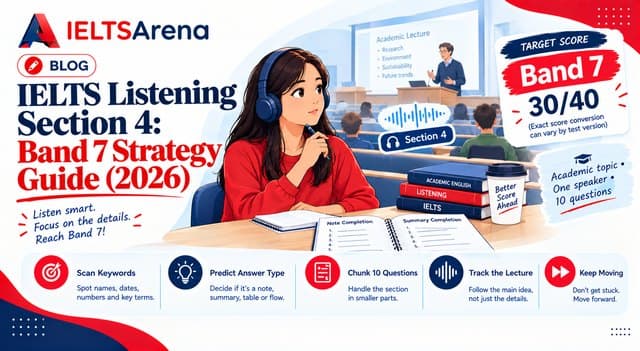
It is a single, uninterrupted academic monologue. One speaker. Ten questions. No break halfway through to read ahead. No second voice to give you time to recover if you miss something. The topic is always academic and often highly specialised: archaeology, environmental science, cognitive psychology, economic history.
The vocabulary is formal and technical. The speaker does not slow down or simplify. The content does not follow the obvious conversational cues you have come to rely on in the first three sections.
You also receive only 30 seconds to read through all ten questions before the audio starts. In Sections 1 to 3, there is a mid-section pause that lets you preview the second half. In IELTS listening section 4, there is no such pause. You must manage your attention across all ten questions from the start.
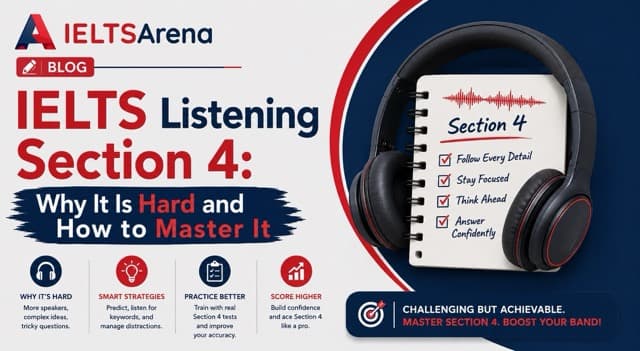
This combination of no break, academic vocabulary, dense content, and specialised topics is what makes IELTS listening section 4 consistently the hardest section on the test.
Advertisement
Why Common Preparation Strategies Fail for Section 4
Many test-takers prepare for IELTS Listening by listening to English audio content. Podcasts, news broadcasts, television series. This approach builds general listening fluency, and it is better than no practice at all. But it does not specifically prepare you for IELTS listening section 4.
The problem is that casual listening is passive. You can follow a podcast without catching every word because the context, your prior knowledge, and the informal nature of the content fill in the gaps. In IELTS listening section 4, there are no gaps to fill. Every answer is a specific word or phrase that appears exactly once in the audio. If you miss it, it is gone.
Another common mistake is practising all four sections equally without targeting Section 4 specifically. If IELTS listening section 4 is consistently your weakest area, practising balanced across all four sections means you are spending 75% of your time on sections that are not your problem.
A third mistake is reading all ten questions in detail during the 30-second preview window. There is not enough time to process ten questions and understand each one fully. Candidates who try to do this often reach the audio already overwhelmed and fall behind in the first minute.
A Student Who Cracked Section 4 After Three Attempts
James, a 29-year-old civil engineer from Nigeria, was aiming for Band 7.5 overall for a postgraduate visa application. His Listening was stuck at Band 6.5 despite scoring well in Sections 1 to 3. Section 4 was giving him 4 or 5 out of 10 consistently.
"I thought I was a good listener," he said. "I watched a lot of academic YouTube content. But the exam felt completely different."
James started targeting IELTS listening section 4 specifically, using IELTSArena's section-filtered practice mode to do three Section 4 recordings daily. He also changed his preview strategy, scanning for question keywords rather than reading full questions.
By his next exam, his Section 4 score had moved to 8/10. His overall Listening band was 7.5.
The turning point was not more general listening. It was deliberate, targeted practice on the specific structure of IELTS listening section 4.
What the Data Shows About Section 4 Performance
Analysis of IELTS Listening score distributions consistently shows that Section 4 produces the highest error rates across all candidate groups. Across all proficiency levels, the average accuracy in Section 4 is approximately 15 to 20 percentage points lower than in Section 1.
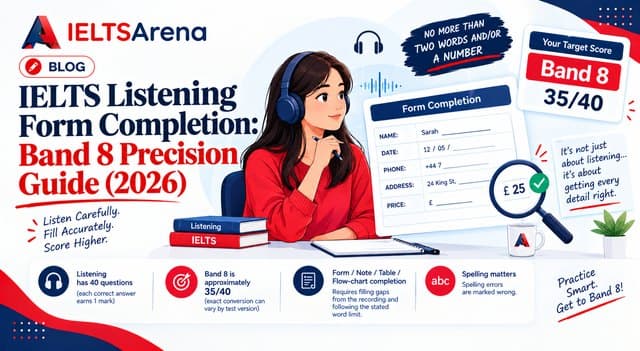
The question types most commonly found in IELTS listening section 4 are note completion, sentence completion, and summary completion. These require candidates to write exact words from the audio, spelled correctly, within the word limit given (usually "no more than two words and/or a number").
Research from Cambridge English profiling IELTS responses shows that the most common errors in Section 4 are: missing the answer due to unfamiliar vocabulary (candidates hear a word but do not recognise it or cannot spell it), writing paraphrases instead of the exact words from the audio, and exceeding the word limit by adding articles or prepositions unnecessarily.
Candidates who practise IELTS listening section 4 in isolation, at least three times per week, show measurably faster improvement in this section compared to those who practise general listening or rotate evenly across all four sections.
The average time to move from consistently scoring below 6/10 to above 8/10 in Section 4 with targeted practice is approximately four to six weeks, based on structured preparation outcomes.
The Right Approach to Master IELTS Listening Section 4
Here is the step-by-step approach that produces consistent Section 4 improvement.
Step 1: Understand the format before you practise. Know exactly what to expect. IELTS listening section 4 is ten questions, one uninterrupted academic monologue, 30 seconds to preview. There are no surprises in the format. Knowing this prevents the disorientation many candidates feel in the exam.
Step 2: Change your preview strategy. In the 30-second window, do not read. Scan. Look for the key noun or topic in each question. Underline one or two content words that signal what the answer will be about. You are not trying to understand the question fully. You are setting visual anchors that will alert you when the relevant part of the audio arrives.
Step 3: Practise "chunking" your attention. IELTS listening section 4 is ten questions across one long recording. Treat it as two groups of five. Focus on questions 1 to 5 first. When you have answered question 5, shift your full attention to questions 6 to 10. This mental chunking reduces cognitive overload and prevents you from trying to monitor all ten answer slots simultaneously.
Step 4: Build your academic vocabulary systematically. Section 4 topics are drawn from academic disciplines. Regularly encountering vocabulary from fields such as environmental science, archaeology, economics, and sociology means fewer surprises in the exam. IELTSArena's listening preparation includes academic topic exposure specifically curated for Section 4 content areas.
Step 5: Practise active listening with transcripts. After completing a Section 4 recording, compare your answers to the transcript word by word. Identify exactly where you went wrong. Did you mishear the word? Did you hear it but not recognise it? Did you write the right idea in the wrong form? Each error type requires a different fix.
Step 6: Practise daily with Section 4 recordings specifically. Three Section 4 recordings per day, with transcript review, will produce faster results than six general listening exercises. Volume matters less than targeted repetition of the specific format.
Step 7: Simulate exam conditions for at least one session per week. Sit down with a full Section 4 recording, use only the 30-second preview window, and write your answers under timed conditions. Review with the transcript afterward. This trains your brain to perform under the exact constraints of the real exam.
How IELTSArena Prepares You Specifically for IELTS Listening Section 4
IELTSArena is designed to replicate the exact IELTS exam experience, including all four listening sections in their correct format and difficulty level.
The IELTSArena platform allows you to filter practice by section. If IELTS listening section 4 is your weakness, you can run Section 4 recordings back to back, building your accuracy and stamina for the exact format that is costing you marks.
All IELTSArena listening practice uses the computer-based test (CBT) interface, which matches the exact layout you will see in the real exam. You type your answers directly into the answer fields, just as you will on test day. This matters because typing under time pressure while listening is a skill that needs practice.
IELTSArena provides instant scoring after each listening session, showing your accuracy per section. You can track whether your Section 4 scores are improving session by session.
The IELTSArena listening bank includes recordings across the full range of academic topics covered in IELTS listening section 4, from physical geography and biology to history and social science. Regular exposure to this variety reduces vocabulary-related errors in the exam.
Expert tutors on IELTSArena can also review your Section 4 performance patterns and give you targeted advice if your scores are not improving with self-practice alone.
Candidates who use IELTSArena consistently report that Section 4 is the section where they see the fastest improvement, specifically because the platform allows targeted, isolated practice on the exact section they need to fix.
Self-Diagnosis: How Ready Are You for IELTS Listening Section 4?
Before your next practice session, work through these questions:
- Do you know all the question types that appear in IELTS listening section 4? Note completion, sentence completion, and summary completion are the most common. If you are not sure what each looks like or requires, start with format familiarity.
- What is your current accuracy in Section 4 compared to Section 1? If the gap is more than three marks, you have a specific Section 4 problem, not a general listening problem.
- Are you reading or scanning during the 30-second preview? If you are trying to read every word of every question, you are using that window inefficiently.
- Can you identify the academic vocabulary areas where you consistently miss answers? If the same topic types (science, history, economics) keep catching you out, targeted vocabulary work in those areas will directly improve your Section 4 results.
- Are you practising Section 4 recordings at least three times per week? Infrequent, scattered practice will not produce the consistent improvement this section requires.
IELTS listening section 4 is difficult, but it is not unpredictable. The format is fixed, the strategies are known, and the improvement is measurable. What you need is the right practice environment.
Start Targeted Section 4 Practice on IELTSArena →
Frequently Asked Questions
Why is IELTS listening section 4 so much harder than sections 1 to 3?
IELTS listening section 4 is harder because it is a single uninterrupted academic monologue with no mid-section pause, dense technical vocabulary, and specialised academic topics. Sections 1 to 3 include everyday language, conversational cues, and a mid-section break to read ahead. Section 4 removes all of these supports. IELTSArena's section-filtered practice helps you build the specific skills this section demands.
How do I follow a long academic monologue in IELTS listening section 4?
Use mental chunking. Divide the ten questions into two groups of five and shift your focus after answering question 5. This prevents cognitive overload from trying to monitor all ten answer slots simultaneously. Scanning for key content words during the 30-second preview window also helps you track the audio without losing your place.
What question types appear most in IELTS listening section 4?
Note completion, sentence completion, and summary completion are the most common question types in IELTS listening section 4. All three require you to write exact words from the audio, correctly spelled, within the specified word limit. Practising these formats on IELTSArena prepares you for what you will actually encounter.
How do I improve my note-taking for IELTS listening section 4?
Focus your notes during the preview window on content words in each question, not full sentences. Use the question as a framework: identify what category of answer is expected (a number, a noun, an adjective) and where in the audio it is likely to appear. Reviewing transcripts after practice sessions shows you exactly which words you missed and why.
What vocabulary do I need to understand academic lectures in IELTS listening section 4?
IELTS listening section 4 draws on academic topics including environmental science, archaeology, cognitive psychology, economics, and physical geography. High-frequency academic vocabulary from these fields reduces the number of unfamiliar words you encounter in the exam. IELTSArena's listening bank spans all these topic areas, so regular practice builds the vocabulary exposure you need systematically.