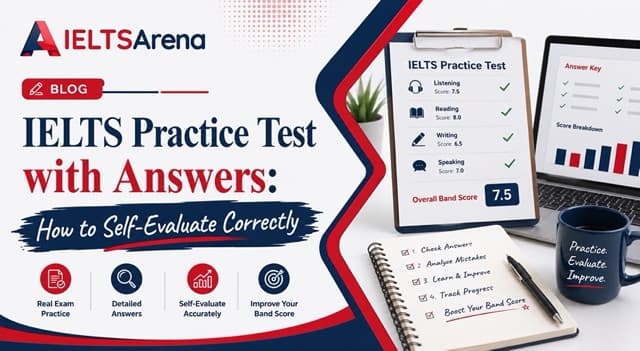
Most IELTS candidates take dozens of practice tests before exam day. Yet a large portion of them score significantly lower in the real exam than they expected. The problem is not how many IELTS practice tests with answers they completed. The problem is how they evaluated those tests.
Marking your own practice paper is a skill in itself. When done poorly, it gives you a false sense of readiness that collapses the moment you sit in the actual test centre. When done well, it reveals exactly which sub-skills to target and accelerates your progress faster than any grammar book ever could.
This guide walks you through the correct way to self-evaluate every section of an IELTS practice test with answers, so your preparation actually translates to the score you need.
Why Self-Evaluation Is the Hardest Part of IELTS Preparation
It sounds straightforward: complete a practice test, check your answers, count your score. But IELTS is not a simple right-or-wrong test. Two of its four sections, Writing and Speaking, are assessed using complex, multi-criteria marking rubrics that trained examiners spend months learning to apply consistently.
When you take an IELTS practice test with answers, the Listening and Reading sections are relatively easy to mark. Each item has a clear correct response. You count what you got right and derive a band score from the conversion table.
But Writing and Speaking are different. The IELTS Writing rubric assesses Task Achievement, Coherence and Cohesion, Lexical Resource, and Grammatical Range and Accuracy. Speaking is marked on Fluency and Coherence, Lexical Resource, Grammatical Range and Accuracy, and Pronunciation. Without understanding what each criterion actually means at each band level, you cannot meaningfully evaluate your own performance.
This is where most candidates go wrong. They read their Writing essay, feel it sounds good, and award themselves a Band 6.5 or 7. They record a Speaking response, listen back, and decide it was fluent enough for a 7. These self-assessments are almost always inflated, sometimes by a full band or more.
Advertisement
Why Common Self-Study Approaches Fail
The most common approach to using an IELTS practice test with answers is passive review: complete the test, check the answer key, read a brief explanation for wrong answers, and move on to the next test. This method produces the illusion of progress while systematically ignoring the weaknesses that will cost you marks on exam day.
There are three core reasons this fails.
First, answer keys for Listening and Reading do not explain why a distractor was wrong or what cognitive trap you fell into. If you keep choosing the same type of wrong answer, you never identify the pattern that is costing you.
Second, most freely available Writing band descriptors are simplified versions of the official IELTS rubric. Students using these simplified guides consistently over-rate their own essays because they are not applying the same standards an examiner would.
Third, Speaking self-assessment without structured feedback is almost meaningless. It is nearly impossible to objectively evaluate your own fluency, grammar range, and vocabulary while simultaneously listening to a recording of yourself speaking.
Without addressing these three problems, you can complete 50 IELTS practice tests with answers and still plateau at the same band score.
A Real Student's Experience
Priya, a 26-year-old nurse from the Philippines, was targeting Band 7 overall for her registration application. She had completed eight full IELTS practice tests with answers over two months and was consistently scoring herself at 7 in Writing. On exam day, she received a 6.0.
"I was devastated," she said. "I thought I had prepared so well. I had done so many practice tests. But when I looked back at my Writing samples, I realised I had no idea what 'Task Achievement' actually meant. I was just writing a lot of words and assuming that was enough."
After joining IELTSArena, Priya submitted her Writing samples for AI feedback and saw for the first time how examiners actually evaluated each criterion. Within six weeks of targeted practice on IELTSArena, she retook the exam and scored 7.0 in Writing and 7.5 overall.
Her experience is not unusual. It is one of the most common patterns IELTSArena sees among candidates who self-study with practice tests alone.
What the Data Shows About Self-Scoring Accuracy
Research on self-assessment in high-stakes language testing consistently shows that test-takers overestimate their performance on productive skills. A study of over 400 IELTS candidates found that self-scored Writing bands were on average 0.5 to 1 band higher than the scores awarded by trained examiners.
In the Speaking section, the overestimation gap was even wider. Approximately 68% of candidates rated themselves at least 0.5 bands above their actual examiner-awarded score. Only around 14% of candidates accurately self-assessed their Speaking performance to within 0.25 bands.
This matters because a 0.5 band gap in Writing or Speaking can represent months of additional preparation time. It means the feedback loop that should be accelerating your improvement is actually misleading you.
When you use an IELTS practice test with answers without structured evaluation criteria, you are working with incomplete data. You may be spending hours rehearsing strengths you already have while entirely neglecting the sub-skills that are holding your score down.
IELTSArena was built specifically to address this problem, by giving candidates access to the same quality of feedback that trained examiners apply.
The Right Approach: How to Self-Evaluate an IELTS Practice Test Correctly
The following method turns every IELTS practice test with answers into a high-quality diagnostic tool rather than just a score-checking exercise.
Step 1: Simulate real exam conditions completely. Timing is non-negotiable. Use the exact time limits: 60 minutes for Listening, 60 minutes for Reading, 60 minutes for Writing (20 minutes for Task 1, 40 for Task 2), 11 to 14 minutes for Speaking. If you exceed the time, your score is not a valid estimate of your real performance.
Step 2: Mark Listening and Reading with the official band conversion table. Do not just count correct answers. Use the published band score conversion table from Cambridge or the British Council to translate raw scores into band scores. Note the exact boundary you are at. If you are scoring a raw 30 in Reading, understand that you are at Band 7, not "almost Band 7.5."
Step 3: For every wrong Listening or Reading answer, categorise the error type. Did you mishear a word? Did you fail to identify a paraphrase? Did you fall for a distractor? Keeping an error log by category reveals patterns far more useful than a total score.
Step 4: For Writing, evaluate each of the four criteria separately. Do not read your essay and give it a single score. Read it once assessing Task Achievement only. Read it again for Coherence and Cohesion only. Then Lexical Resource. Then Grammar. Use the official band descriptors from IELTS.org for each criterion. Your final Writing band is an average of the four, not the highest one.
Step 5: For Speaking, record your response, then transcribe a 60-second portion. Transcription is the single most effective way to identify your grammar and vocabulary patterns. You will notice things in writing that you completely miss when listening to your own voice.
Step 6: Submit your Writing and Speaking responses for expert or AI feedback. This is the most important step. IELTSArena provides AI-powered Writing and Speaking feedback that evaluates your responses against the official band descriptors and gives you specific, criterion-level guidance. This replaces the guesswork of self-scoring with accurate, examiner-standard assessment.
Step 7: Prioritise your lowest criterion, not your total score. If your Task Achievement is Band 5.5 and your Lexical Resource is Band 7.5, your overall Writing score will be dragged down by Task Achievement regardless of how good your vocabulary is. Always target your weakest criterion first.
How IELTSArena Transforms Your Practice Test Review
IELTSArena is built specifically for candidates who are serious about understanding, not just completing, their IELTS practice tests with answers.
When you complete a full mock test on IELTSArena, the platform provides computer-based test conditions that replicate the actual IELTS CBT interface. This means your practice experience looks and feels exactly like exam day, which reduces test-day anxiety and eliminates the interface shock that affects many candidates.
For Writing, the platform's AI evaluates your essay or report against all four official band descriptors and gives you a score for each criterion, along with specific written feedback explaining what you need to improve. This is the equivalent of having a trained examiner review your work after every practice session.
For Speaking, the platform allows you to record your responses and receive automated fluency, pronunciation, and grammar analysis. You can see exactly which aspects of your spoken English are holding your score down and get targeted exercises to address them.
The platform also tracks your performance over time across all sections, so you can see whether your self-evaluation improvements are translating into genuine band score progression. This data-driven approach removes the guesswork entirely.
Candidates who use IELTSArena for structured practice test review consistently report greater confidence and more accurate self-assessment in their actual exam performance. The platform has helped thousands of candidates bridge the gap between practice test scores and real exam results.
You can start your first full IELTS practice test with answers on the platform today and receive instant, examiner-standard feedback on your Writing and Speaking responses.
Self-Diagnosis: Is Your Current Practice Test Method Working?
Before your next practice session, honestly answer these questions.
Can you name the four criteria used to mark IELTS Writing, and describe what Band 6 looks like for each one? If you cannot, you are not evaluating your Writing accurately.
After completing a practice test, do you know which specific error type cost you the most marks in Reading or Listening? If your review stops at "I got 32 out of 40," you are missing actionable information.
Have you submitted at least one Writing sample for feedback from a qualified source in the last two weeks? If not, your Writing band estimate may be off by 0.5 to 1 full band.
Do you record and transcribe your Speaking practice responses? Transcription is the fastest way to identify your grammatical patterns. If you skip it, you are missing your most effective feedback tool.
Is your practice test score improving across multiple sessions, or are you stuck at the same band despite completing more tests? Stagnation after multiple practice tests almost always signals a review method problem, not a preparation volume problem.
If you answered no to two or more of these questions, the issue is not how many IELTS practice tests with answers you are completing. It is how you are learning from them.
Start Practising the Right Way with IELTSArena
Self-evaluation is the skill that separates candidates who plateau from those who keep improving. The good news is that with the right tools and the right method, accurate self-assessment is entirely learnable.
IELTSArena gives you full-length IELTS practice tests with answers, a CBT interface that mirrors the real exam, and AI-powered feedback on Writing and Speaking that applies the same standards a trained examiner would use. Every session on IELTSArena is an opportunity to build both your language skills and your ability to understand and evaluate your own performance.
Stop guessing what your band score is. Start knowing.
Frequently Asked Questions
How do I mark my own IELTS writing practice test accurately?
To mark your IELTS writing accurately, you need to evaluate each of the four official criteria separately: Task Achievement, Coherence and Cohesion, Lexical Resource, and Grammatical Range and Accuracy. Read the official band descriptors from IELTS.org for each criterion and apply them individually to your essay. IELTSArena provides AI feedback that does this automatically and gives you a score and explanation for each criterion, removing the guesswork from self-assessment.
Where can I find IELTS practice tests with full answer keys?
Cambridge IELTS books (1 to 19) are the most reliable source of authentic IELTS practice tests with answers. The British Council and IDP also publish official practice materials on their websites. IELTSArena provides full-length practice tests in a CBT format that matches the actual exam interface, with detailed answers and AI feedback for Writing and Speaking sections that answer keys alone cannot provide.
How do I know if my IELTS practice score matches the real exam?
Practice scores are only accurate if you simulate real exam conditions: strict timing, no interruptions, and no assistance. The biggest risk of inaccuracy is in self-scored Writing and Speaking. Research shows that candidates routinely overestimate their Writing band by 0.5 to 1 full band. Using IELTSArena's AI evaluation for your Writing and Speaking responses gives you an examiner-standard assessment that is far more reliable than self-scoring.
Can I self-evaluate my IELTS speaking practice using a recording?
Yes, but structured self-evaluation of Speaking is more effective than casual listening. Record your response, then transcribe a 60-second section to identify grammar and vocabulary patterns you miss when just listening. Better still, use IELTSArena's Speaking feedback tool, which analyses your fluency, pronunciation, grammar range, and vocabulary and gives you criterion-level scores based on the official IELTS marking rubric.
Do IELTS practice tests with answers actually improve your score?
Practice tests improve your score only when combined with high-quality review. Completing tests without understanding your specific errors and without accurate feedback on Writing and Speaking can create a false sense of readiness. Candidates who use structured evaluation methods, including AI or expert feedback for productive skills, see significantly greater score improvements than those who rely on answer-key-only review. IELTSArena is designed to make every practice test a genuine learning opportunity, not just a score-checking exercise.