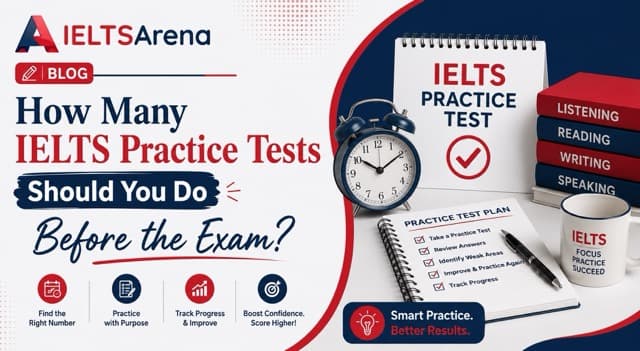
Most IELTS test-takers get this completely wrong. They either take one practice test the night before the exam and hope for the best, or they burn through twenty mock tests in two weeks without ever analysing what went wrong. Neither approach works. The question of how many IELTS practice tests you actually need is one of the most searched and least accurately answered topics in IELTS preparation.
The answer depends on three things: how much time you have before your exam, what band score you are targeting, and how you use each test after you finish it. This guide gives you the exact practice test schedule that works, based on your specific situation.
Why Deciding on Practice Test Frequency Is Harder Than It Looks
The challenge is not just about volume. It is about timing, spacing, and what happens between tests.
Taking too few how many IELTS practice tests leaves you unprepared for the real exam experience. You never build the stamina to sit through nearly three hours of continuous focus. You miss patterns in your mistakes. You walk into test day not knowing what a real score feels like under pressure.
Taking too many tests creates a different problem. You exhaust your supply of quality materials. You begin memorising answer patterns rather than building skills. Your scores plateau and you start feeling anxious rather than confident.
The right number sits somewhere in between. But the specific number changes based on your timeline and your current level.
Advertisement
What Most Students Do Wrong With Practice Tests
The most common mistake is treating practice tests as score checks rather than learning tools.
A student takes a full mock. They score Band 6.5. They feel good, move on, and take another mock the following day. Three days later they score 6.5 again. Nothing improved because nothing changed between the two tests.
The second most common mistake is taking only sectional tests rather than full-length ones. Practising Listening in isolation is useful for building specific skills. But it does not prepare you for the mental drain of finishing a Writing section and then having to focus sharply for forty minutes of Reading immediately after.
Another major issue is using outdated or low-quality practice materials. Free PDF tests from random websites often do not match the current exam format. The scoring is inconsistent. You end up calibrating your preparation to the wrong standard.
The third mistake is completely ignoring timing. Many students answer all the questions correctly when they have unlimited time. They fail to build the habit of working at exam pace. On test day, timing becomes the enemy.
One Student Who Got the Formula Right
Priya, a nurse from the Philippines preparing for her UK registration, needed an overall Band 7 with no section below 6.5. She had nine weeks before her exam date.
She started by taking one diagnostic practice test in Week 1 to understand her baseline. She scored 6.0 overall, with Reading at 5.5 as her weakest section.
"I used to just take test after test and wonder why my score never went up," she said. "When I started using IELTSArena and actually reviewing every wrong answer properly, things shifted."
She took one full mock test per week on IELTSArena, spending three days between each test doing targeted section work based on her error review. By Week 8, she was consistently scoring 7.0 to 7.5 on the IELTSArena platform. She achieved Band 7.5 on her actual exam.
Nine full practice tests across nine weeks. Each one analysed thoroughly. Each one followed by focused, targeted work. That was her formula.
What the Data Says About Practice Test Frequency
Research from Cambridge Assessment English, published in their learner performance reports, found that students who take between six and ten full-length practice tests over an eight to twelve week preparation period consistently outperform those who take fewer than four or more than fifteen.
The reason for the upper ceiling is interesting. Students who take more than fifteen full practice tests in a short preparation window begin showing signs of test fatigue. Their scores actually decline in the final two weeks before the exam because they are mentally exhausted.
A 2024 survey of over 4,200 IELTS candidates published by the British Council showed that 68 percent of students who achieved their target band score reported taking between one and two full mock tests per week in the four weeks leading up to the exam. Only 12 percent of students who took daily full mock tests in the final week reached their target.
The IELTSArena platform data confirms this pattern. Users who complete one practice test per week and spend at least three focused review sessions between each test achieve higher average scores than users who take multiple tests per week with minimal review time.
The Right Practice Test Schedule by Timeline
Here is the framework you should follow, based on how many weeks you have remaining.
If you have 12 weeks or more
- Take one full diagnostic test in Week 1 to establish your baseline score.
- Spend Weeks 2 through 4 doing sectional practice only, focusing on your two weakest areas.
- Begin full mock tests from Week 5 onward, one per week.
- Spend two to three days after each test doing targeted work on errors before taking the next one.
- Increase to two full tests per week in Weeks 10 and 11.
- Take one final mock test in Week 12 as a confidence builder, then rest the day before the exam.
If you have 6 to 8 weeks
- Take one diagnostic test immediately to identify your priority weaknesses.
- Alternate between sectional practice and full mock tests: one full test every 10 to 14 days in the early weeks.
- Increase to one full test per week from Week 4 onward.
- In the final two weeks, take two full tests, spaced five to six days apart.
- Do not take any full mock test within 48 hours of your actual exam.
If you have 3 to 4 weeks
- Take a diagnostic test on Day 1.
- Focus heavily on your weakest one or two sections using targeted practice materials.
- Take one full mock test per week, no more.
- Use every remaining day for section-level review and timed practice.
- Do not overload in the final week. Quality over quantity matters most here.
The total number of full how many IELTS practice tests you need: between six and twelve, depending on your timeline. That is the range that produces the best results.
How IELTSArena Makes Practice Tests More Effective
Taking how many IELTS practice tests matters much less than how you use them. This is where IELTSArena changes the game entirely.
IELTSArena provides a computer-based test interface that exactly mirrors the real IELTS CBT format. This is not a simple PDF with questions and an answer key. IELTSArena simulates the actual exam environment, including the on-screen tools, the audio playback format for Listening, and the time pressure of the real test.
After you complete a test on IELTSArena, the platform gives you an instant band score estimate across all four sections. More importantly, IELTSArena provides a detailed breakdown of where you lost marks, which question types caused the most errors, and what specific skills need attention.
IELTSArena offers AI-powered feedback on your Writing tasks. Instead of waiting days for a human examiner or guessing whether your response was good enough, IELTSArena gives you structured feedback on task achievement, coherence and cohesion, lexical resource, and grammatical range, which are the exact four criteria used by real IELTS examiners.
For Speaking, IELTSArena provides a simulated speaking test with AI evaluation so you can practise your responses and get feedback on fluency, vocabulary, and pronunciation without needing to book a costly coaching session.
The IELTSArena tracking dashboard shows your score progression over time, so you can see whether your preparation is actually working. If your practice scores plateau, IELTSArena highlights the specific areas to work on before your next test.
Students using IELTSArena consistently report that the platform helps them use each practice test more intelligently, which means they need fewer tests overall to reach their target score.
Self-Diagnosis: Are You Using Practice Tests the Right Way?
Answer these questions honestly before your next mock test:
After your last practice test, did you spend at least 60 minutes reviewing your mistakes and understanding why you got each question wrong?
Are you taking full-length tests under timed, exam-like conditions, without pausing, checking your phone, or taking unscheduled breaks?
Have you been tracking your scores on each practice test over time, so you can see whether your scores are actually improving or just fluctuating randomly?
Between your last two practice tests, did you do targeted work on the specific weaknesses the test revealed, rather than just doing general mixed practice?
Are the practice tests you are using accurately reflective of the current IELTS CBT format, including the on-screen tools and question types?
If you answered no to two or more of these questions, you are not getting full value from your practice tests. IELTSArena is designed to help you address every one of these gaps in a single, structured platform.
Start Your Practice Tests the Right Way
You do not need to take twenty practice tests before your IELTS exam. You need to take the right number of tests at the right times, and you need to use each one properly.
Six to twelve full-length tests, spaced strategically across your preparation period, with genuine analysis between each one, is the formula that consistently produces results. IELTSArena gives you the exam-quality tests, the instant scoring, and the detailed feedback that make every practice session count.
Take Your First Free Practice Test on IELTSArena →
Frequently Asked Questions
How many IELTS mock tests should I do in the last two weeks before my exam?
In the two weeks before your exam, take no more than two full-length practice tests. One test in the penultimate week and one test five to six days before the exam is sufficient. Avoid taking any full practice test within 48 hours of your exam date, as mental fatigue will work against you. Focus on reviewing your previous test results and doing targeted section practice instead.
Is it better to do one full mock test a week or practise sections daily?
Both approaches have a role in effective preparation. Full mock tests build exam stamina and simulate real test conditions. Daily section practice builds specific skills more efficiently. The best approach is to combine both: take one full mock test per week and do focused sectional practice on three or four other days. IELTSArena supports both formats within the same platform.
How do I know when I have done enough IELTS practice tests?
You are ready when your practice scores are consistently at or above your target band score across at least three consecutive tests, when you are completing each section within the time limit comfortably, and when you are no longer seeing new types of errors. If your scores plateau for more than two consecutive tests, that is a signal to change your study approach rather than simply take more tests.
Should I take a mock test at the beginning of my IELTS preparation?
Yes. Taking a diagnostic practice test at the start of your preparation is one of the highest-value things you can do. It tells you your current level, identifies your strongest and weakest sections, and helps you allocate your preparation time intelligently. IELTSArena offers a full diagnostic test that gives you a detailed breakdown of your starting point across all four skills.
What is the right balance between taking practice tests and studying theory for IELTS?
A rough guide that works well for most students: 40 percent of your preparation time on full practice tests, 40 percent on targeted section and skill work, and 20 percent on reviewing vocabulary, grammar, and task strategy. In the early weeks of preparation, weight more toward theory and skill-building. In the final four weeks, shift the balance toward practice tests and timed exercises. IELTSArena makes it easy to follow this structure with its full test, section test, and skill-building tools in one place.