
Section 4 of the IELTS Listening test is where Band 6.5 candidates lose Band 7. It is 10 minutes of continuous academic monologue, no break, one preview, and the audio does not stop. If this is where your Listening band keeps capping, start a free Section 4 practice on IELTSArena first to see your current baseline before reading the rest of this guide. Most candidates assume Section 4 is just a harder version of Sections 1 to 3 and prepare accordingly. That assumption is wrong, and it is why months of general Listening practice produce no visible Section 4 improvement.
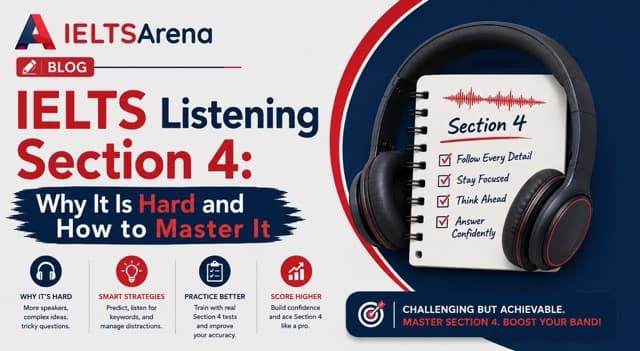
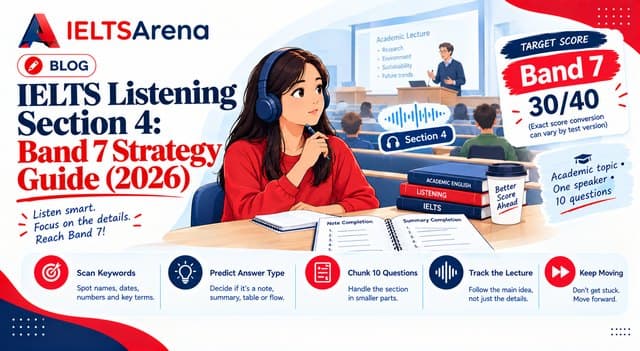
Quick answer: IELTS listening section 4 is the final section of the Listening test. It is a 10-minute academic monologue (a university lecture or formal talk) delivered at natural speed with no pauses, no repetitions, and only one preview window of approximately 30 seconds before the audio starts. It contains 10 questions, usually a mix of note completion, summary completion, sentence completion, and occasional multiple choice or flow chart completion. Section 4 is scored on the same 40-question raw-score scale as the rest of the Listening test, so each Section 4 mark is worth the same as a Section 1 mark toward your final band. The common Band 6.5 to Band 7 blocker is not English ability. It is the lack of a note-taking framework and the mistaken belief that Section 4 can be practised like Section 3.
Try it before you read. The fastest way to know whether Section 4 is your specific gap is to attempt one timed Section 4 under exam conditions. Take a free IELTS Listening practice test on IELTSArena and come back with your baseline score. If Section 4 accuracy is below 7 out of 10, the rest of this guide is written for you.
In This Guide
- What Section 4 Actually Is
- Why Section 4 Is a Different Test Design, Not Just a Harder Section
- How Section 4 Compares to Sections 1, 2, and 3
- The 3 Structural Traps Unique to Section 4
- Section 4 Raw Scores and What They Mean for Your Band
- A Real Student's Story: 4/10 to 9/10 on Section 4 in Four Weeks
- The Data Behind This Section
- The Right Approach: A 4-Week Section 4 Fix Plan
- The Note-Taking Framework That Band 8 Candidates Use
- The 10 Most Common Section 4 Academic Topic Areas
- Sample Section 4 Excerpt with Note-Taking Walkthrough
- How IELTSArena Helps You Drill Section 4 Specifically
- Self-Diagnosis: Is Section 4 Capping Your Band?
- Key Takeaways
- Frequently Asked Questions
Advertisement
What Section 4 Actually Is
IELTS listening section 4 is the final section of the Listening test. It is a single-speaker academic monologue (typically a university lecture, a formal research presentation, or a professional talk) delivered at natural speed. The section contains exactly 10 questions, bringing the overall Listening test to 40 questions across the four sections. The audio runs for approximately 8 to 10 minutes without pause.
Section 4 follows the same mark-weighting as Sections 1, 2, and 3. Each correct answer is worth one mark toward the 40-question raw score, and the raw score converts to a Listening band using the standard conversion table (see our IELTS Band Score Chart for the full raw-score-to-band conversion and the IELTS Band Score Calculator to work out your band from a sample score).
The question types in Section 4 are a specific subset of the full IELTS Listening question-type library. You will almost always see note completion, summary completion, or sentence completion. You may see multiple choice (though less often than in Section 2 or Section 3, where it is more common; see our dedicated guide on IELTS Listening Multiple Choice). You occasionally see flow chart completion or diagram labelling for technical topics. You will almost never see map labelling in Section 4; that is a Section 2 feature (covered in our IELTS Listening Map Questions guide).
Why Section 4 Is a Different Test Design, Not Just a Harder Section
The most damaging mistake candidates make about Section 4 is treating it as a difficult version of Section 3. The two sections share the "academic" label, but their underlying test design is fundamentally different, and the preparation strategy differs accordingly.
Section 3 is an academic conversation between 2 to 4 speakers (usually students discussing coursework with a tutor). The conversational format means natural pauses, question-and-answer rhythm, repetition when one speaker clarifies for another, and change-of-speaker cues that reset your attention. All of this gives you micro-breaks to catch up if you fall behind.
Section 4 has none of these recovery mechanisms. One speaker talks for 8 to 10 minutes without a break. There is no "wait, could you repeat that?" from a second speaker. There is no shift in tone that signals a new topic. There is only one preview opportunity at the very start of the section, covering all 10 questions. If you fall behind on question 3, there is no second preview to help you catch up on questions 7, 8, 9, and 10.
The practical implication is important. General Listening practice helps Sections 1, 2, and 3 but produces almost no Section 4 improvement, because the recovery mechanisms you have been relying on in those sections do not exist in Section 4. The techniques covered in IELTS Listening Tips 2026 apply across all four sections, but Section 4 needs its own dedicated note-taking and prediction framework on top of them.
How Section 4 Compares to Sections 1, 2, and 3
Understanding what makes Section 4 structurally different is the fastest way to stop preparing for it the wrong way.
| Section | Format | Speakers | Preview windows | Recovery mechanisms |
|---|---|---|---|---|
| Section 1 | Social conversation (booking, enquiry) | 2 | 2 preview windows | Natural dialogue pauses, speaker changes |
| Section 2 | Social monologue (tour, announcement) | 1 | 2 preview windows | Topic-shift cues, lists of items |
| Section 3 | Academic conversation (students, tutor) | 2 to 4 | 2 preview windows | Multiple speakers, question-answer rhythm |
| Section 4 | Academic monologue (lecture, talk) | 1 | 1 preview window | None |
Three structural differences stand out. First, Section 4 has only one preview window, not two. In Sections 1 to 3, you preview questions 1 to 5, then listen to the first half, then preview questions 6 to 10, then listen to the second half. In Section 4, you preview all 10 questions in one go, then listen to the whole monologue in one go. The entire test design assumes you can hold a prediction map for all 10 questions in your head for the full 8 to 10 minutes.
Second, Section 4 has one speaker, which eliminates the micro-recovery that speaker changes provide. In Section 3, when the student replies to the tutor, you get a 2-second pause before the response begins. In Section 4, there is no such pause.
Third, Section 4 has no recovery mechanism. If you miss the answer to question 4, there is no clarification question from a second speaker, no "wait, I did not catch that", no tonal shift that signals a new chunk. The next sentence is already answering question 5.
These are not quirks. They are deliberate test design choices to measure sustained academic listening endurance, which is the specific skill universities and professional bodies care about. For candidates targeting IELTS Band 7, Band 7.5, or Band 8, Section 4 is where this specific skill is tested.
The 3 Structural Traps Unique to Section 4
Three specific traps account for most Section 4 marks lost at the Band 6 to Band 7 level.
Trap 1: The one-preview overload. You get roughly 30 seconds to preview all 10 questions. Candidates read question 1, then question 2, then look up at question 5 or 6, panic, and start the audio with an incomplete prediction map. Fix: preview in two passes. First pass (10 seconds): skim all 10 questions for topic area, question type, and roughly where in the monologue each question will appear. Second pass (20 seconds): read questions 1 to 3 carefully, since those come first. Questions 4 to 10 can be re-read during natural pauses in the monologue (end of paragraphs, examples, lists) once the audio starts.
Trap 2: Topic-shift blindness. The monologue typically covers 3 to 4 sub-topics (background, main point 1, main point 2, conclusion, for example). Each sub-topic contains 2 to 3 questions. Candidates who miss the topic-shift markers ("Moving on to the second factor...", "Another important consideration is...", "To summarise so far...") lose track of where they are in the question sequence. Fix: train yourself to listen for shift markers rather than content keywords. The marker tells you which group of 2 to 3 questions is about to be answered.
Trap 3: The stamina drop at question 7 to 10. Section 4 comes at the end of a 30-minute Listening test. Candidate concentration has been running for 25 minutes by the time Section 4 starts. Questions 7, 8, 9, 10 come at the point where fatigue peaks. Fix: deliberately slow your breathing in the 30-second preview before Section 4 starts, and treat questions 7 to 10 as the test within the test. Candidates who score 10/10 on Section 1 and 4/10 on Section 4 are almost always losing marks on questions 7 to 10, not questions 1 to 3.
Section 4 Raw Scores and What They Mean for Your Band
Section 4 scores on the same 1-mark-per-question scale as the rest of the test. Here is what different Section 4 performance patterns typically mean for your overall Listening band, assuming average performance across Sections 1 to 3.
If you consistently score 4 out of 10 on Section 4 with 8 out of 10 on Sections 1 to 3, your overall raw score is roughly 28, which maps to Listening Band 6.5. This is the exact pattern that caps most candidates at Band 6.5 overall.
If you lift Section 4 to 7 out of 10 while holding the other sections steady, your overall raw score moves to roughly 31, which maps to Listening Band 7.
If you lift Section 4 to 9 out of 10 and maintain 8 out of 10 across the other three sections, your overall raw score reaches 33, which maps to Listening Band 7.5.
The pattern is clear. Section 4 improvement is one of the highest-leverage interventions available for the Band 6.5 to Band 7.5 range. For context, the full raw-score-to-band conversion is published in the IELTS Band Score Chart and the IELTS Band Score Calculator.
Mid-article check. If you are currently scoring 4 to 6 on Section 4 and your target is Band 7 overall, Section 4 drilling is likely your fastest path forward. Start structured Section 4 practice on IELTSArena with timed sections and automatic scoring by question type.
A Real Student's Story: 4/10 to 9/10 on Section 4 in Four Weeks
Rania, a researcher from Alexandria applying for a PhD position at the University of Manchester, needed IELTS Academic Band 7 overall with 6.5 in each component. Her first two sittings returned Listening 6.5 both times, held down almost entirely by Section 4. Her Section 4 scores were 4 out of 10 and 5 out of 10 across the two attempts. Her Sections 1, 2, and 3 averaged 8 out of 10.
I thought I was doing something wrong on the actual Section 4 questions. I kept re-doing full practice tests hoping Section 4 would improve. It never did. The gap between my Section 1 and my Section 4 was the same across every mock. Six out of ten points difference. Something structural was happening, and I could not see it until my tutor made me watch my own eye movements during a practice preview.
Her diagnostic revealed two specific problems. First, she was using the 30-second preview to read all 10 questions carefully, which meant she started the audio only halfway through question 5 and had read nothing for questions 6 to 10. Second, she was listening for content keywords without tracking topic-shift markers, so when the lecturer moved from "the first factor" to "the second factor", she did not notice and kept listening for the first-factor answers.
She fixed both over four weeks. Week 1: she drilled the two-pass preview routine (10-second skim, 20-second careful read of questions 1 to 3) until it was automatic. Week 2: she drilled topic-shift marker recognition using TED Talks and academic podcasts (not just IELTS practice material). Week 3: she drilled Section 4 under timed conditions, 3 sections per day. Week 4: she took full Listening mocks and tracked Section 4 accuracy specifically. Her third sitting scored Section 4 at 9 out of 10. Overall Listening band: 7.5. Manchester cleared her application two weeks later. The techniques Rania used are covered in detail in our IELTS Study Plan 3 Months guide and in the IELTS 30-Day Study Plan.
The Data Behind This Section
Cambridge Assessment English publicly reports that Section 4 is consistently rated the most difficult section by test-takers across all four Listening sections, with the gap between Section 1 and Section 4 scores often reaching 2 to 4 marks for candidates in the Band 6 to Band 7 range (Cambridge Assessment English, IELTS Test Statistics 2024 to 2025).
British Council guidance identifies "insufficient preparation for extended academic listening" as the most common reason Section 4 scores lag behind Sections 1 to 3. IELTS.org confirms the Listening test structure continues unchanged in 2026, with Section 4 remaining a single-speaker academic monologue of 8 to 10 minutes with one preview window (IELTS.org, 2026 test specification).
For candidates applying to universities, Section 4 specifically simulates the type of listening required in lectures, which is why it carries disproportionate practical weight for study-abroad routes. The same test design features behind Section 4 are what universities in the UK, Canada, Australia, and New Zealand expect you to be able to handle as a student. See the UK Student Visa IELTS requirements and IELTS Score for Canada PR for the specific thresholds universities and immigration programmes apply.
The Right Approach: A 4-Week Section 4 Fix Plan
Fixing IELTS listening section 4 is a focused four-week process. Do not substitute general Listening practice for Section 4 drilling. The two are not interchangeable.
Week 1: Build the two-pass preview routine. Spend 15 minutes per day on preview drills. Open a Section 4 question set, start a 30-second timer, and practise the two-pass structure. First 10 seconds: skim all 10 questions. Final 20 seconds: read questions 1 to 3 carefully. Repeat with 10 different Section 4 question sets. By end of Week 1, the two-pass routine should feel automatic.
Week 2: Drill topic-shift marker recognition. Spend 15 minutes per day listening to TED Talks or academic podcasts (BBC Radio 4 "In Our Time" is excellent for this). Specifically listen for shift markers: "moving on to", "another factor", "to turn to", "the second point", "to summarise so far", "in contrast", "however". Pause the audio each time you hear a shift marker and note what topic the speaker just moved to. This trains the specific recognition skill Section 4 rewards.
Week 3: Full Section 4 drills under timed conditions. Do 3 Section 4 practice sections per day under exam conditions. Score each one and review the specific questions you missed. If misses cluster at questions 7 to 10, your stamina drop is the issue (slow your breathing in the preview). If misses cluster at questions 1 to 3, your preview routine is not working (back to Week 1). If misses are scattered, topic-shift tracking is the gap (back to Week 2).
Week 4: Full Listening mocks with Section 4 focus. Take 2 full timed Listening mocks per week and specifically track Section 4 accuracy. Target 8 out of 10 or above on Section 4 consistently. If you reach that threshold, your Section 4 fix is complete. If not, extend the plan by two weeks on the specific sub-skill (preview, shift markers, or stamina) that is still weakest.
For candidates needing a broader section-by-section lift, see the IELTS 30-Day Study Plan and IELTS Study Plan 3 Months for structured programmes that include Section 4 as part of the whole-test preparation.
The Note-Taking Framework That Band 8 Candidates Use
Section 4 is the only section where note-taking during the audio is a meaningful advantage. In Sections 1 to 3, the pace is slow enough that most candidates write directly in the question gaps. In Section 4, you need a note-taking shorthand that captures key information faster than full-word writing.
Rule 1: Abbreviate everything predictable. Common nouns that recur across academic lectures should have 2 to 3 letter abbreviations: gov (government), env (environment), tech (technology), ed (education), econ (economics), soc (society), yr (year), K (thousand), M (million). Build the abbreviation set once and stick to it.
Rule 2: Use symbols for relationships. Up arrow for increase, down arrow for decrease, right arrow for leads to, equals for means, slash for or, percentage sign for share. These are faster than words and clearer than full phrases under pressure.
Rule 3: Capture structure, not content. Note the topic marker, not the full sentence. "2nd factor: env" captures everything you need to orient your attention. Writing "The second factor the researcher mentions is the environment" wastes 7 seconds you cannot afford.
Rule 4: Expand notes during transfer time. On paper IELTS, you get 10 minutes transfer time after the audio ends. On computer IELTS, you type answers directly during the audio. Either way, your note-taking shorthand only needs to make sense to you for the 10 minutes between audio end and submission. For computer IELTS specifically, the technique shifts slightly because you are typing answers in real time, so the shorthand lives mentally rather than on paper.
Build this framework over 2 weeks of daily practice. By week 3, the abbreviations and symbols should be automatic. Candidates targeting Band 8 or Band 8.5 use these techniques across all four Listening sections, but Section 4 is where they are indispensable.
The 10 Most Common Section 4 Academic Topic Areas
Section 4 topics are drawn from a predictable set of academic domains. Familiarity with the vocabulary and typical arguments in each domain gives you a significant preview advantage.
The 10 recurring topic areas are: environmental science (climate change, biodiversity, pollution), education policy (teaching methods, higher education reform, access), history and archaeology (ancient civilisations, historical events, archaeological discoveries), psychology and human behaviour (cognitive studies, memory, decision-making), business and economics (globalisation, consumer behaviour, markets), health and medicine (public health, epidemiology, nutrition), technology and innovation (AI, renewable energy, biotechnology), social sciences (urbanisation, demographics, migration), arts and culture (museum studies, cultural heritage, language), and sciences (astronomy, biology, physics applied to real-world problems).
For each topic area, spend 20 minutes building a 15-word vocabulary bank of academic terms. For environmental science: sustainability, biodiversity, emissions, carbon footprint, ecosystem, conservation, renewable, deforestation, mitigation, adaptation, policy framework, stakeholder, baseline, measurable outcome, long-term trend. For education policy: curriculum, pedagogy, literacy rate, access, equity, standardised assessment, formative, summative, early-years, lifelong learning, vocational, academic rigour, teacher-student ratio, intervention, outcome.
Build banks across the 10 topics for a total of 150 academic words. This vocabulary also strengthens your Writing Lexical Resource (see our dedicated guide on IELTS Writing Task Response) and your Speaking Part 3 responses (see IELTS Speaking Part 3 Questions), so the preparation effort pays off across multiple sections of the test.
Sample Section 4 Excerpt with Note-Taking Walkthrough
Here is a sample Section 4 excerpt covering an environmental science topic, with notes a Band 8 candidate would take during the audio.
Audio excerpt (approximately 90 seconds of a longer monologue):
"Today I want to talk about three factors that influence urban heat islands, which are areas within cities where temperatures are significantly higher than the surrounding countryside. The first factor is building density. In cities like Singapore and Tokyo, where buildings are packed closely together, heat from the sun is absorbed by concrete and asphalt during the day and released slowly at night, which keeps overnight temperatures elevated. Research from the University of Melbourne published in 2024 shows that building density alone can account for up to 3 degrees Celsius of urban temperature elevation.
Moving on to the second factor, which is vegetation cover. Cities with less than 15 percent tree canopy coverage consistently show stronger heat island effects than cities with over 30 percent coverage. Toronto's green infrastructure programme, launched in 2019, demonstrated this clearly: neighbourhoods with increased tree planting showed a measurable 1.8 degrees Celsius reduction in average summer temperatures within five years.
The third and perhaps most under-appreciated factor is pavement colour. Dark surfaces absorb up to 95 percent of incoming solar radiation, while light-coloured surfaces reflect roughly 55 percent. Los Angeles's cool pavement initiative, which painted asphalt streets with a reflective coating, achieved temperature reductions of 1.1 degrees Celsius in treated areas during peak summer months."
Band 8 candidate's notes during the audio:
"UHI = urban heat islands, hotter than countryside F1: bldg density → Spore/Tokyo, concrete absorbs, Melbourne 2024 up 3°C F2: vegetation, <15% tree bad, >30% good, Toronto 2019 down 1.8°C/5yr F3: pavement colour, dark 95% absorb, light 55% reflect, LA cool pavement 1.1°C down"
Notice the pattern. The notes capture: topic markers (F1, F2, F3), key concepts (bldg density, vegetation, pavement colour), specific places that are likely to appear as fill-in answers (Spore/Tokyo, Melbourne, Toronto, LA), specific numbers that are likely answer values (3°C, 15%, 30%, 1.8°C, 95%, 55%, 1.1°C), and relationship markers (up arrow for increase, down arrow for decrease). Nothing else. The 90 seconds of audio compresses into 4 lines of notes that take under 25 seconds to write.
Candidates targeting Band 7 or above should practise this exact note-taking density. See our IELTS Band 7 guide for the section-by-section plan that includes Section 4 as a specific focus area, and our IELTS Band 7.5 guide for the next-level upgrade.
How IELTSArena Helps You Drill Section 4 Specifically
IELTSArena's Listening practice library lets you filter by section, so you can drill Section 4 in isolation without taking a full test every session. Each Section 4 practice runs the exact CBT interface used in the real exam, with the one-preview-only timing enforced and the audio delivered at natural speed by trained academic voice actors covering the full range of IELTS accents.
The platform's progress analytics track your Section 4 accuracy separately from Sections 1 to 3, which is critical for the diagnostic work this guide describes. If your Section 1 average is 8 out of 10 and your Section 4 average is 4 out of 10, that six-point gap is the specific thing to fix, and IELTSArena shows it directly in your performance dashboard.
More than 10,000 students have used IELTSArena to improve their Listening band, with Section 4 being one of the question types where structured drilling produces the fastest visible improvement. The platform also provides full Academic and General Training mock tests (see our IELTS General Training guide and the Free IELTS Listening Practice Test 2026) and section-by-section results that let you track exactly which section is capping your band.
Start your free IELTS Listening practice on IELTSArena and take a Section 4 practice section this week.
Self-Diagnosis: Is Section 4 Capping Your Band?
Work through these questions honestly against your last Listening practice session or mock test.
Compare your Section 1 score to your Section 4 score. Is there a gap of 2 marks or more? Did you preview all 10 Section 4 questions in the 30-second window, or did you run out of time partway through? Did you notice topic-shift markers during the audio, or did you only listen for content keywords? Did your attention drop noticeably between questions 7 and 10? Did you take any notes during the Section 4 audio, or did you try to write directly into the question gaps? Can you name the 10 most common Section 4 academic topic areas (see the list above), or does the topic area feel random to you? When the lecturer mentioned specific numbers or place names, did you capture them in notes, or did you try to hold them in your head?
If you hesitated on more than two of these, Section 4 is likely the specific gap holding your Listening band below your target. Drill the two-pass preview and the topic-shift markers for four weeks and re-test.
For a broader diagnostic covering all four skills, see our dedicated guides for IELTS Writing Mistakes to Avoid, IELTS Speaking Common Mistakes, and the IELTS One Skill Retake 2026 option if Listening is the only section holding your overall band back.
Key Takeaways
- IELTS listening section 4 is a 10-minute academic monologue with 10 questions, one speaker, one preview window, and no recovery mechanisms. It is a different test design from Sections 1 to 3, not just a harder version.
- Section 4 improvement is one of the highest-leverage interventions for candidates in the Band 6.5 to Band 7.5 range. Lifting Section 4 from 4 out of 10 to 7 out of 10 typically moves overall Listening band from 6.5 to 7.
- The three structural traps are: one-preview overload (fix with two-pass preview routine), topic-shift blindness (fix with shift-marker drilling), and stamina drop at questions 7 to 10 (fix with pre-section breathing).
- Note-taking during the Section 4 audio is a meaningful advantage. Use a shorthand system of 2 to 3 letter abbreviations, symbols for relationships, and structure markers rather than full sentences.
- The 10 recurring Section 4 academic topic areas (environment, education, history, psychology, business, health, technology, social sciences, arts, sciences) are predictable. Build 15-word vocabulary banks for each.
- Four weeks of focused Section 4 drilling (preview routine, shift markers, timed sections, full mocks) typically moves accuracy from 4 out of 10 to 7 to 9 out of 10 for most candidates.
Related Guides on IELTSArena
Listening cluster:
- Free IELTS Listening Practice Test 2026: Audio and Full Answers
- IELTS Listening Multiple Choice: Why Students Lose Marks
- IELTS Listening Map Questions: Complete Strategy Guide
- IELTS Listening Tips 2026: Score Band 8-9 in Every Section
Reading cluster:
- IELTS Reading Tips: 10 Proven Strategies to Score Band 8
- IELTS Reading Skimming vs Scanning Explained
- IELTS Matching Headings: Stop Getting It Wrong
- IELTS Academic Reading vs General Training Reading
Band target posts:
- IELTS Band 6: How to Reach It
- How to Get Band 7 in IELTS
- How to Get Band 7.5 in IELTS
- How to Get Band 8 in IELTS
- How to Get Band 8.5 in IELTS
Visa and immigration routes:
- IELTS for UK Visa: Score Requirements
- IELTS Score for Canada PR 2026
- IELTS Score for Australia PR 2026
- IELTS for NMC UK Nursing
Study plans and tools:
- IELTS Study Plan 3 Months: Zero to Band 7 in 90 Days
- IELTS 30-Day Study Plan: Prepare and Score Band 7
- IELTS One Skill Retake 2026: Complete OSR Guide
- IELTS Band Score Chart 2026
- IELTS Band Score Calculator 2026
Try Section 4 Under Real Exam Conditions Today
Take a free Section 4 Listening practice on ieltsarena.com and apply the two-pass preview, topic-shift tracking, and note-taking shorthand to a real IELTS academic monologue. In one timed session, you will know whether Section 4 is the specific gap holding your Listening band back.
Start your free IELTS practice on IELTSArena
Frequently Asked Questions
Why is IELTS Listening Section 4 so hard? Section 4 is structurally different from the other three sections, not just more difficult. It has one speaker, one preview window (compared to two in every other section), no conversational pauses, no speaker changes, no clarification questions, and no repetition. The 10-minute academic monologue is designed to measure sustained academic listening endurance, which is the specific skill universities expect. Candidates who prepare for Section 4 the same way they prepare for Sections 1 to 3 almost always underperform, because the recovery mechanisms they rely on in those sections do not exist here. The fix is a dedicated preparation framework: two-pass previewing, topic-shift marker tracking, and note-taking shorthand. Four weeks of focused drilling typically moves accuracy from 4 out of 10 to 7 or 8 out of 10.
How do I improve IELTS Listening Section 4 scores? Follow a four-week structured plan. Week 1: drill the two-pass preview routine (10-second skim of all 10 questions, 20-second careful read of questions 1 to 3) until automatic. Week 2: drill topic-shift marker recognition using TED Talks and academic podcasts, pausing each time you hear a shift marker like "moving on to" or "the second factor". Week 3: do 3 Section 4 practice sections per day under timed conditions and review misses by question position (1 to 3 means preview issue, 7 to 10 means stamina issue, scattered means shift-marker issue). Week 4: take 2 full timed Listening mocks per week and target 8 out of 10 or above on Section 4 consistently. Build a note-taking shorthand of abbreviations and symbols in parallel across all four weeks.
What is in IELTS Listening Section 4? Section 4 is a single-speaker academic monologue delivered at natural speed for approximately 8 to 10 minutes. It contains 10 questions, usually a mix of note completion, summary completion, and sentence completion, with occasional multiple choice or flow chart completion. The speaker is typically presenting a university lecture, a formal research presentation, or an academic talk on a topic drawn from a predictable set of academic domains: environmental science, education policy, history and archaeology, psychology, business and economics, health and medicine, technology, social sciences, arts and culture, and sciences. Section 4 has only one preview window at the start of the section, covering all 10 questions, which is a significant structural difference from Sections 1, 2, and 3 (which each have two preview windows).
How many questions are in Section 4 of IELTS Listening? Section 4 contains 10 questions. This brings the total number of questions across the four sections of the IELTS Listening test to 40. Each question is worth one mark toward your raw score, and the raw score converts to a Listening band using the standard conversion table published by Cambridge Assessment English. Section 4's 10 questions are typically grouped around 3 to 4 sub-topics within the overall monologue, and the question types most commonly used are note completion, summary completion, and sentence completion. Multiple choice and flow chart completion appear less frequently in Section 4 than in Sections 2 or 3. Map labelling, which is a common Section 2 feature, almost never appears in Section 4.
Can I take notes during IELTS Listening Section 4? Yes, and you should. Section 4 is the only section where note-taking during the audio gives a meaningful performance advantage. Sections 1 to 3 move slowly enough that most candidates write directly in the question gaps, but Section 4 moves too quickly for that approach to work for all 10 questions. Build a shorthand system: 2 to 3 letter abbreviations for recurring academic nouns (gov, env, tech, ed), symbols for relationships (up arrow for increase, right arrow for leads to, percentage sign for share), and structural markers that capture topic shifts (F1, F2, F3 for first factor, second factor, third factor). The notes do not need to be full sentences. They need to be enough to reconstruct the key information during the 10-minute transfer time (on paper IELTS) or alongside typing answers (on computer IELTS).
Last updated September 2026 by the IELTSArena Editorial Team, a team of IELTS tutors, certified CBT examiners, and Listening preparation specialists who publish weekly research-backed guides on ieltsarena.com.