In the IELTS Listening test, 90 percent of the answers are in the audio. The remaining 10 percent come from whether you are prepared to catch them.
Most candidates who miss answers are not missing them because they lack English ability. They miss them because they do not know what to listen for, when to listen for it, or how to stay focused across all four sections of a 40-minute recording.
The right IELTS listening tips change everything. This guide gives you the strategies that consistently help candidates move from Band 6 or 7 into Band 8 or higher, covering every section of the test with specific techniques you can apply in your next practice session.
What Makes the IELTS Listening Test Genuinely Difficult
The IELTS Listening test is not simply a test of how well you understand spoken English. It is a test of your ability to track spoken information, hold multiple details in working memory, anticipate what comes next, and transfer the right answer at the right moment.
The audio plays once. That is the most critical factor. Unlike reading, where you can re-check a passage, you get exactly one chance to hear the answer. If your attention slips for even a few seconds in the wrong place, you can miss two or three consecutive answers.
The test is also designed to mislead you. Speakers in the recording frequently change their mind, correct themselves, or offer information that sounds like an answer before giving a different one. These are distractors. They appear in every section, particularly in Sections 2 and 3, and they consistently claim marks from candidates who are not specifically trained to recognise them.
A third challenge is pacing. The four sections increase in difficulty, but many candidates burn through their focus in the first two sections and arrive at Sections 3 and 4 with depleted concentration. This is a stamina issue, not a language issue.
Understanding these specific challenges is the first step in applying IELTS listening strategies that actually work.
Advertisement
Why Most IELTS Listening Practice Misses the Point
The most common preparation mistake is passive listening practice. Candidates listen to British podcasts, watch English-language films, or replay practice audio without specific, active engagement. This builds general listening ability, but it does not train the skills the IELTS Listening test actually measures.
Passive listening does not train you to read questions before the audio starts. It does not teach you to predict the type of answer expected from a question, whether a number, a name, a place, or a short phrase. It does not develop the discipline to move to the next question when you miss one, rather than dwelling on the gap and losing the following answers too.
A second mistake is practising without strict time conditions. Many candidates pause the audio when they miss something or replay sections to check answers. This removes the most important constraint in the actual test: the audio plays once at a fixed pace.
The third mistake is reviewing results without understanding errors. Candidates check their score after a practice section but do not dig into the specific reasons behind each wrong answer. Was it a distractor? Did they mishear a spelling? Did they run out of time during transfer? Each type of error requires a different fix.
IELTSArena's Listening module is designed to overcome exactly these mistakes. Every practice test plays in real exam conditions. After each section, the platform provides a question-by-question breakdown showing the correct answer, the distractor (where applicable), and the timestamp in the audio where the answer appears.
From Section 2 Failures to Band 8.5
James, a hospitality manager from Kenya, consistently scored between 27 and 31 out of 40 in IELTS Listening practice. His Section 1 scores were reliable, but he lost multiple marks in every Section 2 and almost always fell apart in Section 4.
He came to IELTSArena two months before his exam after his second attempt failed to reach the Band 8.0 he needed for his professional visa application.
Working through IELTSArena's Listening practice tests, he discovered two patterns he had never noticed before. In Section 2, he was consistently selecting the first number or place mentioned rather than the final, confirmed answer. And in Section 4, he was not reading the questions before the audio started, so he was always one step behind.
"I thought I was failing because my English wasn't good enough. But when IELTSArena showed me exactly where I was losing marks, I could see it was technique, not language," he said.
He spent his remaining preparation time on targeted IELTS listening techniques for Sections 2 and 4 specifically, completing 14 full Listening tests on IELTSArena. His third exam result was a Listening score of 8.5.
What Research and Test Data Show
The IELTS Listening test has a scoring distribution that shows most candidates scoring between Band 5.5 and Band 7. Reaching Band 8 or above requires correct answers on approximately 35 or more of the 40 questions, meaning you can miss no more than five.
Analysis of common error patterns shows that distractor-related mistakes account for a disproportionate share of lost marks, particularly in Sections 2 and 3. Candidates who are specifically trained to recognise and resist distractors reduce their error rate significantly compared to candidates who rely on general listening ability alone.
IELTSArena's platform data consistently shows that candidates who complete at least 10 full Listening practice tests with detailed review achieve significantly higher scores on their actual exam than candidates who practise sections individually without structured review.
The margin between Band 7 and Band 8 in Listening is often a matter of five to eight questions. That is achievable through targeted technique improvement rather than a dramatic increase in general language ability.
The Right IELTS Listening Tips for Every Section
Apply these strategies section by section.
Section 1 (Two speakers, everyday situation)
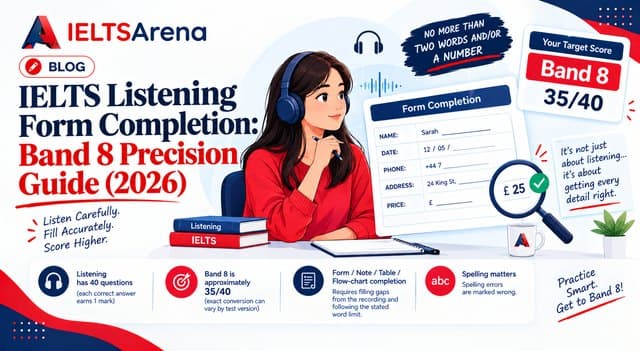
Use the 30-second preview time before the audio to read all questions carefully. Predict the answer type for each question: Is it a number? A name? A date? A place? Knowing what type of answer you are looking for helps you filter the audio effectively. Spell names and numbers carefully, as spelling errors count as wrong answers.
Section 2 (One speaker, public information)
This is the section where distractors are most dangerous. Speakers frequently mention a price, a date, or a location and then correct it. Listen for correction phrases: "Actually", "Sorry, I meant", "Let me correct that". The final confirmed answer is almost always the correct one. Do not select anything until the speaker has finished the relevant sentence.
Section 3 (Two to four speakers, academic discussion)
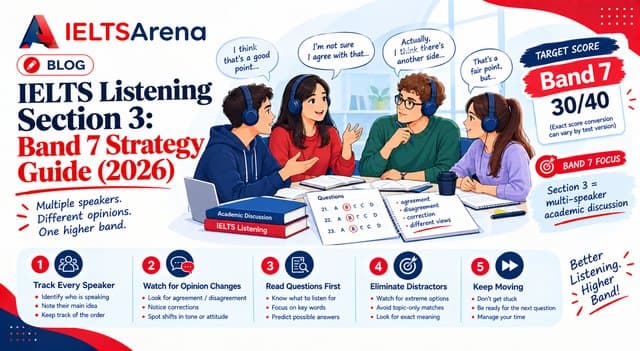
Read all questions before the audio begins. Note key terms that signal each answer location. In multiple-choice questions, eliminate obviously wrong options during the preview time. Listen for how speakers build on or contradict each other, as the correct answer is often a consensus position rather than the first opinion expressed.
Section 4 (One speaker, academic lecture)
This is the most demanding section. The speaker uses a wide academic vocabulary and moves through points quickly. Predict missing words from the context of the sentence before the audio reaches the gap. Use abbreviations during the listening phase and expand them during transfer time. Stay on pace: if you miss a question, accept it and keep moving forward.
For all sections
Use the 10-minute transfer time to check spelling, capitalisation, and word count limits carefully. Many marks are lost in transfer, not during listening. If an answer has more words than the question allows, it is wrong.
How IELTSArena Builds Your Listening Score Systematically
IELTSArena provides exam-realistic IELTS Listening practice in a computer-based test environment that mirrors the actual interface used in official test centres.
Every listening test on IELTSArena plays under real exam conditions: the audio runs once at the correct speed, section breaks last exactly as long as they do in the real test, and the 10-minute transfer time is timed automatically.
After each test, IELTSArena gives you a detailed analysis of your results by section and by question type. You can see exactly which questions you answered incorrectly, what the correct answer was, and where distractor traps appeared in the audio. This level of detail is not available from printed practice books.
IELTSArena also tracks your performance across multiple Listening tests over time. You can see whether your scores are improving consistently or whether there is a specific section or question type that keeps pulling your score down.
For candidates who are preparing for IELTS listening band 8 or higher, IELTSArena's advanced practice sets include higher-difficulty audio with more complex distractor patterns and denser academic vocabulary, reflecting the actual difficulty of the test at that level.
Thousands of candidates preparing for study, work, and migration visas trust IELTSArena because the platform is designed around the real exam, not around simplified practice exercises.
Self-Diagnosis: Where Are You Losing Marks?
These five questions will help you identify your specific weaknesses before your next practice session.
When you miss an answer in IELTS Listening, do you know why? If you cannot explain whether you missed it due to distraction, a distractor, a spelling error, or running out of time, you are not learning from your practice sessions.
Do you read all the questions for a section before the audio starts? If you are reading questions while the audio is playing, you are always behind the speaker. Use every second of preview time.
How does your Section 4 score compare to your Section 1 score? A significant drop between sections indicates a concentration or stamina problem rather than a language problem. Targeted IELTS listening strategies for long-form academic audio can address this directly.
Are you practising in real exam conditions, or do you pause and replay the audio? If you are replaying sections, you are not training for the actual test experience. Every practice session should run at full pace.
Have you completed at least five full Listening tests with detailed question-by-question review? If not, you are missing the most effective IELTS listening techniques for identifying and correcting your specific error patterns.
Start Practising Smarter Today
The gap between your current Listening score and Band 8 is almost certainly a technique gap, not a language gap. The strategies in this guide, applied consistently across realistic practice tests, are what close that gap.
IELTSArena gives you exam-realistic Listening tests, detailed performance analysis, and the specific feedback you need to improve section by section.
Take Your First Listening Test on IELTSArena →
Frequently Asked Questions
Why do I keep missing answers in IELTS listening even when I concentrate?
Concentration alone is not enough if you are not using the right IELTS listening strategies. The most common reasons for missing answers despite concentrating are: not reading questions before the audio starts, not predicting the answer type, and falling for distractors that sound like correct answers but are then changed or corrected by the speaker. IELTSArena's question-by-question feedback shows you exactly which of these patterns is causing your missed answers.
How do I avoid distractor answers in IELTS listening?
Train yourself to listen for correction phrases such as "Actually", "Let me change that", "No wait", or "Sorry, I meant". These almost always signal that the first piece of information was a distractor. In Section 2 in particular, practise holding off on writing your answer until the speaker confirms the final detail. Completing IELTS listening section tips exercises that specifically highlight distractor patterns, like those on IELTSArena, builds this habit much faster than general practice.
What is the best strategy for IELTS listening when speakers change topic?
Use the questions themselves as a map. Each question corresponds to a specific moment in the audio in order. When one speaker changes topic or another speaker joins the conversation, you are typically moving to the next question. If you lose track of where you are in the questions, look for a key word in the next question and listen for it to anchor yourself. IELTSArena's practice tests include multi-speaker sections that help you build this tracking skill.
How do I improve my IELTS listening score if English is not my first language?
Focus on the techniques that have the highest impact regardless of your language background: reading questions before the audio, predicting answer types, resisting distractors, and managing the transfer time carefully. These how to improve IELTS listening strategies are the same whether English is your second, third, or fourth language. IELTSArena is used by candidates from more than 40 language backgrounds, and the platform's feedback system identifies technique errors separately from language errors.
Should I read the IELTS listening questions before the audio starts?
Yes, without exception. The 30 to 45 seconds of preview time before each section is one of the most valuable moments in the test. Use it to read every question, identify the answer type expected, and underline key words that will help you track the audio. Candidates who skip this step are consistently one step behind the speaker. This is one of the most impactful IELTS listening tips regardless of your current band level, and IELTSArena's practice interface is designed to enforce this habit by building preview time into every practice section.