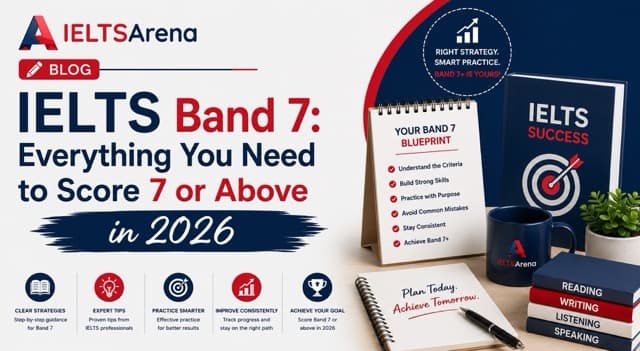
Band 7 is the target that matters most for millions of IELTS test-takers worldwide. It is the threshold for most UK and Australian skilled worker visas, for graduate-entry university programmes, and for professional registrations in nursing, accounting, and engineering. Yet the gap between Band 6.5 and Band 7 is exactly where the largest number of candidates get stuck. Not because they are not good enough. But because they are preparing the wrong way. This guide explains what IELTS band 7 actually requires in each section and gives you a specific plan to get there in 2026.
What IELTS Band 7 Actually Means
The IELTS band score scale runs from 1 to 9 in 0.5 increments. Your overall band score is the average of your four section scores, rounded to the nearest 0.5.
IELTS band 7 in practical terms means you are an "operational" English user. According to the official IELTS band descriptors, a Band 7 candidate has "operational command of the language with occasional inaccuracies, inappropriacies, and misunderstandings in some situations. Handles complex detailed argumentation well."
What this means for each section:
Listening Band 7: Approximately 30-32 correct answers out of 40.
Reading Band 7: Approximately 30-32 correct answers out of 40.
Writing Band 7: Essays show clear positions and task completion, with varied vocabulary, mostly accurate grammar, and coherent organisation with minor lapses.
Speaking Band 7: Fluent with occasional hesitation, wide vocabulary range used flexibly, mostly accurate grammar, and clear pronunciation with minor issues.
The important insight: Band 7 does not mean perfection. It means consistent competence with occasional errors. Many candidates over-focus on eliminating all errors and miss the bigger requirement, which is covering the full demands of each task.
Advertisement
Why Most Candidates Get Stuck at Band 6.5
There is a specific reason Band 6.5 to 7.0 is the most common plateau in IELTS preparation. Each section has a different bottleneck at that level.
In Listening, candidates at Band 6.5 typically lose marks on Section 3 and 4 due to academic vocabulary gaps. They catch common words but miss technical terms and inferential meaning in longer monologues.
In Reading, the block at Band 6.5 is usually time management combined with True/False/Not Given confusion. Candidates know the skill in theory but apply it too slowly under exam pressure.
In Writing, the gap is almost always Task 2. Candidates write acceptably organised essays with adequate vocabulary but fail to develop their arguments fully enough or use sufficiently varied grammatical structures to reach Band 7 on Lexical Resource and Grammatical Range and Accuracy.
In Speaking, the plateau is over-reliance on memorised phrases and limited use of discourse markers. Candidates speak fluently on familiar topics but slow down and simplify language on less familiar Part 3 topics.
Knowing which bottleneck applies to you is the first step. Generic IELTS practice does not fix a Speaking fluency issue. Only targeted Speaking practice does.
A Candidate Who Crossed the Band 7 Line
Marcus, a 31-year-old civil engineer from the Philippines, had been stuck at Band 6.5 for two attempts. He needed an IELTS 7 band overall for a skilled migration visa to Australia. His scores were Listening 7.0, Reading 7.0, Writing 6.0, Speaking 6.5. The weak links were clear.
"Everyone told me to just read more and write more," Marcus said. "But I had been doing that for six months and nothing changed."
The turning point was switching to criterion-specific practice. On IELTSArena, Marcus used the AI writing feedback to understand exactly which of the four Writing criteria he was losing marks on. It was Grammatical Range and Accuracy, specifically overuse of simple sentence structures. He also submitted three essays per week to an expert tutor for band-focused corrections.
For Speaking, he practised Part 3 questions daily on IELTSArena's AI Speaking feedback tool, which scored his fluency, vocabulary, grammar, and pronunciation separately. He targeted discourse markers and abstract vocabulary. After ten weeks, he scored Writing 7.0 and Speaking 7.5. Overall: Band 7.5.
What the Numbers Show About Band 7 Candidacy
The IELTS Global Performance Report from Cambridge Assessment English shows that of all candidates sitting IELTS globally, approximately 22% achieve an overall Band 7.0 or higher on their first attempt. For candidates who attempt the test a second time after a Band 6.5 result, approximately 38% reach Band 7.0, suggesting that targeted preparation for a second sitting is highly effective.
Writing is statistically the hardest section to achieve Band 7 in. The mean Writing score across all global test-takers in 2024 was approximately 6.0, compared to 6.5 for both Listening and Reading. This gap reflects that Writing requires active production under time pressure, not passive recognition.
For candidates moving from Band 5.5, reaching IELTS band 7 typically requires 200-400 hours of focused preparation, according to Cambridge English proficiency research. Moving from Band 6.5 to Band 7 typically requires 60-120 hours if preparation is targeted to specific weak criteria rather than general revision.
The Right Approach to Each Section
Listening: From 6.5 to 7.0
Focus specifically on Sections 3 and 4. These carry the marks that separate Band 6.5 from Band 7.
Section 3 features academic discussions between two or three speakers. Practise identifying which speaker holds which view. The distractors are designed to catch candidates who hear a word but miss the context around it.
Section 4 is a monologue on an academic topic. Build academic vocabulary in science, environment, social studies, and technology. Practise note-taking as you listen. Do not write full sentences. Write key words that anchor the information.
One tactic that consistently helps: review the recording after each mock test, listening for the exact moment you lost the answer. IELTSArena's listening practice tests let you review your approach and see where you lost marks by question type.
Reading: From 6.5 to 7.0
True/False/Not Given questions are the highest source of error at Band 6.5. The distinction between "False" and "Not Given" is precise. False means the passage actively contradicts the statement. Not Given means the passage simply does not mention it. When in doubt, ask: "Does the passage say the opposite?" If it does not say the opposite, the answer is "Not Given."
Time pressure is the second issue. At Band 7, you need to complete 40 questions in 60 minutes. Practise under strict time conditions. If you spend more than 3 minutes on a single question, mark your best guess and move on.
Writing Task 2: The Biggest Band 7 Lever
Task 2 accounts for two-thirds of your Writing score. These four criteria each carry 25% weight:
- Task Response: Answer the exact question asked, with a fully developed position.
- Coherence and Cohesion: Each paragraph has one clear idea, linked logically to the next.
- Lexical Resource: Use topic-specific vocabulary accurately, not just high-frequency words.
- Grammatical Range and Accuracy: Mix complex and simple sentences deliberately. Relative clauses, conditionals, passives, and nominalisations all demonstrate range.
The single highest-leverage action for most candidates is getting expert feedback on each of these four criteria separately. IELTSArena's AI feedback scores all four instantly. IELTSArena's expert tutors give you examiner-style corrections that show precisely where each criterion is strong or weak.
Speaking: From 6.5 to 7.0
Part 3 is where Band 7 candidates separate from Band 6.5 candidates. Part 3 asks abstract, debatable questions: "Do you think governments should invest more in public transport?" "How has technology changed the way people communicate?"
At Band 6.5, candidates answer these questions with simple observations. At Band 7, candidates develop an argument, acknowledge a counterpoint, and use discourse markers like "What is interesting about this is...", "The issue becomes more complex when we consider...", "While it is true that... the broader point is..."
Practise 5 Part 3 answers out loud every day. Record yourself. Listen back. Ask: "Did I develop this idea or just state it?" IELTSArena's AI Speaking feedback gives you scores on all four Speaking criteria after each practice response, so you know in real time whether you are hitting Band 7 fluency and vocabulary levels.
How IELTSArena Helps You Reach IELTS Band 7
Reaching IELTS band 7 requires a different type of practice than scoring Band 6.0. It requires criterion-level insight. You need to know not just "my Writing is weak" but "my Grammatical Range is holding my Writing at Band 6.5."
IELTSArena provides that precision. The AI writing feedback scores your Task 2 essays on all four criteria and identifies the specific patterns holding each criterion below Band 7. The AI speaking feedback does the same for all four Speaking criteria, including Pronunciation and Fluency.
When AI feedback is not enough, IELTSArena's expert tutors step in. These are experienced human coaches who give you band-focused corrections, not generic grammar edits. They tell you exactly what an examiner would mark and why.
The platform also replicates the real IELTS CBT interface. You practise in the exact environment you will face on test day, with a timer, highlighter, and digital notepad. No surprises. No unfamiliarity. Just performance.
IELTSArena supports both IELTS Academic and General Training, so whether your IELTS band 7 requirements are for a university application, a visa, or a professional qualification, you are practising the right test type.
Over 10,000 learners have used IELTSArena to reach their target band, with 5.0-star ratings from over 2,500 reviews.
Start your free practice on IELTSArena and find out exactly which criterion is between you and Band 7 today.
Are You Ready? Diagnose Yourself Now
Before your next mock test, answer these five questions:
- Do you know which of your four section scores is preventing your Band 7 overall, and which specific criterion within that section is the problem?
- Can you complete a Listening Section 4 monologue test with 30 or more correct answers out of 40?
- Can you write a Task 2 essay of 280+ words in 40 minutes that takes a clear position and develops it across two distinct body paragraph arguments?
- When answering Part 3 Speaking questions, do you develop a reasoning chain or just state an observation?
- Have you practised at least three full mock tests under real exam timing in the past two weeks?
If you answered "no" or "not sure" to any of these, you have identified your Band 7 work. IELTSArena gives you the tools to close each of those gaps specifically, not through generic practice but through scored feedback and expert guidance on the exact skills that define Band 7.
Take One Free Test and Know Exactly Where You Stand
IELTS band 7 is achievable for anyone who prepares with the right information. The candidates who get stuck at 6.5 are usually not behind on English ability. They are behind on understanding what Band 7 requires from each criterion in each section.
Take a Free Band 7 Diagnostic on IELTSArena →
Frequently Asked Questions
How hard is it to get IELTS band 7 for someone who speaks English as a second language?
IELTS band 7 requires consistent, operational use of English with occasional inaccuracies. For non-native speakers, reaching Band 7 is achievable but requires targeted preparation. Globally, approximately 22% of first-time IELTS candidates reach Band 7 or above. The most common challenge is Writing Task 2, which demands structured argumentation, lexical variety, and grammatical range all within 40 minutes. Candidates who use criterion-specific feedback tools, such as the AI writing feedback on IELTSArena, typically progress faster because they know exactly which aspect of their English needs work rather than practising generally.
What do I need to do differently to move from IELTS band 6.5 to band 7?
The most important change is shifting from general practice to criterion-targeted practice. At Band 6.5, you likely have a specific weakness in one or two criteria across one or two sections. In Writing, it is often Grammatical Range or Lexical Resource. In Speaking, it is often limited development in Part 3 answers. In Reading, it is frequently True/False/Not Given accuracy. Use scored feedback to identify your exact gap. IELTSArena's AI feedback breaks down each section by criterion, so you know precisely what to fix. Then practise that specific skill intensively, not the whole test.
Which IELTS section is hardest to get band 7 in?
Writing is statistically the hardest section for most candidates. The mean Writing score across global IELTS test-takers is approximately 6.0, lower than Listening and Reading. Writing requires active production under time pressure across four equally weighted criteria: Task Response, Coherence and Cohesion, Lexical Resource, and Grammatical Range and Accuracy. Achieving Band 7 in Writing requires a clear task response with fully developed arguments, varied vocabulary used accurately, and a deliberate mix of sentence structures. Most candidates improve fastest by getting expert human feedback on their essays, which platforms like IELTSArena provide through their tutor network.
How long does it take to prepare for IELTS band 7 from band 5.5?
Cambridge English proficiency research suggests that moving from Band 5.5 to Band 7.0 typically requires between 200 and 400 hours of focused study. The range is wide because it depends entirely on which skills are weakest and how targeted the preparation is. Candidates who practise general English broadly tend to take longer. Candidates who identify their weakest criterion in each section and train that specifically tend to reach Band 7 in 16 to 24 weeks. Daily practice of 60 to 90 minutes with regular mock tests and scored feedback is more effective than occasional intensive sessions.
What is the minimum score I need in each section to get IELTS overall band 7?
There is no single combination, because the overall band is the average of all four sections rounded to the nearest 0.5. However, a common combination that produces an overall Band 7.0 is Listening 7.0, Reading 7.0, Writing 6.5, Speaking 7.0. You could also achieve an overall Band 7.0 with Listening 7.5, Reading 7.0, Writing 6.0, Speaking 7.5. What matters is that the four scores average to at least 6.75, which rounds to 7.0. Note that some universities and visa categories set minimum scores per section in addition to the overall band, so check the specific requirement for your application before you set section targets.