
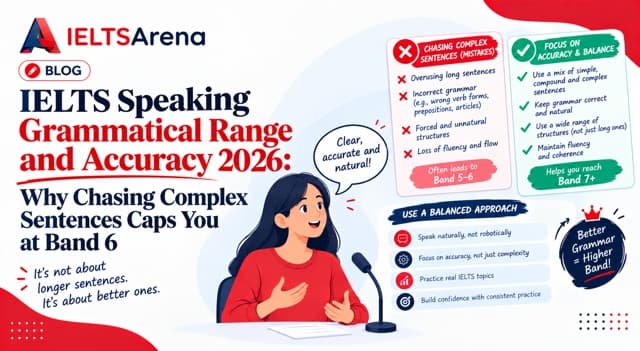
Your tutor told you Band 7 Speaking needs complex sentences, so you started forcing a conditional, a relative clause, and a passive construction into every answer. Your Grammatical Range and Accuracy dropped from Band 6 to Band 5.5. This happens because the criterion name is misleading. It is called "Grammatical Range AND Accuracy", and the AND does most of the work. A candidate who uses one complex structure accurately scores higher than a candidate who attempts five complex structures with errors. Range without accuracy is not range at all. It is noise. This guide explains what the criterion actually rewards, the 6 complex structures to deploy, the mix rule that stops you from over-reaching, and the four-week fix that moves candidates from Band 6 to Band 7.
Quick answer: IELTS speaking grammatical range and accuracy is one of the four Speaking assessment criteria, weighted at 25 percent of your Speaking band. It measures two things together: the range of grammatical structures you deploy (simple, complex, conditional, passive, relative clauses, nominalisations), and the accuracy with which you deploy them. Band 7 requires a mix of simple and complex structures with more accuracy than error. Attempting complex structures without controlling them produces a lower score than sticking to simple structures used accurately. The fastest fix for sub-Band 7 Grammatical Range is to master 6 specific complex structures and deploy one or two per response rather than packing every sentence with them.
In This Guide
- What Grammatical Range and Accuracy Actually Measures
- The "Range AND Accuracy" Trap: Why More Complex Is Not Always Better
- The 4 Speaking Criteria and GRA's Role
- The Band Descriptors from Band 5 to Band 9
- The 4 Grammatical Mistakes That Cap Band 6
- A Real Student's Story: Band 6.0 to Band 7.5 by Stopping, Not Starting
- The Data Behind This Criterion
- The Right Approach: A Four-Week Fix Plan
- The 6 Complex Structures That Lift GRA to Band 7
- Same Part 3 Answer at Band 5, Band 6, and Band 8 with Grammar Annotations
- Common Grammar Errors by First Language Background
- How IELTSArena Helps You Fix GRA Specifically
- Self-Diagnosis: Is Grammatical Range Capping Your Band?
- Key Takeaways
- Frequently Asked Questions
Advertisement
What Grammatical Range and Accuracy Actually Measures
IELTS speaking grammatical range and accuracy is the criterion that assesses the variety of grammatical structures you use and the accuracy with which you use them, in real-time speech. It applies to all three parts of the Speaking test: Part 1's short question and answer, Part 2's 2-minute long turn, and Part 3's abstract discussion. Each part is scored against the same four criteria, and Grammatical Range and Accuracy carries equal 25 percent weight.
The criterion covers four specific observable behaviours. First, range, meaning whether you deploy a mix of simple, compound, and complex sentences rather than relying on one pattern throughout. Second, accuracy, meaning whether most of your sentences are grammatically correct. Third, control under pressure, meaning whether your grammar holds up in Part 2 and Part 3 as topics become more abstract. Fourth, error impact, meaning whether the errors you do make interfere with meaning or stay minor.
Because the criterion combines range and accuracy, candidates get rewarded for using a mix of structures with mostly correct deployment, not for cramming complex structures into every sentence. A candidate who uses one accurate conditional, one accurate relative clause, and six accurate simple sentences in a Part 2 response scores higher than a candidate who attempts six conditionals with errors in each. The AND in the criterion name is what most candidates miss.
The "Range AND Accuracy" Trap: Why More Complex Is Not Always Better
The most damaging piece of IELTS Speaking advice is "use complex sentences for Band 7". It is partially true but dangerously incomplete. Band 7 requires "a range of complex structures with some flexibility, with frequent error-free sentences". The "frequent error-free sentences" clause matters as much as the "range of complex structures" clause. If adding complex structures reduces your error-free sentence count, you are moving backwards, not forwards.
Here is what happens in practice. A candidate at Band 6 Grammatical Range has smooth simple sentences with occasional minor errors. Their tutor says "use conditionals, passives, and relative clauses". The candidate attempts those structures but cannot control them under time pressure. The result: forced complex sentences with multiple errors each, plus the loss of fluency from the mental effort of constructing them. Grammatical Range and Accuracy drops from Band 6 to Band 5.5, and Fluency and Coherence drops too because of the hesitation and self-correction that follow the grammar struggles.
The correct advice is: master 2 or 3 complex structures until you can deploy them accurately under pressure, then deploy them once or twice per response. Not every sentence. Not every answer. The target is a mix, with accuracy preserved. This is what the criterion actually rewards.
The 4 Speaking Criteria and GRA's Role
Your IELTS Speaking band is the average of your four criterion scores: Fluency and Coherence, Lexical Resource, Grammatical Range and Accuracy, and Pronunciation. Each criterion is worth 25 percent.
Grammatical Range and Accuracy is rarely the lowest-scoring criterion at Band 5.5 to Band 6.5 level, which means fixing it is usually not the fastest route to overall band movement from a low baseline. Here is what different criterion profiles produce as overall Speaking band scores.
| Fluency and Coherence | Lexical Resource | Grammatical Range | Pronunciation | Overall Speaking band |
|---|---|---|---|---|
| 7 | 7 | 5 | 7 | 6.5 |
| 7 | 7 | 6 | 7 | 6.75, rounded to 6.5 |
| 7 | 7 | 7 | 7 | 7 |
| 7 | 7 | 8 | 7 | 7.25, rounded down to 7 |
For most Band 5.5 to Band 6.5 candidates, Fluency and Coherence or Pronunciation is the lowest-scoring criterion. Grammatical Range and Accuracy becomes the primary bottleneck once Fluency, Pronunciation, and Lexical Resource are all at Band 7. This is the stage at which this guide becomes directly actionable for candidates targeting Band 7.5 or Band 8.
The Band Descriptors from Band 5 to Band 9
Here is what the publicly available Grammatical Range and Accuracy descriptors say, expressed in plain language rather than official jargon.
Band 5 Grammatical Range and Accuracy. Produces basic sentence forms with reasonable accuracy. Uses a limited range of more complex structures, but these usually contain errors and may cause some comprehension problems.
Band 6 Grammatical Range and Accuracy. Uses a mix of simple and complex structures, but with limited flexibility. May make frequent mistakes with complex structures, though these rarely cause comprehension problems.
Band 7 Grammatical Range and Accuracy. Uses a range of complex structures with some flexibility. Frequently produces error-free sentences, though some grammatical mistakes persist.
Band 8 Grammatical Range and Accuracy. Uses a wide range of structures flexibly. Produces a majority of error-free sentences, with only very occasional inappropriacies or basic/non-systematic errors.
Band 9 Grammatical Range and Accuracy. Uses a full range of structures naturally and appropriately. Produces consistently accurate structures apart from "slips" characteristic of native speaker speech.
Two patterns emerge. First, "frequently error-free sentences" appears at Band 7, which means Band 7 is reached by making most sentences accurate, not by making every sentence complex. Second, "range of complex structures with some flexibility" at Band 7 allows for a modest number of complex deployments. Band 7 is a mix with accuracy preserved, not a complexity contest.
The 4 Grammatical Mistakes That Cap Band 6
Four specific mistakes account for most Band 5 and Band 6 Grammatical Range and Accuracy scores.
Mistake 1: Sticking to simple sentences throughout. Using only subject-verb-object patterns ("I live in Lviv. I work as an engineer. I like my job.") caps Grammatical Range at Band 6 regardless of accuracy. The criterion specifically rewards a mix. Fix: deliberately include at least one complex sentence (with "because", "although", "which", "if") in every Part 3 answer and one in the middle of every Part 2 response. Not every sentence, just one or two per answer.
Mistake 2: Tense inconsistency within a response. Switching between past and present tense within the same answer without a logical reason ("Yesterday I go to the market, and I bought some fruit") is a Grammatical Accuracy issue that drops the criterion by half a band. Fix: pick a tense based on the question (past for narrative questions, present for opinion or habit questions) and stay consistent throughout the response. If you must switch tense, do so at a sentence boundary with a clear time marker.
Mistake 3: Systematic article errors. Omitting "a", "an", and "the" in most noun phrases, or using them incorrectly ("I went to the France last year", "I went to shop", "I read book"), is a Grammatical Accuracy issue that caps GRA at Band 5.5 to Band 6. Candidates from L1 backgrounds without articles (Russian, Ukrainian, Chinese, Japanese, Korean, most Indian languages) are particularly prone to this. Fix: drill the three article rules explicitly and consciously insert articles in every noun phrase during practice. See the L1-specific section below.
Mistake 4: Attempting complex structures without controlling them. Forcing conditionals ("If I would have more time, I would learn piano"), passives, or relative clauses that contain multiple errors each is worse than sticking to simple sentences, because the attempt gets no credit if accuracy fails. The examiner rewards accuracy at the structure level. Fix: master 2 or 3 complex structures first with accuracy drills, then deploy only those structures until they are automatic. Add more structures only once the first ones are solid.
A Real Student's Story: Band 6.0 to Band 7.5 by Stopping, Not Starting
Oleksandr, a software engineer from Lviv applying for a Portugal Golden Visa, sat the IELTS three times and scored Speaking Band 6.0 each time. His Grammatical Range and Accuracy was Band 5.5 across all three attempts, despite months of grammar study.
My tutor kept telling me to use more conditionals, more passives, more relative clauses. So I did. In every sentence. My recording from attempt three had seven forced complex structures in a single Part 2 response, and five of them had errors. My tutor finally listened to the recording and said, "Oleksandr, you need to stop. You are making this worse. Go back to simple sentences for three weeks, and then we will add one structure at a time."
His diagnostic named two specific problems: he was forcing complex structures without controlling them, and he was omitting articles systematically across every noun phrase. He stopped attempting complex structures for three weeks and focused entirely on article accuracy and sentence-level control. In the fourth week, he added one complex structure (conditionals, specifically second conditionals for hypothetical reasoning) and drilled it until he could deploy it without error. His fourth attempt scored Grammatical Range Band 7.5. Overall Speaking band lifted from 6.0 to 7.5. The Golden Visa route cleared. Total time from Band 6.0 to Band 7.5: four weeks of structural discipline, after six months of forcing complexity that was actively lowering his score.
The Data Behind This Criterion
Cambridge Assessment English publicly reports that Grammatical Range and Accuracy is scored on both dimensions equally, and that candidates who attempt complex structures with errors frequently score lower than candidates who use fewer structures with accuracy (Cambridge Assessment English, IELTS Test Statistics 2024 to 2025 and Speaking Assessment Framework).
British Council examiner reports specifically flag "forced complex structures with errors" and "systematic article errors" as the two most common Grammatical Range and Accuracy issues at the Band 5.5 to Band 6.5 level. IELTS.org confirms the four Speaking assessment criteria for 2026 remain Fluency and Coherence, Lexical Resource, Grammatical Range and Accuracy, and Pronunciation, each weighted equally at 25 percent (IELTS.org, 2026 assessment framework).
Internal tracking on IELTSArena shows that candidates who drilled 2 to 3 complex structures to accuracy before adding more saw Grammatical Range movement of 0.5 to 1.0 bands over 4 to 6 weeks, compared to candidates who attempted 5 or more complex structures simultaneously, who saw an average movement of 0.0 to 0.25 bands over the same period. This is direct evidence that structural control precedes structural range.
The Right Approach: A Four-Week Fix Plan
Fixing IELTS speaking grammatical range at scale is a four-step process. Do not skip Step 1, because it decides whether you need to add complexity or fix accuracy first.
Step 1: Diagnose whether your gap is range or accuracy. Record yourself answering one Part 1 question, one Part 2 cue card, and one Part 3 question. Play each recording back with a specific checklist: Did you use only simple sentences, or did at least one complex structure appear per answer? Did you make tense errors, article errors, or subject-verb agreement errors? Count both. If your error count is low but your range is narrow, your gap is range. If your error count is high regardless of range, your gap is accuracy. The fix sequence differs.
Step 2: If accuracy is your gap, fix accuracy first. For three weeks, do not attempt any complex structure you have not already mastered. Focus entirely on the specific accuracy error that appears most often in your recordings: articles, tense consistency, or subject-verb agreement. Drill one error type at a time. Only once that error type is below 2 per minute do you move to the next.
Step 3: If range is your gap, add one complex structure at a time. For each of the four weeks, add exactly one new complex structure from the list in the next section. Drill it daily until you can deploy it without error. Only add the next structure once the previous one is automatic. Trying to add all 6 structures at once produces the forced-complexity trap described above.
Step 4: Re-test and consolidate. After four weeks, record three new responses and rescore for both range (how many different complex structures appeared) and accuracy (error count). If both have improved, you are tracking toward Band 7 Grammatical Range. If only one improved, extend the plan for another cycle on whichever dimension lagged.
This is the loop that produces Band 5.5 to Band 7 movement on Grammatical Range in four to six weeks. It works because it treats range and accuracy as separate problems to solve rather than one blob to improve.
The 6 Complex Structures That Lift GRA to Band 7
These six structures are the highest-leverage additions to Band 7 Grammatical Range. Master them in order. Do not add structure 2 until structure 1 is accurate.
Structure 1: Subordinate clauses with "because", "although", and "while". "I enjoy my job because it gives me flexibility." "Although the weather in Lviv is cold in winter, I prefer it to summer." These are the easiest complex structures to deploy accurately and the fastest way to lift GRA from Band 6 to Band 6.5.
Structure 2: Relative clauses with "which", "who", and "that". "My hometown, which is in western Ukraine, has a historic old town." "The person who taught me programming was my university professor." Relative clauses signal range without requiring complex tense manipulation.
Structure 3: Second conditionals for hypothetical reasoning. "If I had more time, I would learn piano." "If people cared more about the environment, cities would be cleaner." Conditionals are powerful for Part 3 hypothetical questions and are specifically rewarded at Band 7.
Structure 4: Present perfect for recent experience and ongoing situations. "I have lived in Lviv for ten years." "I have been working in software for about five years." Present perfect is often misused by candidates whose L1 does not have this tense; getting it right signals control.
Structure 5: Passive voice for appropriate contexts. "The decision was made by the government." "The project is being developed by a small team." Passives are useful in Part 3 for discussing policy, process, and abstract agents. Use sparingly in Part 1 and Part 2.
Structure 6: Nominalisation for abstract Part 3 responses. Converting verbs to nouns to make statements more abstract: "The introduction of new technology has changed working patterns." "The development of social media has affected how people interact." This is the Band 8 structure to add after the first five are solid.
Deploy one or two of these per response, not all six. The mix is the point.
Same Part 3 Answer at Band 5, Band 6, and Band 8 with Grammar Annotations
Here is what different Grammatical Range and Accuracy levels sound like on the same Part 3 prompt. Vocabulary and fluency held roughly constant.
Prompt: "How has technology changed the way people communicate?"
Band 5 Grammatical Range response (46 words, simple sentences only, errors marked in bold): "Technology change communication a lot. People use phone and computer for talk. Before, people write letter and wait long time. Now, we send message and reply is instant. Also social media is popular. People share photo and video every day with friend and family."
Grammatical Range Band 5: all simple sentences, multiple article omissions ("phone and computer", "letter", "social media", "photo and video", "friend"), tense errors ("change" instead of "has changed"), subject-verb agreement issues ("reply is instant"). The response communicates meaning but at a very basic structural level.
Band 6 Grammatical Range response (69 words, mix emerging): "Technology has changed communication a lot in the last twenty years. People now use smartphones and computers for most of their communication, instead of writing letters and waiting weeks for a reply. Social media platforms are also popular. People share photos and videos with friends and family every day. Although communication is faster, some people say it is less personal than before."
Grammatical Range Band 6: present perfect used accurately once ("has changed"), articles mostly correct, one subordinate clause ("Although communication is faster"), no major errors. Clear and accurate but only one complex structure.
Band 8 Grammatical Range response (97 words, range deployed with accuracy): "Technology has fundamentally transformed how people communicate, particularly over the last two decades. Where people used to write letters and wait weeks for a reply, we now exchange messages instantly through smartphones and social media platforms, many of which did not exist twenty years ago. Although this has made communication faster and more global, it has also changed the nature of what we share. If we reflect on how face-to-face conversations have been partly replaced by text messages and video calls, there is a legitimate concern that depth has been traded for convenience."
Grammatical Range Band 8: present perfect used four times accurately ("has transformed", "has made", "has changed", "has been partly replaced"), relative clause ("many of which did not exist"), subordinate clause ("Although this has made"), conditional-style framing ("If we reflect"), passive construction ("depth has been traded"), and all articles correct. Six different complex structures deployed in one answer with no errors. This is what range plus accuracy looks like at Band 8.
Common Grammar Errors by First Language Background
Different L1 backgrounds produce predictable grammar error patterns in English. Knowing yours lets you drill the specific errors examiners expect to find.
Slavic languages (Russian, Ukrainian, Polish, Czech): systematic article omission ("I went to shop", "I read book"), tense sequence issues in reported speech, difficulty with articles for abstract nouns.
East Asian languages (Chinese, Japanese, Korean): systematic article omission, difficulty with countable versus uncountable nouns, tense marking issues (English marks tense on the verb, these languages often do not).
Romance languages (Spanish, Portuguese, Italian, French): over-use of "the" where English drops it ("the people are", "the music is important"), gender transfer errors (treating English nouns as having gender), present continuous versus present simple confusion.
Semitic languages (Arabic, Hebrew): subject-verb-object order variation under pressure, "the" over-use, difficulty with English verb-to-be constructions.
Indian subcontinent languages (Hindi, Bengali, Tamil, Urdu, Punjabi): article omission and over-use, present continuous for stative verbs ("I am knowing", "I am understanding"), tense sequence issues.
If your L1 is on this list, drill the specific errors associated with your background rather than attempting a general grammar overhaul. Target drills on your 3 to 4 predictable error types produce faster movement than broad study.
How IELTSArena Helps You Fix GRA Specifically
IELTSArena's AI Speaking feedback scores every recorded response against Fluency and Coherence, Lexical Resource, Grammatical Range and Accuracy, and Pronunciation separately. The Grammatical Range feedback specifically flags tense errors, article errors, subject-verb agreement issues, and over-reliance on simple sentences, which are the four specific patterns that cap the criterion at Band 6.
Expert tutors on IELTSArena review Speaking responses with specific focus on the range-versus-accuracy balance for candidates targeting Band 7 and above, which is the level at which Grammatical Range becomes the next bottleneck after Fluency and Coherence and Pronunciation. The platform also provides model responses at Band 5, Band 6, and Band 8 on the same prompts, so you can hear exactly how the mix of simple and complex structures changes at each band level. More than 10,000 students have used IELTSArena to reach their target Speaking band.
Start your free IELTS practice on IELTSArena and record your first Part 3 response for automated Grammatical Range feedback this week.
Self-Diagnosis: Is Grammatical Range Capping Your Band?
Work through these questions honestly against a recording of your last practice response.
Did your response use only simple sentences, or did at least one complex sentence appear per answer? Did you make tense errors (switching between past and present without reason) or stay consistent within each response? Did you drop articles ("a", "an", "the") in more than half of your noun phrases? Did you attempt any complex structure that contained an error, and if so, how many? Did you force complex structures into contexts where simpler ones would have worked better? Can you deploy a second conditional ("If I had... I would...") without hesitation, or does the structure trip you up? Can you use present perfect ("I have lived here for...") accurately in context, or do you default to simple past?
If you hesitated on more than two of these, Grammatical Range and Accuracy is likely worth working on, especially once Fluency and Coherence and Pronunciation are already at Band 7.
Key Takeaways
- IELTS speaking grammatical range and accuracy is one of the four Speaking assessment criteria, weighted at 25 percent. It measures both range (variety of structures) and accuracy (correctness of deployment).
- The AND in "Range AND Accuracy" matters. A candidate who uses one complex structure accurately scores higher than a candidate who attempts five with errors.
- Band 7 requires "a range of complex structures with some flexibility" plus "frequently error-free sentences". The mix with accuracy preserved is the target, not complexity in every sentence.
- Grammatical Range is rarely the lowest-scoring criterion at Band 5.5 to 6.5 level. Fix Fluency and Coherence and Pronunciation first. GRA becomes the next bottleneck when targeting Band 7.5 or Band 8.
- The four mistakes that cap Band 6 are: sticking to simple sentences, tense inconsistency, systematic article errors, and forced complex structures with errors.
- The six complex structures to master in order are: subordinate clauses, relative clauses, second conditionals, present perfect, passives, and nominalisation. Add one per week, not all at once.
- L1-specific error patterns are predictable. Drill your 3 to 4 expected errors (articles, tense, agreement) rather than attempting a general grammar overhaul.
Related Guides on IELTSArena
- IELTS Speaking Test Format: What Happens on Exam Day
- IELTS Speaking Part 2 Cue Card Strategy
- IELTS Speaking Fluency and Coherence
- IELTS Speaking Pronunciation
- IELTS Speaking Lexical Resource
- IELTS Speaking Common Mistakes
- How to Practise IELTS Speaking Alone
- IELTS Speaking Part 3 Questions and Sample Answers
- How to Get Band 7.5 in IELTS
- How to Get Band 8 in IELTS
- IELTS Speaking Pronunciation 2026: The Four Sub-Components
See Where Your Grammatical Range Band Stands Today
Try a free mock test at ieltsarena.com and record one timed Speaking Part 3 response. In one free practice session, you will know whether Grammatical Range and Accuracy is capping your Speaking band and whether your specific gap is range, accuracy, or both.
Start your free IELTS practice on IELTSArena
Frequently Asked Questions
What is Grammatical Range and Accuracy in IELTS Speaking? IELTS speaking grammatical range and accuracy is one of the four Speaking assessment criteria, weighted at 25 percent of your Speaking band. It measures two things together: the range of grammatical structures you deploy (simple sentences, compound sentences, complex sentences with subordinate clauses, relative clauses, conditionals, passives, and nominalisations), and the accuracy with which you deploy them. The AND in the criterion name matters. A candidate who uses one complex structure accurately scores higher than a candidate who attempts five complex structures with errors in each. Range without accuracy produces a lower score than fewer structures used correctly. The target is a mix of simple and complex structures with accuracy preserved.
How do I improve grammar in IELTS Speaking? First, diagnose whether your gap is range or accuracy. Record yourself and count both: how many different sentence structures appeared, and how many grammar errors per minute. If your error count is high regardless of range, fix accuracy first by drilling one error type at a time (articles, tense consistency, or subject-verb agreement). If your error count is low but your range is narrow, add one complex structure per week from the six-structure sequence: subordinate clauses, relative clauses, second conditionals, present perfect, passives, nominalisation. Drill each until it is automatic before adding the next. Four weeks of this targeted approach moves most candidates from Band 6 to Band 7 Grammatical Range, faster than attempting a broad grammar overhaul.
Do I need complex sentences for Band 7 in IELTS Speaking? Yes, but with accuracy preserved. The Band 7 descriptor requires "a range of complex structures with some flexibility" alongside "frequently error-free sentences". Both halves of the descriptor matter. If adding complex structures reduces your error-free sentence count, you are moving backwards. The practical target is one or two complex structures per response (not per sentence), deployed accurately, mixed with simple sentences that are also accurate. Attempting complex structures without controlling them scores lower than sticking to simple structures used correctly. Master two or three complex structures to the point where you can deploy them without hesitation, then let them appear naturally in your responses when the content calls for them.
Why is my Grammatical Range scored Band 5 in IELTS Speaking? Four specific mistakes cap Grammatical Range at Band 5. First, using only simple sentence patterns throughout, with no complex structures appearing at all. Second, tense inconsistency within a single response, especially switching between past and present without a reason. Third, systematic article errors, omitting "a", "an", and "the" across most noun phrases. Fourth, attempting complex structures that contain multiple errors each, which gets no credit from the examiner and often produces fluency drops too. The combination of range failure (no complex structures) and accuracy failure (frequent errors in simple ones) is what produces Band 5. Fixing both takes four weeks of targeted drilling with recordings and criterion-level feedback.
What grammar structures should I use in IELTS Speaking? Master six complex structures in sequence: subordinate clauses with "because", "although", and "while"; relative clauses with "which", "who", and "that"; second conditionals for hypothetical reasoning ("If I had more time, I would..."); present perfect for recent experience and ongoing situations ("I have lived here for..."); passive voice for appropriate contexts (especially Part 3 policy discussion); and nominalisation for abstract Part 3 responses ("The introduction of new technology has changed..."). Add one per week during a four-week drilling cycle, not all at once. Deploy one or two per response, not every sentence. The mix of simple and complex structures with accuracy preserved is what the Band 7 descriptor rewards. Not every sentence has to be complex.
Last updated September 2026 by the IELTSArena Editorial Team, a team of IELTS tutors, certified CBT examiners, and Speaking feedback specialists who publish weekly research-backed guides on ieltsarena.com.