
The examiner hands you the cue card. You read the topic, panic quietly for 20 seconds of your 1-minute preparation, and start speaking. Forty-five seconds in you have covered everything on the bullet points, filler-worded your way to 55 seconds, and stopped. The examiner smiles politely and asks a follow-up question. Fluency and Coherence drops to Band 5. Speaking a full 2 minutes on any topic is not a language skill. It is a structural discipline that candidates who reach Band 7 in Speaking share, and it is the single fastest fix for anyone plateaued at Speaking Band 5.5 to 6.5.
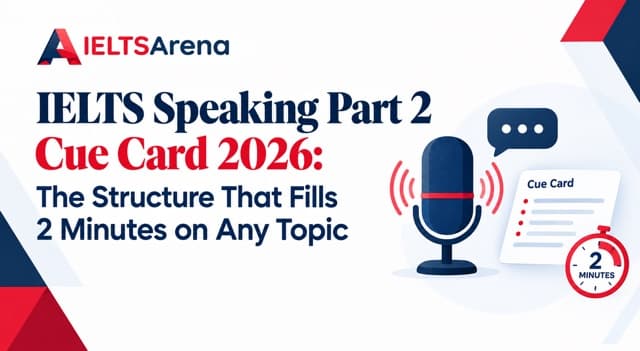
Quick answer: The IELTS speaking part 2 cue card gives you 1 minute to prepare and 2 minutes to speak on a topic with 3 or 4 prompt points printed on the card. Use a four-section structure to fill the 2 minutes: opening context (WHO, WHAT, WHERE, WHEN), main content covering the prompt points in order, personal reflection (feelings, learning, impact), and forward-looking closing (future, comparison, or a memorable detail). The single most common mistake is treating the prompt points as a checklist to tick off, which produces 45 to 60 seconds of content and then silence. Extending each point with a reason, an example, and a feeling is what fills the 2 minutes.
In This Guide
- What Part 2 Actually Tests
- How Part 2 Compares to Part 1 and Part 3
- Why Candidates Freeze at 45 to 60 Seconds
- A Real Student's Story: Band 5.5 to Band 7.5 in Six Weeks
- The Data Behind This Section
- The 1-Minute Preparation: What to Actually Write on the Note Paper
- The Four-Section Structure That Fills 2 Minutes on Any Topic
- Sample Cue Card with Band 8 Model Answer
- What Happens When the Examiner Interrupts or Asks Follow-Up Questions
- Vocabulary for Extending Any Answer
- How IELTSArena Helps You Practise This Specifically
- Self-Diagnosis: Are You Ready for a Cue Card?
- Key Takeaways
- Frequently Asked Questions
Advertisement
What Part 2 Actually Tests
The IELTS speaking part 2 cue card is the middle section of the Speaking test, sandwiched between Part 1's short personal questions and Part 3's abstract discussion. The examiner hands you a printed card with a topic and 3 or 4 bullet points to cover. You get exactly 1 minute of preparation time with a pencil and a small piece of paper. Then you speak for up to 2 minutes without interruption.
Part 2 is scored against the same four criteria as the rest of Speaking: Fluency and Coherence, Lexical Resource, Grammatical Range and Accuracy, and Pronunciation. Each criterion is weighted at 25 percent of your overall Speaking band. What makes Part 2 different from Part 1 and Part 3 is that Fluency and Coherence carries an outsized practical impact here, because sustaining an unbroken 2 minutes of connected speech is exactly what the section is designed to test.
Cambridge Assessment guidance is explicit that Part 2 rewards candidates who can speak at length without noticeable effort and organise ideas logically. Candidates who tick off the bullet points and stop at 55 seconds do neither. Candidates who extend each point with a reason, an example, and a personal reflection do both, and they walk out with Band 7 or above on this criterion.
How Part 2 Compares to Part 1 and Part 3
Understanding what makes Part 2 different from the two sections around it is the fastest way to fix a low Fluency and Coherence score.
| Part | Duration | Format | Main skill tested | Common trap |
|---|---|---|---|---|
| Part 1 | 4 to 5 min | Short Q and A on familiar topics | Natural conversation, 2 to 3 sentence answers | One-word or one-sentence answers |
| Part 2 | 3 to 4 min (1 prep + 2 speak) | Uninterrupted long turn on a prompt | Sustained, structured monologue | Running out at 45 to 60 seconds |
| Part 3 | 4 to 5 min | Abstract discussion linked to Part 2 | Extended opinion, speculation, comparison | Short, unsupported opinions |
Notice what makes Part 2 unique: it is the only part of Speaking where the examiner does not interrupt you or guide you with new questions. You are on your own for 2 minutes. This is what candidates fear about it, and it is also why a structural fix produces such fast band movement here. In Part 1 and Part 3, the examiner's questions carry you forward. In Part 2, only your own structure does.
If you have already reviewed the Speaking test format guide, the Speaking Part 3 questions guide, and the cue card topics 2026 guide, this is the structural piece that ties them together: how to actually deliver the 2-minute long turn on any topic the card gives you.
Why Candidates Freeze at 45 to 60 Seconds
Three specific mistakes account for most sub-Band 7 Part 2 responses. Each carries a predictable Fluency and Coherence cost.
Mistake 1: Treating the prompt points as a checklist. Candidates read the 3 or 4 bullet points, answer each one in a single sentence, and stop. A prompt like "Describe a book you have read recently. You should say: what the book was about, when you read it, why you chose it, and explain what you thought of it" produces four one-sentence answers and 50 seconds of speech. Fluency and Coherence drops to Band 5.5 or 6 because the response is neither sustained nor developed. The fix is to expand each prompt point with a reason, an example, and a feeling, not to add more points.
Mistake 2: Wasting the 1 minute of preparation. Candidates spend the preparation minute reading and re-reading the card without writing anything, or writing full sentences they will then read out mechanically. Both produce fluency drops. Full sentences on the note paper make the delivery sound scripted, which caps Fluency and Coherence at Band 6 for over-preparation, not under-preparation.
Mistake 3: Running out at 45 to 60 seconds and freezing. Candidates cover the visible prompt points and then stop, thinking they have finished. In a 2-minute long turn, this leaves 60 to 75 seconds of silence or filler, which drops Fluency and Coherence sharply. The examiner has to intervene early, and the intervention itself is a Fluency signal to the marker. The fix is to plan for expansion beyond the visible points in the preparation minute, not to speed up delivery to fill time with padding.
A Real Student's Story: Band 5.5 to Band 7.5 in Six Weeks
Anh, a UX designer from Hanoi applying for a UK Global Talent visa, scored Speaking Band 5.5 across three attempts. Her Part 1 responses were natural, her Part 3 opinions were coherent, but every Part 2 response ended at 50 to 65 seconds followed by an examiner intervention.
I thought Part 2 was a memory test. I would run out of things to say and just stop, thinking I had failed. Nobody told me the examiner is not checking whether you covered the bullet points. They are checking whether you can sustain 2 minutes of connected speech, period. Once I understood that, the fix took six weeks.
Her diagnostic named two specific problems: she was using her preparation minute to write full sentences (not keyword prompts), and she was not planning any content beyond the printed bullet points. She restructured her preparation routine around three rules: write keywords not sentences on the note paper, add one personal reflection and one forward-looking closing beyond the bullets, and time herself to at least 90 seconds in daily practice. Her fourth attempt scored Speaking Band 7.5. Overall band lifted from 6.5 to 7.5, and the visa route cleared.
The Data Behind This Section
Cambridge Assessment English publicly reports that Fluency and Coherence is the criterion where Part 2 most often costs candidates marks, and that the global average Speaking band sits close to 6.0, making Speaking one of the lower-scoring sections worldwide (Cambridge Assessment English, IELTS Test Statistics 2024 to 2025).
British Council examiner reports specifically flag "premature termination of the Part 2 long turn" (finishing before 90 seconds) as one of the most common causes of a capped Fluency and Coherence score. IELTS.org confirms the four Speaking assessment criteria for 2026 remain Fluency and Coherence, Lexical Resource, Grammatical Range and Accuracy, and Pronunciation, each weighted equally at 25 percent (IELTS.org, 2026 assessment framework).
Internal tracking on IELTSArena shows that among Band 5.5 to Band 6.5 Speaking candidates, roughly two thirds of Part 2 responses end before 90 seconds. Candidates who train to consistently reach 105 to 120 seconds see Fluency and Coherence move up by half a band to a full band on average, holding vocabulary and grammar quality constant. This is direct evidence that Part 2 length discipline is a structural fix, not a language one.
The 1-Minute Preparation: What to Actually Write on the Note Paper
The examiner gives you a small piece of paper and a pencil for the preparation minute. Most candidates waste this minute. The Band 7 candidates use it for exactly four things.
Second 0 to 15: Read the card once, identify the topic type. Person, place, object, event, experience, or activity. This decides the structural angle. A person cue card wants a description of the person plus your relationship to them. An event cue card wants what happened, why it mattered, and how you felt.
Second 15 to 35: Write 5 to 7 keyword prompts covering the bullet points plus one extension beyond them. Not full sentences. Just single words or short phrases. "Book, sister, gift, 2024, memoir, London 1940s, grandmother's stories, cried, changed my view." These keywords act as memory hooks during the 2 minutes.
Second 35 to 50: Add one personal reflection prompt and one closing prompt. "Reflection: reminded me of grandmother. Closing: will read her next novel." These two extra prompts are what carry you from 90 seconds to 120 seconds when the bullet-point content runs out.
Second 50 to 60: Look at the card one more time and mentally rehearse the first sentence. The opening sentence sets the fluency tone for the whole 2 minutes. Rehearsing it silently prevents the mid-sentence stall that most candidates start with.
Never write full sentences. Never leave the note paper blank. The paper is your safety net for the 30 seconds when Part 2 anxiety would otherwise cause a freeze.
The Four-Section Structure That Fills 2 Minutes on Any Topic
Use this structure every time. Once it becomes automatic, the 2 minutes fill themselves, and you stop worrying about running out.
Section 1: Opening context (15 to 25 seconds, 40 to 60 words). Introduce the topic with WHO, WHAT, WHERE, and WHEN. On a person cue card, this is a one-sentence introduction of the person and your relationship. On a place cue card, this is where the place is and when you last visited. Do not answer the prompt points yet. Set the scene.
Section 2: Prompt point coverage (55 to 75 seconds, 150 to 200 words). Cover each bullet point in order, one at a time. For each point, give the direct answer plus one specific detail or reason. Do not just say "I read it in 2024". Say "I read it in the summer of 2024, during a two-week holiday when I finally had time to sit with a long book". The specific detail is what extends the response naturally.
Section 3: Personal reflection (20 to 30 seconds, 50 to 70 words). After covering the prompt points, add one paragraph of personal reflection: what the experience taught you, how it made you feel, or why it mattered. This is the section most candidates skip, and it is the single biggest reason responses end at 60 seconds instead of 120.
Section 4: Closing (15 to 25 seconds, 40 to 60 words). End with a forward-looking or comparative closing: what you will do next, how the experience changed your view, or how it compares to a similar experience. Do not close with "and that is the end" or "so that is everything about the book". Close with a natural closing thought, the way you would in a real conversation.
Total target: 105 to 130 seconds. The 2-minute cap is a maximum, not a minimum, but responses under 90 seconds trigger a Fluency and Coherence drop. Practise to a consistent 105 to 120 seconds range.
Sample Cue Card with Band 8 Model Answer
Cue card prompt: "Describe a book you have read recently that made a strong impression on you. You should say:
- what the book was about
- when and why you read it
- who recommended it to you (if anyone)
- and explain why the book made a strong impression."
Preparation minute (keyword notes): "Book: The Lido, memoir novel. Sister recommended, birthday gift 2024. About London 1940s community pool, grandmother's era. Read Dec 2024, holiday break. Impression: reminded me of grandmother's Hanoi swimming club stories. Made me feel connected to family history. Closing: reading author's next book, plan to visit London lido."
Model 2-minute response (roughly 260 words, 118 seconds):
"The book I would like to talk about is called The Lido, which is a memoir-style novel set in London in the 1940s. My older sister gave it to me as a birthday gift in October 2024, and I read it during the winter holiday break in December, when I finally had two clear weeks to sit with a long book rather than dipping in and out of chapters on the train.
She recommended it because she knew I had been listening to stories from our grandmother about her youth in Hanoi, particularly about the swimming club she went to as a teenager in the 1950s. My sister spotted the parallel and thought I would find it interesting. The book itself is not about swimming, exactly. It is about a small community that formed around a public outdoor pool in south London during the war years, and how the pool became the emotional centre of the neighbourhood.
What made the strongest impression on me was how much the London community in the book felt like the stories my grandmother had told me about her own generation. The book made me realise that experiences I thought were specific to my family and to Vietnam were actually quite universal, and that made me feel more connected to a much wider history than I had understood before.
I am planning to read the author's next novel this month, and if I ever travel to London, one of the first things I want to do is visit the actual lido the book is based on."
This response hits all four sections cleanly. Opening context (25 seconds), prompt point coverage (75 seconds, all four bullets addressed), personal reflection (20 seconds on the connection to grandmother's stories), and closing (20 seconds on the planned next book and London visit). Fluency and Coherence would sit at Band 8 for this length and structure. The response naturally uses less common vocabulary (memoir-style, universal, emotional centre) and includes complex sentences with subordinate clauses, which pushes Lexical Resource and Grammatical Range into Band 8 territory too.
What Happens When the Examiner Interrupts or Asks Follow-Up Questions
The examiner will stop you at exactly 2 minutes, mid-sentence if necessary. This is normal. It is not a signal that you spoke too much or that the response was going badly. If you are still mid-thought when the examiner stops you, thank them briefly and let them move on. Do not apologise.
After the 2 minutes, the examiner may ask 1 or 2 short follow-up questions on the same topic. These are not Part 3 yet. Keep answers to 15 to 25 seconds. The follow-ups are typically factual: "Do you often read books like this?" or "Would you recommend it?" A Band 7 answer to these is a natural 2-sentence response, not another mini long-turn.
If you finish before 2 minutes and the examiner is silent, you have not failed. The examiner will let you continue if you have more to say, or move on to the follow-up questions if not. But every second under 90 that the examiner has to fill counts against your Fluency and Coherence score, so aim for at least 105 seconds consistently in practice.
Vocabulary for Extending Any Answer
Part 2 rewards natural extension phrases that carry your response from one section to the next.
For opening context: "The one that comes to mind is", "I would like to talk about", "The person I want to describe is", "There is a place that stands out for me".
For adding detail to bullet points: "What was interesting about it was", "Looking back on it", "One specific memory I have is", "The thing that really stood out was".
For personal reflection: "What made it particularly memorable was", "It taught me that", "Looking back now, I realise", "The reason it made such an impression is".
For closing: "Since then, I have", "I am planning to", "It has changed the way I", "If I had the chance again".
Avoid: "That is all I can say", "I do not know what else to add", "That is the end". These phrases signal to the examiner that you have stopped trying to extend, which drops Fluency and Coherence directly.
How IELTSArena Helps You Practise This Specifically
IELTSArena's Speaking practice module includes a dedicated Part 2 cue card practice set that replicates the exam interface: the printed card, the 1-minute preparation timer, and the 2-minute response timer. Every response you record is scored against Fluency and Coherence, Lexical Resource, Grammatical Range and Accuracy, and Pronunciation separately, so if your response is losing marks because it ended at 65 seconds or because you covered the bullets without personal reflection, the feedback names it directly.
Expert tutors on IELTSArena review Part 2 responses with a specific focus on the two most common gaps: premature termination and mechanical bullet-point coverage. The platform's AI feedback also flags filler sounds ("um", "er", "like") and unnatural pauses, so you can measure your fluency improvement session by session. More than 10,000 students have used IELTSArena to reach their target Speaking band, with Part 2 being the section where structural discipline produces the fastest visible movement.
Start your free IELTS practice on IELTSArena and record your first timed Part 2 cue card this week.
Self-Diagnosis: Are You Ready for a Part 2 Cue Card?
Work through these questions honestly against your last practice cue card response.
Did your response reach at least 105 seconds, or did it end before 90? Did you use the full 1-minute preparation, or did you finish preparing in 30 seconds and sit staring at the card? Did you write keywords on the note paper, or did you write full sentences, or nothing at all? Did you cover the bullet points and then add personal reflection and a closing, or did you stop after the bullets? Did you start with an opening context sentence, or did you dive straight into the first bullet point? Did you use extension phrases like "what stood out was" and "looking back", or did you finish each point in one flat sentence? Have you timed yourself on 10 different cue cards in the last two weeks, or fewer?
If you hesitated on more than two of these, Part 2 structure is likely the specific gap capping your Speaking band, and it is one of the fastest structural fixes on the whole exam.
Key Takeaways
- The IELTS speaking part 2 cue card gives you 1 minute to prepare and 2 minutes to speak. Aim for 105 to 130 seconds consistently in practice.
- Use a four-section structure: opening context (15 to 25 seconds), prompt point coverage (55 to 75 seconds), personal reflection (20 to 30 seconds), closing (15 to 25 seconds).
- Treating the bullet points as a checklist is the single biggest mistake and typically produces 45 to 60 seconds of response and then silence.
- The 1-minute preparation should produce 5 to 7 keyword prompts on the note paper, plus one reflection prompt and one closing prompt, not full sentences.
- Personal reflection and closing are the two sections most candidates skip, and adding them is what lifts responses from 65 seconds to 120 seconds.
- The examiner will stop you at exactly 2 minutes and may ask 1 or 2 short follow-up questions. Keep those answers to 15 to 25 seconds.
Related Guides on IELTSArena
- IELTS Speaking Test Format: What Happens on Exam Day
- IELTS Speaking Part 3 Questions and Sample Answers
- IELTS Cue Card Topics 2026: 30 Most Common Topics
- How to Get Band 7 in IELTS: Section-by-Section Plan
- How to Get Band 7.5 in IELTS
- How to Get Band 8 in IELTS
- IELTS Band Score Chart 2026
- IELTS Speaking Fluency and Coherence
- IELTS Speaking Lexical Resource
- IELTS Speaking Grammatical Range and Accuracy
- IELTS Speaking Pronunciation 2026: The Four Sub-Components
- IELTS Speaking Pronunciation: How to Score Full Marks
- IELTS Speaking Mistakes to Avoid
- How to Practise IELTS Speaking Alone
See Where Your Part 2 Band Stands Today
Try a free mock test at ieltsarena.com and record one timed Part 2 cue card response. In one free practice session, you will know exactly how long you can currently sustain the long turn and which of the four Speaking criteria is capping your Part 2 band.
Start your free IELTS practice on IELTSArena
Frequently Asked Questions
How do I structure a 2-minute cue card response in IELTS Speaking? Use a four-section structure. Start with 15 to 25 seconds of opening context: introduce the topic with WHO, WHAT, WHERE, and WHEN before answering any bullet points. Follow with 55 to 75 seconds covering the prompt points in order, giving a direct answer plus one specific detail or reason for each. Then add 20 to 30 seconds of personal reflection: what the experience taught you, how it made you feel, or why it mattered. Close with 15 to 25 seconds looking forward, comparing to a similar experience, or explaining how it changed your view. Aim for 105 to 130 seconds total. This structure fills the 2 minutes on any topic and works for person, place, object, event, experience, and activity cue cards alike.
What do I do with the 1-minute preparation time in Part 2? Use the full minute. Spend the first 15 seconds identifying the topic type (person, place, object, event, experience, or activity). Write 5 to 7 keyword prompts covering the bullet points and one extension beyond them in the next 20 seconds. Add one personal reflection prompt and one closing prompt in the next 15 seconds. Use the final 10 seconds to look at the card once more and mentally rehearse the opening sentence. Never write full sentences on the note paper because they cause you to read out mechanically, which caps Fluency and Coherence at Band 6. Keywords act as memory hooks without turning the response into a scripted reading.
How do I fill 2 minutes on any cue card topic without freezing? Plan beyond the visible bullet points. The prompt points on the card typically provide 45 to 60 seconds of content when answered directly. To reach the full 2 minutes, add one personal reflection paragraph (what the experience taught you or how it made you feel) and one forward-looking closing (what you will do next or how it changed your view). These two extra sections carry the response from 60 to 120 seconds. During the 1-minute preparation, write a keyword prompt for each of the two extra sections alongside your bullet-point prompts. This is the single biggest structural fix for candidates whose Part 2 responses end at 45 to 65 seconds.
What happens if I run out of things to say before 2 minutes in IELTS Speaking Part 2? If you stop before 90 seconds, Fluency and Coherence drops sharply, often by half a band or a full band. The examiner will typically wait a few seconds to see if you continue and then move on to follow-up questions or Part 3. Stopping early is not disqualifying, but it signals to the marker that you could not sustain the long turn, which is exactly what the section is designed to test. The fix is to plan for expansion beyond the bullet points during the preparation minute and practise reaching 105 seconds consistently in advance, so you never encounter the freeze under real exam conditions.
Can the examiner interrupt me during my Part 2 response in IELTS Speaking? The examiner will stop you at exactly 2 minutes, even if you are mid-sentence. This is standard procedure and does not indicate anything about your performance. If you have said all four sections of your response by that point, being interrupted mid-closing is a positive signal to the marker because it shows you had more content to give. The examiner will not typically interrupt you before 2 minutes unless you have obviously stopped and are not planning to continue. If you finish before 2 minutes with silence, the examiner will move on to 1 or 2 short follow-up questions on the same topic, which do not count as Part 3 but are still marked as part of the overall Speaking band.
Last updated September 2026 by the IELTSArena Editorial Team, a team of IELTS tutors, certified CBT examiners, and Speaking feedback specialists who publish weekly research-backed guides on ieltsarena.com.