Three weeks before your official IELTS, you need to answer one specific question: what band is my Speaking actually at right now. Not what band it was two months ago. Not what band your tutor says it should be based on your vocabulary. The real band, measured against the four official criteria, under the full 14-minute format, with the same timer and prompts the examiner will use.
A Speaking mock test is the only way to answer that question before you walk into the real exam. Daily practice sessions are useful but they do not simulate test-day pressure, format, or marking. A single full mock test tells you more about your actual Speaking band than 20 isolated practice sessions put together.
This guide covers what a proper IELTS Speaking mock test includes, how it differs from piecemeal Speaking practice, how IELTSArena's free full-length mock test works, and the six-week mock test schedule that most Band 7 candidates follow before their official exam. Start your first mock test today at IELTSArena, and you will have your current Speaking band in your inbox within minutes.
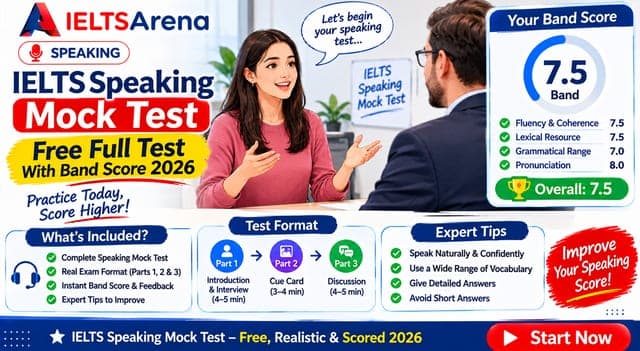
Quick Answer: An IELTS Speaking mock test is a full 14-minute simulation of the official exam, covering all three parts (4 to 5 minute Part 1 interview, 3 to 4 minute Part 2 cue card long turn, 4 to 5 minute Part 3 discussion), with per-criterion band scores on Fluency and Coherence, Lexical Resource, Grammatical Range and Accuracy, and Pronunciation. A proper mock test uses real examiner questions, enforces the 60-second Part 2 preparation window, and scores the full test like the real examiner will. IELTSArena offers free AI-marked Speaking mock tests with results in minutes, plus Expert Tutor Review by a trained IELTS examiner on request for your final two or three mock tests before the official exam. Most Band 7 candidates take three to five full mock tests across the four to six weeks before their test.
Who this is for: Test-takers in the final four to six weeks before their official IELTS, repeat test-takers who need a clean band read before deciding whether to re-register, and anyone who wants a confidence-building rehearsal of the full Speaking format before test day.
Why Speaking Mock Tests Do What No Other Practice Can
Daily Speaking practice drills specific skills. Part 1 extension. Part 2 cue card timing. Part 3 development with PPEEL. Each session targets one thing and improves it in isolation. This is efficient for building skills but it is not how the real test works.
The real test puts all three parts back to back in a 14-minute block. Your Part 1 answers affect your Part 2 performance because the examiner has already formed an opening band impression. Your Part 2 performance affects your Part 3 because the Part 3 questions build directly on your cue card topic. Mental fatigue builds across the 14 minutes. A candidate who is Band 7 on isolated Part 1 practice can drop to Band 6.5 on Part 3 in a mock test because they ran out of mental energy by minute 10.
The second thing a mock test simulates is examiner pressure. A real examiner moves at a specific pace, holds eye contact, and does not give you extra time to think between questions. Daily practice at your own pace does not reproduce this. A mock test with a timed prompt sequence does.
The third thing is the full-test band average. Your official Speaking band is a single number computed from four criteria across all three parts. Isolated practice tells you your current Part 1 Fluency band or your current Part 2 Lexical Resource band. Only a mock test tells you your overall Speaking band under full test conditions.
For the four to six weeks before your official exam, mock tests are not an add-on to practice. They are the main measurement tool. Everything else in your preparation is in service of the mock test score.
What a Real IELTS Speaking Mock Test Must Include
Not every "Speaking test" on the internet is a mock test. Four requirements separate real mock tests from informal practice sessions.
Full 14-minute format. All three parts in sequence, no breaks, no restarting. If the tool lets you practise Parts 1, 2, and 3 separately, it is practice, not a mock test. A mock test runs the full 14 minutes exactly as the examiner will on test day.
Real examiner questions. The questions must be drawn from the actual Cambridge Speaking question bank or verified past-exam content, not generic conversation starters. A mock test using invented questions does not match the difficulty or style of the real test.
60-second Part 2 preparation window. The Part 2 cue card must appear, you must get exactly 60 seconds of silent preparation with the ability to make notes, then you must speak for up to 2 minutes. No pausing, no extending the preparation time. A mock test that gives you unlimited prep time inflates your Part 2 score and misrepresents your band.
Per-criterion band scoring. The result must break down into four separate band scores: Fluency and Coherence, Lexical Resource, Grammatical Range and Accuracy, Pronunciation. A single overall band without per-criterion breakdown tells you where you are but not what to fix. The whole point of a mock test is diagnosis, not just measurement.
If any of these four is missing, what you are taking is practice, not a mock test. The distinction matters because the band score accuracy depends on the format accuracy.
Elena's Story: Confidence Lost and Rebuilt in Three Mock Tests
Elena is a 36-year-old registered nurse from Bucharest applying for Irish Nursing and Midwifery Board of Ireland registration. She needed Band 7 Speaking as part of the 7 overall requirement. Her preparation had gone well across six weeks of daily practice: Part 1 extensions were Band 7, Part 2 cue cards were Band 7, Part 3 answers were Band 7 with the PPEEL framework in place.
Four weeks before her test, Elena took her first full mock test on IELTSArena. The result came back at Band 6.5. Her per-criterion breakdown showed Band 7 on Lexical Resource and Grammatical Range, but Band 6 on Fluency and Coherence and Band 6.5 on Pronunciation. The isolated practice sessions had hidden the fact that mental fatigue was dropping her Fluency by Part 3.
The second mock test, two weeks later, came back at Band 7. Elena had deliberately practised full 14-minute sessions in week 2, including building up her Part 3 energy management. Fluency and Coherence rose to Band 7, Pronunciation stayed at 6.5.
Her third mock test, one week before the official exam, came back at Band 7.5 with an Expert Tutor Review. The tutor flagged two specific intonation habits that were dropping Pronunciation and gave her a targeted drill for the final week.
"The daily practice told me I was ready. The first mock test told me I was not. Three mock tests across four weeks got me from a 6.5 that would have failed to a 7.5 that gave me a buffer. Without the mock tests I would have walked into the real exam thinking I was Band 7, and I would have come out at Band 6.5."
Her official test came back at Band 7.5 on Speaking. Three mock tests and 24 days separated the first mock test from the real exam. Half a band of improvement, all of it driven by the diagnosis the mock tests provided.
The Data Behind Mock Test Timing and Count
Cambridge Assessment English and the British Council have both published guidance recommending at least one full mock test two to three weeks before the official exam as part of final preparation. IELTS trainers consistently report that candidates who take three or more full mock tests across the final six weeks score an average of half a band higher on their official exam than candidates who take zero or one.
The specific reason is diagnostic accuracy. A single mock test can be an outlier. The first mock test is often lower than the candidate's real band because of unfamiliarity with the full-test format. The second mock test typically shows the candidate's actual steady-state band. The third mock test shows whether targeted improvement between tests one and two has stuck.
In the 2026 marking approach, examiners have been given more consistent guidelines for scoring borderline bands. This has made both human and AI mock test scoring more reliable than it was five years ago. A mock test score of Band 6.75 two weeks before the exam now predicts official Band 7 within a quarter band for about 70 percent of candidates. The same prediction accuracy was closer to 55 percent in 2020.
For most test-takers aiming Band 7, the pattern that produces the best official exam result is three to five full mock tests spaced evenly across the four to six weeks before the exam, with the final one or two getting Expert Tutor Review for band-level accuracy.
Three Signs You Need a Mock Test Now
Specific signals that a full mock test should be the next thing you do, not more isolated practice.
You have four weeks or less until your official exam and have never taken a full mock test. The first mock test needs to happen now so you have time to act on the results. Taking your first mock test the week before the exam leaves no room for correction.
You have been practising daily for four weeks and your Speaking band feels unknown. Daily practice gives you per-session scores but not an overall band. If you cannot answer the question "what band is my Speaking at right now" with a specific number, you need a mock test.
You took a previous IELTS and the official result was lower than your practice scores suggested. The mock test will tell you whether the problem is band-level overestimation in your practice (meaning your practice scores are inflated) or test-day performance drop (meaning your practice is accurate but test pressure is lowering your actual result). The two problems have different fixes.
If any of these three is true, the next hour of your preparation should be a mock test, not another isolated Part 1 drill.
How IELTSArena's Speaking Mock Test Works
IELTSArena's full-length Speaking mock test runs on the Real CBT Interface, which means the format, timing, and prompt structure match the official computer-based test you will take on exam day. The 14-minute test flows through all three parts in sequence with no pausing between them.
Part 1 (4 to 5 minutes). The AI examiner introduces itself, asks the ID verification question, then runs through 10 to 15 Part 1 questions across two or three familiar topics drawn from the Cambridge question bank. You answer each question within 20 to 40 seconds. The system records every answer.
Part 2 (3 to 4 minutes). The cue card appears on screen with a topic and four bullet points. The 60-second preparation timer starts automatically with a notes field for your written plan. After 60 seconds the timer stops and the recording starts. You speak for up to 2 minutes. The timer cuts off at 2 minutes exactly, just like the real test. One or two rounding-off questions follow.
Part 3 (4 to 5 minutes). Five to seven abstract questions linked to your Part 2 topic, each answered in 40 to 60 seconds. The AI examiner follows your answers with natural follow-ups.
Scoring within minutes. The AI returns a full breakdown within three to five minutes: overall Speaking band, per-criterion band scores for all four criteria, per-part band scores, and specific flagged sentences across the test where language dropped the band. More than 1,200 learners have used this flow to measure their Speaking band in the weeks before the official exam.
Expert Tutor Review on request. For band-level accuracy, submit your mock test for review by a trained IELTS examiner. The tutor reviews the full 14-minute test, scores it against the four criteria, writes a rewrite of your weakest answer at the next band, and gives you three specific priorities for the remaining preparation time. Returned within 24 to 48 hours.
Start your first full mock test today at IELTSArena, and you will have your current Speaking band in your inbox within minutes. No credit card required.
How to Read Your Mock Test Results
A mock test result is only useful if you act on it correctly. Four reading rules.
Look at the per-criterion scores before the overall band. Your overall band tells you where you are. The per-criterion scores tell you what to fix. If your overall is 6.5 and three criteria are at Band 7 but one is at Band 5.5, you have a single fix target. If three criteria are at Band 6 and one is at Band 7, you have a much broader fix list.
Compare per-part scores to find your fatigue pattern. If your Part 1 Fluency is Band 7 but your Part 3 Fluency is Band 6, you have a mental energy problem across the 14 minutes. If all three parts score similarly, your Fluency is where it is.
Focus on the lowest-scoring criterion, not the lowest-scoring part. The band is driven by criterion-level averages across all three parts. Fixing your weakest criterion is more valuable than fixing your weakest part.
Use the flagged sentences as your diagnostic. The AI flag or tutor comment on specific sentences is the fastest way to understand what moved the band. "Memorised phrase in Part 2 opener" is actionable. "Lexical Resource at Band 6" is not actionable until you see which specific words or sentences caused it.
A good mock test review takes 30 minutes: 10 minutes reading the results, 10 minutes identifying the top two fixes, 10 minutes writing a one-week drill plan for those two fixes. The mock test is the raw data. The review is where the band improvement actually happens.
The Six-Week Mock Test Schedule That Works
A tested schedule for most Band 6 to Band 7 candidates with six weeks until the official exam.
Week 1 (six weeks out): first mock test. Take one full mock test on IELTSArena with AI scoring. Read the results carefully. Identify your weakest criterion. Build a drill plan for weeks 1 to 2 around that criterion. Do not take a second mock test this week. Let the results sink in.
Week 2 (five weeks out): drill the weakest criterion. Daily 30 to 45 minute practice sessions focused on your identified weakest criterion. No mock test this week. The point is to let the drill work before measuring again.
Week 3 (four weeks out): second mock test. Take a second full mock test. Compare the per-criterion scores against the first mock test. Confirm the targeted criterion moved. Identify the next weakest criterion.
Week 4 (three weeks out): drill the second weakest criterion. Daily sessions, same format as week 2. Still no mock test.
Week 5 (two weeks out): third mock test, with Expert Tutor Review. This is the mock test that matters most. The Expert Tutor Review gives you band-level accuracy and three specific priorities for the final two weeks.
Week 6 (one week out): fourth mock test, final rehearsal. One full mock test under exact test-day conditions (same time of day, same mental energy state, no interruptions). The point is dress rehearsal, not score chase. Rest for two days before the official exam.
Four mock tests, 100 to 150 isolated practice sessions, half to one band of improvement for most candidates. The mock tests are the measurement tool. The daily practice is the improvement tool. Both are needed. Neither works alone.
Self-Diagnosis: Are You Ready for Test Day
Answer honestly.
- Can you name your current overall Speaking band in a specific number, not a range?
- Can you name which of the four criteria is your weakest right now?
- Have you completed a full 14-minute Speaking simulation in the last four weeks?
- Do you know whether your Part 3 Fluency drops compared to your Part 1 Fluency, or whether both are at the same band?
- If your official exam were tomorrow, could you predict your Speaking band within a quarter of a point of what you would actually score?
If you answered no to two or more, your preparation is missing the measurement layer that mock tests provide. The next hour of your preparation should be a full mock test, not another isolated practice session.
Take Your Free Speaking Mock Test Today
A full 14-minute mock test on IELTSArena. All three parts. Per-criterion band scoring. Results in your inbox within minutes. Expert Tutor Review on request for your final two or three mock tests before the official exam. Start free at IELTSArena. No credit card and no commitment.
Related Guides
These sit inside the Speaking cluster on IELTSArena. Use them to drill the specific criterion your mock test flagged.
- IELTS Speaking: The Complete Guide
- AI IELTS Speaking Practice
- Speaking Part 3: How to Extend Your Answers to 40-60 Seconds
- Speaking Band 7 vs Band 8: What Lifts the Band
- Speaking Part 2 Cue Card Strategy
- IELTS Speaking Fluency and Coherence
- IELTS Speaking Pronunciation
- IELTS Speaking Lexical Resource
- IELTS Speaking Grammatical Range and Accuracy
- IELTS Speaking Mistakes to Avoid
- How to Practise IELTS Speaking Alone
FAQ
How do I take a free IELTS Speaking mock test? Sign up free at IELTSArena, open the Speaking Mock Test module, and take the full 14-minute test inside the Real CBT Interface. The test runs through all three parts in sequence: a 4 to 5 minute Part 1 interview, a 3 to 4 minute Part 2 cue card with 60-second preparation, and a 4 to 5 minute Part 3 discussion. Your answers are recorded automatically. Within three to five minutes you receive your results by email: overall Speaking band, per-criterion band scores on all four criteria, per-part band scores, and specific flagged sentences. For band-level accuracy on your final mock tests before the official exam, add Expert Tutor Review by a trained IELTS examiner who returns a detailed report within 24 to 48 hours. No credit card and no commitment.
Is a Speaking mock test the same as the real IELTS test? A proper mock test matches the real IELTS Speaking test in format, timing, question type, and marking criteria. The 14 minute length, three-part structure, 60-second Part 2 preparation window, and four-criteria scoring are identical to the official exam. What differs is the delivery (AI examiner or human tutor on a mock test versus trained examiner on the official test) and the score weight (mock tests are diagnostic, the official test determines your actual IELTS result). A mock test from a reputable source like IELTSArena predicts your official Speaking band within a quarter band for roughly 70 percent of candidates when taken two to three weeks before the real exam. The gap closes further when Expert Tutor Review is added.
How many Speaking mock tests should I take before IELTS? Three to five full mock tests across the four to six weeks before your official exam is the pattern that produces the best official result for most Band 6 to Band 7 candidates. The first mock test, taken six weeks out, identifies your weakest criterion. The second, taken four weeks out, confirms whether your targeted drilling has moved that criterion. The third, taken two weeks out with Expert Tutor Review, gives you band-level accuracy and three specific priorities for the final two weeks. An optional fourth mock test, taken one week out, is a dress rehearsal under exact test-day conditions. Taking more than five mock tests usually means skipping the targeted drill phases between tests, which breaks the measurement-drill loop.
Can I get a band score from a Speaking mock test? Yes. A proper IELTS Speaking mock test gives you per-criterion band scores on all four marking criteria (Fluency and Coherence, Lexical Resource, Grammatical Range and Accuracy, Pronunciation), per-part band scores for Part 1, Part 2, and Part 3, and an overall Speaking band computed from the average of the four criterion scores. The AI-marked band score on IELTSArena is accurate within half a band for roughly 85 percent of candidates. Expert Tutor Review by a trained IELTS examiner is accurate within a quarter band for roughly 95 percent of candidates. For your final two or three mock tests before the official exam, Expert Tutor Review is the right choice because band-level accuracy matters most at that stage.
What should I do if my Speaking mock test score is lower than my target? Three steps. First, look at the per-criterion breakdown. If one criterion is dragging the band down while the others are at target, you have a focused fix target for the next two to four weeks. If three or four criteria are below target, you have a broader preparation gap and may need to consider rescheduling your official exam. Second, read the flagged sentences and identify the pattern. A memorised Part 2 opener, Part 3 answers under 30 seconds, repeated filler phrases, and heavy pronunciation of accent-affected consonants are all specific fixes with specific drills. Third, re-mock. Do one targeted drill cycle of two weeks on the identified weakness and then take a second mock test to confirm the fix. Do not take a second mock test without a drill cycle in between because the score will not have moved.