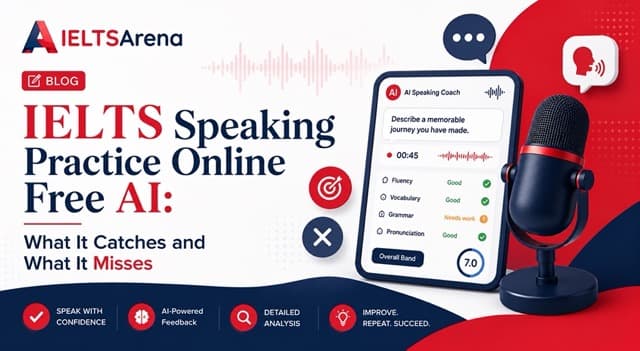
IELTS Speaking practice online free AI has quietly become the most credible way for self-study candidates to prepare for the Speaking section without a partner or tutor. The AI genuinely evaluates three of the four official IELTS Speaking criteria, gives instant band feedback, and lets you practice 24/7 without scheduling. What it misses is narrower than most reviews admit but more important than most marketing hides.
This guide covers what AI Speaking evaluation actually catches, where it still fails, which free tools deliver in 2026, and how to use AI Speaking practice well rather than trusting the band score at face value.
The Four IELTS Speaking Criteria, and What AI Actually Handles
Every IELTS Speaking response is scored on four criteria, each contributing 25% of your Speaking band: Fluency and Coherence, Lexical Resource, Grammatical Range and Accuracy, and Pronunciation.
Fluency and Coherence. AI handles this well. Speech-recognition systems can measure speech rate, pause frequency, filler word density (um, ah, like), and logical flow through transcript analysis. This is one of the AI's strongest criteria because it maps to measurable acoustic and linguistic features.
Lexical Resource. AI handles this well through transcript analysis. It identifies vocabulary range, less common lexical items, appropriate collocations, and topic-relevant word choice. It struggles with subtle register mismatches (formal vocabulary in an informal context) but is broadly reliable at the criterion level.
Grammatical Range and Accuracy. AI handles this well, again through transcript analysis. It identifies simple versus complex structures, error patterns, and consistency of accuracy. This mirrors AI Writing checkers and works the same way.
Pronunciation. AI handles this with genuine but imperfect accuracy. It measures phoneme-level accuracy, stress patterns, intonation, and rhythm. It is less reliable when accents are strong or when regional variations differ from the training data. Cambridge-linked pronunciation research suggests AI systems agree with human examiners on pronunciation bands within 0.5 bands roughly 70 to 75% of the time, slightly lower than the 75 to 80% accuracy on the other three criteria.
Taken together, AI evaluation of IELTS Speaking is reliable enough for daily self-study practice. The pronunciation gap is where human review still adds meaningful value before a test.
Advertisement
What Free AI Speaking Tools Actually Do
A useful IELTS speaking practice online free AI tool does five things:
Records your response to a Part 1, Part 2, or Part 3 prompt through your device microphone. Transcribes your speech accurately across accents, including non-native English patterns. Scores your response against all four IELTS Speaking criteria separately. Provides sentence-level or phrase-level feedback quoting your actual transcript. Runs the entire cycle in under 60 seconds so you can practice iteratively.
Tools that skip the criterion-level scoring, or that give one blended band, cannot tell you which of the four is your bottleneck. Tools that fail on transcription accuracy for non-native accents systematically underscore your responses, particularly on Fluency and Pronunciation.
Test any free tool by recording the same 90-second Part 2 response twice and comparing scores. If the two scores differ by more than 0.5 bands, the tool's scoring is inconsistent, and you cannot trust its criterion-level feedback either.
Where IELTS Speaking Practice Online Free AI Still Falls Short
Three specific gaps are worth knowing about before trusting any free AI tool completely.
Nuanced Part 3 discussion depth. IELTS Speaking Part 3 evaluates your ability to develop abstract, opinion-based ideas with reasoning and examples. AI reliably scores your language but is weaker at judging whether your argument is genuinely developed or just wordy. A candidate who talks for two minutes without a clear point may get a decent AI band that a human examiner would score lower for lack of substance.
Pronunciation with strong regional accents. AI trained primarily on North American, British, and Australian English still misjudges intelligibility on some South Asian, West African, and Southeast Asian accent patterns. It sometimes reports pronunciation issues that a human examiner would not penalise, or misses issues a human would catch. This is improving quickly, but not solved.
Interaction and follow-up questions. The real IELTS Speaking test is a conversation, not a monologue. The examiner responds to your answers, asks follow-up questions, and gauges how you handle real-time discussion. Free AI Speaking tools simulate the prompts but not the conversation. This means you can be well-prepared for structured monologue and still struggle with the interactive elements of the real test.
Knowing these three gaps tells you when to book a human tutor session even if AI practice has been going well.
The Free AI Speaking Tools Available in 2026
Here is how the widely-mentioned IELTS speaking practice online free AI tools compare on what actually matters.
SmallTalk2Me. Purpose-built AI IELTS Speaking simulator, over 2.5 million users across 125 countries. Free tier includes daily stories and one monthly mock test; Premium at $7 to $10/month unlocks unlimited practice. Scores against all four IELTS criteria with sentence-level feedback. Strong on the "structured monologue" side, weaker on interactive practice.
English AIdol. All-four-skills coverage including Speaking with band descriptor grading, calibrated against TESOL-certified examiners. Includes a full mock test format with instant scoring. Best for candidates who want Speaking scoring inside a broader four-skill AI platform.
Gabble.ai. Positions as AI mock exams across all four skills including Speaking, with personalized feedback. Adequate free tier but content library is smaller than SmallTalk2Me.
IELTSArena. CBT-native practice platform with AI Speaking evaluation across all four criteria (Fluency and Coherence, Lexical Resource, Grammatical Range and Accuracy, Pronunciation) for Part 1, Part 2, and Part 3 responses. Optional expert human tutor review as a paid upgrade for candidates who want the interaction-and-nuance layer that AI cannot yet provide. Free tier includes at least one full Speaking practice session without credit card or signup gate.
Free ChatGPT-based practice (candidates using ChatGPT with IELTS Speaking prompts). Works for basic feedback but scores meaningfully worse than purpose-built tools at 0.811 QWK against certified examiners, compared to 0.85 to 0.92 QWK for purpose-built graders. Free but less accurate.
A Realistic Student Story
Farhan, a Karachi-based marketing analyst preparing for a UK skilled worker visa, was scoring Band 6.5 on his Writing practice but had no Speaking practice partner and no budget for a tutor. He used a free AI Speaking tool daily for four weeks, recording Part 1, Part 2, and Part 3 responses across a range of topics.
His AI-estimated Speaking band rose from 6.0 to 7.0 across the four weeks. He booked one human tutor session for the week before his test, expecting confirmation of the trajectory. The tutor scored him at Band 6.5, half a band below the AI. The gap was Part 3: the AI had scored his Lexical Resource well, but the tutor pointed out his opinions were not developed with reasoning, they were just repeated in different words.
Two more human sessions focused on Part 3 argument development moved his actual test Speaking score to Band 7.
The AI got him from Band 6 to Band 6.5. The two human sessions got him the final half-band that any AI-only preparation would have missed.
If you have been relying only on AI Speaking practice, try IELTSArena's free Speaking evaluation and see the criterion-level breakdown before deciding whether to add human review for your final pre-test weeks.
How to Use AI Speaking Practice Well
Three habits separate candidates who benefit from AI Speaking practice from candidates who get inflated scores that do not match test-day performance.
Practice all three parts daily, not just Part 2. Part 2 (the long turn) is the most-practised because it is the most structured. Part 1 and Part 3 are where most candidates lose bands they did not know they were losing. The AI is happy to give you a Part 2 band of 7; that says nothing about your Part 3 performance.
Record the same response twice and compare scores. If the tool gives you different bands for identical audio, its scoring is not reliable enough to trust for weekly progress tracking. Consistency is the first-order test.
Book at least one human review session before your test. The three gaps AI cannot yet close (Part 3 depth, accent nuance, real interaction) are exactly the things a certified tutor identifies quickly. One 45-minute session in the two weeks before your test tells you whether your AI-estimated band is actually your test-day band.
Where IELTSArena Fits
IELTSArena's AI Speaking evaluation covers all four criteria across Part 1, Part 2, and Part 3 prompts, with sentence-level feedback quoting your transcript. The full practice test hub includes Speaking practice alongside CBT Reading, Listening, and Writing, so your Speaking preparation sits inside a full four-skills practice environment rather than a Speaking-only tool.
Optional expert human tutor review is available for Speaking responses flagged below your target band, particularly useful for closing the Part 3 depth and interaction gaps that AI alone cannot address before your actual test.
A Quick Self-Check
Have you tested your AI Speaking tool by recording the same response twice and comparing the scores? Do you have a criterion-level breakdown (Fluency, Lexical, Grammar, Pronunciation) or only one overall band? Have you practised Part 3 (discussion) as much as Part 2 (long turn)? Have you booked at least one human tutor session before your test to check whether your AI band matches your test-day band?
If any of these are no, the IELTS speaking practice online free AI you are using may be delivering less than you assume, and the three habits above will fix that.
Test Your Speaking Baseline This Week
The single most useful thing you can do this week is record a full 11 to 14 minute Speaking simulation (all three parts) and get a criterion-level breakdown before your next practice session. Try IELTSArena's free Speaking evaluation and see where your four criteria actually sit.
FAQ
How good is AI at scoring IELTS Speaking? Purpose-built AI IELTS Speaking tools reach 0.85 to 0.92 QWK against certified examiners on the four criteria collectively. Pronunciation is the weakest criterion at roughly 70 to 75% agreement within 0.5 bands, while Fluency, Lexical Resource, and Grammatical Range track closer to 75 to 80%. General-purpose AI like ChatGPT scores meaningfully worse at 0.811 QWK.
What does AI actually evaluate in IELTS Speaking? All four official criteria: Fluency and Coherence (speech rate, pauses, filler words), Lexical Resource (vocabulary range, collocations), Grammatical Range and Accuracy (structural variety and error patterns), and Pronunciation (phoneme accuracy, stress, intonation). Pronunciation is the least reliable of the four, particularly for strong regional accents.
Which free AI IELTS speaking tools are worth using? Purpose-built tools like SmallTalk2Me, English AIdol, and IELTSArena's Speaking evaluation are meaningfully more accurate than general-purpose AI. Check that any tool gives you criterion-level scores rather than one blended band, and test consistency by recording the same response twice.
Can AI replace a human examiner for IELTS Speaking? For weekly practice, mostly yes. For the final pre-test check, no. AI struggles with three specific gaps: judging Part 3 argument depth, evaluating strong regional accents, and simulating real interaction with follow-up questions. One human tutor session in the two weeks before your test closes these gaps.
How should I combine AI and human feedback for IELTS Speaking? Use AI daily for the volume-of-practice benefits: criterion-level scoring, sentence-level feedback, and 24/7 availability. Book one human tutor session in the final two weeks before your test to verify your AI-estimated band and identify any gap in Part 3 depth or interaction skills. This combination typically costs $30-80 and adds 0.5 to 1.0 bands to what AI-only preparation delivers.
![Best App for IELTS Preparation [2026]: The Honest Ranking (and the One Problem Nobody Mentions)](/_next/image?url=%2Fblog%2Fcover-best-app-for-ielts-preparation.jpeg&w=3840&q=75&dpl=dpl_DXyM63YUHjigMzg2B75HT6s5tc1D)